Nykaa Luxe’s Premium Beauty Retail Strategy
INDUSTRY AND COMPETITIVE CONTEXT
India's beauty and personal care market is among the fastest-growing in the world. A joint Redseer and Peak XV report projected a 10 percent compound annual growth rate between 2022 and 2027, taking the market to about US$30 billion. A more recent Redseer analysis projects the market at US$40 billion by 2030, which would make India the fourth-largest beauty and personal care market globally. Redseer has also estimated the premium segment at US$3 to 3.2 billion by 2028.
The luxury tier is narrower but is described as expanding. A Kearney and Luxasia report estimated that India's luxury beauty customer base could grow from 15.5 million people in 2022 to 33 million by 2030. A Luxasia India executive estimated that international labels account for about 90 percent of India's luxury beauty market, compared with about 60 percent in China, Japan and South Korea, and described India as having open shelf space and limited local competition at the luxury end.
This structure creates a distinctive competitive problem. When international brands dominate a category, the retailer's role is to earn access to those brands and then give them a credible environment. Luxury houses typically prefer to control presentation, so a multi-brand retailer must prove it can protect brand equity. Competition comes from several directions: brand-owned boutiques and e-commerce sites, and other retail groups moving into premium beauty, including Reliance's Tira. Chanel illustrates the first route. By 2025 it already operated seven standalone fragrance and beauty boutiques in India and had launched its own e-commerce platform in 2024.
BRAND SITUATION BEFORE THE PREMIUM PUSH
Nykaa's starting position was a trust-led online retailer that expanded offline in stages. Its first physical store opened at Delhi airport in 2014. The Luxe format took shape over the following years: a flagship in Defence Colony, South Delhi, opened on 31 October 2018, and a Luxe flagship followed as the exclusive beauty retailer at The Chanakya, a DLF lifestyle destination in Delhi, where trained beauty experts were positioned to offer recommendations to shoppers. Nykaa listed on the stock exchanges in November 2021.
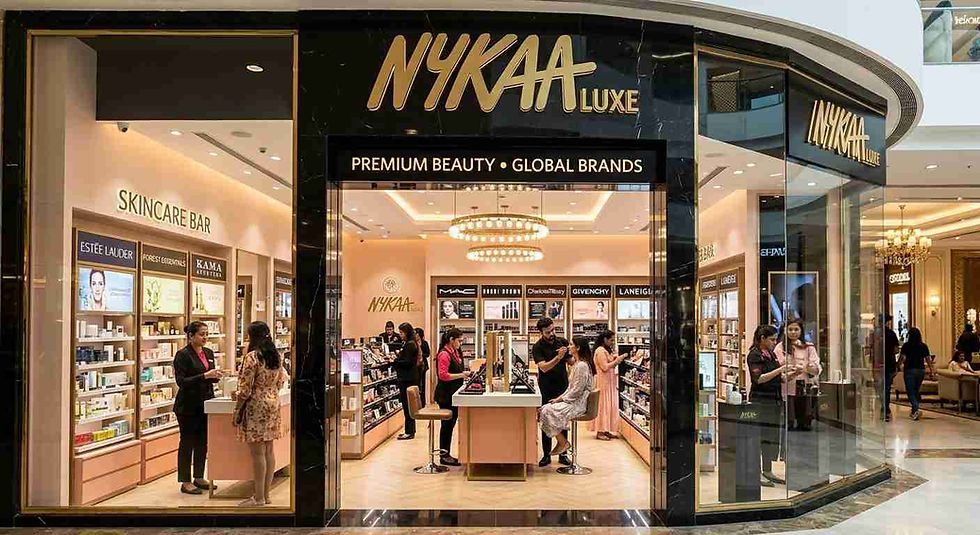
By the time of its FY23 annual report, Nykaa described a network of 145 stores across three formats: Nykaa Luxe, Nykaa On Trend and kiosks. It listed more than 3,400 beauty and personal care brands, spanning international, luxe, FMCG and D2C labels. Brokerage research published around the IPO described Nykaa Luxe as selling only luxury brands in premium malls and high streets, with 38 stores averaging about 1,134 square feet. That research also noted that Nykaa used stores for trial, brand building and organic customer acquisition. A Luxe store opened in Mumbai's R City Mall in November 2021 illustrates the format. It carried dedicated sections for brands such as Estée Lauder, Clinique and Bobbi Brown, a section for Nykaa's own label, and a multi-brand fragrance section.
At the FY24 annual general meeting, Nykaa's presentation described the Luxe offer as "delivering a truly luxury omnichannel retail experience." It cited an online Luxe store, a new flagship luxury immersive beauty experience, and a network of 200 beauty stores across 72 cities.
STRATEGIC OBJECTIVE
Nykaa has not published a Luxe-specific financial or market-share target. No verified public information is available on that point. The objective can nonetheless be read from company statements.
The FY25 AGM presentation listed "Premiumization" as the second of its strategic missions. Under it, Nykaa described creating desire for premium beauty through aspirational marketing and community building, supported by destination marketing for premium beauty. Anchit Nayar, CEO of Nykaa Beauty, has described the company's evolution in phases. He said Nykaa first expanded availability, then shaped consumer understanding and built trust. A second phase then moved beyond color cosmetics into haircare, skincare and fragrance, and built long-term partnerships with global groups including Estée Lauder, L'Oréal and Amorepacific. He named deepening omnichannel retail, including a larger physical footprint, as one of three current strategic priorities.
Read together, these statements point to a two-part objective. The first part is to be the preferred distribution partner for global luxury and prestige brands. The second is to build consumer desire for that category through both stores and brand communication.
CAMPAIGN ARCHITECTURE AND EXECUTION
The documented execution has four layers.
The first is assortment and partnerships. In its Q2 FY26 results release, Nykaa stated that it offers the largest luxe assortment in the country and has added over 70 luxury brands in the past three years. That quarter's additions included Prada Beauty, La Prairie, Maison Margiela and IT Cosmetics. The most prominent partnership was Chanel Fragrance and Beauty, announced in May 2025. It launched on Nykaa's website and app and at Nykaa Luxe stores in Mumbai (Palladium Mall), Bengaluru (100 Feet Road) and Chandigarh (Nexus Elante Mall). Chanel said it intended to be in more than 10 Nykaa Luxe stores by the end of 2025. No verified public information is available on whether that target was met.
The second layer is physical formats. By 31 July 2025, Nykaa's investor presentation listed 10 flagship stores, described as experience-led with skin consultation tools and beauty services, and 75 Luxe stores carrying a curated collection of 80-plus premium brands. By FY26, Nykaa had added a Nykaa Perfumery format and an "Ultra Luxe" flagship format. Trade press reported that Nykaa opened its largest Luxe store to date, 5,500 square feet with more than 80 brands, at Ambience Mall, Vasant Kunj, New Delhi. It also reported a Nykaa Luxe Mini Mart pop-up in Delhi built around luxury beauty miniatures, a format reported as intended to make trial of premium products more accessible.
The third layer is brand communication. In June 2025, Nykaa Luxe named actor and model Lisa Haydon as the face and muse of a new campaign. The campaign film, directed by Shivin and Sunny and photographed by Taras Taraporvala, showcased hero products across eyes, lips, face and fragrance from global brands. Nykaa's own investor update said her appointment strengthened its position in prestige beauty and that she embodies "the Luxe ethos" of iconic international brands curated for the Indian consumer. Nykaa's FY25 AGM materials also list Nykaa Luxe Squad and Nykaa FragTok, a fragrance-focused community initiative, under premium destination marketing. No verified public information is available on the reach or results of either initiative.
The fourth layer is the commercial calendar. Nykaa's Pink Summer Sale, held in May 2025, acted as a premium-beauty demand event, with results reported in the Q1 FY26 investor materials.
POSITIONING AND CONSUMER INSIGHT
Nykaa Luxe's positioning has two documented components: curation and experience.
On curation, the company's language consistently frames Nykaa as the place where international brands are selected for the Indian consumer. It also claims leadership in specific niches, such as bridal luxury beauty, which it said Nykaa Luxe continues to cement itself as India's premier destination for. Chanel's own statement about the partnership referred to a shared dedication to curated experiences and an understanding of the Indian consumer. This is a retailer-as-editor position rather than a retailer-as-warehouse position.
On experience, the clearest public statement of consumer insight came from a Nykaa spokesperson at the time of the Lisa Haydon launch. The spokesperson said Nykaa had seen a significant shift in how Indian consumers engage with luxury beauty, with shoppers seeking not only premium products but a complete, elevated experience. That insight is consistent with the format choices above: advisory services in flagships, trial-oriented miniatures, and store environments built around discovery.
The decision to name a "muse" rather than run a product-led promotion is also telling. The campaign language emphasizes self-expression, confidence and "understated" glamour rather than discounts or price. For a retailer whose broader brand is associated with accessibility and scale, this creates a deliberate separation between the Nykaa master brand and the Luxe sub-brand. No verified public information is available on consumer research, demographics or brand-tracking data specific to Nykaa Luxe shoppers.
MEDIA AND CHANNEL STRATEGY
The documented channel mix is omnichannel by design. The Luxe offer runs through the Nykaa website and app, a dedicated online Luxe store, and a physical network of Luxe and flagship stores. Chanel's launch was explicitly announced across both online and in-store channels.
On communication, the verified elements are a brand film with a named ambassador, rolled out, according to trade coverage, across platforms and stores, and community-led initiatives such as FragTok. Nykaa's investor materials also report scale metrics for the Pink Summer Sale: more than 84 million visits, up 57 percent year on year, and an average reach of over 500 million.
No verified public information is available on media spend, media mix, agency structure or channel-level return for Nykaa Luxe.
BUSINESS AND BRAND OUTCOMES
Only documented results are reported here, and they are mostly company-level or format-wide rather than Luxe-specific.
Nykaa's Q2 FY26 release stated that its Beauty business had achieved over 25 percent GMV growth for several consecutive quarters. It also stated that the Beauty customer base was approximately 40 million, up 31 percent year on year. In the Pink Summer Sale of May 2025, omnichannel beauty GMV grew 33 percent year on year and premium beauty GMV grew 42 percent, which indicates that premium outpaced the overall event. The investor presentation also cited more than 4 lakh Luxe products sold during the sale.
The physical footprint has expanded in a documented sequence. Nykaa reported 145 stores at FY23, 200 stores in 72 cities at the FY24 AGM, and 313 stores in 99 cities at 31 March 2026. The company added 76 stores in FY26, its highest ever in a year, and entered 20 new cities. This figure covers all formats, so it should not be read as a Luxe-only count. Nykaa Beauty ended FY26 with about Rs 150 billion in GMV, and consolidated Nykaa GMV for FY26 was reported at Rs 19,963 crore, up 28 percent, against about Rs 15,600 crore in FY25.
Looking forward, Nykaa has publicly stated targets for FY30: GMV above US$5 billion, a store network of more than 600 locations, and a consumer base of 100 million.
What cannot be stated: no verified public information is available on Nykaa Luxe's revenue, profitability, same-store sales or customer retention as a separate format. There is also none on the commercial return of the Lisa Haydon campaign, the Chanel partnership, or any Luxe-specific marketing initiative. Any claim of Luxe-specific success beyond the figures above would be inference.
STRATEGIC IMPLICATIONS
First, access is a strategic asset in luxury retail. The sequence of brand additions, culminating in Chanel's decision to list on a third-party platform, shows that Nykaa's strategy rests on becoming a trusted partner to houses that have other options. That credibility was assembled over years through authenticity, store quality and trained staff, not through a single campaign. The lesson for marketers is that in categories where suppliers hold the power, the retailer's brand is part of the pitch to the supplier.
Second, the strategy separates a luxury sub-brand from a scale master brand. Nykaa's broader positioning is built on breadth, from mass to prestige, while Luxe uses a different tone, a different ambassador language and different store formats. The documented evidence is consistent with a house-of-brands logic applied to retail formats. The risk, which the sources do not address, is dilution if the two registers drift together. No verified public information is available on how Nykaa manages that boundary.
Third, physical retail serves a role beyond sales in this category. Nykaa's own format evolution, from small mall stores to flagships and now Ultra Luxe and miniature-led pop-ups, tracks a logic of trial and experience. Premium beauty involves fragrance, texture and skin consultation, which are hard to deliver online. The company's omnichannel framing treats stores and the app as complementary rather than competing.
Fourth, the evidence base for evaluating the strategy is thin at the format level. Nykaa reports Luxe in operational terms (store counts, brand additions) and reports financial outcomes at company or beauty-vertical level. An analyst can therefore confirm that the premium push coincided with growth but cannot isolate how much of that growth Luxe produced. This is a structural limit of public-company disclosure and a useful reminder that strategy cases built on public data must separate correlation from attribution.
Fifth, expansion creates its own test. Nykaa's FY30 store target implies a store network roughly double its 2026 size, and the company has stated it intends to grow while holding premium positioning. How premium formats scale beyond metros is a question the public record does not yet answer.
DISCUSSION QUESTIONS
Nykaa positions itself as a curator of international luxury brands rather than as a luxury brand itself. What are the advantages and risks of a retailer-led luxury position compared with the brand-owned boutique model Chanel also operates in India?
The public record shows Nykaa reporting store counts and brand additions but not Luxe-specific financial results. If you were an investor or a brand partner, what additional metrics would you want disclosed, and how would you evaluate the strategy in their absence?
Nykaa Luxe uses a muse-led brand film, community initiatives such as FragTok, and experiential formats such as miniature pop-ups. How should a retailer decide how to allocate effort between brand-building and trial-driven activation in a luxury category?
Nykaa operates both mass-to-prestige and luxury formats under one corporate umbrella. What brand architecture principles would you apply to prevent the master brand from diluting the Luxe sub-brand, and what signals would tell you the separation is failing?
Nykaa has publicly stated a target of more than 600 stores by FY30. What factors should determine which cities and formats receive premium investment, and how would you judge whether expansion is strengthening or weakening the luxury positioning?



Comments