Paytm's Offline Merchant Awareness Campaigns: Building India's Largest Merchant Payments Network
Industry & Competitive Context
India's digital payments ecosystem prior to 2016 was characterised by low penetration, fragmented infrastructure, and deep consumer dependence on cash. According to the Reserve Bank of India, cash transactions constituted the overwhelming majority of retail commerce, particularly in the informal and unorganised sectors — which account for a disproportionate share of India's retail economy. The mobile wallet segment, while nascent, had attracted several players including Paytm, MobiKwik, Freecharge, and telecom-anchored offerings such as Airtel Money. However, none had achieved meaningful penetration with offline merchants — the kirana stores, vegetable vendors, auto-rickshaw operators, and small service businesses that formed the backbone of everyday commerce. The policy environment was shifting incrementally. In 2014, the RBI mandated two-factor authentication for all online card transactions, which inadvertently made mobile wallets more frictionless by comparison. In 2015, Paytm secured a semi-closed wallet licence from the RBI, enabling it to operate as a payment intermediary across merchant categories. The National Payments Corporation of India's Unified Payments Interface (UPI), launched in August 2016, would subsequently redefine the competitive landscape — but in the 2015–2016 period, mobile wallets remained the dominant digital alternative to cash at the point of sale. Paytm's primary competitive distinction entering this period was scale: it had already built a consumer base through mobile recharges, bill payments, and e-commerce partnerships, giving it a latent network that could be activated on the merchant side. The strategic challenge was converting that consumer base into a two-sided marketplace in which offline merchants had sufficient incentive, capability, and awareness to accept Paytm as a payment method.
Brand Situation Prior to the Merchant Campaign
Paytm, owned and operated by One97 Communications Limited, was founded in 2010 by Vijay Shekhar Sharma and initially operated as a mobile recharge and bill payment platform. By 2014, it had launched the Paytm Wallet with RBI approval and attracted major institutional partnerships — including Indian Railways and Uber — as payment acceptance channels. As of August 2015, Paytm's registered user base had grown from 1.18 crore (August 2014) to 10.4 crore, with its travel business crossing $500 million in annualised gross merchandise value (GMV), as disclosed in public filings. In January 2015, Ant Financial Services Group (an Alibaba affiliate) acquired a 25% stake, providing capital and the Alibaba ecosystem's operational experience in mass-merchant onboarding — directly relevant to what would become Paytm's defining growth initiative. Paytm rolled out its offline merchant acceptance programme in 2015, initially using QR code-based payments. Within a relatively short period, it signed up approximately 850,000 offline merchant entities, as reported by Zee Business in December 2016. However, this penetration, while significant in absolute terms, was far below the potential addressable market of India's tens of millions of small traders and unorganised retailers. The brand was largely consumer-facing in its communication; the merchant acquisition process was primarily field-force driven with limited above-the-line marketing directed specifically at convincing merchants — rather than consumers — of the value proposition of accepting digital payments. The fundamental asymmetry in Paytm's two-sided network was clear: consumer pull was building, but merchant-side supply and awareness remained the binding constraint on transaction volume.
Strategic Objective: Owning the Merchant Acceptance Layer
Paytm's merchant awareness strategy can be understood through two distinct but sequential phases of strategic intent. In Phase 1 (2015–2016), the objective was foundational: achieve critical mass in offline merchant sign-ups sufficient to create genuine two-sided network effects. The logic was classic platform economics — a mobile wallet is only as valuable to a consumer as the number of merchants who accept it. Paytm needed a sufficient density of acceptance points to justify consumer wallet adoption, and sufficient consumer base to justify merchant adoption. This required simultaneous activation of both sides of the market. In Phase 2 (November 2016 onwards), catalysed by the Indian government's demonetisation announcement, the objective shifted to rapid category capture. With cash suddenly unavailable across the economy, the structural barrier to digital payment adoption was temporarily removed. The strategic imperative was to acquire the maximum number of merchants and consumers in the shortest possible window — before competitors could respond and before cash re-entered circulation and normalised behaviour. According to the official Paytm blog published during this period, the company deployed over 4,000 field agents onboarding 25,000 offline merchants daily at peak. The overarching long-term strategic objective — evident in retrospect across both phases — was brand ownership of the merchant acceptance category. By making "Paytm Karo" the generic term for digital payment acceptance, Paytm sought to achieve the same category-brand fusion that Xerox achieved in photocopying or Fevicol in adhesives — a form of mental availability so dominant that the brand becomes synonymous with the behaviour itself.
Campaign Architecture & Execution
Paytm's offline merchant awareness campaign was not a single campaign but a layered, multi-phase initiative executed across distinct operational modes. The following account draws exclusively from publicly disclosed sources, including Paytm's own official blog, Zee Business reporting from December 2016, and verified press coverage.
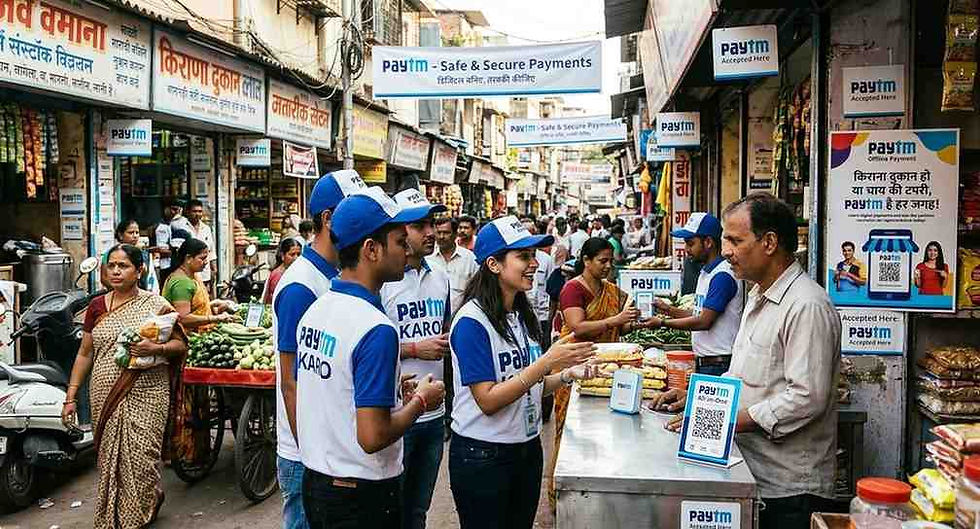
Pre-Demonetisation Merchant Foundation (2015–October 2016). Paytm's initial merchant push combined field-force deployment with simplified onboarding infrastructure. The company introduced QR code-based acceptance — requiring no point-of-sale hardware investment from the merchant — specifically to lower the adoption barrier for small and micro-businesses. The zero-cost QR model was a deliberate product-strategy decision with direct marketing implications: removing the financial objection from the merchant conversation allowed awareness campaigns to focus on benefits (digital receipts, settlement speed, no change-giving hassle) rather than overcoming cost objections. By November 2016, this ground-up approach had enrolled approximately 850,000 offline merchants, per Zee Business.
Demonetisation Blitz (November–December 2016). On the night of November 8, 2016, Prime Minister Narendra Modi announced the demonetisation of ₹500 and ₹1,000 notes. Within hours, Paytm's communications team had designed creatives and booked media space. The following morning, Paytm appeared as front-page jacket advertisements in three major national publications — Hindustan Times, The Telegraph, and The Hindu — as disclosed in Paytm's own official blog entry published during this period. The headline campaign, "Ab ATM Nahi, Paytm Karo" ("Now, don't use an ATM, use Paytm"), directly addressed the immediate crisis: a nation without functional cash. The campaign was subsequently revised to "Chinta Nahi, Paytm Karo" ("No worries, use Paytm") following criticism over the original framing's perceived opportunism, as reported by Zee Business.
The scope of the overnight communication push — as documented in Paytm's official blog — included front-page jackets in over 20 national and regional publications the following day, a concurrent television campaign already in production, over 10 radio spots recorded within hours of the announcement, and takeover of banner advertising across major digital properties. Paytm simultaneously launched five distinct online video executions under the "Paytm Karo" brand: these included "ATM Nahi, Paytm Karo," "Chinta Matt Karo, Paytm Karo," and "Shaadi Ka Shagun Cash Nahi, Paytm Karo" — each targeting a specific use-case or objection among both consumers and merchants. Critically, the merchant-side communication was distinct from the consumer-side in its execution. Paytm rolled out print advertisements specifically educating merchants on the registration process — including, as noted by industry observers at the time, ads with a tearable strip that merchants could retain as a reference card. The Paytm for Business portal (paytm.com/business) was simultaneously launched as a dedicated merchant onboarding destination. Parallel merchant support channels — a missed-call hotline and a WhatsApp number — were announced in the same official blog post, indicating a deliberate multi-channel merchant service design. The Android app was made available in 10 regional languages — Hindi, Tamil, Telugu, Gujarati, Marathi, Bengali, Kannada, Malayalam, Oriya, and Punjabi — on the day after demonetisation, per the same Paytm blog source. The agency on record for the television campaign during this period was McCann Delhi, which developed the "Drama Band Karo, Paytm Karo" TV spots, as reported by Zee Business. Paytm had allocated ₹600 crore for branding and marketing in FY 2016-17, as publicly disclosed; however, the specific incremental spend deployed during the demonetisation window was not officially broken out.
The Soundbox Era (2017–2024). As UPI gained traction from 2017 onwards and the wallet-centric model was disrupted by the NPCI's open-standard payment rails, Paytm evolved its merchant value proposition beyond QR codes. The Paytm Soundbox — a proprietary audio-enabled IoT payment device that provides real-time voice payment confirmation to merchants — became the centrepiece of the company's merchant retention and awareness strategy in this phase. Paytm describes itself as the first company in India to launch audio payment confirmations through such a device, per the official Paytm blog published in September 2023. The Soundbox addressed a genuine operational insight: small merchants in high-footfall environments — street markets, salons, kirana stores — frequently could not hear or verify mobile payment notifications over ambient noise, leading to disputes and eroding trust in digital payments. The device provided an audible, language-specific confirmation (the now-iconic "Paytm pe [amount] prapt hue" chime) that made payment verification friction-free for both merchant and customer. According to Paytm's official blog, by March 31, 2023, more than 6.8 million merchants were paying subscriptions for Paytm payment devices including the Soundbox and Point-of-Sale terminals. A further official update in the FY 2025 Annual Report disclosed that the cumulative merchant subscription base for devices reached 1.24 crore (12.4 million) as of March 2025, up from 1.07 crore as of March 2024. The marketing approach for the Soundbox, as described in Social Samosa's documented Brand Saga on Paytm (April 2025), was notably different from the mass-advertising model used in 2016. Paytm initially avoided large-scale television campaigns and instead relied on organic merchant testimonials, demo videos featuring real traders, and word-of-mouth propagation within merchant communities. This ground-up, peer-credibility model was later supplemented with digital content — Instagram reels and YouTube videos — featuring actual merchants explaining the device's benefits.
Positioning & Consumer Insight
Paytm's merchant-facing strategy rested on a positioning insight that was fundamentally different from its consumer-facing proposition. For consumers, the primary Jobs-to-be-Done were convenience and cashback incentives — transactional and reward-driven. For merchants, the primary jobs were operational: eliminating the "chhutte ki chinta" (change-giving anxiety), reducing cash-management risk, establishing payment credibility with customers, and accessing the formal financial ecosystem (including loans and settlements).
The campaign architecture reflected this segmentation precisely. Consumer-facing executions used urgency framing ("No cash? Use Paytm") while merchant-facing communications used operational-benefit framing — simplicity of onboarding, same-day settlement, and the elimination of daily friction. This dual-audience messaging within a single brand campaign is strategically sophisticated: it speaks to supply and demand simultaneously, using the same tagline but entirely different benefit propositions for each audience. The deeper strategic insight was Paytm's recognition that merchant adoption was not primarily a rational calculation for small traders — it was a social and credibility signal. A kirana store owner who displayed the Paytm QR sticker was communicating modernity and trustworthiness to customers. This behavioural understanding explains why Paytm invested in physical stickers, branded QR displays, and Soundbox devices as visible merchant-facing artefacts — they were simultaneously functional tools and social proof mechanisms. The Soundbox in particular, with its audible confirmation chime, created a publicly verifiable signal of payment completion that served both merchant verification and ambient brand advertising every time a transaction occurred.
Media & Channel Strategy
Paytm's channel strategy for its merchant awareness campaigns was consistently multi-layered and calibrated to the specific literacy, language, and media consumption patterns of India's small-business community. Several dimensions of this strategy are documentable from public sources. In print, Paytm executed a national newspaper blitz on the morning of November 9, 2016 — achieving front-page jacket placements across more than 20 national and regional publications, as confirmed in Paytm's own official blog. This was supplemented with merchant-education print ads featuring tearable reference strips, as noted in industry media at the time. The choice of print as a primary channel reflects the media consumption reality of India's semi-urban and rural merchant base, where print newspapers retain high credibility and reach relative to digital. In broadcast, the McCann Delhi-produced television campaign ("Drama Band Karo, Paytm Karo") ran across national and regional channels during the demonetisation period. Per a SilverPush analytics report cited by Zee Business in December 2016, TV spots for e-wallet companies increased to 1,386 post-demonetisation from 734 pre-announcement — and Paytm accounted for a disproportionate share of this category presence. The company also deployed radio advertising, with over 10 radio spots recorded in the hours immediately following the demonetisation announcement, per its official blog. In digital, Paytm launched multiple video executions simultaneously on YouTube and social media platforms, covering distinct use-cases and objections. The banner advertising takeover across major Indian digital properties during this period was confirmed in the Paytm official blog. Regional language availability — 10 languages at Android app launch on November 9, 2016 — was itself a channel strategy decision, enabling the campaigns to be relevant across India's linguistic diversity. Ground-level activation was a structural component of the channel strategy. Paytm's field force of over 4,000 agents, onboarding 25,000 merchants daily at peak, was both a distribution mechanism and a communication channel — trained agents conducting face-to-face merchant onboarding sessions served as the highest-trust, most targeted form of merchant awareness in a category where digital literacy and payment technology familiarity could not be assumed.
For IPL (Indian Premier League) sponsorship — disclosed in Social Samosa's Brand Saga — Paytm held the IPL title sponsorship from 2016 to 2019 under a deal publicly reported at ₹203 crore for the Indian cricket team's home matches. This cricket association was explicitly cited by founder Vijay Shekhar Sharma (VSS) as enabling Paytm to reach remote corners of the country and directly contributed to merchant ecosystem acceptance, as reported by A Junior VC, a credible financial publication that extensively documented the Paytm growth story. The demonetisation-period metrics are among the most concrete publicly available evidence of campaign effectiveness. Within 1.5 months of November 8, 2016, Paytm doubled its offline merchant base from approximately 850,000 to 1.5 million — a figure disclosed by Paytm's vice president for marketing, as reported in Zee Business in December 2016. Daily transactions crossed 5 million on November 14, 2016, a figure cited both in the Paytm official blog and corroborated by a Mint report from November 23, 2016 (as referenced in industry commentary). The company also disclosed via the Paytm blog that 5 million new users were acquired in the fortnight following demonetisation.
The wallet user growth from 125 million pre-demonetisation to 185 million within three months is cited in a Harvard Business School report referenced by Social Samosa's Brand Saga — though the primary source is the HBS document and not a Paytm press release, this figure has been widely cited in credible industry literature. The longer-term trajectory — wallet users reaching 450 million by 2019 — is reported by multiple sources but is not independently verifiable from a single official Paytm disclosure for this case study's purposes.
The Soundbox subscriber metrics are drawn directly from official sources: Paytm's official blog confirmed 6.8 million device subscribers as of March 31, 2023, and the FY2025 Annual Report of One97 Communications explicitly states the cumulative merchant subscription base for devices reached 1.24 crore (12.4 million) as of March 2025, up from 1.07 crore as of March 2024. The FY25 Annual Report also confirms that over 4 crore merchants have been enabled on the zero-cost QR platform as of that filing period. From a competitive outcome standpoint, Paytm maintained the largest merchant base on UPI from an acquirer-side perspective. As noted in a January 2025 JM Financial institutional research report, Paytm holds approximately 35% acquirer-side GMV market share on UPI — the highest of any single player — despite consumer-side market share erosion. This data point confirms that the merchant-facing strategy, sustained over nearly a decade, has produced a structurally defensible position on the supply side of India's digital payments market.
Strategic Implications
1. Opportunity Marketing as Category Capture. Paytm's response to demonetisation is a landmark example of what marketing strategists call "opportunity marketing" — the rapid exploitation of an exogenous event to capture disproportionate share of mind and market. The strategic brilliance was not merely speed of execution (front-page ads within 12 hours) but the pre-existence of an operational infrastructure — a field force, a wallet licence, a regional-language app — that could absorb the demand surge the campaign created. Marketing speed without operational readiness would have generated consumer frustration rather than loyalty. This alignment of campaign and capability is the underappreciated lesson.
2. Two-Sided Market Communication. Paytm's campaigns simultaneously addressed both sides of its platform — consumers and merchants — with the same tagline but differentiated benefit propositions. This is analytically rare in two-sided market strategy: most platforms communicate predominantly to one side (usually the demand side) and rely on a purely operational approach to supply. Paytm's explicit merchant-education campaigns, merchant hotlines, and dedicated onboarding portals represented a supply-side marketing investment that is unusual in its visibility and strategic coherence.
3. Product as Brand Communication Channel. The Paytm Soundbox is one of the most successful examples of product-as-advertising in recent Indian marketing history. Each Soundbox deployment creates ambient brand presence in the merchant's environment — the audio chime heard by every customer in a shop is, in effect, a brand impression. The subscription model (with officially disclosed subscriptions of 1.24 crore by March 2025) means each device generates both revenue and ongoing brand reinforcement. This integration of product economics and brand economics is a strategic model applicable across fintech and B2B categories.
4. The Verb Trap and Category Erosion Risk. Paytm's achievement of "verb status" — "Paytm Karo" becoming a generic term for digital payment — is simultaneously its greatest brand equity asset and its most significant strategic vulnerability. When a brand becomes a generic verb for a category, it accelerates category adoption broadly, benefiting all competitors. As UPI grew and PhonePe, Google Pay, and others captured consumer-side share, a portion of the "Paytm Karo" mental equity accrued to the category rather than the brand. This phenomenon — documented across category-creating brands globally — explains why Paytm retained dominant merchant-side share (35% acquirer GMV per JM Financial) but saw consumer-side market share decline to approximately 7% in UPI payments by mid-2024 per NPCI data, as reported by Business Standard.
5. Regulatory Risk as the Ceiling on Merchant Strategy. Paytm's merchant network, built over nearly a decade of investment, faced its most severe stress test not from competition but from regulation. The RBI's order in January 2024 directing Paytm Payments Bank Ltd. to cease most operations — disclosed in official regulatory communications — severely disrupted Paytm's payments infrastructure and required migration of merchant accounts to third-party banking partners. One97's FY2025 Annual Report acknowledges payment services revenue declined 35% year-on-year primarily due to this disruption. The episode underscores a strategic implication applicable to all fintech players: a merchant awareness strategy that builds dependency on a proprietary payment rails architecture carries regulatory concentration risk that marketing investment alone cannot mitigate.
Discussion Questions
Paytm's overnight response to the November 8, 2016 demonetisation announcement — front-page ads in over 20 publications, television spots, and a merchant field-force deployed at scale — has been widely cited as a case of exceptional opportunity marketing. However, the campaign also received significant public backlash for its "Ab ATM Nahi, Paytm Karo" framing. Using stakeholder marketing frameworks, evaluate the trade-offs Paytm navigated between speed of execution and reputational risk. Was the decision to subsequently revise the campaign to "Chinta Nahi, Paytm Karo" a strategic concession or a brand-appropriate adjustment?
Paytm's merchant acquisition strategy employed a zero-cost QR code model for MSMEs while later introducing a subscription-based Soundbox device (6.8 million subscribers by March 2023; 12.4 million by March 2025). Analyse the transition from a free-to-adopt model to a subscription-revenue model from the perspective of platform economics and merchant lifetime value. What conditions make this transition viable, and what risks does a brand incur in shifting a free service to a paid one within an existing installed base?
Paytm holds approximately 35% acquirer-side GMV market share on UPI (per JM Financial, January 2025) — the highest single-player share — despite having a consumer-side UPI market share of approximately 7% as of mid-2024 (per NPCI data, Business Standard). What does this asymmetry between merchant-side and consumer-side market share reveal about the durability of Paytm's merchant strategy? Is merchant-side dominance a sustainable competitive advantage in a category where consumer payment choice is increasingly driven by bank-native UPI apps?
The "Paytm Karo" tagline successfully achieved generic verb status in Indian commerce — a rare brand achievement. However, research on generic brand names (Xerox, Hoover, Google) suggests that verb-status brands frequently see the category benefit distributed across all competitors rather than accruing exclusively to the originating brand. Evaluate the evidence for and against this "verb trap" in Paytm's case. What brand management strategies could Paytm deploy to defend specific associations within the broader digital payments category it helped create?
One97 Communications' FY2025 Annual Report discloses a 35% decline in Payment Services revenue, explicitly attributing it to the disruption caused by the RBI's January 2024 order against Paytm Payments Bank. Yet the same report confirms growth in merchant device subscriptions (from 1.07 crore to 1.24 crore) and sustained GMV performance. What does this divergence between regulatory disruption at the infrastructure level and relative resilience at the merchant relationship level reveal about the nature of Paytm's merchant equity? How should brand-building strategy in regulated industries account for the possibility of regulatory disruption to a core business model?


Comments