Pears Soap's Purity-Centric Advertising Campaigns
- Jul 1
- 9 min read
Executive Summary
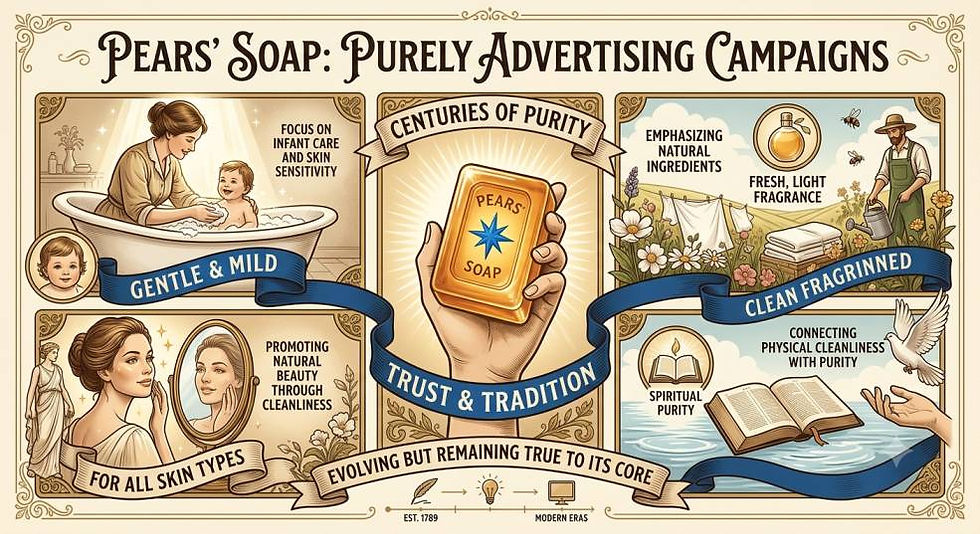
Pears soap, first produced and sold in 1807 by Andrew Pears in London, is widely documented as the world's oldest continuously existing registered brand. Under the marketing leadership of Thomas J. Barratt — who joined the firm in 1865 and has been credited by Guinness World Records as the world's first brand manager and is widely described as "the father of modern advertising" — Pears built a sustained advertising strategy around the idea of purity: a gentler, transparent, glycerin-based soap positioned against the harsher, often chemically adulterated soaps and cosmetics of the Victorian era. This case documents the verified historical record of that purity-centric positioning, the specific advertising techniques Barratt pioneered to communicate it (fine-art appropriation, celebrity testimonial, saturation repetition, and publicity stunts), and the brand's subsequent ownership history under Lever Brothers and Unilever through to its present-day manufacture in India.
Industry and Competitive Context
In the late eighteenth and nineteenth centuries, soap and cosmetic products available to British consumers were frequently harsh and, in some documented cases, contained arsenic or lead. Andrew Pears, a Cornish-born barber who had relocated to London and opened a shop in the affluent Soho district, observed that his wealthy clientele were using his powders and creams to cover skin damage caused by these harsher contemporary products. This observation is documented as the original commercial insight behind the brand: a gap existed for a soap that was visibly and verifiably gentler than the prevailing market standard.
By the mid-to-late nineteenth century, Pears competed in an increasingly crowded soap market that included Lever Brothers' own Sunlight Soap, which used a parallel purity-themed slogan, "Sunlight! Guarantee of Purity," according to the Victoria and Albert Museum's documented collection of period advertising. Both companies are documented as using similar marketing approaches during this era: acquiring and adapting fine-art paintings to lend their products cultural respectability, and commissioning bold graphic posters featuring wholesome children, idealised women, or pristine laundry, paired with memorable slogans. Pears was awarded the prize medal for soap at the Great Exhibition of 1851, a credential the brand subsequently used in its advertising to support its purity and quality claims.
Brand Situation Prior to the Campaign
Andrew Pears completed his soap-purification experiments and began selling his transparent, glycerin-based soap in London in 1807. The product's defining technical attribute — its transparency — was achieved through a purification process that removed impurities from the soap base, and this clarity itself functioned as the visual proof point for the brand's purity claim: an unusually long production process (involving extended drying, in some documented accounts running to several weeks) yielded a soap that was visibly different from the cloudy, opaque bars common at the time. The company became a family firm in 1835 when Andrew Pears' grandson, Francis Pears, joined the business, forming A. & F. Pears. Francis's daughter, Mary, married Thomas J. Barratt in 1865, and Barratt entered the firm as a partner shortly thereafter, eventually rising to chairman.Prior to Barratt's involvement, Pears' marketing is documented as comparatively conventional for the period. It was under Barratt's systematic direction from 1865 onward that the firm adopted what is now regarded as a deliberately constructed brand campaign, combining consistent slogans with commissioned and acquired imagery — a level of marketing system-building that led the Guinness World Records organisation to recognise Barratt, in 2014, as the world's first brand manager.
Strategic Objective
Barratt's publicly documented strategic objective was to equate the Pears brand with quality, purity, and high culture, and to embed regular use of the soap as a marker of respectability and refinement among the emerging Victorian middle class. This is evidenced by his most famous slogan, "Good morning. Have you used Pears' soap?" — a phrase documented as remaining a well-known catchphrase well into the twentieth century — which functioned to normalise daily soap use as a routine, almost moral, habit, reinforcing the purity positioning at the level of everyday behaviour rather than simply at the level of product attributes.
Campaign Architecture and Execution
Barratt's campaign architecture rested on several distinct, well-documented techniques.
Fine-art appropriation. Barratt's most famous tactic was the acquisition of Sir John Everett Millais' 1886 painting, originally titled A Child's World, depicting Millais' five-year-old grandson, William Milbourne James, blowing soap bubbles. The painting and its copyright had first been purchased by Sir William Ingram, who reproduced it in the Illustrated London News, where Barratt saw it. Barratt subsequently paid Ingram £2,200 for the picture, had a bar of Pears soap and lettering added to the image, and used the resulting work — retitled "Bubbles" — as a poster advertisement. Millais reportedly objected to the alteration of his work, but because Barratt held the copyright, he could not prevent its use. "Bubbles" became one of the most widely reproduced images in advertising history and is documented in the collections of institutions including the Wellcome Collection and the Victoria and Albert Museum. Barratt followed this with a broader series of advertisements depicting well-groomed, idealised children in comfortable middle-class domestic settings, deliberately associating Pears with social aspiration and domestic comfort.
Celebrity and scientific testimonial. In 1882, Barratt recruited the English actress and socialite Lillie Langtry, known for her complexion, to serve as the face of Pears soap — a campaign that is documented as making her the first celebrity to formally endorse a commercial product. Barratt also recruited testimonials from contemporary scientists, including Sir Erasmus Wilson, F.R.S., and from prominent public figures of the day, such as the American clergyman Henry Ward Beecher, whose published endorsement stated that his commendation of Pears soap had "opened for it a large sale in the United States." These testimonials lent the purity claim external, ostensibly objective validation rather than relying solely on the manufacturer's own assertions.
Saturation and novelty publicity. Where newspapers of the period restricted illustrated advertising, Barratt is documented as having filled column space by spelling out "PEARS" repeatedly in minute type across multiple columns, achieving visual saturation through sheer repetition rather than imagery. In a separate, well-documented publicity stunt, Barratt imported roughly a quarter to half a million French ten-centime coins (accepted informally as pennies in Britain at the time), had them stamped with the Pears name, and put them into circulation. The resulting public controversy was substantial enough that the British government bought up and melted down the coins and subsequently legislated to prevent a repetition of the tactic — generating considerable free publicity for the brand in the process.
Publishing extensions. Barratt established Pears' Annual in 1891 (some sources date the launch to 1892), an illustrated publication sold for a shilling that featured high-quality colour reproductions of paintings selected or commissioned by Barratt under what was known as the "Pictures for People" scheme; it ran for 38 years and reportedly sold out within a fortnight of each release. In 1897, Barratt introduced Pears' Cyclopaedia, a single-volume encyclopaedia distributed under the Pears name. Both publishing initiatives extended the brand's association with culture, education, and refinement well beyond direct product advertising.
Self-aware use of parody. When the satirical magazine Punch published a Harry Furniss cartoon parodying Langtry's testimonial advertisement — depicting a tramp saying "I used your soap two years ago, and have not used any other since" — Barratt purchased the rights to the cartoon itself and incorporated it into Pears' own marketing, demonstrating an unusually modern willingness to absorb and repurpose public mockery of the brand.
Positioning and Consumer Insight
The consistent throughline across these tactics is a positioning built on the literal and figurative meaning of "purity": the product's visible physical transparency stood as direct evidence of its gentleness relative to harsher contemporary soaps, while the surrounding advertising imagery (innocent children, fine art, refined domestic settings, high-society and scientific endorsement) extended that purity claim into a broader cultural register of cleanliness, respectability, and moral and social aspiration. Barratt is also documented as having linked Pears to British imperial culture, associating the soap's cleansing properties with the imagery of worldwide commerce and the rhetoric of empire — a positioning approach that has subsequently been the subject of academic critique, including scholarship (cited in some museum and university sources) analysing the racialised imagery used in certain nineteenth-century Pears advertisements, such as depictions implying that the soap could turn a Black child's skin white. These advertisements are part of the documented historical record of the brand's nineteenth-century campaigns and are referenced here as part of the historical context of the purity-positioning campaign, without further characterisation beyond what is stated in the cited academic and museum sources.
Media and Channel Strategy
The documented media mix for Barratt-era Pears advertising included newspaper and magazine advertising (including the column-saturation technique described above), illustrated poster advertising distributed in publications such as the Illustrated London News, the company's own Pears' Annual and Pears' Cyclopaedia publications, and the circulating-currency stunt as an unconventional public-attention tactic.
Business and Brand Outcomes
Pears soap is documented by Unilever's own corporate history materials and by multiple independent sources as the world's first registered brand and the world's oldest continuously existing brand. The Bubbles advertisement is documented as one of the most reproduced images in the history of advertising. Thomas Barratt received a Guinness World Record in 2014 recognizing him as the world's first brand manager, based on his role at A. & F. Pears from 1865 onward. On ownership history: Lever Brothers Ltd acquired A. & F. Pears in 1917, according to Unilever's official corporate history archive (a small number of secondary sources state 1914 as the acquisition year; Unilever's own published history states 1917). Pears soap production subsequently moved to Port Sunlight and later to Isleworth before being transferred to India; multiple sources, including the Science Museum Group's collection records, state that production moved to India in 1992 under Hindustan Unilever, which has continued to manufacture the brand for both the Indian and international markets. Unilever's shareholding in Hindustan Unilever has been reported at different points as approximately 52% and, more recently, approximately 67%, according to Wikipedia's Pears (soap) article, which should be cross-checked against Hindustan Unilever's current investor disclosures for the up-to-date figure. On product reformulation: in October 2009, Unilever altered the formula of the classic transparent amber Pears bar, rebranding it as "Gentle Care" with a cellophane wrapper, a softer texture, a shorter usable life, and an altered scent; the "Hypoallergenic, non-comedogenic" claim and the previously stated three-month ageing process were both dropped from the new packaging. This reformulation generated a documented consumer backlash, including an online petition and social media campaign calling for the original formula's return. In 2016, Hindustan Unilever publicly announced a relaunch of Pears in the UK market, described in the company's own announcement as "The beloved British icon returns," responding to this consumer pressure.
Strategic Implications
The Pears case is among the earliest fully documented examples of a brand converting a genuine, demonstrable product attribute (the visible transparency resulting from a purification process) into a sustained, multi-decade brand narrative built around an abstract value (purity, respectability, refinement) rather than around functional claims alone. Barratt's technique of acquiring fine art and altering it for commercial use illustrates an early and aggressive form of cultural appropriation in branding — borrowing the reputational capital of high culture to transfer credibility onto a mass-market consumer product, a strategy that prefigures later twentieth-century practices of celebrity and "prestige" association in advertising. The brand's use of testimonial — both from scientific authorities and from glamorous public figures such as Lillie Langtry — established a template for endorsement-based marketing that has remained a standard tool of consumer-goods advertising. Equally, Barratt's willingness to purchase and repurpose a satirical parody of his own advertising, rather than suppress it, demonstrates an unusually self-aware approach to brand controversy management for the period. The documented 2009 reformulation episode and subsequent 2016 reversal offer a more contemporary lesson: for a brand whose equity is built substantially on a specific, multi-generational sensory identity (in this case, the soap's distinctive scent, texture, and transparency), even technically minor formulation changes can provoke disproportionate consumer backlash, particularly where the brand's positioning has historically rested on continuity and authenticity rather than innovation. Finally, the documented use of racialised imagery in some nineteenth-century Pears advertisements, alongside Barratt's explicit linkage of the brand to imperial and civilising-mission rhetoric, is a documented part of the brand's historical advertising record and offers a case study in how purity-based product positioning was, in this specific historical instance, extended into problematic cultural and racial territory — a cautionary example for contemporary marketers regarding the risks of extending a product attribute claim into broader symbolic or ideological territory.
Discussion Questions
Thomas Barratt's acquisition of Millais' "Bubbles" painting converted a piece of fine art into a commercial advertisement, against the artist's wishes. What does this episode suggest about the relationship between intellectual property ownership and brand-building, and how would such a strategy be evaluated under contemporary copyright, trademark, and brand-safety standards?
Pears built its purity positioning on a genuine, visible product attribute (transparency resulting from a purification process). Compare this to a contemporary example of a brand using a verifiable physical or technical attribute as the centrepiece of an abstract values-based positioning. What are the risks of allowing the "proof point" and the "brand value" to diverge over time?
Barratt's 2009-era successor decision (Unilever's reformulation of Pears into "Gentle Care") triggered a consumer backlash that led to a partial reversal in 2016. What does this suggest about the limits of formulation or product innovation for legacy brands whose equity rests heavily on continuity and sensory memory?
Evaluate Barratt's use of testimonial advertising (Lillie Langtry, Henry Ward Beecher, Sir Erasmus Wilson) as an early form of influencer and authority marketing. What parallels and differences exist between this nineteenth-century approach and contemporary influencer or key-opinion-leader marketing strategies?
The documented use of imperial and, in some advertisements, racialised imagery alongside Pears' purity claims illustrates how a product-attribute positioning can be extended into problematic symbolic territory. What governance mechanisms should a contemporary marketing organisation put in place to prevent a legitimate product claim from being extended into culturally or ethically harmful messaging?


Comments