PharmEasy's E-Prescription Fulfillment Model
Industry & Competitive Context
India's e-pharmacy sector operates inside one of the most legally contested digital-commerce categories in the country. Medicine sale and dispensing in India is governed by the Drugs and Cosmetics Act, 1940, and the Pharmacy Act, 1948 statutes that predate e-commerce and do not explicitly address online dispensing. In the absence of a dedicated regulatory framework, the Office of the Drugs Controller General of India issued a notice in December 2015 clarifying that existing Drugs and Cosmetics Rules applied equally to online and offline drug sales, which effectively opened the door for e-pharmacy licensing rather than an outright ban (SCC Online, "Regulation of Online Pharmacies in India," 2023).
This ambiguity produced sustained litigation. In 2018, Dr. Zaheer Ahmed filed a public interest litigation in the Delhi High Court arguing that online drug sales violated the Drugs and Cosmetics Act. On December 12, 2018, a Delhi High Court division bench (Chief Justice Rajendra Menon and Justice V. Kameswar Rao) ordered an all-India interim injunction against the online sale of medicines by unlicensed platforms (reported contemporaneously and confirmed by the International Bar Association's 2023 legal analysis, "E-pharmacies and the law: an uneasy balance"). In response, the leading e-pharmacy platforms of the time including PharmEasy, Netmeds, and 1mg approached the Delhi High Court seeking protection from coercive enforcement action (IJPS Journal, "Evolving Regulatory Framework for E-Pharmacies in India," 2026). A parallel petition before the Madras High Court produced a different outcome: in July 2024, the Madras High Court's division bench explicitly permitted the online sale of drugs, on the condition that all such sales be routed through licensed druggists and chemists, while directing the Central Government to finalize a formal regulatory framework (Lexology, "Madras High Court Greenlights Online Sale of Drugs and Medical Devices in India," 2024). As of that ruling, the Central Government had still not notified the Draft E-Pharmacy Rules first published for comment in 2018, and in March 2023 it told the Delhi High Court that a rule-making proposal remained "under consideration" (SCC Online, 2023).
This regulatory backdrop is structurally important: it means every India-based e-pharmacy operator, PharmEasy included, has had to build its fulfillment model around a legal requirement that prescription medicines be dispensed only through licensed pharmacists and licensed retail entities not through a direct-to-consumer inventory model that bypasses the traditional chemist network entirely.
Competitively, the market has consolidated around a small set of scaled players. By September 2023, independent research firm RedSeer's data (cited in a Business Standard report drawing on Economic Times reporting) showed Tata 1mg holding a 31% share of e-pharmacy gross merchandise value (GMV), up from 19% in October 2022, while PharmEasy's GMV share fell to 15% from approximately 33% over the same period. Flipkart Health+, Reliance's Netmeds, and Apollo together held a combined 15–18% share (Business Standard, "Tata 1mg overtakes PharmEasy as leaders in India's e-pharmacy market," November 2023). The same report attributed PharmEasy's share decline specifically to a strategic pivot toward profitability, including reduced marketing spend and cost discipline, beginning in early 2023.
Brand Situation Prior to the Model's Current Form
PharmEasy is operated by API Holdings, and by 2021 had established itself, per TechCrunch's reporting on its Thyrocare acquisition, as India's largest online pharmacy and diagnostics brand, with a business-to-business pharma marketplace connecting over 6,000 consultation clinics and 90,000 partner retailers (TechCrunch, June 2021). At that time the company had raised approximately $572 million to date from investors including Prosus Ventures, Temasek, Eight Roads Ventures, TPG, B Capital Group, and Bessemer Venture Partners, and was valued at $1.5 billion in an April 2021 financing round (TechCrunch, June 2021).
In June 2021, API Holdings through its subsidiary Docon Technologies agreed to acquire a 66.1% stake in the listed diagnostics chain Thyrocare Technologies for approximately Rs 4,546 crore (about $613 million), triggering a mandatory open offer for an additional 26% stake at Rs 1,300 per share, worth roughly Rs 1,788 crore (Business Standard, June 2021; TechCrunch, June 2021). This was reported as the first-ever acquisition of a publicly listed company by an Indian unicorn startup (TechCrunch, June 2021). The transaction extended PharmEasy's model beyond medicine fulfillment into diagnostics, and API Holdings was reported to be simultaneously in talks to raise a $500 million round at a $4 billion valuation, with its overall valuation later reported at $5.6 billion following a financing round in the second half of 2021 (TechCrunch, June 2021).
The company subsequently filed for an $843 million initial public offering in November 2021 but later deferred those plans (TechCrunch, undated report on the IPO deferral). Following the deferral, PharmEasy encountered financing difficulty: it struggled to secure a new funding round even at a $2 billion valuation, and Economic Times reporting (cited by TechCrunch) indicated the company planned a rights issue that would value its shares at Rs 5, down from Rs 50 previously which would have made it the first major Indian unicorn to complete a down round. Separately, Business Today (via a Nishith Desai Associates media compilation) reported that media accounts in 2023 pointed to a proposed $292 million fundraise at what was characterized as a roughly 90% valuation markdown, implying a valuation in the $500–600 million range against the earlier $5.5 billion figure though this account should be read as reported deal speculation at the time rather than a confirmed, closed transaction. The same Business Today piece also reported that PharmEasy had borrowed $285 million from Goldman Sachs to refinance an earlier Kotak Mahindra Bank loan used to fund the Thyrocare acquisition. Cumulatively, TechCrunch and Entrackr reporting indicate the company has raised over $1.1 billion in equity and debt combined, from investors including TPG, Prosus, Temasek, B Capital, Bessemer Venture Partners, Eight Roads Ventures, Steadview Capital, JM Financial, and Ranjan Pai's MEMG.
Leadership changed materially in 2025: Entrackr reported (citing PharmEasy's own financial statements) that co-founders Dharmil Sheth, Dhaval Shah, and Hardik Dedhia stepped back from the company, and a fourth co-founder, Siddharth Shah, exited shortly after. Rahul Guha, who also serves as Managing Director and CEO of Thyrocare, was appointed MD and CEO of API Holdings (Entrackr, September 2025).
Strategic Objective
What is verifiable from financial disclosures and reporting is a directional shift in stated priorities: Business Standard's November 2023 reporting noted that PharmEasy's management had, in an August 2023 update, adjusted expectations to what was described as a "new reality," with an explicit focus on sustainable growth and profitability rather than GMV or market-share maximization. This is corroborated by the financial trajectory disclosed in API Holdings' own results: consolidated net loss narrowed 51% year-on-year to Rs 2,533 crore in FY24 from Rs 5,212 crore in FY23, driven substantially by a reduction in goodwill impairment charges (to Rs 582 crore from Rs 2,826 crore) and lower employee benefit expenses (down to Rs 699 crore from Rs 1,283 crore) (BW Businessworld, "PharmEasy Reports 15% Dip In Revenue In FY24," citing API Holdings' financial results). This pattern accepting revenue and market-share contraction in exchange for cost discipline is consistent with a profitability-oriented strategic objective, though PharmEasy has not, in the sources reviewed for this case, published a formal mission or objective statement specific to prescription fulfillment.
Operating Model Architecture & Execution
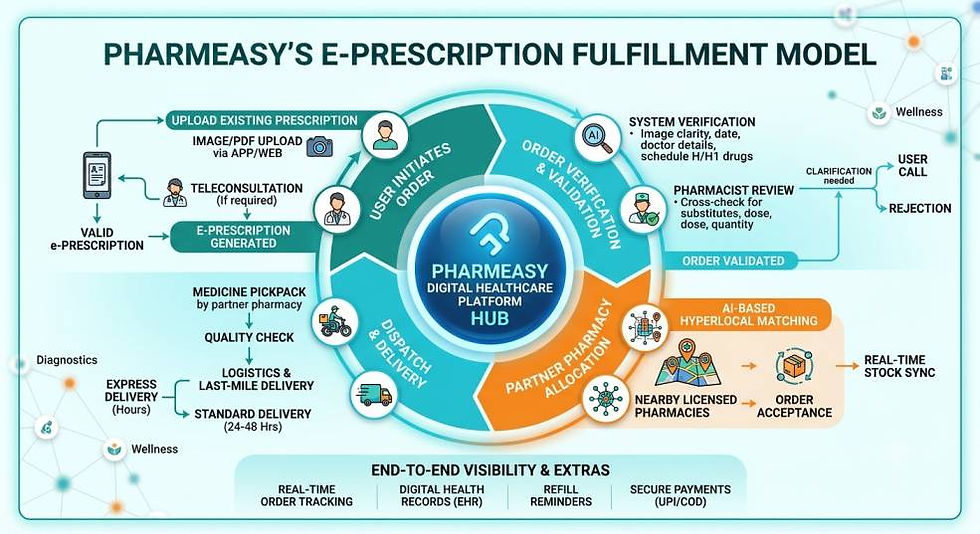
PharmEasy's fulfillment model operates within the legal constraint described in Section 1: prescription medicines must be dispensed through licensed pharmacists and licensed retail or wholesale entities. The Madras High Court's July 2024 order made this explicit for the industry as a whole, permitting online drug sales only when "routed through licensed druggists and chemists only" (Lexology, July 2024). Claims to this effect appear in unverified marketing and business-model blogs that are not classified as credible sources under the sourcing standard applied to this case, and are therefore excluded.
What is verifiable is the scope of the business that this fulfillment infrastructure supports. API Holdings' FY25 financial statements, as reported by Entrackr (September 2025), show consolidated operating revenue of Rs 5,872 crore, of which approximately 87% (Rs 5,097.5 crore) was derived from the sale of pharmaceutical and cosmetic products, with the remainder from diagnostics, teleconsultation, delivery, warehousing, and facilitation commissions. This confirms that medicine fulfillment the segment directly dependent on prescription verification and dispensing remains the dominant revenue driver of the platform, even after diversification into diagnostics and teleconsultation.
The Thyrocare acquisition (Section 2) extended the model to diagnostics, allowing the same consumer base to be served across medicine and lab-test fulfillment. Thyrocare's own FY25 financial performance, reported separately, showed revenue of Rs 687.5 crore, a 20% increase over FY24's Rs 571.88 crore, with profit growing 30% to Rs 90.75 crore (Entrackr, September 2025) indicating that the diagnostics vertical acquired in 2021 was, by FY25, both growing and profitable, in contrast to the group's medicine-fulfillment business, which continued to report losses at the consolidated level.
Positioning & Consumer Insight
What can be established from the regulatory record is the structural consumer proposition that all licensed e-pharmacy operators, including PharmEasy, have had to satisfy under Indian law: verified prescription-based dispensing, delivered through a licensed pharmacist, as a substitute for or complement to physical chemist visits. The Delhi High Court's 2018 interim order and the Madras High Court's 2024 final order (Sections 1 and 4) together establish that the entire category's consumer proposition has been legally constrained to operate through licensed intermediaries rather than an unregulated direct-to-consumer channel a constraint that necessarily shapes how any player in this category, including PharmEasy, can position its speed, convenience, or trust claims to consumers. Beyond this regulatory framing, this case does not assert any specific positioning claim, tagline, or brand narrative for PharmEasy that could not be independently verified through the source categories specified for this case.
Media & Channel Strategy
The only verifiable, sourced datapoint relevant to channel strategy is indirect: Business Standard's November 2023 reporting attributed PharmEasy's GMV market-share decline (from approximately 33% to 15% between October 2022 and September 2023) in part to management's decision to restrict marketing spending as part of a broader shift toward profitability (Business Standard, November 2023). This indicates a documented reduction in marketing investment intensity during this period.
Business & Brand Outcomes
The following outcomes are drawn directly from company financial disclosures as reported by credible business news outlets, and from independent market-research data:
Revenue trajectory: API Holdings' consolidated revenue from operations fell 14.7% year-on-year, from Rs 6,643 crore in FY23 to Rs 5,664 crore in FY24 (BW Businessworld, citing API Holdings' financial results, November 2024). Revenue then grew modestly, up 3.7% to Rs 5,872 crore in FY25 (Entrackr, September 2025).
Losses: Consolidated net loss narrowed 51% to Rs 2,533 crore in FY24 from Rs 5,212 crore in FY23, aided by a reduction in goodwill impairment charges and lower employee costs (BW Businessworld). Entrackr's September 2025 reporting further noted that losses were cut in FY25 as well, attributed to lower finance and depreciation costs, though it characterized underlying operating "burn" as flat year-on-year.
Working capital: Inventory levels fell to Rs 555 crore in FY24 from Rs 688 crore in FY23; trade receivables stood at Rs 706 crore; finance costs rose to Rs 728 crore in FY24 from Rs 665 crore in FY23 (BW Businessworld).
Market share: PharmEasy's e-pharmacy GMV share, as measured by RedSeer and reported via Economic Times/Business Standard, fell from approximately 33% (October 2022) to 15% (September 2023), while Tata 1mg's share rose from 19% to 31% over the same period (Business Standard, November 2023).
Diagnostics segment: Thyrocare, acquired for approximately $613 million in 2021, reported FY25 revenue of Rs 687.5 crore (up 20% year-on-year) and profit of Rs 90.75 crore (up 30% year-on-year) the group's only verifiably profitable disclosed segment in the sources reviewed (Entrackr, September 2025).
Capital raised: Approximately $1.1 billion raised cumulatively in equity and debt, per TechCrunch and Entrackr/TheKredible data.
Leadership transition: All four co-founders had exited management roles by late 2025, with Rahul Guha (also Thyrocare's MD/CEO) appointed MD and CEO of API Holdings (Entrackr, September 2025).
Strategic Implications
Three verifiable dynamics are visible from this record, and are offered here as analytical interpretation rather than as additional facts.
First, PharmEasy's fulfillment model has operated for its entire existence inside an unresolved regulatory environment. The absence of finalized e-pharmacy rules first drafted in 2018 and still not notified as of the Madras High Court's 2024 ruling means that the legal basis for the licensed-pharmacist routing model that underpins prescription fulfillment has rested on court-supervised interim arrangements rather than settled legislation. This is a durable source of operating risk that is structural to the category, not specific to any one company's execution.
Second, the documented shift from GMV growth to profitability between 2022 and 2024 reflected simultaneously in falling market share, falling revenue, and narrowing losses indicates a deliberate trade-off rather than a purely defensive retreat. The market-share loss to Tata 1mg over the same window, however, shows that this trade-off had a directly observable competitive cost: profitability discipline at PharmEasy coincided with, and was reported as a contributing cause of, a rival's category leadership.
Third, the relative financial performance of the group's two major disclosed segments a profitable and growing diagnostics business in Thyrocare, against continuing losses at the consolidated group level, where pharmaceutical product sales remain roughly 87% of revenue suggests that the acquisition-led diversification strategy of 2021 has, on the evidence available through FY25, delivered a more resilient earnings profile in diagnostics than the core e-prescription and medicine-fulfillment business has achieved on its own.
Discussion Questions
Given that Indian courts have twice reached different conclusions on the legality of online drug sales (Delhi High Court's 2018 interim injunction versus the Madras High Court's 2024 conditional approval), how should a platform like PharmEasy structure its fulfillment architecture to remain resilient to divergent or unsettled regulatory outcomes across jurisdictions?
PharmEasy's GMV market share fell from roughly 33% to 15% over the same period it narrowed its losses and pursued profitability. Under what conditions is trading market share for margin the correct strategic choice in a still-consolidating category, and when does it instead cede a defensible position permanently to a competitor?
Thyrocare, the diagnostics business acquired for approximately $613 million in 2021, was profitable and growing in FY25 while the core medicine-fulfillment business continued to report losses. What does this suggest about the relative economics of prescription-based e-pharmacy fulfillment versus diagnostics as business models, and how should a diversified healthcare platform allocate capital between them?
The reported rights issue that would have priced PharmEasy shares at Rs 5 versus a prior Rs 50, alongside a $285 million debt refinancing via Goldman Sachs, illustrates the capital-structure consequences of an aggressive, acquisition-funded growth strategy. What governance and financing safeguards might a board put in place before pursuing a large, debt-financed acquisition inside a company that has not yet reached profitability?
With all four co-founders having exited by late 2025 and a Thyrocare executive installed as group CEO, what are the risks and potential benefits of transferring leadership of a core e-pharmacy fulfillment business to an executive whose operating background is in a different, better-performing segment (diagnostics) of the same group?


Comments