Policybazaar's Digital Insurance Comparison Model
Industry & Competitive Context
India's insurance industry prior to Policybazaar's founding was structured around tied agents and bank/corporate agency channels, with pricing that had only recently been deregulated. Policybazaar was founded in June 2008 in Gurgaon by Yashish Dahiya, Alok Bansal, and Avaneesh Nirjar under the entity ETECHACES Marketing and Consulting Private Limited, with seed funding from Info Edge, the parent of Naukri.com. Dahiya, an IIT Delhi engineering graduate with an INSEAD MBA, had previously worked at Bain & Company and led online travel firm ebookers.com; Bansal had a background at Mahindra & Mahindra.
The company began as an online information and lead-generation portal for life and health insurance comparison, at a time when the regulator, the Insurance Regulatory and Development Authority of India (IRDAI), was still defining how digital intermediaries could operate. In 2011, IRDAI's evolving regulatory framework for online distribution required Policybazaar to adapt its lead-generation model. The company subsequently operated for over a decade as an IRDAI-licensed Insurance Web Aggregator (IWA) a category permitted to list, compare, and generate quotes for insurance products online, but not to directly solicit or push sales in the manner of a broker or agent.
Over the following decade, PB Fintech expanded into adjacent financial comparison verticals, launching Paisabazaar in 2014 as a credit-product marketplace, and later added DocPrime (preventive healthcare, 2018) and PB Partners (an agent-aggregation platform). The company also entered the United Arab Emirates market through Policybazaar.ae.
By the time of its public listing, PB Fintech described Policybazaar as India's largest online insurance marketplace, citing a 93.4% market share by number of policies sold among online insurance distributors as of Fiscal Year 2020 (FY20), a figure sourced to Frost & Sullivan and repeated in the company's IPO prospectus and subsequent investor communications. Public market-research and brokerage coverage (e.g., Motilal Oswal, ICICI Direct) has repeated this figure and later updated it to "over 90%" of the online-insurance-sales segment in FY24–FY25 broker notes, while separately noting that digital channels represent only a small share of India's total insurance premium one brokerage report placed digital insurance sales at approximately 1% of total industry premium as of FY25. Competing digital or hybrid insurance-distribution players named in public reporting include Turtlemint, RenewBuy, Coverfox, and InsuranceDekho, though this case does not report their financial or market-share figures because no verified public source for those figures was reviewed for this document.
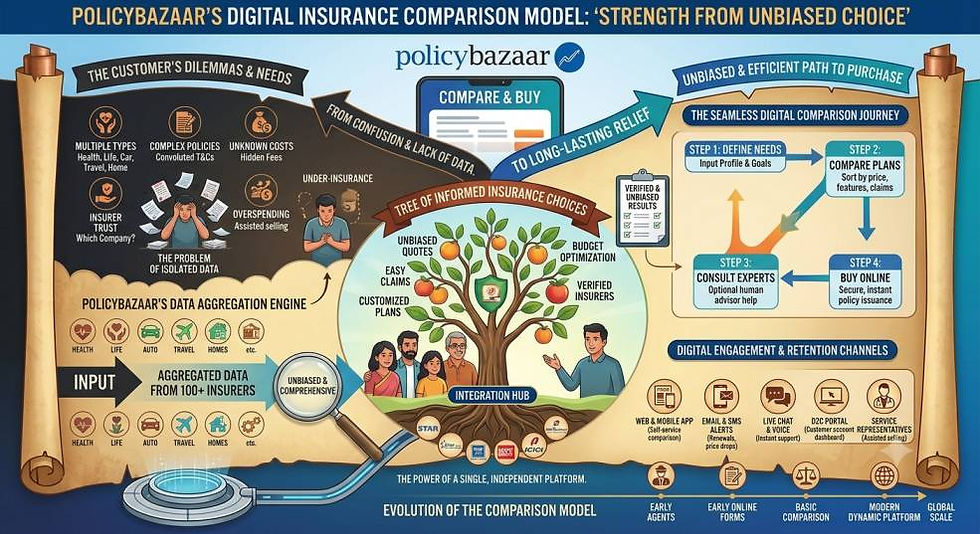
Brand Situation Prior to the Broking-Model Transition
Through the 2010s, Policybazaar operated as a comparison-first digital marketplace, generating revenue predominantly through commissions and outsourcing/consulting fee arrangements with insurers, as described in a Motilal Oswal equity research note (October 2021) covering the company ahead of its IPO. That note recorded that insurance web-aggregator services constituted 68.5% of total revenues, with commission income across Policybazaar and Paisabazaar together making up roughly 36% of revenue and fee income from outsourcing/consulting comprising approximately 52%, for Fiscal Year 2021 (FY21). The same note disclosed that PB Fintech reported a consolidated loss of ₹1.5 billion in FY21, with Policybazaar's segment loss at ₹1.76 billion and Paisabazaar posting a segment profit of ₹136 million its first as a segment. As of that period, the company reported approximately 48 million registered consumers, roughly 19.2 million policies sold, and about 9.6 million unique transacting customers, with partnerships across approximately 51 insurers.
A structural constraint of the web-aggregator license was that it restricted Policybazaar to online comparison and quote generation; it could not provide claims assistance, operate offline points-of-presence, or otherwise engage in activities reserved for licensed brokers and agents under IRDAI regulation. This limited the company's ability to serve segments of the Indian population less comfortable with fully self-directed digital insurance purchase, and to participate in the claims-servicing relationship that insurers and customers often value.
Strategic Objective
Public statements by the company frame two linked strategic objectives during this period, both attributable to management commentary reported by business press and PB Fintech's own investor communications:
Expand addressable market beyond digitally native, self-service consumers, by acquiring the regulatory and operational capability to serve customers offline, assist with claims, and build a hybrid advisor-led distribution network while retaining its core online comparison proposition.
Build category-level brand and consumer trust in a market with historically low insurance penetration, as opposed to competing solely on product-level price or discount messaging.
CEO Yashish Dahiya was quoted publicly, following the 2021 IRDAI broking-license approval, stating that the company "could not have done justice to our objective of increasing India's insurance penetration levels with online channels alone" a statement documented in industry coverage of Policybazaar's distribution strategy shift. This framing positions the broking-license transition as a deliberate move to combine digital scale with physical/advisor-assisted distribution, rather than an abandonment of the comparison-engine model.
Campaign Architecture & Execution — The Comparison-to-Broking Evolution
Regulatory transition (2021): In June 2021, Policybazaar received an insurance broking license from IRDAI, and the company later obtained a composite broker license in February 2024, which per public reporting permits broader insurance distribution services (life, general, and reinsurance broking) than the web-aggregator model. This licensing shift is documented in company exchange filings and repeated across financial press coverage (Business Today, Outlook Money, Business Standard).
Physical distribution build-out: Following the 2021 licensing change, industry reporting recorded that Policybazaar launched an initial set of offline retail stores (reported at 15 locations) with a stated target of expanding to 100 locations, complementing its digital-first model with a brick-and-mortar advisory presence an approach distinct from pure aggregators and closer to a hybrid distribution model.
Agent-aggregation platform (PB Partners): PB Fintech's FY26 investor disclosures describe PB Partners, its agent-aggregator platform, as having over 450,000 advisors and a presence in roughly 19,000 pin codes, covering approximately 99% of pin codes in India. This indicates the comparison-engine model was extended with a large, distributed human-advisor network rather than being replaced by it.
IPO and brand-investment allocation: PB Fintech's November 2021 IPO raised ₹5,709.72 crore (approximately $770 million at contemporaneous exchange rates) through a combination of a ₹3,750 crore fresh issue and a ₹1,959.72 crore offer for sale, at an issue price of ₹980 per share, as recorded in the company's prospectus and reported by Business Standard. The prospectus explicitly allocated ₹1,500 crore of net proceeds toward "enhancing visibility and awareness of brands, including but not limited to Policybazaar and Paisabazaar" a rare instance of a company publicly quantifying planned brand-marketing investment at IPO stage. A further ₹375 crore was earmarked for expanding the consumer base including offline presence, ₹600 crore for strategic investments and acquisitions, and ₹375 crore for international expansion.
Advertising spend disclosure: A Business Standard market report (November 2022) citing PB Fintech's Q2 FY23 (September-quarter) results recorded that advertising and promotion expenses rose 93.51% year-on-year to ₹312.38 crore for that quarter, alongside 105.1% year-on-year revenue growth to ₹573.47 crore indicating that brand and performance marketing scaled materially around and after the IPO period, consistent with the stated use-of-proceeds.
Illustrative advertising execution (2017): Prior to the IPO, Policybazaar ran category-education television advertising. A January 2017 Business Standard/ANI report documents a month-long television campaign with the tagline "Policybazaar.com par term insurance lena bhool kar bhi mat bhoolna" (loosely, "don't forget to buy term insurance on Policybazaar.com"), featuring actress Achint Kaur, designed in-house and executed by K Silent Productions, airing from January 15, 2017. The campaign's stated intent, per quotes attributed to Naveen Kukreja (then Group CMO of Policybazaar and CEO of Paisabazaar) and Sai Narayan (then Head of Marketing, Policybazaar), was to counter consumer procrastination on term-insurance purchase and to reframe insurance buying as a proactive rather than agent-pushed decision. This is presented here as one verified, dated example of Policybazaar's category-education advertising approach; it should not be read as representative of all campaigns the company has run, since a comprehensive public archive of Policybazaar's advertising history was not available to this case.
Positioning & Consumer Insight
Public company and press material consistently frames Policybazaar's positioning around three linked ideas: (a) information asymmetry correction — giving consumers the ability to compare products, pricing, and insurer terms that were previously mediated only by commission-incentivized agents; (b) category urgency and financial protection — evident in the 2017 term-insurance campaign's framing of mortality risk and family financial exposure; and (c), post-2021, assisted digital trust — the argument, attributed publicly to CEO Yashish Dahiya, that a purely online channel could not on its own move India's insurance penetration, and that combining digital comparison with human advisory touchpoints (offline stores, PB Partners advisors) was necessary to convert awareness into purchase.
It is also worth noting, as a matter of public record rather than brand narrative, that this consumer-trust positioning has been directly tested by regulatory findings. In August 2025, IRDAI issued an order (dated August 4, 2025) imposing a ₹5 crore (50 million rupee) penalty on Policybazaar (in its former capacity as an Insurance Web Aggregator) following an onsite inspection conducted in June 2020 and a show-cause notice issued in October 2024. Reuters and multiple Indian financial outlets reported that IRDAI's order cited eleven charges under the Insurance Act, 1938, and the IRDAI (Insurance Web Aggregators) Regulations, 2017, including biased or misleading promotion of specific insurers' products as "top" or "best" without disclosed objective criteria, delayed remittance of collected premiums to insurers, deficiencies in outsourcing agreements, KMP/Principal Officer directorship violations, and gaps in mapping telemarketing-sold policies (reported at roughly 98,000 of 430,000-plus policies sold through that channel) to Authorised Verifiers. PB Fintech confirmed the order in an exchange filing, stated that IRDAI had also issued additional (unspecified) directions and advisories to be complied with in a time-bound manner, and stated the order would not affect Policybazaar's ongoing operations. PB Fintech shares fell approximately 2–3% following the disclosure, per Reuters and Business Today reporting. This is a materially relevant, publicly documented tension for a company whose core brand positioning rests on being a neutral, consumer-first comparison platform, and is included here as a verified fact rather than as a hypothesis about the company's practices before or after the inspection period.
Media & Channel Strategy
Verified, publicly documented channel elements of Policybazaar's model include:
Owned digital platform (website and mobile app) as the primary comparison and transaction channel, described in IPO-stage and subsequent filings as covering health, term/life, motor, travel, and other protection products, sourced from insurer partnerships (53 insurer partners disclosed as of Q4 FY24 investor commentary; ~51 partners disclosed around FY21).
Television advertising, documented for the January 2017 term-insurance campaign described above.
Offline retail stores, launched following the 2021 broking-license approval, reported at an initial 15 locations with a stated target of 100.
PB Partners advisor network, an agent-aggregation channel reported at over 450,000 advisors and approximately 19,000 pin codes as of FY26 investor disclosures.
UAE market entry via Policybazaar.ae, including publicly reported promotional pricing offers (e.g., a Gulf News report on Ramadan-period discounts across health, motor, and term life categories in the UAE, attributed to Policybazaar UAE CEO Neeraj Gupta).
Business & Brand Outcomes
The following outcomes are drawn directly from PB Fintech's investor disclosures, exchange filings, and named financial press, covering different reporting dates as indicated:
IPO market reception: PB Fintech's IPO (November 1–3, 2021) was subscribed 16.58 times overall (institutional portion 24.89x, non-institutional/wealthy-investor portion 7.82x, retail portion 3.31x), against a price band of ₹940–980. Shares listed on November 15, 2021, at ₹1,150 a 17.35% premium to the ₹980 issue price and rose as much as 43% intraday over the following session, per Business Standard's Capital Market reporting, briefly placing PB Fintech among India's top-100 companies by market capitalisation.
Post-listing volatility: By November 2022, PB Fintech shares were trading roughly 55.6% below their IPO price, having hit a 52-week low of ₹356.20 in November 2022, according to Business Standard market reporting illustrating that strong listing-day reception did not translate into sustained near-term shareholder value, at least over that one-year window.
Scale metrics (FY24–FY26, as disclosed in investor/broker materials): As of Q2 FY25, the platform reported 86.9 million registered users, 18.3 million active users, and over 46.8 million insurance policies sold cumulatively, per data compiled by Screener.in from company filings. By FY26 (per ICICI Direct's results analysis of PB Fintech disclosures), the company reported 145.7 million registered consumers, 26.4 million transacting consumers, and Insurance Broker Services segment revenue growth of 41.7% year-on-year to ₹6,08,928 lakh (≈₹6,089 crore), alongside a segment result of ₹86,076 lakh (≈₹861 crore). UAE insurance premium was reported to have grown 54% year-on-year in FY26, with the UAE business reported profitable for a full fiscal year for the first time in FY26.
Profitability inflection: A Q3 FY24 investor press release stated that PB Fintech's total insurance premium for that quarter was ₹4,261 crore (an annualised run-rate of ₹17,000 crore), that renewal/trail revenue reached an annualised run-rate of ₹454 crore (up from ₹317 crore a year earlier) and typically carries over 85% margins, and that consolidated nine-month PAT improved by ₹482 crore to a positive ₹4 crore PB Fintech's first period of positive consolidated profit after tax disclosed in that release. The release also disclosed an "Insurance CSAT" (customer satisfaction) score of 88%, without further methodological detail. Company-sourced material (Wikipedia, sourced to company filings) records FY24 (full-year) Policybazaar-entity revenue of ₹3,438 crore, operating income of ₹324 crore, and net income of ₹64 crore.
Regulatory outcome: The August 2025 IRDAI penalty of ₹5 crore, described in Section 5 above, is a documented business/brand outcome in its own right both as a compliance cost and as a reputational event that moved PB Fintech's share price by approximately 2–3% on the announcement date, per Reuters.
Strategic Implications
Three implications follow directly from the verified record above, rather than from inference about undisclosed internal metrics.
First, regulatory license architecture functioned as a strategic lever, not merely a compliance requirement. The shift from web-aggregator to insurance broker (2021) and then to composite broker (2024) status was publicly framed by the company as enabling new revenue and distribution surfaces (claims assistance, offline stores, PB Partners) that were unavailable under the narrower aggregator license. This suggests that in regulated marketplace businesses, license-tier progression can be treated as a deliberate expansion vector, sequenced alongside rather than instead of brand and product investment.
Second, capital-market validation and demonstrated brand trust are not the same thing. PB Fintech's strong IPO subscription and listing-day pop reflected investor appetite for India's first major listed insurtech, but the subsequent 2022 share-price decline and the August 2025 IRDAI penalty centred on allegations of biased product promotion, a direct challenge to the "neutral comparison platform" positioning indicate that public-market enthusiasm and regulator/consumer-trust outcomes can diverge materially and should be evaluated as separate performance dimensions in comparison-marketplace business models.
Third, the disclosed advertising-expense growth (93.51% YoY in the Q2 FY23 quarter cited above) alongside revenue growth of 105.1% in the same quarter indicates that, at least in that period, Policybazaar was willing to scale marketing investment ahead of or in step with top-line growth consistent with a strategy of using the IPO's earmarked ₹1,500 crore brand-investment allocation to defend category leadership during a period when new entrants (e.g., InsuranceDekho, RenewBuy, Turtlemint, per named industry coverage) were also competing for digital and hybrid insurance-distribution share, even though this case cannot verify the relative market shares of those competitors.
Discussion Questions
Policybazaar operated for over a decade under an Insurance Web Aggregator license before obtaining a broking license in 2021 and a composite broker license in 2024. What are the strategic trade-offs of building a large consumer brand and data asset under a restrictive license tier before "unlocking" broader distribution rights and what risks does this sequencing create if the regulator later scrutinizes conduct from the earlier, more restricted period?
PB Fintech's IPO prospectus explicitly earmarked ₹1,500 crore of proceeds for brand-visibility investment one of the largest publicly disclosed brand-marketing allocations by an Indian listed company at IPO stage. What does this signal about how capital markets and management jointly viewed brand investment as a strategic asset for a comparison-marketplace business, and how would you evaluate whether that capital was well spent using only the outcomes documented in this case?
The August 2025 IRDAI order found that Policybazaar had promoted certain products as "top" or "best" without disclosed objective criteria a direct challenge to a platform whose core value proposition is neutral comparison. How should a marketplace business structurally separate commercially incentivized ranking or promotion decisions from the "neutral advisor" brand promise it sells to consumers, and what governance mechanisms would you propose?
Comparing the 93.51% year-on-year rise in advertising and promotion expense against 105.1% revenue growth in the same quarter (Q2 FY23), and the later shift in FY24 toward positive consolidated PAT, what does this trajectory suggest about the phasing of growth-stage versus profitability-stage marketing strategy in a two-sided marketplace, and what leading indicators (beyond the ones disclosed here) would you want visibility into before concluding the shift was successful?
Given that India's digital insurance sales reportedly represent only around 1% of total industry premium even as Policybazaar holds a dominant share of that online segment (per cited brokerage estimates), what does this imply about the total addressable market for a digital-first comparison model, and how does Policybazaar's move into offline stores and the PB Partners advisor network change the nature of the business from a pure digital marketplace to a hybrid distribution company?


Comments