RedBus’ Insight into Digital Bus Booking Adoption
- 20 minutes ago
- 11 min read
Industry and Competitive Context
India's intercity bus travel market, prior to 2006, was one of the most structurally fragmented and information-opaque segments in the country's transportation economy. With the second-largest road network in the world, buses formed the backbone of mobility for hundreds of millions of Indians, particularly those in non-metro regions where railways did not reach or where affordability constrained air travel. Despite this enormous scale, the market had no dominant digital intermediary, no standardised seat inventory system, and no reliable mechanism for passengers to confirm whether a seat was actually available before arriving at a physical counter or local travel agent's office.
The industry functioned through a layered web of independent bus operators, local travel agents, and informal roadside booking points. Bus operators, many of them small family-run businesses, managed their seat allocations manually. There was no standardised method for numbering or allocating seats, meaning customers had no assurance of a confirmed seat assignment and, in many cases, no guarantee of a seat at all. Payments flowed from agents to operators on monthly cycles, creating cash flow constraints for operators who had already carried passengers but had not yet been compensated. The information asymmetry between operators, agents, and travellers was systemic rather than incidental, and it discouraged trust in the system broadly.
Competing modes of travel booking were beginning to digitise adjacent categories. Indian Railways had its IRCTC platform, and early online travel agencies such as MakeMyTrip had begun addressing flight bookings. However, the private intercity bus segment, which carried a disproportionately large share of Indian travellers by sheer volume, remained entirely unaddressed by digital platforms. This was not a market that lacked demand; it lacked a trustworthy, organised infrastructure through which that demand could be expressed digitally.
Brand Situation Prior to the Digital Push
redBus was founded in August 2006 by three engineers from the Birla Institute of Technology and Science, Pilani. Phanindra Sama, Charan Padmaraju, and Sudhakar Pasupunuri had each worked in the Indian technology industry at companies including Texas Instruments, IBM, and Honeywell. The founding moment of the company has been documented as a direct personal experience: Phanindra Sama, attempting to travel home to his family during Diwali in 2005, was unable to secure a bus ticket because agents had sold out their allocations and there was no central system through which remaining inventory across operators could be discovered. The insight was not marketing-led in the conventional sense. It was operational and deeply systemic.
The company launched with an initial investment of five lakh rupees, starting with a single bus operator and five seats. It was selected in 2006 for the TiE Entrepreneurship Acceleration Program, which provided early mentoring, and received its first institutional funding from Seedfund in 2008. The operating entity at the time was Pilani Soft Labs Private Limited, which built and operated the redbus.in platform.
In its earliest phase, redBus was not a consumer brand in the way that term is conventionally understood. It was an attempt to create a system where none existed: a real-time, verifiable seat-inventory platform spanning multiple independent bus operators. The brand did not carry pre-existing equity, and there was no category norm for online bus booking in India that it needed to reframe. It was building the category itself, and the challenge was therefore simultaneously one of supply aggregation, operator trust-building, consumer education, and technology infrastructure.
Strategic Objective
The documented strategic objective of redBus was to replace an opaque, agent-mediated, and unreliable bus ticketing ecosystem with a transparent, real-time digital platform accessible to consumers across India. This required solving a dual-sided market problem. On the supply side, the company needed to bring bus operators who were accustomed to manual, cash-based, agent-dependent operations onto a digital inventory management system. On the demand side, it needed to convince Indian consumers, many of whom were new to online transactions and deeply sceptical of digital payments, to shift their booking behaviour away from walk-in ticket counters and familiar local agents toward an online channel.
The strategic objective was not purely revenue maximisation in its early form. It was adoption-creation: building the trust infrastructure, the supply-side network, and the consumer habit formation that would allow a digital bus-booking category to exist and then grow. This positions redBus not simply as an e-commerce startup but as a market-design initiative embedded within a consumer technology company.
Campaign Architecture and Execution
The architecture of redBus's digital adoption strategy operated across two distinct but interdependent tracks. The first was directed at the supply side, meaning bus operators and travel agents. The second was directed at end consumers.
On the operator side, redBus recognised early that asking small-scale bus operators to simply join a digital marketplace was insufficient. Operators needed tools, not just a channel. The company developed BOSS, the Bus Operator Software System, a proprietary SaaS product that allowed even small, family-run operators to manage seat inventory, routes, pricing, and scheduling digitally. BOSS was offered to operators to overcome their initial scepticism of computerised systems, reducing the friction of adoption by making the technology functionally accessible rather than imposing. For operators who had their own computerised systems, redBus built integration interfaces. The company also built BOGDS, a cloud computing service for bus operators, and SeatSeller, which functioned as a Global Distribution System for bus inventory distribution across multiple booking channels. This entire software stack was built on Amazon Web Services, a decision the co-founder Charan Padmaraju specifically cited as enabling the company's development teams to focus on application building rather than infrastructure management, while also providing the scalability the platform needed as operator volumes grew.
The consumer-facing strategy was built on a digital-first channel architecture. redBus invested in search engine optimisation and was among the early entrants to use paid search advertising in the Indian online travel context, recognising that bus travel keywords were growing in search volume and that capturing that intent at the top of results would be decisive for category awareness. Partnerships with payment platforms, including Paytm as digital wallet penetration grew in India, extended the platform's reach by placing it in ecosystems where consumers already trusted the payment infrastructure. For consumers who were uncomfortable with online payment, redBus introduced cash-on-delivery options, acknowledging that the adoption barrier was not always awareness but payment trust. The company also established physical call centres at regional locations to provide assisted booking and human-voice reassurance to travellers who were uncertain about navigating an unfamiliar digital system.
redBus's supply-side expansion was pursued on a two-track basis that distinguished between private bus operators and government-operated Road Transport Corporations. Private operators were onboarded through direct relationship-building and the provision of the BOSS software ecosystem. Government RTCs required a different engagement model, as their structures and procurement processes were institutionally distinct. Over time, redBus onboarded more than twenty state-run RTCs in addition to its private operator network, making their inventory discoverable and bookable in real time on the platform.
Positioning and Consumer Insight
The central consumer insight that animated redBus's positioning was neither aspirational nor lifestyle-oriented in its early phase. It was rooted in the elimination of uncertainty. Indian bus travellers, particularly those in non-metro regions who depended on buses for necessity rather than convenience, experienced the pre-redBus booking process as an exercise in anxiety. Seat availability was unknowable without physically visiting an agent. Price transparency was limited. The risk of arriving at a departure point and discovering a booking had not been processed was real. redBus identified this uncertainty, rather than the absence of comfort or technology, as the core problem it was solving.
The positioning therefore emphasised trust, confirmation, and control. Booking a bus ticket through redBus meant knowing a seat was confirmed, knowing the price before paying, and having a record of the transaction. These were not features in the way that mobile apps conventionally tout features. They were reassurances that addressed the anxiety of an unfamiliar and historically unreliable process. The company's documented emphasis on reliability extended to post-booking service: if a bus was cancelled or a timing changed, redBus invested in notifying passengers across multiple communication channels, reinforcing the proposition that the platform relationship did not end at the point of payment.
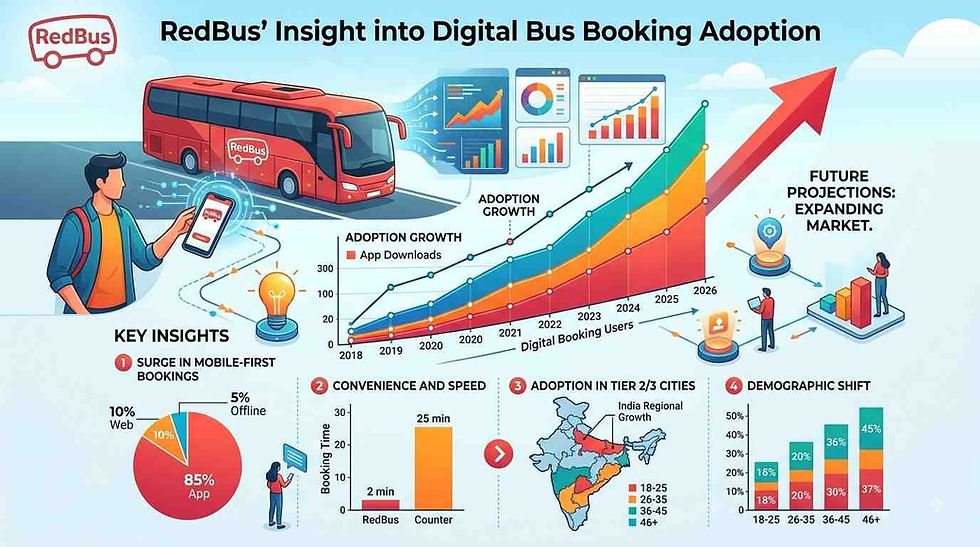
A critical dimension of the consumer insight was geographic. redBus recognised that a significant share of Indian bus travel originated from non-metro locations, including towns and cities that conventional consumer brands typically addressed last. The company's expansion into smaller cities and its onboarding of routes connecting Tier 2 and Tier 3 towns made the platform relevant to a consumer segment that was underserved by existing digital travel products. By the time the company began publishing its own data on travel patterns through the BusTrack Report in 2024, the documented pattern showed that bookings were heavily weighted toward non-metro origin points, consistent with the market structure the founders had observed at the outset.
Media and Channel Strategy
No verified public information is available on the precise media spending allocations, campaign budgets, or agency relationships that governed redBus's marketing expenditure in its formative years. What is documented is the channel architecture that the company deployed and the priorities it set within that architecture.
Search engine marketing and search engine optimisation were documented as central pillars of the customer acquisition strategy. The growing volume of online search queries around bus travel keywords made search a high-intent and relatively cost-efficient channel for a category that was being built rather than contested. redBus prioritised digital advertising through social and search platforms as the primary mechanism for brand awareness and direct acquisition, consistent with the logic that digital-native consumers searching for bus travel options were already in the consideration phase.
Partnership marketing was deployed as a secondary channel. Integrations with digital payment providers extended the platform's reach into transactional ecosystems where consumers were already active. The call centre infrastructure served as a hybrid channel that bridged the gap between consumers who were aware of online booking but insufficiently confident to transact independently and those who completed bookings entirely through the digital interface.
Mainstream media campaigns, including festival-period advertising tied to peak travel seasons, were used to reinforce brand presence at moments of high consumer intent. The documented use of celebrity endorsement, specifically the onboarding of Allu Arjun as a brand ambassador, targeted both the Hindi-speaking market and the South Indian market, which represented a geographic stronghold for the platform given its Bangalore origins and the density of operator networks in southern states.
Business and Brand Outcomes
The business outcomes documented through public sources reflect a trajectory of sustained market leadership within the category that redBus created. By 2018, the company had achieved a gross merchandise value of fifty billion rupees in the Indian online bus ticketing segment and commanded a seventy percent share of that segment. This figure was reported by The Hindu BusinessLine. In 2019, the company's revenue was reported at eighty-five million US dollars.
The acquisition of redBus by the Ibibo Group in June 2013 for an estimated amount that Business Standard placed at slightly above one hundred million US dollars, with other industry sources placing the figure closer to one hundred and thirty-five million dollars, was a transaction whose precise value was not officially disclosed by either party. The acquisition validated the market position the company had built in seven years of operation.
Following the January 2017 merger of the Ibibo Group into MakeMyTrip, redBus became a business unit within the MakeMyTrip group. Its financial performance since that point can be tracked through MakeMyTrip's publicly available filings with the US Securities and Exchange Commission, where the company reports as a NASDAQ-listed entity. According to MakeMyTrip's earnings press release for full-year FY25, filed in May 2025, the bus ticketing segment generated revenue of one hundred and thirty-one million US dollars in FY25, representing year-on-year growth of approximately thirty-one percent in constant currency terms compared to the one hundred and two million US dollars reported in FY24. The bus ticketing segment had reported ninety-two point seven million US dollars in FY24, itself a significant increase from the preceding year. As of March 31, 2025, MakeMyTrip's platform connected customers with tickets from over five thousand nine hundred and fifty bus operators across India and several international markets, as documented in the company's SEC filing.
The redBus Annual BusTrack Report for FY25, published on the company's official blog in June 2025, reported that an estimated 223.85 million intercity bus journeys were made in India in FY25. The report also noted that India added six thousand four hundred new buses in FY25, generating an additional two hundred and sixty-five thousand daily seats for travellers. November 1, 2025, the day following Diwali, recorded the year's highest single-day ridership at over nine hundred and seventy thousand travellers on the platform. The same report noted seven hundred and sixty electric buses operational in the intercity segment, reflecting the sector's evolving composition. redBus had also expanded its operator relationships to more than five thousand private bus operators and over twenty state-run RTCs, as documented in publicly available coverage.
At the time of the BusTrack Report's publication, redBus was described as the world's largest online bus ticketing platform, with operations in eight countries including India, Singapore, Malaysia, Indonesia, Peru, Colombia, Cambodia, and Vietnam.
Strategic Implications
The redBus case presents a set of strategic lessons that are generalisable beyond the specific context of Indian bus travel, particularly for organisations attempting to create or formalise digital adoption in markets previously governed by informal, fragmented, or entirely offline structures.
The most foundational implication concerns the sequencing of market-creation. redBus did not launch a consumer-facing product and assume that supply would follow demand. It recognised that in a fragmented B2B2C model, supply-side digitisation is a prerequisite for consumer-facing credibility. The BOSS software platform, distributed to overcome operator resistance rather than to generate direct revenue, was an act of category infrastructure investment that made the consumer proposition possible. Organisations entering similarly undigitised markets must invest in supply-side enablement before expecting demand-side adoption to materalise at scale.
The second implication concerns the nature of the trust deficit in newly digital categories. redBus did not position itself on the emotional or aspirational dimensions that consumer brands in adjacent travel categories employed. It positioned on the elimination of uncertainty, because that was the precise barrier between its target consumer and the behaviour change it required. This is a reminder that in markets where digital adoption is not yet normalised, the competitive frame is not other digital platforms but the offline alternative, and the marketing task is therefore trust-building rather than preference-winning.
Third, the case illustrates the strategic value of non-metro market prioritisation as a source of durable competitive advantage. By designing the platform for the intercity traveller in smaller towns rather than exclusively for the metro consumer already comfortable with online transactions, redBus built network density in geographies that competitors were slower to address. The documented weight of non-metro bookings in the platform's eventual traffic composition suggests that this strategic choice compounded over time into a structural barrier.
Fourth, the trajectory from a five-lakh-rupee startup to a category leader acquired at a valuation of over one hundred million US dollars within seven years, followed by integration into India's largest online travel group, reflects the market-design logic of platform economics. Once redBus became the infrastructure through which operators managed their inventory, switching costs for those operators increased significantly. The platform's value to any individual operator rose with each additional operator that joined. This network effect, built through the BOSS software ecosystem rather than through consumer marketing, was the underlying architecture of the company's competitive moat.
Finally, the sustained growth of the bus ticketing segment within MakeMyTrip's disclosed financials, growing from approximately ninety-three million dollars in FY24 to one hundred and thirty-one million dollars in FY25, suggests that digital bus booking adoption in India is still in an expansion phase rather than a mature one. The addition of over six thousand new buses to the intercity fleet in a single fiscal year and the growing integration of state RTCs into the digital booking ecosystem indicate that the market redBus created in 2006 continues to deepen, even two decades after the platform's founding.
Discussion Questions
redBus resolved a classic chicken-and-egg problem in a two-sided marketplace by investing in supply-side software enablement before scaling consumer acquisition. In what other industries facing similar structural fragmentation might this sequencing be applied, and what conditions determine whether supply-side or demand-side investment should come first in a platform launch?
The company's consumer positioning was built on uncertainty elimination rather than aspirational value. How does this approach to positioning differ from the frameworks used in established consumer travel categories, and under what market conditions is a trust-based positioning more durable than an aspirational one?
redBus built its competitive moat through proprietary operator software rather than through marketing spend or pricing strategy. Evaluate the long-term sustainability of a technology-infrastructure moat in a market where well-capitalised competitors such as MakeMyTrip and AbhiBus also operate distribution platforms.
The company's integration into MakeMyTrip following two successive ownership transitions, first to the Ibibo Group and then to MakeMyTrip, retained the redBus brand identity as a distinct unit within a larger portfolio. What criteria should govern the decision to preserve a brand identity versus merge it into an acquiring company's master brand, and what evidence from the redBus case supports the approach that was taken?
The BusTrack Report for FY25 documents that 68 percent of bookings originate from non-metro areas, and India added over six thousand new buses to the intercity fleet in a single year. What are the strategic implications of continued non-metro growth for redBus's product development, operator partnership strategy, and competitive positioning over the next five years?


Comments