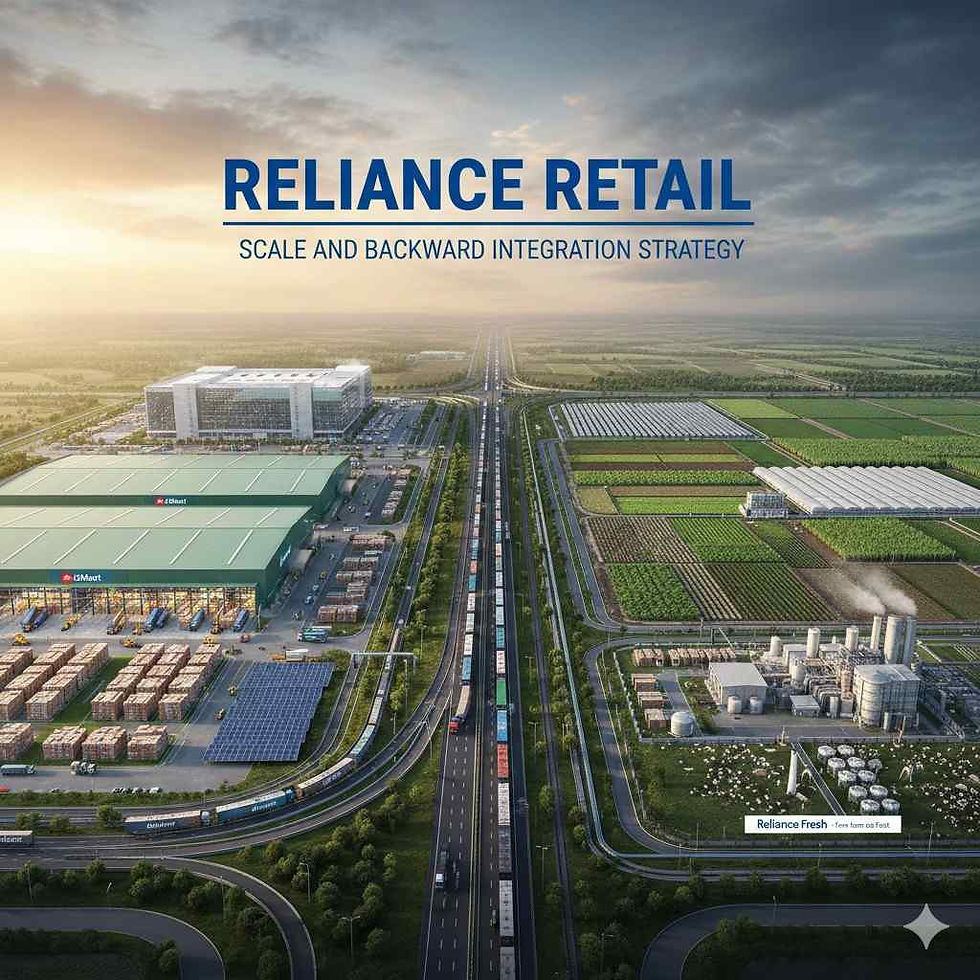
Reliance Retail – Scale and Backward Integration Strategy
Updated: Jan 11
Executive Summary
Reliance Retail Limited, a subsidiary of Reliance Industries Limited (RIL), represents one of India's most significant retail expansion stories. The company operates across multiple formats including grocery, consumer electronics, fashion and lifestyle, connectivity, and digital services. According to Reliance Industries' Annual Report 2023-24, Reliance Retail achieved a revenue of ₹3,00,702 crore ($36.1 billion) and operated 18,836 stores across 8,842 cities as of March 31, 2024. The company's strategy has centered on achieving massive scale while pursuing backward integration across its value chain, though the extent and specifics of backward integration vary significantly by business segment.
Company Background and Evolution
Reliance Retail was incorporated in 2006 as part of Reliance Industries Limited's diversification strategy beyond its core petrochemicals and refining businesses. According to statements by Mukesh Ambani, Chairman and Managing Director of Reliance Industries, in various Annual General Meetings, the retail venture was conceived as a way to transform Indian retail by bringing organized retail formats to a market dominated by traditional trade. The company began operations with a focus on multiple retail formats simultaneously rather than scaling a single format first. According to RIL's Annual Report 2007-08, Reliance Retail launched stores across grocery (Reliance Fresh), consumer electronics (Reliance Digital), and specialty stores in its initial years. By March 2008, the company operated 567 stores across various formats. The growth trajectory accelerated significantly over the following years. As reported in RIL's Annual Report 2015-16, Reliance Retail operated 5,005 stores by March 2016. By March 2020, this had expanded to 11,784 stores according to the Annual Report 2019-20. The COVID-19 pandemic period saw both disruption and acceleration, particularly in digital commerce. The Annual Report 2023-24 indicates the store count reached 18,836 stores.
Scale Strategy: Multi-Format Expansion
Horizontal Expansion Across Formats
Reliance Retail pursued a distinctive strategy of operating across multiple retail formats simultaneously rather than focusing on a single category. According to the Annual Report 2023-24, the company's business is organized into several key segments:
Grocery Retail: Operating under brands including Reliance Fresh, Reliance Smart, and Reliance Market, this segment focuses on fruits, vegetables, staples, and FMCG products. The Annual Report 2023-24 states that grocery retail contributed significantly to the overall store footprint with formats ranging from neighborhood stores to hypermarkets.
Consumer Electronics: Under the Reliance Digital brand, the company operates consumer electronics and durables stores. According to the Annual Report 2023-24, Reliance Digital has established itself as one of India's largest consumer electronics retailers.
Fashion and Lifestyle: This segment includes both owned brands and partnerships with international brands. The Annual Report 2023-24 mentions that Reliance Retail operates fashion stores under brands including Trends, Reliance Jewels, and has partnerships with numerous international fashion brands.
Connectivity: Operating under the Reliance Jio brand in partnership with Jio Platforms, this segment sells mobile devices and services. The Annual Report 2023-24 indicates this segment operates thousands of stores across India.
Digital and New Commerce: According to the Annual Report 2023-24, JioMart represents the company's digital commerce platform integrating online ordering with offline fulfillment capabilities.
Geographic Penetration
The scale strategy involved aggressive geographic expansion. According to RIL's Annual Report 2023-24, Reliance Retail's 18,836 stores operated across 8,842 cities and towns as of March 31, 2024. This represents presence in both metropolitan cities and smaller tier-2 and tier-3 locations, though the specific distribution across city tiers is not publicly disclosed in detail. In an interview with Economic Times in August 2023, Isha Ambani, Director of Reliance Retail, stated that the company aims to reach deeper into semi-urban and rural markets, indicating continued geographic expansion as a strategic priority.
Omnichannel Integration
The company has pursued what it describes as a "new commerce" model integrating physical and digital retail. According to the Annual Report 2023-24, JioMart connects digital ordering with local stores for fulfillment, leveraging the physical store network for last-mile delivery. However, specific operational details about inventory management, order routing systems, or the technology infrastructure enabling this integration have not been publicly disclosed in detail.
Backward Integration Strategy
Sourcing and Supply Chain
Reliance Retail has pursued backward integration in its grocery business through direct sourcing from farmers and producers. According to RIL's Annual Report 2021-22, the company works directly with farmer producer organizations (FPOs) and individual farmers for fruits, vegetables, and staples procurement. In a press release dated September 2020, Reliance Retail announced the acquisition of the retail and wholesale business and the logistics and warehousing business from Future Group for ₹24,713 crore. According to the press release, this acquisition was intended to enhance Reliance Retail's supply chain capabilities and expand its presence in key retail formats including Big Bazaar, FBB, and Easyday. However, this deal faced regulatory and legal challenges, and according to news reports from Reuters and Economic Times in August 2022, the deal was eventually called off after Future Group's assets were acquired by other parties following insolvency proceedings. The Annual Report 2023-24 mentions that Reliance Retail operates warehousing and distribution infrastructure to support its retail operations, but specific details about the number of warehouses, total warehousing capacity, or distribution network specifics are not disclosed in the public reports.
Private Label and Manufacturing
Reliance Retail has developed private label brands across multiple categories. According to the Annual Report 2023-24, the company markets several owned brands across grocery, fashion, and consumer goods, though the specific revenue contribution from private labels versus third-party brands is not publicly disclosed. In the fashion segment, the company has invested in brand acquisitions and manufacturing capabilities. According to news reports from Economic Times in April 2023, Reliance Retail has acquired or invested in several fashion brands including Abraham & Thakore, Ritu Kumar, and Manish Malhotra's label. These investments represent backward integration into design and manufacturing for the fashion segment. The extent of vertical integration in manufacturing varies by category. While Reliance Retail operates some manufacturing facilities for select product categories, the proportion of products manufactured in-house versus sourced from third-party manufacturers is not publicly disclosed in detail.
Technology and Infrastructure
Reliance Retail has benefited from technology infrastructure developed by its parent company and sister concern Jio Platforms. According to statements by Mukesh Ambani in the Annual General Meeting 2020, the integration between Reliance Retail and Jio Platforms enables technology-driven retail operations, digital payment systems, and customer engagement platforms. The Annual Report 2023-24 mentions deployment of technology across store operations, supply chain management, and customer interface, but specific details about the technology stack, proprietary systems, or development capabilities are not disclosed publicly.
Strategic Partnerships and Investments
Reliance Retail has pursued partnerships and minority investments as part of its scale strategy. In September 2020, Reliance Retail Ventures Limited (RRVL), the holding company of Reliance Retail, raised ₹47,265 crore by selling approximately 10.09% equity stake to various investors including Silver Lake, KKR, General Atlantic, TPG, and others, according to press releases issued by Reliance Industries during September-November 2020. These investments valued Reliance Retail Ventures at an equity value of ₹4.587 lakh crore on a fully diluted basis at that time. The company has also formed partnerships with international brands for the fashion and lifestyle segment. According to news reports from Economic Times and Business Standard during 2022-2023, Reliance Retail operates as a franchisee or has partnership arrangements with numerous international brands including Burberry, Jimmy Choo, Tiffany & Co., Pottery Barn, and others, though the specific commercial terms of these partnerships are not publicly disclosed.
Competitive Positioning
Reliance Retail operates in a competitive environment with both organized and traditional unorganized trade. A 2023 RedSeer Consulting report highlights that traditional trade still dominates India's retail market, though organized retail is growing. Key competitors in organized retail include Tata Group's ventures, Future Group (before insolvency), DMart, and e-commerce platforms like Amazon India and Walmart-owned Flipkart. In groceries, DMart focuses on essentials, while Reliance Retail uses a multi-format approach. As of March 31, 2024, DMart had 363 stores, fewer than Reliance Retail, but with a concentrated format. Comparing the two is difficult due to differing business models and disclosure practices. Amazon India and Flipkart are major e-commerce rivals, though they don't disclose detailed India-specific financials. According to 2023 reports from Economic Times and Mint, platforms like Flipkart, Amazon, and JioMart compete fiercely in electronics, fashion, and increasingly in groceries.
Challenges
Operational Complexity
The multi-format strategy, while providing scale and diversification, creates operational complexity in terms of supply chain management, inventory optimization, and format-specific capabilities. The specific challenges faced and how the company addresses them operationally are not detailed in public disclosures.
Capital Intensity
Retail operations, particularly with extensive physical store presence, require significant capital investment. While Reliance Retail has access to capital through its parent company Reliance Industries and has raised external investment, the specific return on capital employed (ROCE) or return on investment (ROI) metrics for different retail formats are not publicly disclosed.
Regulatory Environment
The retail sector in India operates under various regulations including foreign direct investment (FDI) restrictions in certain formats, local sourcing requirements, and state-specific regulations. According to news reports from Reuters and Economic Times during 2020-2023, regulatory challenges affected Reliance Retail's proposed acquisition of Future Group's retail assets, with competition law and creditor rights issues ultimately preventing deal completion.
Technology Integration
While the company emphasizes its omnichannel capabilities and technology integration, specific details about system integration challenges, technology adoption rates among store staff, or the effectiveness of digital-physical integration are not available in public disclosures.
Limitations
Operational Metrics: Reliance Retail does not publicly disclose detailed operational metrics such as same-store sales growth, sales per square foot, inventory turnover ratios, or format-specific profitability. Customer acquisition costs, lifetime value, retention rates, and conversion metrics are not available in public documents.
Business Segment Performance: While the Annual Report 2023-24 provides revenue figures for broad segments (comprising consumer electronics, fashion and lifestyle, grocery, pharma and connectivity), detailed profitability, margin structure, or operational performance by specific format or brand is not disclosed.
Supply Chain Specifics: The extent of backward integration, proportion of products sourced directly versus through intermediaries, warehouse capacity, distribution center locations, and logistics network details are not comprehensively disclosed in public reports.
Technology Infrastructure: Specific details about proprietary technology systems, IT architecture, development capabilities, or technology spending are not available in public disclosures beyond general statements about digital integration.
Competitive Metrics: Detailed market share data by category, regional performance comparisons, or quantitative competitive positioning metrics are not available from company disclosures and third-party market research reports with such detail are not consistently available for the Indian retail sector.
Human Resources: Employee count by function, store staffing models, compensation structure, training programs, or organizational design details are not disclosed in public reports beyond aggregate employee numbers.
Real Estate Strategy: While store count is disclosed, details about real estate ownership versus leasing, lease terms, rental costs, store size distribution, or real estate acquisition strategy are not available in public documents.
The analysis in this case study is therefore limited to information explicitly disclosed in annual reports, investor presentations, press releases, and credible news reports based on executive interviews or company announcements.
Key Lessons
Multi-Format Scale Strategy: Reliance Retail's approach demonstrates pursuit of scale across multiple retail formats simultaneously rather than sequential format expansion. This strategy provided diversification and broad market presence but also created operational complexity. The effectiveness of this approach compared to focused format strategies pursued by competitors like DMart cannot be conclusively assessed without detailed profitability metrics by format.
Leverage of Conglomerate Resources: The company's expansion was facilitated by access to capital, real estate, technology infrastructure, and operational capabilities from parent company Reliance Industries Limited and sister concern Jio Platforms. This conglomerate advantage enabled faster scale-up than might be possible for standalone retail ventures, though the specific cost of capital or transfer pricing for shared resources is not publicly disclosed.
Varying Degrees of Integration: Backward integration strategy appears to vary significantly by business segment. In grocery, direct farmer relationships and supply chain control are emphasized. In fashion, brand acquisitions and partnerships provide integration. In electronics, the business primarily operates as a retailer of third-party brands. This selective integration approach reflects category economics and strategic priorities, though detailed rationale for integration decisions by category is not publicly explained.
Physical-Digital Integration: The company's "new commerce" model attempts to leverage physical store infrastructure for e-commerce fulfillment rather than building parallel online-only operations. This approach potentially provides capital efficiency compared to pure-play e-commerce models, though comparative unit economics are not publicly available to validate this hypothesis.
Execution Challenges in M&A: The failed acquisition of Future Group's retail assets despite a signed agreement demonstrates that even large, well-capitalized companies face regulatory, legal, and creditor challenges in consolidating fragmented retail markets. This highlights execution risk in inorganic growth strategies.
Discussion Questions
Strategic Trade-offs in Multi-Format Retail: Reliance Retail pursued a multi-format strategy across grocery, fashion, electronics, and connectivity simultaneously, while competitors like DMart focused on a single format (grocery/household essentials). Without access to format-specific profitability data, how should students evaluate which approach creates more value? What frameworks from corporate strategy would help analyze whether diversification across retail formats creates or destroys value? Consider concepts such as economies of scope, resource sharing, and organizational complexity.
Backward Integration Justification and Limits: The case describes varying degrees of backward integration across Reliance Retail's business segments – from direct farmer sourcing in grocery to brand partnerships in fashion to third-party product retailing in electronics. Using transaction cost economics and value chain analysis frameworks, what factors should determine optimal integration decisions in retail? How would you assess whether Reliance Retail's integration choices are appropriate given the limited public information about procurement costs, supplier relationships, and vertical integration benefits?
Conglomerate Advantage vs. Standalone Efficiency: Reliance Retail benefits from being part of Reliance Industries conglomerate, with access to capital, technology from Jio Platforms, potential real estate advantages, and shared infrastructure. However, this structure might also create inefficiencies through complex governance, transfer pricing questions, and potential subsidization of underperforming segments. How should investors or analysts evaluate whether conglomerate structure creates or destroys value in retail when detailed segment economics and inter-company arrangements are not publicly disclosed?


Comments