Tata Neu: Building an Integrated Loyalty and Commerce Platform
Industry & Competitive Context
Tata Neu entered a market where large platforms were already pursuing the "super app" ambition. Launch coverage said Tata was taking on Walmart-owned Flipkart, Amazon and Reliance's Jio Platforms. Other reporting noted that Amazon, Paytm and Reliance Jio had already built super apps and that JioMart was preparing to follow. RedSeer projected India's consumer digital economy at US$800 billion by 2030, with online retail as the largest component. The category's reference models were China's Alibaba and Tencent, and Tata executives acknowledged at launch that no super-app model had yet made wide inroads in India.
Loyalty was a second arena. A 2025 ResearchAndMarkets report lists Payback India, Tata Neu, Flipkart Plus and Amazon Prime among the programmes shaping India's loyalty market, and notes that payment apps such as Paytm and PhonePe run their own reward systems [24].
Analysis. The competitive set spanned three overlapping layers: commerce marketplaces, payments apps and loyalty currencies. Tata's documented answer was not a messaging or social layer, which Tata Digital's president said a super app does not require. It was a portfolio of existing category brands bound by one rewards programme.
Brand Situation Prior to Launch
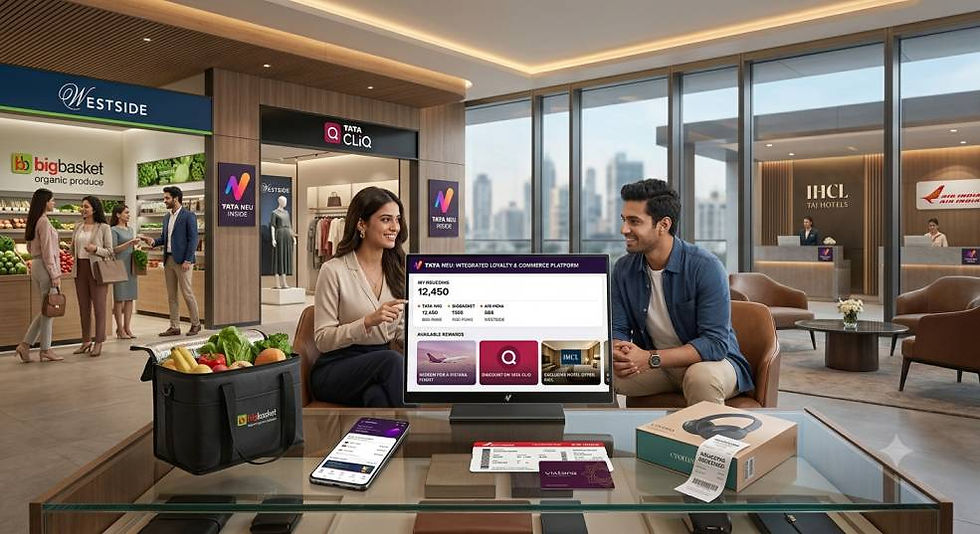
Tata Digital was set up in 2019 as a wholly owned subsidiary of Tata Sons to build consumer and business digital offerings. YourStory reported that chairman N Chandrasekaran first disclosed super-app plans that year. In 2021 Tata Digital took stakes in three startups, including BigBasket and 1mg, and acquired 55% of 1mg in June 2021. At launch the app listed AirAsia India, BigBasket, Croma, IHCL, Qmin, Starbucks, Tata 1mg, Tata CLiQ, Tata Play and Westside. Tata Digital's CEO described a cumulative consumer base of 120 million users, 2,500 offline stores and an 80 million app footprint across the group's digital assets.
These businesses ran separate loyalty offerings, which Tata intended to merge into NeuCoins. The app reached the public after several months of employee testing. On the parent-brand side, Tata replaced VIVO as IPL title sponsor for 2022. WARC reported that observers were divided on the benefit to a conglomerate, while noting that Tata had been acquiring more consumer-facing businesses.
Analysis. The starting position was asset-rich but interface-poor: established brands with their own customers but no shared identity, currency or login.
Strategic Objective
The chairman framed the aim as bringing the group's businesses together into a unified platform with an omnichannel experience, built around choice, seamlessness and loyalty and delivering a "One Tata experience". The company described the product as a blend of product commerce, service commerce and financial services. Operationally, the objective included consolidating the businesses' separate loyalty programmes into NeuCoins.
Targets were reported rather than formally published. Inc42, citing a media report, said Tata Digital targeted US$2–2.5 billion in sales in the app's first year and an internal US$200 million gross sales figure for the first month. Tata Digital's CEO said the aim was to become a profitable business. On scope, the chairman said the platform's evolution would be "customer-driven, not contract driven" and would eventually include non-Tata brands. Tata Digital's CEO later said non-Tata brands would be added only in categories where the group lacks a significant presence.
The objective was restated in the FY26 shareholder letter. The chairman described a decisive shift to refocus Tata Neu on financial services and loyalty, with plans to raise payments monthly transacting users tenfold and to expand across lending and insurance.
Analysis. The 2022 objective had three legs: unify brands, run a common loyalty currency, and add financial services. The 2026 statement keeps the second and third and drops breadth of commerce as the organising idea.
Campaign Architecture & Execution
Product architecture. NeuCoins are worth ₹1 each and can be earned in any category and spent in any category. NeuPass members earn 5% in NeuCoins or more on shopping, dining and travel through the app, and the programme lists free deliveries, exclusive offers, a built-in credit line and early access to launches among its benefits. NeuCoins can also be used in-store. The app launched with Tata Pay, a UPI-enabled payments service that also offers loans and insurance, and with an in-house digital magazine called Stories [6]. It was offered on Android, iOS and the web.
In 2022 Tata Neu partnered with HDFC Bank on two co-branded credit cards, on RuPay and Visa networks. At launch the Plus variant earned 2% and the Infinity variant 5% in NeuCoins on partner Tata brands, with 1% and 1.5% respectively elsewhere. Card rewards stacked with the app's 5% for a combined 7% or 10% on Tata Neu purchases.
Launch communications. The app went live at 7:30 PM on 7 April 2022 during an IPL match. Tata was IPL title sponsor for the 2022 and 2023 seasons, and the group described the tournament as an effective launch pad for Tata Neu. Exchange4media reported that Tata Neu used TV commercials in the tournament's first week and then a set of broadcast integrations. These included a daily "Playing 11" segment after the toss and a "Tata Neu Challenge" in which Star Sports experts explored the app. The stated objectives were brand awareness, downloads and app exploration.
In 2024, with Tata Neu as an associate partner of the Tata IPL, the brand ran the #RuknaKyun campaign. It used short videos with content creators, who were interrupted mid-production and then paused, under the line "Why stop?".
Analysis. The design links a mass-reach launch property to a membership and currency, and then extends the currency beyond the app through a co-branded card. The loyalty mechanic is the constant across the 2022 launch, the 2022 card and the 2026 refocus.
Positioning & Consumer Insight
The documented launch positioning is a unified, trusted group experience: choice, seamlessness and loyalty. At the launch conference, Tata Digital's president said NeuPass and trust in the Tata name were what made Tata Neu a super app, even without a messaging layer. He also said Tata Neu's average revenue per user during testing was three to four times that of comparable offerings; the comparator and measurement basis were not specified in the source.
By 2024 the communication had moved from the functional promise of one app to an occasion-based one. #RuknaKyun tied shopping to celebrating the IPL season, and Campaign India judged the creator-led videos effective at building brand stickiness in a cluttered environment. That is the publication's assessment, not a company-reported outcome.
Analysis. The constant in the documented positioning is a reward on everyday spending, with the Tata name as the reason to trust the system. The launch message sold the integrated ecosystem. The later message sold the occasion, and the later strategy sold financial services.
Media & Channel Strategy
Verified channels. They were: IPL television and broadcast integrations; creator-led digital video in 2024; owned channels, namely the app, the web version and the Stories magazine; Tata's offline footprint, with 2,500 stores cited at launch and in-store NeuCoin use; and HDFC Bank as card-issuing partner, with cards applied for through the app.
Early response, as reported. Exchange4media reported 2.2 million downloads and 2.1 million enrolments in the first week. TechCrunch reported 2.2 million downloads in the first four days, citing Tata Digital's CEO. Inc42 reported that the CEO cited about 7 million downloads at seven weeks, and separately that App Annie data put April–May downloads above 11 million. These figures use different windows and sources and cannot be reconciled from public material.
Business & Brand Outcomes
Early months. Inc42, summarising a media report, said gross sales in the first month were US$120–150 million against the US$200 million internal target, and that initial user feedback cited technical glitches and a poor shopping experience. The sources reviewed contain no official Tata confirmation of these figures.
FY24. According to Tata Sons' annual report as reported by Business Standard, Tata Digital's loss narrowed to ₹1,200.82 crore from ₹1,370.09 crore, and its revenue more than doubled to ₹420.51 crore. The report gave GMV of ₹37,355 crore and 20.76 million transacting customers, 1.18 million co-branded credit cards and a NeuPass base of 116.4 million members. Business Standard noted that the new CEO, appointed in February 2024, had tightened the cost structure.
Co-branded card. By March 2025 the Tata Neu HDFC Bank card had passed two million issuances, and the issuer's statement said it accounted for over 13% of net new credit cards issued in Q3 FY25 per RBI data. The card ran at over 12 million transactions and over ₹800 crore of UPI spend a month, with grocery, fuel and utilities making up nearly 30% of spending.
FY25. Tata Digital's loss rose 9.5% to ₹4,609.9 crore. Outlook Business, citing the Economic Times, reported that Tata Sons infused ₹4,000 crore into Tata Digital during the year and that the e-commerce unit's cumulative losses stood at ₹16,958.3 crore.
FY26. Per Tata Sons' annual report as reported by Inc42, Tata Digital's revenue rose 11.9% to ₹35,990 crore from ₹32,188 crore and its loss widened to ₹4,974 crore from ₹4,610 crore. GMV reached ₹46,515 crore within four years of launch. BigBasket accounted for nearly 64% of the loss, and Tata Sons' direct investment in Tata Digital stood at ₹22,903 crore at March 2026. The chairman attributed part of the difficulty to the market's rapid shift toward quick commerce, to which BigBasket is adapting, and called the Tata Neu card one of India's largest co-branded cards.
Basis caution. Outlets label Tata Digital's figures inconsistently. Business Standard describes ₹37,355 crore as FY24 GMV, while Inc42 uses the same figure as the FY24 consolidated operating revenue comparator in its FY25 coverage. This case therefore draws no year-on-year conclusion where the basis is unclear.
Strategic Implications
Analysis. First, the loyalty currency proved to be the retained asset. Of the three 2022 pillars, the documented milestones that survive into the FY26 narrative are loyalty and financial services: a NeuPass base of 116.4 million, a card past two million issuances and a stated priority on payments, lending and insurance. Breadth of commerce is no longer the organising idea.
Second, the unit of analysis is a measurement problem. Tata Neu is a shared layer on top of capital-intensive operating businesses. The loss disclosed for FY26 sits largely in a constituent, BigBasket, and no Neu-level financials are public. For a marketer, this means the platform's contribution to portfolio economics cannot be isolated from outside the company, and the documented success metrics (downloads, members, cards) are volume measures rather than engagement or profitability measures.
Third, the strategy depended on patient capital. Tata Sons' direct investment of ₹22,903 crore, and a ₹4,000 crore infusion in FY25 alone, show a funding model few standalone platforms could replicate. The record does not show whether results would have differed under other spending patterns, and no source establishes why the refocus occurred beyond the chairman's own statement.
Fourth, early success metrics and later ones diverge. The launch was reported through downloads and enrolments, while later disclosures moved to members, transacting customers, cards and GMV. Active-user and retention data have not been published. The FY26 target to multiply payments monthly transacting users tenfold cannot be evaluated because no baseline is public.
Fifth, a high earn rate is a commitment that scales with usage. The launch card terms stacked up to 10% in NeuCoins on Tata Neu purchases. Whether and how that was funded is not disclosed.
Discussion Questions
Tata launched as a broad super app and, per the FY26 letter, later refocused on financial services and loyalty. Using only the documented evidence, would a loyalty-and-payments-first launch have been the better sequencing? What would you need to know to decide?
The public record includes downloads, enrolments, NeuPass members, transacting customers and card issuances, but no active-user, retention or redemption data. Design a measurement framework for an integrated loyalty platform, and identify which undisclosed metrics would change your conclusions.
Evaluate IPL title sponsorship as a launch vehicle for Tata Neu. What does the documented evidence say about reach versus durable engagement, and what evidence is missing?
The co-branded card extends NeuCoins beyond the app and had passed two million issuances by March 2025. How does it change the role and economics of the loyalty currency, and what risks come with stacked earn rates of up to 10% when the liability cost is undisclosed?
BigBasket accounted for nearly 64% of Tata Digital's FY26 loss while Tata Neu is the shared customer layer. How should a conglomerate judge a platform separately from the operating businesses it fronts, and how should capital be allocated between them?


Comments