The Growth of Social Commerce in India: From Browsing to Buying
Industry & Competitive Context
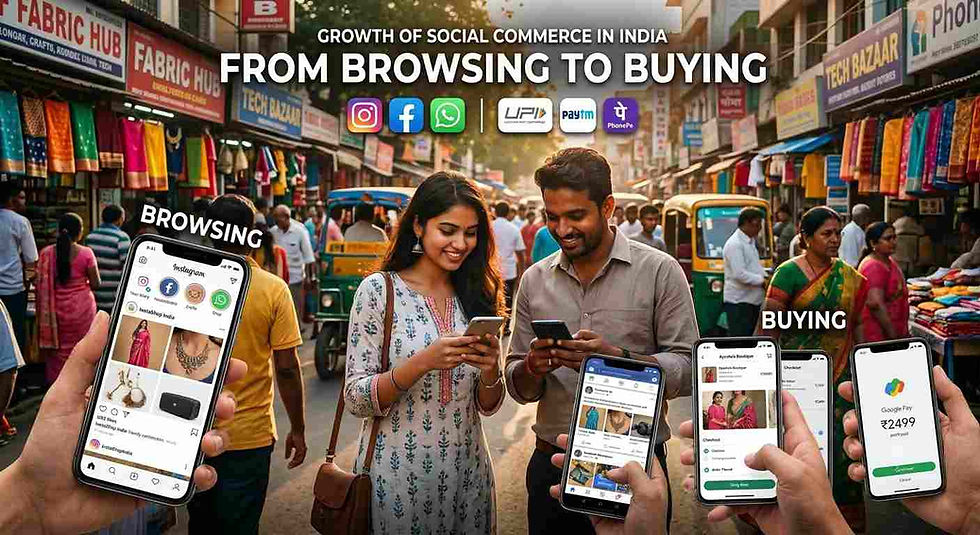
India's social commerce story began with a widely cited projection rather than a proven market. In December 2020, Bain & Company and Sequoia Capital India published The Future of Commerce in India – the rise of social commerce, which sized the category at USD 1.5–2 billion in gross merchandise value and projected USD 16–20 billion within five years and USD 60–70 billion by 2030. The report's structural argument mattered more than its number: India's e-commerce sector was roughly USD 30 billion in FY2020, only about 8 percent of Indians (approximately 105 million people) shopped online, and average annual online spend was about USD 286, far below comparable markets. Meanwhile, digitally connected Indians were spending around three hours a day online, of which more than two hours went to messaging, social networking and video. The arbitrage was obvious. Attention had already migrated to social surfaces; transactions had not.
That gap attracted capital across several distinct models. Reseller networks such as Meesho, GlowRoad and Shop101 recruited individuals, largely women, to sell catalogues onward through WhatsApp and Facebook. Group-buying and community-led models such as DealShare and CityMall aggregated demand at the neighbourhood level. Video and live-selling platforms such as Simsim, Bulbul and Trell attempted to replicate the entertainment-led discovery of Chinese and Southeast Asian markets. Incumbents responded quickly. Flipkart launched Shopsy in July 2021 as a reseller app, subsequently repositioning it as a zero-commission marketplace; by December 2022 it reported around 1.1 million sellers with 68 percent of customers from Tier-2 cities, and in February 2023 Flipkart stated that Shopsy accounted for 40 percent of its new customers. Amazon acquired GlowRoad in an all-cash transaction in April 2022, with financial terms undisclosed.
The shakeout was faster than the forecasts. Wooplr shut down in 2019. Shop101 and GlowRoad exited through acquisition. YouTube, having acquired Simsim, shut the app down in March 2023. Trell moved away from its original model. The conclusion an analyst should draw is not that the thesis was wrong but that it was misspecified. Social commerce in India did not emerge as a standalone category owned by standalone companies. It emerged as a discovery and trust layer that was absorbed into the operating model of scaled marketplaces. Meesho, the category's most prominent name, is the clearest illustration of that absorption.
No verified public information is available on the aggregate revenue, GMV or profitability of India's social commerce category as a defined segment; published market-size estimates originate from different consultancies using undisclosed methodologies and differ materially from one another.
Brand Situation Prior to the Strategic Shift
Meesho was founded in 2015 in Bengaluru by Vidit Aatrey and Sanjeev Barnwal. It began life as Fashnear, an on-demand local delivery concept, before being rebuilt around a reseller model in which individuals created stores from a retailer's catalogue and distributed them through Facebook and WhatsApp, with payment links handled through third-party apps. The company's early positioning was explicitly social: the platform's value lay in the interpersonal trust between a reseller and her contacts, which substituted for the brand trust that unbranded, long-tail merchandise could not supply on its own.
By April 2022, that positioning had already shifted. Meesho publicly stated that approximately 75 percent of its business came directly from consumers on its own platform, with 25 percent from resellers. The reseller layer had functioned as a customer acquisition and trust-transfer mechanism, and once users were comfortable transacting, they came directly. This is a critical detail for the case: the social layer worked, but it worked as an onboarding device rather than as a durable transaction channel.
The financial situation entering the strategic shift was constrained but improving. For FY2024, Meesho reported operating revenue of ₹7,615 crore, up 33 percent, with adjusted losses down 97 percent to ₹53 crore and positive operating cash flow of ₹232 crore. It reported 145 million unique annual transacting users and stated that 45 percent of customers came from Tier-4 cities and beyond. Its FY24 annual report disclosed roughly 400,000 transacting sellers, around 110 million daily active listings, and approximately 17,000 content creators on the platform. In other words, the company had scale, affordability and cash discipline, but its content and creator ecosystem was still a rounding error relative to its user base.
No verified public information is available on Meesho's customer acquisition cost, lifetime value, retention cohorts or conversion rates, as these have not been disclosed in its filings or public statements.
Strategic Objective
The strategic problem Meesho faced was not acquisition but engagement economics. A marketplace serving value-conscious consumers with an average order value in the region of ₹265 cannot fund growth through discounting, and it cannot easily raise basket size without abandoning its positioning. The only remaining lever is frequency, and frequency in a low-ticket category is a function of how often a user opens the app without a specific purchase intent.
The objective, as expressed through the company's disclosed initiatives, was therefore to convert a transactional utility into a discovery habit. Meesho's stated design philosophy supports this reading: its filings describe a hyper-personalised, infinite-scrolling feed built from browsing and transaction history, intended to promote discovery-led shopping rather than search-led shopping. The creator layer was the content supply required to make that feed worth scrolling. Reported order frequency moved from 7.5 times a year in FY23 to 9.4 times in FY25, which is the metric this strategy is designed to move.
Campaign Architecture & Execution
In February 2025, Meesho launched a creator marketplace platform, stating it was working with around 21,000 influencers and that over 14 million people who bought on the app in the preceding year had been influencer-driven. The company said the initiative had produced a threefold increase in order volume and close to tenfold growth in categories including women's western wear, jewellery, footwear, home décor and furnishing, kidswear and toys, and beauty and personal care. It followed with Creator Club, an in-house affiliate programme, alongside video-led discovery and live selling formats within the app.
The architecture has three components that are worth separating analytically. First, supply of creators, addressed through simplified onboarding and affiliate mechanics that pay commission on attributable sales rather than flat fees. Second, supply of merchants capable of producing content-ready catalogues; annual transacting sellers grew 81 percent year-on-year to 1.04 million in Q1 FY27, with sellers from Tier-2 cities and beyond forming 45 percent of the base and Tier-4 seller numbers rising 125 percent. Third, an attribution and ranking layer, which the company attributes to AI-enabled creator tooling that surfaces content performance and optimisation signals.
The execution choice that distinguishes this from conventional influencer marketing is that the content lives inside the transaction environment rather than outside it. There is no hand-off from a social platform to a marketplace. The creator, the content, the catalogue, the payment and the attribution all sit within one property, which is precisely the structural weakness that independent social commerce startups could never resolve.
Meesho also acquired Kirana Club and took a minority stake in Retail Pulse Labs for ₹202.08 crore, disclosed in its Q1 FY27 filings.
No verified public information is available on Meesho's commission structures by creator tier, its creator payout pool, or its marketing spend allocation between creator commerce and other channels.
Positioning & Consumer Insight
The consumer insight underpinning Indian social commerce was articulated in the Bain–Sequoia work: almost half of consumers do not know what they are looking for and are not loyal to specific brands, recommendations from friends and relatives drive action, and unstructured long-tail categories dominate the landscape. This is the inverse of the search-and-compare assumption on which Western e-commerce interfaces were built. Where intent is low and brand heuristics are absent, a search box is a poor interface and a feed is a good one.
BCG's 2025 report From Content to Commerce: Mapping India's Creator Economy quantified the scale of that influence. It identified 2 to 2.5 million active digital creators, defined as individuals with more than 1,000 followers, influencing an estimated USD 350–400 billion in annual consumer spending, with direct ecosystem revenues of USD 20–25 billion projected to reach USD 100–125 billion by 2030. It found creators influencing more than 30 percent of consumer decisions and reported that over 60 percent of consumers in Tier-2 and Tier-3 towns said creator content shaped their purchase decisions. Critically, it noted that only 8 to 10 percent of creators monetise effectively and that around 90 percent of creator revenue remains brand-funded advertising rather than commerce.
That last finding defines the strategic opening. Influence in India is abundant; monetisation of influence is scarce. Meesho's positioning does not compete for a share of brand advertising budgets. It converts unmonetised regional creators into a performance-compensated distribution network, which is a supply-side arbitrage rather than a media buy.
The positioning trade-off is visible in the numbers. Average order value declined from ₹274.18 in H1 FY25 to ₹265.50 in H1 FY26 and stood at ₹262.80 in Q1 FY27. The affordability position is being defended, not upgraded, and growth is coming from users and frequency rather than basket value.
Media & Channel Strategy
Three verified channel developments frame the environment in which this strategy operates.
Messaging remains the dominant commerce surface. On Meta's Q3 2023 earnings call, Mark Zuckerberg stated that more than 60 percent of people on WhatsApp in India message a business account every week and that revenue from click-to-message ads in India had doubled year-on-year. WhatsApp launched end-to-end in-app shopping in India with JioMart, allowing browsing and payment without leaving the app, and has expanded in-chat payments in India working with partners including Razorpay and PayU. Meta's India leadership has publicly described WhatsApp and business messaging as the next engine of growth in the market.
Video-led affiliate infrastructure arrived in October 2024, when YouTube launched its Shopping affiliate programme in India in partnership with Flipkart and Myntra, allowing eligible creators with at least 10,000 subscribers to tag products in videos, Shorts and livestreams and earn on purchases made on the retailers' sites.
Owned-surface content commerce is where Meesho concentrated. Its disclosed Content Commerce results show NMV growing 141 percent year-on-year in Q1 FY27, with active order-generating content pieces up 143 percent to 1.7 million. At the time of its IPO, the company reported more than 50,000 active content creators over the trailing twelve months, against approximately 17,000 in FY24.
On sizing the broader influencer market, published estimates conflict and should be treated with care. EY, with Collective Artists Network's Big Bang Social, projected India's influencer marketing sector at ₹2,344 crore in 2024 and ₹3,375 crore by 2026 at an 18 percent CAGR. Other published estimates for comparable periods are materially higher. No single verified, methodologically disclosed figure for the size of India's influencer marketing market is publicly available.
Business & Brand Outcomes
Meesho's disclosed results provide the documented outcomes.
For FY25, the company reported operating revenue of ₹9,389.9 crore against ₹7,615.1 crore in FY24; NMV of ₹29,988 crore, up 29 percent; 1.8 billion orders placed, up 37 percent; nearly 199 million annual transacting users; over 500,000 sellers; and order frequency of 9.4 times a year. Contribution margin reached ₹1,483.6 crore, or 4.95 percent of NMV, against 2.94 percent in FY23. Loss before tax and exceptional items narrowed to ₹108 crore from ₹1,672 crore in FY23, while the reported net loss was ₹3,941.7 crore, driven by one-time exceptional items including reverse-flip and perquisite taxes associated with redomiciling to India. The company reported no outstanding borrowings as of 31 March 2025 and free cash flow of ₹1,032 crore including interest income. Average time for a new seller to receive a first order fell from 32 days in FY23 to 16 days in FY25.
For H1 FY26, operating revenue rose 29 percent to ₹5,577.5 crore, NMV rose 44 percent to ₹19,194 crore, annual transacting users reached 234.2 million against 175.1 million, orders rose to 1,261 million from 825 million, and net loss narrowed 72 percent to ₹700.7 crore.
Meesho listed on 10 December 2025, raising approximately USD 606 million at a price band of ₹105–111, with trailing-twelve-month metrics of 234.2 million transacting users, 706,471 annual sellers and more than 50,000 active content creators.
For Q1 FY27, the quarter ended June 2026, revenue from operations rose 48.28 percent year-on-year to ₹3,712.81 crore, net loss narrowed 54 percent to ₹132.84 crore, NMV grew 34 percent to ₹11,614 crore, annual transacting users reached approximately 274 million, annual transacting sellers reached 1.04 million, and 725 million orders were placed, up 29 percent. Cost per delivered order fell by roughly ₹1 sequentially despite fuel and wage increases.
No verified public information is available on the incremental contribution of content commerce to Meesho's overall profitability, or on the unit economics of its creator affiliate programme.
Strategic Implications
Four implications follow from the documented record.
Social commerce in India became a feature, not a sector. Every independent pure-play either exited, pivoted or was absorbed. The economics of discovery are inseparable from the economics of fulfilment, returns and payments, and a company that owns only the first cannot capture enough of the value chain to survive. Strategy students should note that the Bain–Sequoia thesis about consumer behaviour proved broadly directionally sound while the accompanying assumption about industry structure did not.
The reseller was a trust bridge with a finite life. Meesho's own disclosure that three-quarters of business was direct within a few years shows that the social intermediary's function was to move a first-time user across the trust threshold. Once crossed, the intermediary's margin becomes a cost. Any business model built on a permanent intermediary in a market with rapidly rising digital confidence should be stress-tested against this pattern.
Creator commerce is a supply-side arbitrage, not a media strategy. With 2 to 2.5 million creators and only 8 to 10 percent monetising effectively, the binding constraint is monetisation infrastructure, not influence. A platform that supplies attribution, catalogue and payout to an under-monetised creator base acquires distribution at performance-linked cost. This is structurally different from buying influencer campaigns at fixed fees, and it is why the initiative scaled inside a marketplace rather than inside an agency.
Frequency is the only lever available at low average order value. With average order value drifting down and defended deliberately, growth must come from users and order frequency. Content is the mechanism that generates unplanned sessions. The verified movement in order frequency and in content-attributable NMV is consistent with this, though the profit contribution remains undisclosed and the company remains loss-making.
Discussion Questions
Meesho's reseller base declined in strategic importance even as the company scaled. Was the reseller model a genuine competitive advantage or a transitional customer acquisition subsidy? How would you distinguish between the two in advance rather than in hindsight?
Independent social commerce ventures in India consistently failed while the same behavioural thesis succeeded inside scaled marketplaces. Which specific elements of the value chain must a firm control for a discovery-led model to be defensible, and under what conditions could a pure-play still win?
Meesho's average order value has declined across recent reporting periods while frequency has risen. Evaluate the sustainability of a growth model that deliberately resists basket-size expansion. What would cause you to conclude that the affordability position has become a ceiling rather than a moat?
BCG's finding that roughly 90 percent of creator revenue remains brand-funded suggests commerce-linked monetisation is early. Assess whether platform-owned affiliate programmes such as Meesho's Creator Club or YouTube's Shopping affiliate programme are more likely to expand the creator economy or to compress creator earnings through performance-based pricing.
Meta's disclosures indicate that messaging is the dominant commerce surface in India, yet the largest documented content-commerce outcomes occurred inside a marketplace app. Where should a consumer brand with limited budget concentrate: on owned messaging channels, on third-party creator affiliate programmes, or on marketplace-native content? Justify your allocation using only publicly verifiable evidence.


Comments