The Rise of AI Marketing Teams: Will AI Replace Traditional Marketing Roles?
- 1 day ago
- 12 min read
INDUSTRY AND COMPETITIVE CONTEXT
The global marketing function has entered a period of structural disruption unlike anything it has experienced since the commercialization of the internet. The trigger is generative artificial intelligence, a class of technology capable of producing original text, imagery, and strategic recommendations at a scale and speed that fundamentally challenges the labor economics of traditional marketing departments. Unlike earlier waves of digital automation that targeted repetitive operational tasks, generative AI is penetrating knowledge-intensive creative and analytical roles that were once considered immune to automation. This shift has placed marketing at the center of one of the most consequential workforce debates in contemporary business.
The scale of the commercial opportunity is substantial. McKinsey's June 2023 landmark report, "The Economic Potential of Generative AI: The Next Productivity Frontier," estimated that generative AI could add the equivalent of $2.6 trillion to $4.4 trillion annually across 63 identified use cases. For context, the United Kingdom's entire GDP in 2021 stood at $3.1 trillion. The same analysis identified marketing and sales, customer operations, and software development as the three functions with the potential to deliver approximately 75 percent of the total annual value from generative AI use cases. This finding positioned marketing not merely as a beneficiary of AI, but as one of its primary proving grounds.
The competitive dynamics within the marketing services industry have accelerated this shift further. France's Publicis Groupe overtook WPP as the world's largest advertising group, a displacement that coincided directly with Publicis making AI infrastructure central to its operating model from as early as 2017. The contrast between the two groups' AI strategies offers one of the most instructive documented case studies in how AI orientation is reshaping competitive standing in the marketing industry.
THE PRE-AI MARKETING LANDSCAPE
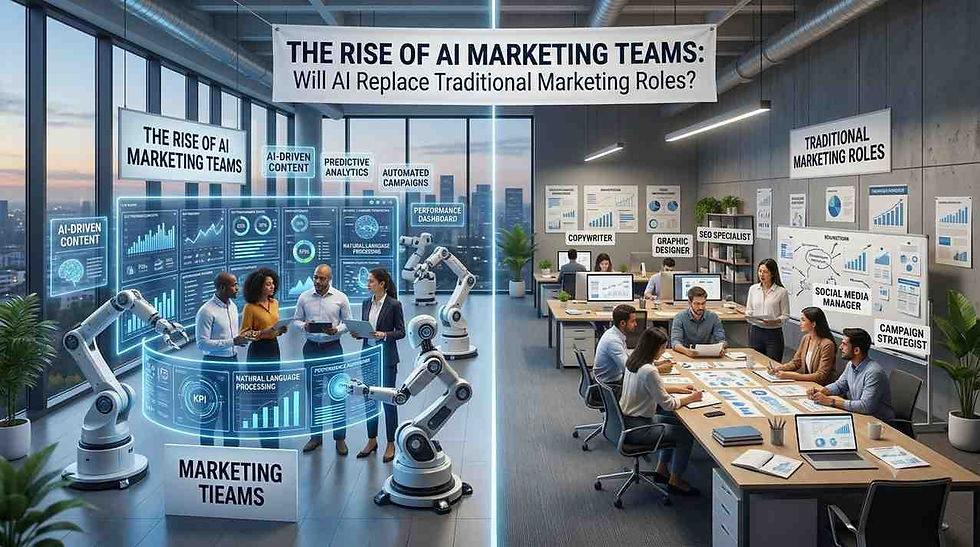
Before the generative AI era, marketing organizations relied on distinct functional layers, each employing specialized human talent. Creative teams developed brand narratives and campaign concepts. Media planners and buyers managed channel strategy and budget allocation across fragmented digital and traditional environments. Data analysts interpreted campaign performance and customer behavior. Copywriters, graphic designers, social media managers, and SEO specialists each occupied defined professional lanes. These roles were supported by large agency networks billing clients on the basis of headcount and hours, a model built on labor intensity as a commercial feature rather than a limitation.
This structure was already under pressure from platform-led automation in media buying. Programmatic advertising had largely displaced manual media placement decisions through real-time bidding systems run by Google, Meta, and Amazon. What remained largely human was the creative, strategic, and insights-generation work. Generative AI changed that calculus significantly by demonstrating the capacity to produce viable creative outputs, analyze data at scale, and synthesize strategic recommendations in seconds rather than weeks.
The World Economic Forum's Future of Jobs Report 2023, which analyzed 673 million jobs across 45 economies, projected that approximately 23 percent of all jobs globally would change within five years. Notably, it forecast growth of approximately 4 million digitally-enabled roles including Digital Marketing and Strategy Specialists, even as traditional administrative and operational roles declined. This finding introduced an important nuance into the AI and marketing jobs debate: the transition is not uniformly destructive. It is, however, uneven, and its consequences are distributed in ways that marketing leadership teams are only beginning to fully understand.
STRATEGIC OBJECTIVES DRIVING AI INTEGRATION
Organizations integrating AI into their marketing operations are pursuing several distinct but related strategic objectives, each of which has been documented through official corporate communications and published industry research.
The first and most immediate objective is operational efficiency. Marketing departments are under sustained pressure to do more with constrained budgets, a reality made more acute by the cost-of-living pressures that reduced advertising investment across multiple categories in 2022 and 2023. AI-powered content generation, campaign planning, and performance analysis tools allow smaller teams to operate at the output scale previously associated with much larger ones. McKinsey's 2023 global survey on AI found that 40 percent of organizations reporting AI adoption expected to increase overall AI investment because of generative AI, with marketing and sales identified as the most common business function deploying these newer tools.
The second objective is personalization at scale. The gap between marketers' aspirations for one-to-one customer engagement and their actual execution capability has been a persistent source of commercial underperformance. Salesforce's ninth-edition State of Marketing report, based on insights from nearly 5,000 marketers worldwide, found that while over half of marketers had access to real-time data, they consistently lacked the technical capability to activate it meaningfully. Generative AI tools are now being positioned as the bridge between data availability and data activation, enabling content variation, audience segmentation, and dynamic messaging at a scale no human team could achieve manually.
The third objective, most acutely felt by agency groups and enterprise marketing organizations, is competitive repositioning. As AI lowers the cost of content production and strategic analysis, organizations that rely on premium pricing for creative labor are under structural threat. The documented response across the industry has been to reframe AI not as a replacement for human creativity, but as an augmentation that increases the strategic leverage of human insight. The degree to which this reframing reflects genuine strategic evolution versus defensive messaging is a question that the evidence is only now beginning to resolve.
ARCHITECTURE OF AI-DRIVEN MARKETING OPERATIONS
The emerging architecture of AI-driven marketing teams is not a single model but a spectrum of organizational configurations, each reflecting a different philosophy about the appropriate boundary between machine and human capability.
At the most elementary level, organizations are deploying standalone generative AI tools for discrete tasks: copywriting assistants for digital ad copy, AI image generators for visual content, and natural language analytics platforms that translate campaign data into plain-English summaries for non-technical stakeholders. These deployments typically sit alongside existing human workflows without fundamentally restructuring them.
At a more advanced level, organizations are building integrated AI systems that connect content generation, audience data, media deployment, and performance measurement into a unified operational loop. In this configuration, AI does not merely assist individual tasks; it orchestrates the relationship between tasks, collapsing what was previously a multi-step, multi-team workflow into a more compressed cycle managed by fewer people with different skills. This model represents a more significant structural challenge to traditional marketing roles because it eliminates coordination overhead rather than simply automating individual outputs.
At the frontier, a small number of organizations are experimenting with what might be described as autonomous AI marketing agents: systems designed to plan, execute, and optimize marketing activities with minimal human intervention, notifying human managers only when results deviate from expected parameters. Salesforce's Agentforce platform, positioned as a "digital workforce" for marketing among other functions, exemplifies this direction. Salesforce's 10th Edition State of Marketing report, drawn from a survey of 4,450 marketing professionals across 26 countries, found that 75 percent of marketing organizations were using AI, but that full integration remained a work in progress for 61 percent of those adopters. Privacy, data security, and AI accuracy were the top concerns inhibiting fuller deployment.
POSITIONING AND ORGANIZATIONAL INSIGHT
One of the most consequential and publicly documented tensions in this transition is between the efficiency rationale and the creative integrity rationale for AI adoption. Leading agency networks have uniformly positioned AI as an amplifier of human creativity rather than a replacement for it. This positioning is strategically coherent because it protects the premium pricing of creative services while allowing operational cost reduction through efficiency gains. However, it also reflects a genuine insight: the functions most difficult for AI to replicate convincingly are those requiring cultural sensitivity, original strategic thinking, and the kind of brand intuition that derives from sustained human engagement with markets and consumers.
The documented evidence from IBM's internal transformation is instructive on this point. IBM's CEO Arvind Krishna stated publicly in May 2023 that AI was expected to replace approximately 7,800 back-office positions at the company. IBM then reduced headcount in its marketing and communications division in March 2024, a decision reported by CNBC. However, IBM's total workforce did not decline as a result. IBM subsequently announced plans to triple US entry-level hiring in 2026, with IBM CHRO Nickle LaMoreaux stating publicly that the companies most successful in three to five years would be those that doubled down on entry-level hiring during this period. IBM reported that its AI-powered AskHR internal platform handled more than 11.5 million interactions in 2024 and that AI automation had saved an estimated 3.9 million employee hours in that year. The company reported $4.5 billion in productivity gains over the two years following its AI transformation initiative. The IBM trajectory reveals a pattern that contradicts the simplest version of both the optimistic and pessimistic AI narratives: human headcount rose even as AI automation delivered substantial productivity improvements, but the nature of the roles changed significantly.
DOCUMENTED CORPORATE IMPLEMENTATIONS
The most extensively documented corporate AI marketing implementation in the consumer goods sector is Coca-Cola's. On February 21, 2023, Bain and Company announced a global services alliance with OpenAI, identifying Coca-Cola as the first company to engage with that alliance. James Quincey, Chairman and CEO of The Coca-Cola Company, stated in the official press release that the company saw "opportunities to enhance our marketing through cutting-edge AI." The partnership leveraged ChatGPT and DALL-E to support personalized advertising copy, targeted messaging, and creative production. Bain subsequently confirmed on its website that the alliance had produced the "Create Real Magic" campaign for Coca-Cola. OpenAI's head of go-to-market products described Coca-Cola's AI marketing strategy as the most ambitious his firm had encountered from any consumer goods company. Coca-Cola's engagement established a widely-referenced benchmark for enterprise-level AI integration in brand marketing within a large, globally-distributed marketing organization.
In the marketing services sector, Publicis Groupe's multi-year AI transformation has been the most thoroughly documented. Publicis first announced the Marcel platform in 2017, pausing all award entries for one year to fund its development in partnership with Microsoft. Marcel was positioned as an AI-powered internal workforce platform connecting 80,000 employees globally, built on Microsoft AI and Knowledge Graph technologies. By January 2024, Publicis announced a further strategic evolution, unveiling CoreAI and committing to a total investment of 300 million euros over three years, with 100 million euros earmarked for 2024 alone. That investment was split equally between human capital, specifically upskilling, training, and recruitment, and technology infrastructure. Publicis reported 2023 organic growth of 6.3 percent, outperforming industry expectations for the fourth consecutive year. More than 130 generative AI training programs were deployed internally, and the company reported 108,179 employees as of December 31, 2024 per its Universal Registration Document.
By contrast, WPP's trajectory has been markedly more turbulent. Under CEO Mark Read, WPP launched WPP Open as its proprietary AI marketing platform, which was adopted by tens of thousands of employees across the company. Despite this investment, WPP experienced a 1 percent decline in organic revenue in 2024, lost the Coca-Cola account, and saw its share price reach a five-year low. Headcount at WPP fell from 108,044 in 2024 to 98,655 at the end of 2025, a reduction of approximately 9,400 positions. WPP subsequently announced restructuring into four integrated divisions, targeting 500 million pounds in gross annual cost savings by 2028, with WPP CFO Joanne Wilson confirming the savings would involve headcount reductions. Mark Read stepped down as CEO at the end of 2025.
Across the broader advertising industry, the workforce impact of AI has been substantial and accelerating. According to Forrester analysis cited by Digiday, agency headcounts fell 8 percent in 2025. Dentsu announced the elimination of 3,400 jobs, approximately 8 percent of its staff. Interpublic Group laid off 3,200 employees in 2025, while Omnicom cut 3,000 positions in 2024. British official data showed job openings in advertising and marketing had declined 7.5 percent between 2022 and 2025.
BUSINESS AND WORKFORCE OUTCOMES
The documented outcomes of AI integration in marketing reveal a pattern that is more complex than either replacement or augmentation narratives suggest in isolation. The evidence points to three observable effects occurring simultaneously.
The first is genuine productivity amplification. IBM's documented 3.9 million hours saved in 2024 and its $4.5 billion in productivity gains over two years demonstrate that AI can deliver measurable operational value within large enterprise marketing and corporate functions. Publicis's sustained outperformance of industry organic growth over four consecutive years, during which its AI infrastructure was actively deployed, provides correlative evidence at the marketing services sector level, though no causal attribution has been officially published.
The second is structural role displacement. The advertising industry's documented headcount reductions are real, accelerating, and concentrated in traditional creative production, content management, and media coordination roles. Dentsu's 8 percent workforce reduction, Omnicom's cost-cutting programme, and WPP's nearly 10,000 headcount decline over one year collectively represent one of the most significant periods of agency workforce contraction in recent history. These reductions are linked publicly by the companies involved to a combination of AI efficiency, client in-housing of marketing functions enabled by AI tools, and revenue pressure from the same technological disruption.
The third is a demonstrated mismatch between AI adoption and AI integration. Salesforce's 10th Edition State of Marketing, drawn from 4,450 marketing decision-makers across 26 countries in late 2025, found that 75 percent of marketing organizations were using AI, yet 84 percent acknowledged running generic campaigns. The gap between stated adoption and measurable personalization outcomes indicates that AI tools have been absorbed into existing workflows without fundamentally transforming the quality of marketing output for most organizations. This suggests that the replacement of human roles has, in many documented cases, outpaced the actual performance capability of the AI systems substituted for them.
STRATEGIC IMPLICATIONS
The evidence accumulated across these documented cases supports several strategic conclusions that carry direct relevance for marketing leaders, organizations investing in AI capabilities, and the professionals navigating these transitions.
The first implication is that AI is not eliminating marketing as a function; it is bifurcating it. Roles defined primarily by volume outputs, such as content production, data reporting, basic social media management, and templated campaign execution, face the most immediate displacement risk. Roles defined by strategic judgment, creative direction, brand stewardship, and institutional relationship management are, by documented evidence, being recruited against more actively than before, as organizations like IBM have explicitly confirmed. The marketers most at risk are those whose value proposition was volume rather than insight.
The second implication is that AI infrastructure strategy is now a determinant of competitive standing in the marketing services industry. Publicis's documented outperformance relative to WPP and the broader agency market correlates directly with the earlier and more comprehensive deployment of its Marcel and CoreAI platforms. This does not establish AI investment as a sufficient condition for commercial success, but the documented divergence in the fortunes of the two largest agency groups in the world is a data point of considerable strategic weight.
The third implication concerns organizational design. The IBM case demonstrates that automation-driven headcount reduction and overall workforce growth can coexist, provided that freed resources are deliberately reinvested in higher-value human capabilities rather than extracted as pure cost savings. Organizations that treat AI purely as a downsizing mechanism are, according to IBM's own documented recalibration, likely to discover that they have eliminated the developmental pipeline on which their long-term human capability depends.
The fourth implication is about trust and accuracy. Salesforce's documented finding that 84 percent of marketers continue to run generic campaigns despite high AI adoption rates, and that privacy and AI accuracy remain the primary barriers to full integration, suggests that the technology is not yet a reliable substitute for human judgment in the domains that matter most to brand equity: creativity, relevance, and cultural resonance. Organizations that deploy AI primarily to reduce headcount without investing equally in the strategic human capabilities that direct and quality-control that AI risk a measurable degradation of brand output quality.
Finally, the transition underway in marketing is better understood not as a binary question of replacement versus preservation, but as a structural redefinition of what marketing work is. The organizations that have documented the most constructive transitions are those that treated AI as a new kind of infrastructure requiring new kinds of people to manage it, rather than as a tool capable of managing itself. No verified public evidence from any major organization suggests that fully autonomous AI marketing teams, operating without human strategic oversight, are producing superior outcomes. What the evidence does support is that human teams equipped with AI infrastructure and the skills to deploy it are outperforming human teams without it.
DISCUSSION QUESTIONS
Publicis Groupe's documented outperformance of WPP across four consecutive years of organic growth coincided with its sustained AI infrastructure investment through Marcel and CoreAI. What alternative explanations for this divergence in commercial performance should be rigorously tested before attributing the gap to AI strategy, and what additional evidence would be needed to establish a stronger causal claim?
IBM's documented experience shows that AI-driven headcount reduction in back-office and marketing communication roles was followed by a decision to triple entry-level hiring in 2026, with the CHRO stating publicly that companies doubling down on junior talent during this period would be the most successful in three to five years. What does this reversal suggest about the limits of the "AI replaces junior roles" strategic hypothesis, and how should marketing organizations apply this learning to their current talent pipelines?
Salesforce's 10th Edition State of Marketing found that 84 percent of marketers acknowledged running generic campaigns despite 75 percent reporting AI adoption. What does this gap between stated AI use and measurable personalization outcomes imply about the current state of AI integration in marketing, and what organizational or data-related factors are most likely to explain it?
Coca-Cola's partnership with Bain and OpenAI positioned the company as the first major consumer goods brand to formally commit to AI-enhanced marketing at an enterprise level. Given that Coca-Cola subsequently lost its WPP account, what questions does this raise about the strategic coherence between a brand's AI marketing ambitions and its agency relationship model, and what governance frameworks should large advertisers establish to manage this tension?
The WEF Future of Jobs Report 2023 projected growth in Digital Marketing and Strategy Specialist roles even as it acknowledged broader automation-driven displacement. If demand for higher-order marketing roles is genuinely increasing while demand for execution-level roles declines, what are the implications for marketing education curricula, professional development investment inside organizations, and the expected career trajectory of a marketing professional entering the industry today?


Comments