Tropicana and the "Breakfast Nutrition" Communication Platform
- 3 hours ago
- 9 min read
Industry & Competitive Context
The global fruit juice category has faced a structural, multi-decade decline in per-capita consumption in mature markets, driven by consumer concern over sugar content and the rise of functional and better-for-you beverage alternatives. Euromonitor International's Soft Drinks data, cited by its own analysts, identified Tropicana as the second-largest juice brand globally by volume in 2020 (behind Coca-Cola's Minute Maid) and the largest brand in the 100% juice sub-category, a position built primarily on leadership in North America. Despite this scale, the same analysis noted that a temporary 2020 uptick in juice consumption linked to consumers seeking vitamin C during the COVID-19 pandemic did not reverse the long-term downward trend in fruit juice consumption in North America.
In India, the competitive picture differed. According to a 2018 DNA India report quoting PepsiCo India executive Vipul Prakash (referred to as "Warrier" in the sourced article), the fruit juice category was described as experiencing strong penetrative growth beyond metro markets, into small towns, "rest of urban," and rural India, even as metro growth continued. At that time, the Tropicana master brand (encompassing Tropicana 100%, Slice and related sub-brands) was reported as a roughly Rs 1,000-crore business within PepsiCo India's portfolio and was described in that same article as one of the fastest-growing beverage brands in the company's India stable. Independent market-analysis documents from the period (student/consultancy market studies, not corporate disclosures) placed Tropicana's local market share behind Dabur's Real brand in specific city-level surveys; these are unofficial, non-corporate sources and are cited here only to indicate that Tropicana operated as a challenger, not a category leader, in parts of the Indian juice market during this period.
Competitively, Tropicana in India faced Dabur Real, Parle Agro's Frooti, and (in later years) newer entrants such as Paper Boat, reflecting a fragmented juice and juice-drinks category with both multinational and domestic players.
Brand Situation Prior to Campaign
Tropicana's India communication in 2010–2011 was built around a specific consumer tension rather than generic health messaging. Exchange4media's contemporaneous coverage of the 2010 campaign described the brand's positioning problem as the rise of the "rushed breakfast": with urban lifestyles compressing morning routines, consumers were reported to be skipping or truncating breakfast, which the brand's own executives characterized as compromising nutrition intake. PepsiCo India's Director of Juice & Juice Drinks, Homi Battiwalla, was quoted framing this directly as a lifestyle problem: hectic modern schedules were "taking a toll on the nutrition intake" of consumers.
This framing positioned Tropicana 100% not as a stand-alone beverage choice but as a category solution to an existing, named behavioral gap incomplete or skipped breakfast rather than as an alternative to other juices.
Strategic Objective
Based on statements from PepsiCo India and its agency JWT published in Exchange4media, the communication objective across the 2010 and 2011 campaigns was to establish Tropicana 100% as an integral, non-negotiable component of the Indian breakfast occasion, and specifically to "unlock the juice category in India" by repositioning juice from an optional refreshment to a functional part of a complete breakfast meal, particularly under time-pressured, weekday conditions.
The subsequent 2018 "My Health My Way" campaign, as described by PepsiCo India executive Prakash to DNA India, had a related but distinct objective: to reposition the broader Tropicana brand toward youth and millennial consumers by connecting the brand to individualized health and nutrition routines, and to build awareness of Tropicana Essentials Iron as a product addressing iron-deficiency anaemia, which the executive stated affected 55% of women and 24% of men in India.
Campaign Architecture & Execution
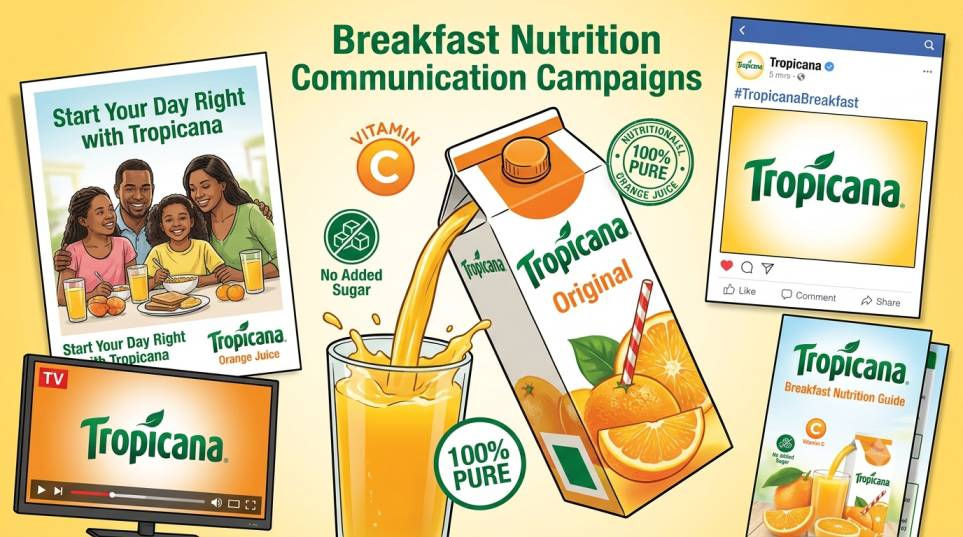
"Let's Make Breakfast 100%" (2010). According to Exchange4media's campaign review, this television-led campaign (agency: JWT) depicted a typical urban household's rushed weekday morning and positioned Tropicana 100% as a way to preserve nutritional completeness even when time was short. JWT India's Hari Krishnan was quoted describing the campaign as reinforcing "the wonders of a warm, nutritious and fulfilling breakfast" while tackling a serious everyday issue in an entertaining manner. The brand simultaneously revamped its packaging to foreground the nutritional benefit tied to the "rushed breakfast" occasion, and supported the television creative with in-store and channel-centric activities designed to reinforce the "Tropicana – complete breakfast" concept at the point of purchase.
"Tropicana Breakfast Club" (2011). This was a digital-first extension of the same breakfast-nutrition territory, again via JWT. Exchange4media reported that the campaign dramatized the same underlying tension breakfast losing out to competing morning priorities such as a boss's phone call or the desire for extra sleep through television commercials depicting symbolic contests (for example, an egg versus a mobile phone, and a dosa versus a pillow), with the "distraction" consistently winning over breakfast. JWT's Saurabh Saksena described the creative logic as representing "the futility of a duel between breakfast and other such priorities." The campaign's core claim, per the same source, was that Tropicana 100%, formulated with what was described as nine fruit nutrients, helped consumers close this "nutrition gap" despite time pressure. Execution extended into an interactive digital hub with a branded application ("Breakfast Bites Back") and social-media activity, which PepsiCo India's Battiwalla described as building on the "immense success" of the brand's prior initiatives (the specific results of that prior success were not quantified in the source material).
"My Health My Way" (2018). Reported by DNA India, this campaign coincided with a distribution and packaging overhaul: PepsiCo India partnered with franchise bottler Varun Beverages to expand Tropicana's outlet reach from roughly 100,000 to approximately 250,000 outlets and its town coverage from about 100 to more than 330 towns across North and East India, a region the article stated accounted for 80% of India's juice market. The Varun Beverages partnership itself was independently confirmed by Business Standard's coverage of the deal, which described it as an expansion of VBL's existing Tropicana Slice and Tropicana Frutz manufacturing, sales and distribution rights in North and East India. On the communications side, the new television commercial (described as going live in the first week of April 2018) was positioned, per Prakash's statement to DNA India, to celebrate "time-pressed millennials who find their own health and nutrition hacks to suit their individual lifestyles," and was to be amplified through what was described as a "360-degree marketing plan."
"The Juice That Starts It All" (2024, North America). Marketing Dive's coverage of this PepsiCo/Tropicana campaign described advertising built around the brand's 1954 founding story and its role in everyday rituals "breakfast to-go, morning people, fridge chugging" explicitly aimed at extending the brand's relevance to younger, Gen Z audiences. Marketing Dive reported the campaign's channel plan included paid placement on Meta, TikTok and YouTube, along with audio and digital out-of-home takeovers in a number of major U.S. cities. The same report noted this push followed a documented decline in U.S. orange juice consumption in recent years, while noting Tropicana remained the leading juice brand by sales in 2020.
Positioning & Consumer Insight
Across the India campaigns, the consistent strategic insight, as articulated in agency and client statements to Exchange4media, was that breakfast nutrition was not contested on taste or brand preference but on time and competing priorities. Rather than arguing that Tropicana 100% was nutritionally superior to other juice brands, the creative logic argued that breakfast itself and by extension its nutritional content was losing out to modern morning behaviors (sleep, mobile phones, work calls). This reframes the product's job-to-be-done: Tropicana is positioned as a low-friction way to preserve nutritional completeness within an already-compressed routine, rather than as a beverage competing for share of stomach against other juices.
The 2018 "My Health My Way" campaign shifted the insight toward individualization: per PepsiCo India's own framing, millennial consumers were understood to construct their own idiosyncratic "health and nutrition hacks," and the brand sought to align with that behavior rather than prescribe a single correct breakfast ritual while also using the platform to introduce a functional nutrient claim (iron) tied to a documented public-health statistic on anaemia prevalence in India.
The 2024 North American campaign reflects a different insight, tied to category headwinds rather than occasion framing: with per-capita juice consumption in decline and younger consumers less habituated to the category, Marketing Dive's reporting indicates PepsiCo leaned on Tropicana's heritage and cultural presence (its role in "brunch, mimosas and fridge chugging") to make an emotional, nostalgia-and-ritual case for relevance, rather than a nutrition-gap argument.
Media & Channel Strategy
2010 "Let's Make Breakfast 100%": Television as lead medium (per Exchange4media, medium listed as "Television"), supported by packaging redesign and in-store/channel activation.
2011 "Tropicana Breakfast Club": Digital-first, built around an interactive branded web destination and social media, layered on top of continuing television commercials from the broader campaign territory.
2018 "My Health My Way": Television commercial as the anchor asset, described by PepsiCo India as amplified through a "360-degree marketing plan"; the specific channels comprising that plan were not detailed in the source. This was paired with a structural distribution expansion via the Varun Beverages partnership, extending physical retail reach in North and East India.
2024 "The Juice That Starts It All": A 45-second flagship spot, extended into paid social (Meta, TikTok, YouTube), audio advertising, and digital out-of-home placements in select U.S. cities, per Marketing Dive.
Business & Brand Outcomes
Publicly available sources are limited on campaign-specific, quantified outcomes. The following are the only documented, attributable data points:
PepsiCo India's 2018 statements to DNA India described Tropicana as "one of the fastest growing beverage brands" in its India portfolio and quantified the master brand's scale at approximately Rs 1,000 crore, but did not attribute this growth specifically to the breakfast-nutrition or "My Health My Way" communication, nor did it provide a growth percentage.
The Varun Beverages distribution partnership, confirmed independently by Business Standard, is documented to have expanded planned outlet coverage from roughly 100,000 to approximately 250,000 outlets and town coverage from about 100 to over 330 towns in North and East India; these are stated targets/expansion plans reported at the time of the announcement, not independently verified post-implementation results.
Euromonitor International data (2020, as cited by Euromonitor's own analysts) confirms Tropicana's global position as the second-largest juice brand by volume and the largest 100% juice brand, with particular strength in North America context for the brand's scale but not a direct measure of any single campaign's effect.
Globally, PepsiCo's fruit juice business (Tropicana, Naked, and other juice brands) generated approximately $3 billion in revenue in 2020, a figure PepsiCo disclosed in the context of announcing the August 2021 sale of these brands to PAI Partners for $3.3 billion, retaining a 39% non-controlling stake in the resulting joint venture, according to reporting by NBC News and other outlets citing PepsiCo's own statement. This same reporting cited Euromonitor's Howard Telford attributing the divestiture in part to "the uncertain role of fruit juice in the consumer's routine long term" and ongoing sugar-related concerns, particularly in North America.
Marketing Dive's 2024 reporting on "The Juice That Starts It All" did not include post-campaign performance metrics (e.g., sales lift, brand awareness shift, or engagement figures); it reported only the campaign's creative concept, channel plan, and the category headwind (declining U.S. orange juice consumption) it was designed to address.
PepsiCo's overall India business reported double-digit organic revenue growth in 2024 and stated it held or gained beverage-category market share in India that year, per PepsiCo's own disclosure as reported by Business Standard; this is a company- and category-level figure covering PepsiCo India's full beverage portfolio, not a Tropicana-specific or campaign-specific metric.
Strategic Implications
Three patterns are documented across the sourced material and are analytically significant for MBA-level discussion, independent of unverified performance claims.
First, Tropicana's India breakfast-nutrition campaigns consistently reframed the competitive set. Rather than positioning against other juice brands on taste or price, the 2010–2011 campaigns (as described by PepsiCo India and JWT) positioned the brand against non-consumption itself—competing morning behaviors that displace breakfast entirely. This is a category-expansion strategy rather than a share-capture strategy, consistent with PepsiCo's own stated objective to "unlock" the juice category in India.
Second, communication was paired with, rather than substituted for, structural investment. The 2018 campaign coincided with a documented, formal distribution partnership (Varun Beverages) that materially expanded physical retail access. This indicates that PepsiCo India treated advertising as one lever within a broader go-to-market program that also included route-to-market expansion and packaging change, rather than relying on communication alone to drive category or brand growth.
Third, the geographic divergence in strategy is notable and publicly documented: in India, PepsiCo pursued occasion-based category expansion under continued corporate ownership, while in North America the company ultimately divested the Tropicana brand in 2021, citing (through third-party analyst commentary reported by NBC News) long-term category decline and sugar-related consumer concern, only for the brand's new ownership structure (with PepsiCo retaining a minority stake) to launch a heritage-and-ritual repositioning campaign in 2024 aimed at younger consumers. This suggests that breakfast-occasion and nutrition-based messaging was viewed as more durable as a growth lever in an emerging, under-penetrated market (India) than as a defense against structural, long-term category decline in a mature, saturated market (North America), where the eventual public communication response shifted toward emotional heritage branding rather than functional nutrition claims.
Discussion Questions
Tropicana's India campaigns reframed the competitive set from "juice vs. juice" to "breakfast vs. distraction." What are the strategic advantages and risks of a category-expansion positioning strategy relative to a conventional share-capture strategy, particularly for a challenger brand in an under-penetrated category?
PepsiCo paired the 2018 "My Health My Way" campaign with a formal distribution partnership (Varun Beverages) that materially expanded retail outlet reach. What does this sequencing suggest about the relationship between communication strategy and go-to-market/distribution strategy in emerging markets, and when should marketing investment lead versus follow distribution investment?
PepsiCo divested Tropicana in North America in 2021 citing long-term category decline, yet the brand (under new ownership, with PepsiCo retaining a minority stake) continued to invest in breakfast/heritage-oriented communication in 2024. What does this indicate about the limits of communication-led strategies in reversing structural category decline versus their effectiveness in markets with continued category growth?
The available public record does not include campaign-specific sales, share, or awareness metrics for any of the Tropicana breakfast-nutrition campaigns discussed. As an MBA analyst, how would you design a measurement framework to isolate the incremental effect of occasion-based nutrition messaging from concurrent distribution expansion and packaging changes?
The 2018 campaign introduced a functional health claim (iron fortification) tied to a public-health statistic on anaemia prevalence in India, layered onto an emotional "individualized health" positioning. What are the strategic trade-offs of combining functional/ingredient-based claims with lifestyle-based emotional positioning within a single campaign platform?


Comments