Wakefit's Digital-First Brand Strategy in Home Solutions
Industry & Competitive Context
India's mattress and home-furnishings market has traditionally been large, fragmented, and dominated by legacy manufacturers such as Kurl-On and Sleepwell, which relied on multi-tier dealer networks, showroom-led selling, and limited price transparency. According to Wakefit's Red Herring Prospectus (RHP) filed ahead of its December 2025 IPO, India's home and furnishings market — spanning furniture, mattresses, and furnishings & décor — was estimated at roughly ₹2.8–3.0 trillion (US$34–36 billion) as of calendar year 2024, and was projected to grow at an 11–13% CAGR to reach ₹5.2–5.9 trillion by CY2030. The RHP describes Wakefit as India's largest D2C home and furnishings company by revenue in Fiscal 2024, with a revenue CAGR of 24.87% between FY2022 and FY2024.
Wakefit's entry coincided with a broader shift in Indian retail: rising e-commerce penetration, the arrival of investment-banking-tracked forecasts (Avendus Capital has estimated the Indian D2C brands market could reach US$100 billion within five to seven years), and growing consumer comfort with purchasing high-consideration, high-ticket products online post-COVID. Within this landscape, Wakefit was among the earliest entrants to build a brand around sleep as a category rather than mattresses as a commodity, later joined by competitors including The Sleep Company, SleepyCat, and Duroflex's own online push — making sleep-focused D2C a distinct, competitive sub-segment of India's home-furnishings industry.
Brand Situation Prior to Strategic Repositioning
Wakefit Innovations Private Limited was incorporated on March 1, 2016, in Bengaluru, founded by Ankit Garg, a chemical engineer from IIT-Roorkee with prior experience in the foam and polyurethane industry, and Chaitanya Ramalingegowda, an ISB MBA with a background spanning startups including YourStory and LetsVenture. Prior to formally launching the company, Garg tested unit economics in 2015 by purchasing several hundred mattresses and selling them on Amazon, a trial reported by multiple business publications to have generated a profit of approximately ₹60 lakh. The company launched with a narrow product focus — orthopedic memory foam mattresses — sold online without an established distribution network or brand recognition.
Forbes India's reporting frames the founders' core challenge as one of consumer trust: buyers were reluctant to purchase an experiential, high-consideration product like a mattress from an unfamiliar online brand without physical trial. Wakefit's initial response was structural rather than communicative — a risk-reversal mechanism in the form of a long trial period (eventually standardised at 100 nights) and extended warranties of up to 10–20 years on select products. According to Forbes India, Wakefit's operating revenue grew from ₹6.75 crore in FY17 to ₹80 crore in FY19, scaled largely without external venture capital during its earliest years — a period the founders have publicly described as difficult for attracting institutional investors, despite profitable, if modest, growth.
By this stage, however, Wakefit's brand identity remained functionally defined: it was known, if at all, as "an online mattress company." The strategic problem was one of category narrowness and low emotional salience in a market where legacy brands still commanded default trust through decades of offline presence.
Strategic Objective
Public statements from co-founder Chaitanya Ramalingegowda and Wakefit's long-standing creative agency, Spring Marketing Capital, indicate that from January 2019 onward the company's marketing objective was deliberately reframed. Rather than continue as "an online mattress company," Wakefit chose to position itself as a sleep solutions company — with the explicit brief, per Spring Marketing Capital's Arun Iyer as quoted in Storyboard18, of putting sleep back into everyday consumer conversation rather than directly promoting mattresses in every piece of communication. This was a conscious pivot from product-led performance marketing toward mission-based brand-building, aimed at building category ownership of "sleep" itself, ahead of and independent from any specific product transaction.
As the company scaled financially through the following years, its stated strategic priorities — per FY24 and FY25 public disclosures — extended to (a) achieving EBITDA profitability, (b) broadening beyond mattresses into a full home-solutions portfolio spanning furniture and décor, and (c) building an omnichannel distribution model rather than remaining purely online. The digital-first brand strategy was therefore never conceived as a permanent channel constraint, but as the most capital-efficient way to build category salience before layering in physical retail.
Campaign Architecture & Execution
Wakefit's most publicly documented brand-building initiative is the Sleep Internship, created with Spring Marketing Capital and first launched in 2020. Its architecture, as reported by afaqs! and Storyboard18, centred on a simple, participatory mechanic: selected "interns" were required to sleep nine hours a night for 100 consecutive nights, using a Wakefit mattress and a sleep tracker, in return for a stipend reported at up to ₹1 lakh, with the eventual "Sleep Champion" earning as much as ₹9–10 lakh depending on the season. Applicants applied through a dedicated microsite, were shortlisted city-wise, and then represented their state in a national sleep face-off, with counselling support from sleep and fitness experts.
The campaign's scale grew markedly across seasons. Per Storyboard18, the first season in 2020 drew over 1.7 lakh entries from 30 countries; the second season drew roughly 5.5 lakh applicants; and a later season crossed 10 lakh applications, with prize money rising in tandem to ₹10 lakh by the third edition. Storyboard18 also reported that the Sleep Internship microsite had attracted more than one million unique visitors, with the company's own commentary citing an average conversion rate of 30–35% among visitors to the property. Content distribution ran predominantly through YouTube (trailers, intern introductions, winner interviews, behind-the-scenes footage), Instagram, and Facebook, supplemented by influencer participation — including actor Rashmika Mandanna, per Marketing Mind — rather than heavy paid television spend.
Wakefit has since layered additional culturally-anchored campaigns onto this platform rather than replacing it. A 2024 campaign, #Gaddagiri, used the Hindi tagline "Lafda tab hota hai, jab tum barabar nahi sota" ("Trouble happens when you don't sleep properly"). Per Social Samosa, its films used topical cultural references — including a comedic riff on a widely reported controversial job listing by a food-delivery company CEO, and a parody referencing the "YesMadam" termination controversy — to dramatise the real-world consequences of poor sleep on judgment and behaviour. A separate campaign built around the mythological figure of Kumbhkaran (known in the Ramayana for excessive sleep) generated an overall campaign reach of 3.52 crore with 6.5 million YouTube views, per Social Samosa, and its associated hashtag reportedly trended at No. 7 across India during a live-streamed activation. In March 2026, afaqs! reported the launch of a "Dhamki Squad" campaign for World Sleep Day, in which co-founder Chaitanya Ramalingegowda publicly framed the initiative as continuing a decade-long thread of sleep-focused cultural content — including an earlier response to a global streaming platform's public claim that "sleep is our biggest competitor." Storyboard18 has also reported an AI-generated ad featuring Bollywood actor Ayushmann Khurrana, titled "Andar ke bacche ko jaga," continuing the brand's use of celebrity and topical-culture hooks atop its core sleep-education platform.
Positioning & Consumer Insight
Wakefit's positioning rests on two connected, publicly corroborated consumer insights. First, per Business Insider India's interview with Chaitanya Ramalingegowda, the company's marketing philosophy has been articulated as "The More You Know; The Better You Sleep" — an educational rather than a hard-sell posture intended to help consumers research sleep health and mattress quality independently, reducing the information asymmetry that had historically favoured dealer-led offline retail. Second, per Spring Marketing Capital's Arun Iyer, the brand's central cultural insight was that sleep deprivation had been normalised in urban India as a marker of hard work and ambition — hustle culture treating minimal sleep as virtuous — and that reversing this stigma, making rest aspirational rather than lazy, could be pursued as a standalone brand mission distinct from selling mattresses in each communication. Reinforcing this, Storyboard18 has cited LocalCircles survey data indicating that roughly one in two Indians reported getting less than six hours of uninterrupted sleep nightly, giving the brand's cultural thesis an evidentiary anchor in publicly available research.
Commercially, this brand insight was paired with a functional trust proposition: by eliminating dealer margins through a direct online (and later omnichannel) model, Wakefit offered mattresses at materially lower prices than legacy offline brands, using long trial periods and extended warranties as substitutes for the in-store "touch and feel" experience that had historically been central to mattress purchase decisions in India. The brand strategy and the commercial strategy were therefore mutually reinforcing: cultural salience around sleep drove top-of-funnel awareness, while risk-reversal mechanics converted that awareness into first-time online purchase in a low-trust, high-consideration category.
Media & Channel Strategy
Wakefit's channel strategy has evolved across three broadly documented phases. In its earliest years (2015–2018), the company was marketplace-led, selling on Amazon before building its own direct website, wakefit.co. From 2019 through roughly 2022, brand-led digital marketing took precedence: the Sleep Internship and related campaigns ran predominantly through owned and earned digital media — YouTube, Instagram, and influencer mentions — rather than heavy paid television spend, a pattern partially corroborated by the company's own promotional-expense disclosures.
Per Inc42's reporting on the company's RoC filings, Wakefit's advertising and promotional expenses rose to ₹95.91 crore in FY23 (up 57% year-on-year), attributed by the company to brand-building investment, before declining by 19.3% to ₹77.36 crore in FY24 even as revenue continued to grow — a shift the company's leadership linked to improved marketing efficiency and rising organic, brand-driven demand. Inc42 additionally reported the company citing a nearly 40% year-on-year increase in "top of mind awareness" during FY24, alongside the reduction in paid spend.
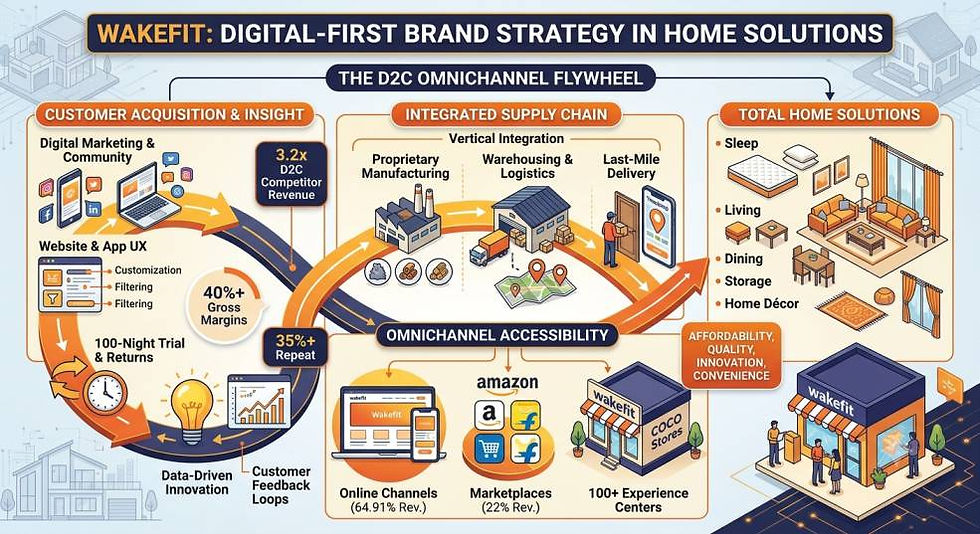
From 2022 onward, Wakefit entered offline retail through a Company-Owned Company-Operated (COCO) store model, marking a shift from a purely digital-first posture to an omnichannel one. Per its RHP and reporting by Business Standard, Groww, and Tickertape, the COCO store count grew from 23 as of March 31, 2023, to more than 80 stores across 26 cities by September 2024, and to 125 stores across 62 cities in 19 states and two union territories as of September 30, 2025. The RHP states that own channels — website plus COCO stores — contributed 57–65% of revenue from FY2023 through the first half of FY2026, with COCO store average order value reported to be 78.78% higher than website average order value. External channels have included e-commerce marketplaces (Amazon, Flipkart, Pepperfry), quick-commerce platforms, and a multi-brand outlet (MBO) network that reportedly scaled to 1,504 outlets within roughly three years of launch. Per Business Standard's September 2024 reporting citing company disclosures, e-commerce platforms accounted for approximately 30–35% of sales at that time, with the balance from physical stores and the owned website — underscoring that "digital-first" describes Wakefit's brand-building origin and cultural strategy more precisely than its present-day sales mix.
Business & Brand Outcomes
Public disclosures document a clear trajectory of scale alongside the brand's cultural visibility. According to Forbes India, operating revenue grew from ₹6.75 crore in FY17 to ₹80 crore in FY19. Per Inc42, Entrackr, and the company's RHP, revenue from operations reached approximately ₹812.6 crore in FY23 and ₹986.4 crore in FY24, with total revenue crossing ₹1,000 crore for the first time in FY24 — reported by the RHP as making Wakefit the fastest home-grown brand among organised peers to cross ₹1,000 crore in total income. The company reported returning to EBITDA profitability in FY24 (₹65–66 crore) for the first time in four years, having been EBITDA-profitable in its earliest years through 2019 before prioritising growth over margin. FY25 revenue was reported in a range of ₹1,273.69–1,305.43 crore across different filings, and FY26 full-year revenue, per exchange filings, reached ₹1,488.94 crore, with the company reporting its first full-year net profit of ₹189.18 crore.
On the brand side, the Sleep Internship's audience metrics — cited above from Storyboard18 and Social Samosa — represent the clearest publicly available indicators of the digital-first strategy's reach: cumulative applicant volumes climbing from 1.7 lakh to over 10 lakh across seasons, more than one million unique visitors to the campaign microsite, and individual activations (such as the Kumbhkaran campaign) generating tens of millions of video views and national trending status. Cumulatively, Wakefit has raised approximately US$105.5–150 million in external funding (estimates vary by source; TheKredible, cited via Entrackr, put the figure at $105.5 million as of late 2024, while Startup Story Media's 2024 reporting citing the company put cumulative funding at roughly $150 million following a subsequent round). Investors named across sources include Peak XV Partners (formerly Sequoia Capital India), Verlinvest, SIG, Investcorp, and Elevation Capital.
Wakefit completed its initial public offering on the NSE and BSE in December 2025. Per Business Standard and PL Capital, the IPO ran from December 8–10, 2025, at a price band of ₹185–195 per share, raising a total of ₹1,288.89 crore — comprising a fresh issue of ₹377.18 crore and an offer-for-sale of ₹911.71 crore. The issue was subscribed 2.52 times overall (retail 3.17x, QIB 3.04x, NII approximately 1.05x), with ₹580 crore raised from anchor investors ahead of the issue. Shares listed on December 15, 2025, at ₹195 on the NSE (flat versus the issue price) and ₹194.10 on the BSE (a 0.46% discount), a debut multiple outlets, including PL Capital and Business Standard, described as "muted" or reflecting measured investor sentiment despite the company's strong brand recall. Per the RHP, IPO proceeds were earmarked in part for marketing and advertisement expenditure (₹108.4 crore, per Business Standard's citation of the RHP), alongside capital expenditure for new COCO stores.
Strategic Implications
Wakefit's digital-first brand strategy illustrates several patterns relevant to category-building in emerging, low-trust online retail markets.
First, the company treated brand-building and risk-reversal as complementary rather than substitute levers: cultural content (the Sleep Internship, #Gaddagiri, the Kumbhkaran activation) built top-of-funnel salience for "sleep" as a category, while trial periods and warranties handled the bottom-of-funnel trust deficit inherent to buying an experiential product online. Neither lever alone would likely have been sufficient in a market where mattress purchase had historically required physical trial.
Second, the documented decline in advertising expenditure as a share of revenue in FY24, alongside a reported rise in brand awareness, suggests that a genuinely resonant cultural insight — sleep deprivation as a hidden, universal pain point — allowed earned and owned digital media to substitute for some paid media intensity over time. This is a meaningfully different growth pattern from performance-marketing-led D2C brands that depend on sustained paid acquisition spend, and it illustrates why "digital-first" brand strategies built on cultural insight, rather than pure media-buying efficiency, may compound in value as campaigns accumulate.
Third, Wakefit's subsequent shift toward an omnichannel model — with COCO stores now contributing a majority of revenue alongside the website, and store AOV reported at nearly 79% higher than website AOV — indicates that a digital-first brand strategy functioned most effectively as a market-entry and awareness-building phase rather than a permanent channel end-state, at least for a high-consideration, high-ticket physical product category. The company's own RHP explicitly frames store-related lease, staffing, and expansion risk as material to its go-forward strategy, an acknowledgment that pure-online brand-building has limits once a company seeks to convert awareness into higher-value transactions at scale.
Finally, Wakefit's flat IPO debut despite a decade of brand-building, recognisable cultural campaigns, and double-digit revenue growth illustrates a broader pattern observed across India's 2024–2026 consumer-startup listings: public market investors have increasingly discounted brand equity and topline growth in the absence of demonstrated, sustained profitability. The company's FY26 return to full-year net profit may be a deliberate attempt to close this gap between cultural brand strength and market-perceived financial credibility in subsequent periods.
Discussion Questions
Wakefit's advertising expenditure declined by 19.3% in FY24 even as revenue grew and reported brand awareness rose by nearly 40%. What does this suggest about the relationship between paid media intensity and brand equity accumulation in categories with strong cultural or emotional resonance, and how might a competitor without a comparable cultural insight attempt to replicate or counter this efficiency?
The Sleep Internship evolved from a single-season stunt into a recurring, multi-year brand property spanning several campaign iterations (#Gaddagiri, Kumbhkaran, Dhamki Squad). What organisational and creative disciplines are required to sustain a single big brand idea across many years without audience fatigue, and where does Wakefit appear to have refreshed the idea versus simply repeating its mechanics?
Wakefit's RHP frames its COCO store network — rather than its website — as central to its next growth phase, citing a substantially higher average order value in stores. Does this represent a natural evolution of the digital-first brand model, or an implicit acknowledgment of its limits for high-consideration, experiential product categories?
Compare the Sleep Internship's campaign architecture — stipend-based participation, tiered city-to-state selection, sleep-tracker validation — to conventional influencer or celebrity-endorsement marketing. What structural features made the campaign self-propagating, and are these features generalisable beyond a taboo/cultural-reversal insight specific to sleep?
Wakefit's IPO listed flat despite strong revenue growth, an established omnichannel presence, and a decade of culturally resonant brand-building. What does this suggest about how public equity markets weigh brand equity against demonstrated profitability when pricing consumer-facing D2C companies, and how should founders and bankers calibrate expectations for brand-led growth stories at IPO?


Comments