Why Consumers Expect Brands to Know Them Before They Buy
Industry and Competitive Context
The expectation that a brand should already understand a consumer's preferences before that consumer makes a purchase has moved from a differentiator to a baseline requirement across global and Indian markets. McKinsey's Next in Personalization research, published in 2021, found that 71 percent of consumers expect companies to deliver personalized interactions, and 76 percent report frustration when this does not happen. This marks a measurable escalation from earlier benchmarks. A Google and Greenberg study conducted in 2018 found that 61 percent of consumers expected their experiences to be shaped by personal preference, a figure that had risen to roughly 72 percent by 2021 according to McKinsey's tracking. The trend line indicates that personalization expectations have hardened over a relatively short period, coinciding with the rapid expansion of e-commerce, mobile-first retail, and data-driven customer relationship management systems during and after the pandemic.
In India, this shift is documented in Salesforce's State of the Connected Customer report, which surveyed customers across markets including India. The fifth edition of the report found that 76 percent of Indian customers expect companies to anticipate and understand their evolving needs, 72 percent expect all companies they interact with to already have the same information about them, and 90 percent say the experience a company provides is as important as the product or service itself. The same report found that 93 percent of Indian customers expect faster service as technology advances, and 95 percent identified trust as the most important factor in a brand relationship. These figures situate India within the same global trajectory McKinsey documents, while also showing that Indian consumers place unusually high weight on consistency and trust as preconditions for accepting personalization.
The competitive backdrop for this shift is the broader growth of India's e-retail sector. A Bain and Company report, cited by Business Standard in March 2025, valued India's e-retail market at approximately 60 billion dollars in 2024, with over 270 million online shoppers, making India the world's second-largest e-retail shopper base. The same report noted that Generation Z shoppers, who make up around 40 percent of India's e-retail consumer base, rely heavily on social media for brand discovery, spend three times more on emerging fashion brands, and make comparatively faster purchase decisions. A market of this scale and behavioral diversity has pushed platforms to compete less on catalogue breadth and price alone, and increasingly on how precisely they can anticipate individual intent across a fragmented, mobile-first consumer base spanning metro and Tier 2 and Tier 3 geographies.

Brand Situation Prior to Personalization Becoming the Default
Before personalization hardened into a baseline expectation, brand marketing operated primarily on segment-level targeting. Companies built customer personas, ran broadcast campaigns across television and print, and used loyalty programs as the main mechanism for differentiated treatment. Digital advertising in its early form largely replicated this logic online, using demographic and contextual targeting rather than individual behavioral history. Salesforce's earlier editions of the Connected Customer report, dating to 2018 and 2019, already showed early signs of the shift, noting that 84 percent of customers considered the experience a company provides as important as its products, and that customers using multiple devices to complete a single transaction expected continuity between those touchpoints. At that stage, however, most companies had not yet built the underlying data infrastructure, such as unified customer profiles and real-time decision engines, to act on this expectation at scale.
The absence of that infrastructure created a visible gap between what consumers wanted and what brands delivered. McKinsey's research into this gap found that while a large majority of consumers expected personalized interactions, companies that failed to deliver risked both immediate frustration and longer-term erosion of consideration, since 76 percent of consumers said personalized communications were a key factor in prompting them to consider a brand in the first place. This gap between rising expectation and uneven delivery capability is the structural condition that framed how brands subsequently invested in personalization architecture, rather than any single company's isolated marketing decision.
Strategic Objective
Across the companies and platforms documented in these reports, the recurring strategic objective is consistent: convert fragmented behavioral and transactional data into a real-time understanding of individual customers that can inform product recommendations, communication timing, pricing, and service interactions, without breaching the trust threshold that governs whether consumers will permit that data use. McKinsey frames this as balancing personalization value against a widely referenced formulation of avoiding what the firm's researchers describe as the line between "creepy and helpful." Salesforce frames the same objective in terms of trust economics, noting in its India-specific findings that 86 percent of customers globally are more likely to trust companies with their personal information if those companies explain how the data leads to a better experience.
The objective, therefore, is not personalization as a marketing tactic in isolation, but personalization as an operating capability that spans data collection, decision-making, and communication, built to be sustained over the long term rather than deployed as a single campaign. This is a meaningful distinction for MBA-level analysis: the shift under study is closer to a change in required organizational capability than a discrete campaign with a start and end date, which is why the evidence base spans multi-year, cross-market research rather than a single brand's press release.
Architecture of Personalization Capability
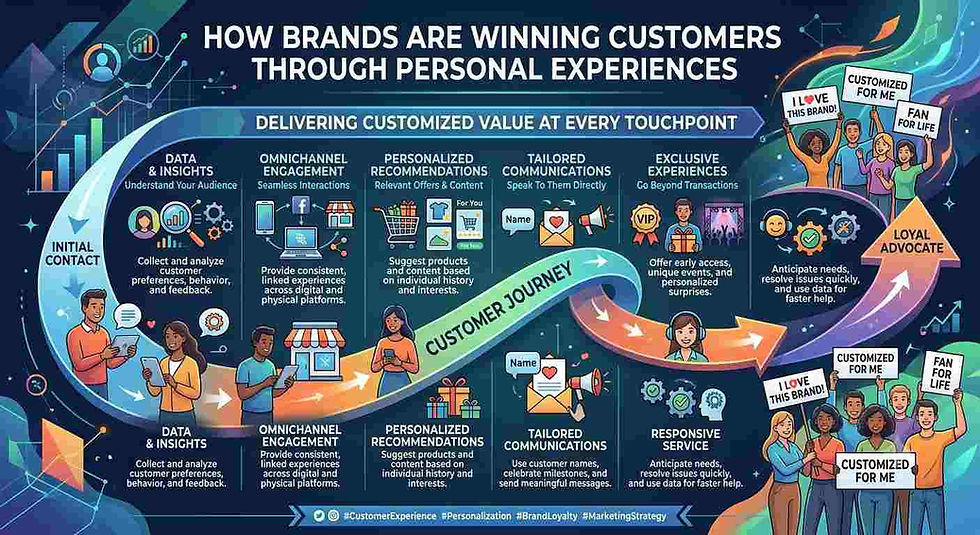
The architecture that companies have built to meet this expectation, as documented across McKinsey and Salesforce research, generally follows four layers. The first is a unified data foundation, meaning a single customer view drawing together browsing history, purchase history, service interactions, and stated preferences. The second is a decision or recommendation engine that translates that data into a ranked set of relevant actions, offers, or content. The third is content and design flexibility, meaning the technical capacity to serve different messaging, imagery, or product sequencing to different individuals in real time rather than a single static experience. The fourth is front-line enablement, meaning that service and sales staff, where human interaction is still involved, have access to the same customer history as the automated system.
Recommendation systems are the most publicly documented expression of this architecture. Industry commentary widely attributes to McKinsey research the finding that a substantial share of Amazon's purchases and the large majority of content watched on Netflix are influenced by algorithmic recommendations, though it is worth noting, as reporting from the University of Florida's Warrington College of Business has pointed out, that neither Amazon nor Netflix has published these exact figures directly, and the commonly cited numbers originate from third-party estimates built on McKinsey's broader personalization research rather than from company-disclosed data. What is verifiable directly from McKinsery's own published research is the underlying architecture claim: that companies which build advanced personalization capability, spanning the four layers described above, generate meaningfully higher revenue growth than those that rely on generic, segment-level marketing, with McKinsey estimating that fast-growing companies drive 40 percent more of their revenue from personalization activities than their slower-growing peers.
In the Indian context, the documented architecture shift is visible in how platforms describe their own capability publicly. Myntra's press communications, including its July 2025 announcement of its Glamstream feature, describe an underlying data and content infrastructure built around its creator ecosystem, which the company stated had grown to over one million registered creators generating 4.5 billion post views since its August 2024 launch. This reflects the same architectural principle described by McKinsey, namely that personalization increasingly extends beyond product recommendations into content and community layers that inform what an individual consumer sees before they browse a catalogue at all.
Positioning and Consumer Insight
The consumer insight underlying this entire shift is that recognition itself has become a component of value, separate from price or product quality. Salesforce's research operationalizes this insight precisely: 72 percent of consumers surveyed globally said they expect businesses to recognize them as individuals and know their interests, and consumers who were asked to define personalization associated it with the experience of being made to feel individually understood rather than treated as a demographic segment. This reframes personalization from a marketing efficiency tool, aimed at improving click-through or conversion rates, into a relationship signal that consumers use to judge whether a brand values them beyond the immediate transaction.
This insight has a second, less discussed dimension documented in more recent research: personalization done poorly damages trust more than an absence of personalization does. Gartner research published in June 2025 found that a substantial share of customers, in that survey 53 percent, reported negative outcomes from traditional personalization approaches and were more likely to regret a purchase at key journey points when personalization felt generic or mistimed rather than genuinely relevant. Twilio Segment's State of Personalization 2023 survey similarly found that only 51 percent of consumers trust brands to keep their personal data safe, even as the same population expects personalized treatment. The insight, in MBA terms, is that consumer expectation has shifted from wanting personalization as an added feature to treating accurate, respectful personalization as a precondition for trust, while treating inaccurate or intrusive personalization as a trust violation rather than a neutral miss.
Media and Channel Strategy
The channel evidence available publicly shows personalization operating primarily through three infrastructure types rather than through traditional media buying. The first is owned digital channels, particularly mobile applications and email, where companies use behavioral history to sequence content. Salesforce's Customer 360 platform materials describe this as unifying marketing, sales, service, and commerce data so that a customer's history is consistent regardless of which channel they use to interact with a brand. The second is algorithmic content and product feeds within owned platforms, the mechanism most visibly used by Netflix and by Indian platforms such as Myntra through its personalized fashion feed and AI-driven styling recommendations described in the company's own marketing communications. The third is data-informed customer relationship management within service interactions, where the front-line enablement layer described earlier allows support and sales staff to reference prior purchase and service history rather than starting each interaction without context.
What is notably absent from the verified public record is evidence that this shift has been driven primarily through paid or broadcast media strategy. The documented channel investment, according to Deloitte's 2024 findings cited in aggregated industry research, shows retailers allocating close to 59 percent of marketing budget toward personalization capability, which spans data infrastructure and owned-channel experience design rather than traditional media placement. This reinforces the earlier point that the phenomenon under study is an operating and infrastructure shift rather than a campaign executed through conventional channel planning.
Business and Brand Outcomes
The documented outcomes attached to effective personalization span revenue, retention, and referral, primarily from McKinsey and Twilio Segment research. McKinsey's Next in Personalization findings state that personalization most often lifts revenue by 10 to 15 percent, with a documented range of 5 to 25 percent depending on sector and execution quality, and that companies excelling at personalization generate 40 percent more of their revenue from those activities than average performers. On the consumer behavior side, McKinsey's research found that 78 percent of consumers said personalized communications made them more likely to make a repeat purchase, and a similar share said such communications made them more likely to refer the brand to others.
Twilio Segment's 2023 State of Personalization survey, covering over 3,000 adults across multiple countries, found that 56 percent of consumers said they would become repeat buyers following a personalized experience, a seven-point increase over the prior year's survey. Epsilon's earlier 2017 survey of 1,000 US adults found that 80 percent of consumers reported being more likely to do business with a company that offered personalized experiences, a figure that has remained a frequently cited early benchmark for the category.
In the Indian market specifically, the verifiable outcome data is more limited in public disclosure. Salesforce's India-specific findings document consumer attitude outcomes rather than company-level financial results, including that 78 percent of Indian respondents believe most companies have the capability to meet their needs, and 81 percent say they trust most companies to meet their needs and expectations. No verified public information is available on the specific revenue or retention impact of personalization initiatives at named Indian consumer brands such as Myntra, Nykaa, or Tata CLiQ, since these companies have not published personalization-specific financial disclosures in their investor communications as of the information available. Where Myntra has made public claims, such as creator community growth following its Glamstream launch, these relate to engagement scale rather than audited financial outcomes, and should be read as company-disclosed operational metrics rather than independently verified business results.
Strategic Implications
The evidence assembled here points to several implications for brand strategy. First, personalization has shifted from a marketing capability that sits within a campaign or a customer relationship management team to an enterprise capability requiring investment in unified data infrastructure, which explains why leadership-level adoption is nearly universal, with Twilio Segment's 2024 research finding that 89 percent of business leaders consider personalization critical to business success over the coming three years, even as execution quality varies widely across companies.
Second, the trust dimension documented by Salesforce and Twilio Segment indicates that personalization strategy cannot be evaluated on engagement or conversion metrics alone. A brand that personalizes accurately but does not explain its data use transparently risks the trust erosion identified in Gartner's 2025 research, where a majority of surveyed customers reported negative experiences from personalization that felt intrusive or inaccurate rather than helpful. This suggests that the strategic question for marketing leaders is no longer whether to personalize, since that expectation is now close to universal, but how to sequence transparency and data governance alongside personalization investment so that the trust precondition is met before the personalization layer is deployed.
Third, the Indian market context, with its unusually high proportion of Tier 2 and Tier 3 e-retail growth and a Generation Z consumer base that discovers brands primarily through social platforms rather than search or television, suggests that personalization strategy in India is likely to be built around content and community layers, similar to Myntra's creator ecosystem approach, rather than purely transactional recommendation engines modeled on the Amazon or Netflix template. This distinction matters for any brand operating in the Indian market, since the infrastructure and data signals required to personalize a content-led discovery journey differ meaningfully from those required to personalize a transaction-led repeat purchase journey.
Finally, the overall pattern across McKinsey, Salesforce, and Twilio Segment research indicates that consumer expectation of being known by a brand before a purchase is not a temporary trend tied to a single technology cycle, but a structural change in how consumers evaluate brand relationships, running in parallel with rising expectations around data trust and transparency. Brands that treat personalization purely as a conversion optimization tool, without addressing the trust and transparency conditions documented in this research, are likely to encounter the frustration and regret effects captured in the more recent 2025 Gartner findings, even as they invest heavily in the underlying technology.
Discussion Questions
McKinsey's research shows that personalization frustration (76 percent) and personalization expectation (71 percent) are both high, while Gartner's 2025 research shows that a majority of customers report negative outcomes from personalization that feels generic or intrusive. How should a marketing leader reconcile these findings when setting personalization strategy, and what internal metrics would distinguish helpful personalization from the kind that erodes trust?
Salesforce's India-specific data shows that 72 percent of Indian consumers expect all companies to already have the same information about them, implying an expectation of consistency across brands rather than within a single brand relationship. What does this imply for how an individual company should think about data portability, third-party data partnerships, or industry-level data standards?
Given that only 51 percent of consumers in Twilio Segment's research trust brands to keep their data safe, while a much larger share expects personalized treatment that depends on that same data, how should a company sequence its investment between data infrastructure, personalization capability, and consumer-facing data transparency communication?
The case notes that verified financial outcome data for personalization investment is publicly available for global platforms such as Amazon and Netflix in only limited and contested form, while Indian platforms disclose engagement metrics rather than personalization-specific financial results. What are the risks of an industry setting strategic benchmarks based on estimated rather than company-confirmed figures, and how should analysts treat such estimates in strategic planning?
India's e-retail growth, per Bain and Company's 2025 findings, is increasingly driven by Tier 2 and Tier 3 consumers and a Generation Z cohort that discovers brands through social platforms rather than search. How should personalization architecture differ for a brand primarily serving this cohort compared to one architected around the transactional recommendation engine model associated with Amazon or Netflix?


Comments