Why Some D2C Brands Scale While Others Fail
Industry & Competitive Context
The direct-to-consumer (D2C) model emerged as a distribution and branding innovation that allowed companies to bypass traditional retail intermediaries, build first-party customer relationships through digital channels, and use performance marketing and influencer-led content to acquire customers at scale. Two companies illustrate the divergent outcomes this model has produced: Honasa Consumer Limited, the Indian parent of the beauty and personal care brand Mamaearth, which completed a public listing on the National Stock Exchange and BSE in November 2023; and Brandless Inc., a United States-based D2C startup that shut down operations in February 2020 after raising close to $292 million in venture funding.
In India, the beauty and personal care (BPC) market was valued at approximately $23 billion in FY25, according to a Redseer Strategy Consultants report, with projections to reach $40 billion by 2030. A joint Redseer–Peak XV Partners report noted that the average revenue growth of the largest pure-play BPC companies between 2017 and 2022 was roughly five times that of large FMCG-led BPC players, indicating that the category had become genuinely attractive to venture investors and public markets. Industry reports from Redseer also note that, as of FY26, only around 20 personal care brands in India exceed INR 1,500 crore in revenue, most of which sit under established FMCG conglomerates underscoring how few new-age D2C brands have scaled to meaningful size.
In the United States, Brandless operated in a more mature and saturated e-commerce landscape, competing directly against Amazon, Walmart, and established consumer packaged goods incumbents on price and convenience a structurally different competitive position from Mamaearth's in an underpenetrated, fast-growing Indian BPC market.
Brand Situation Prior to Scale (or Failure)
Honasa Consumer / Mamaearth: Mamaearth was founded in 2016 by Varun Alagh and Ghazal Alagh. According to company disclosures in its Red Herring Prospectus (RHP), the brand was built around a founder narrative: the Alaghs said they were unable to find toxin-free, safe personal care products for their newborn and built Mamaearth to fill that gap. The company grew its revenue from operations from roughly INR 460 crore in FY21 to INR 943 crore in FY22 and INR 1,492.7 crore in FY23 a compound annual growth rate of more than 48 percent between FY21 and FY23, per its IPO disclosures. The RHP also stated that, as of the twelve months ended September 2022, Mamaearth had become the fastest beauty and personal care brand in India to reach INR 10 billion in annual revenue within six years of launch, a claim attributed to a RedSeer industry report. Honasa expanded beyond Mamaearth into a multi-brand "house of brands" portfolio, acquiring or building The Derma Co., BBlunt, Aqualogica, Ayuga, Dr. Sheth's, and later Staze.
Brandless: Founded in San Francisco in 2016 by Tina Sharkey and Ido Leffler, Brandless launched with a distinctive pricing architecture: nearly every product in its catalog spanning food, beauty, and household goods was priced at a flat $3. According to Crunchbase data cited in multiple press reports, the company raised approximately $292.5 million in total funding, including a $240 million Series C round led by SoftBank's Vision Fund in 2018 that valued the company at roughly $500 million. Axios reported that SoftBank structured this investment in tranches, delivering only around $100 million upfront with a further $120 million contingent on undisclosed milestones that were never met meaning Brandless never actually received the full headline amount of capital its valuation implied.
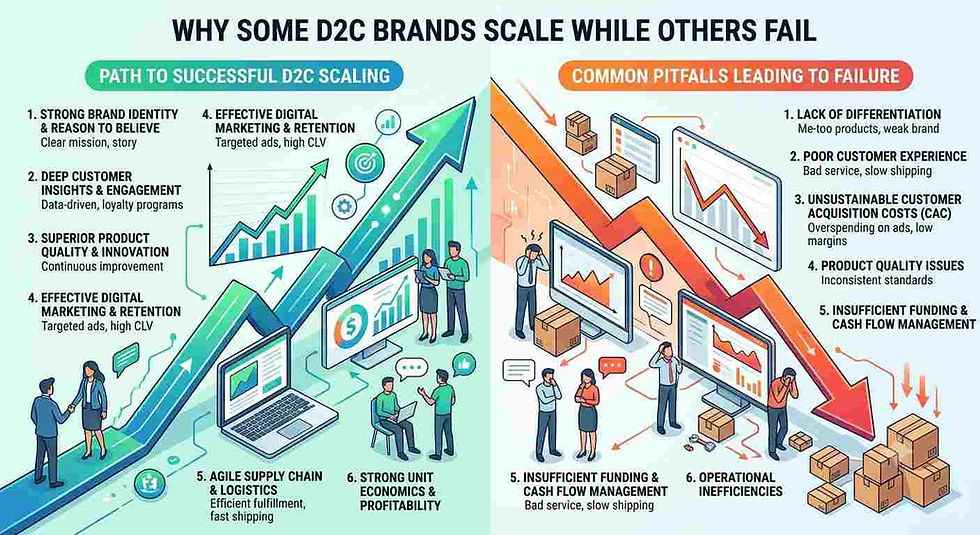
Strategic Objective
Mamaearth's stated strategic objective, as disclosed in its RHP, was to build India's leading digital-first BPC company by combining a differentiated "toxin-free" product positioning with aggressive multi-channel expansion first online through its own D2C website and e-commerce marketplaces, and later through general trade, modern trade, and quick commerce.
Brandless's objective, as reported by Axios and Crunchbase News, was to eliminate the "brand tax" the premium consumers pay for established brand names by offering private-label-quality household and food products at a uniform $3 price point, acquiring customers directly online rather than through retail.
Positioning & Consumer Insight
Mamaearth's core consumer insight, as articulated in its own prospectus and widely reported in Indian business media, centered on parental anxiety about chemical exposure in personal care products for infants and families. The brand built its identity around the "Made Safe" certification claim and the positioning of being "Asia's first brand" certified toxin-free. This positioning proved commercially effective: RedSeer data cited in IPO materials showed Mamaearth was India's most-searched BPC brand on Google Trends between January 2020 and November 2022, and it held a top-three awareness ranking in the grooming category on Flipkart during a comparable period. However, this same positioning later drew public scrutiny. Reporting by Inventiva and an academic case analysis published by the Centre for Comparative and Constitutional Law Research noted that Made Safe, the certifying body Mamaearth referenced, does not recognize Mamaearth as a certified brand, and that the Advertising Standards Council of India (ASCI) flagged the company for advertising violations in multiple consecutive years, including a reported 175 influencer-related violations in a single financial year. This represents a documented gap between claimed positioning and verified certification status a material point for any analysis of the brand's long-term trust equity.
Brandless's consumer insight was price-transparency-led: the company publicly calculated and marketed the "brand tax" consumers paid for name-brand equivalents, positioning itself against both legacy CPG brands and, implicitly, Amazon. Axios reporting noted that this focus diluted over time: the company expanded from its original minimalist catalog into "everything from spatulas to pet food to candy to blenders," a lack of category focus that Axios explicitly identified as a contributing factor in its decline.
Media & Channel Strategy
Mamaearth's channel strategy is unusually well documented because it is a listed company subject to disclosure requirements. Its FY23 revenue mix, per IPO filings and BeautyMatter's reporting, showed online channels (D2C and e-commerce) contributing roughly 59 percent of revenue across nearly 18,600 pin codes, with offline general and modern trade making up an increasing share around 36 percent and rising further in subsequent years. Company disclosures reported in Storyboard18 and BW Marketing World show that by FY25, offline channels contributed close to 60 percent of Mamaearth brand revenue, indicating a deliberate and executed shift from a pure D2C model toward omnichannel retail presence a strategic pivot common among Indian D2C brands seeking to scale beyond the limits of digital-only acquisition.
Advertising intensity is also publicly disclosed. According to Honasa's financial filings reported by BW Marketing World and Storyboard18, the company's advertising and promotion spend was INR 743.65 crore in FY25, representing 36 percent of revenue, up from INR 661.28 crore (also around 34–39 percent of revenue) in prior years. Reporting by Inventiva, drawing on company filings, noted this ratio has remained in the 34–40 percent of revenue range going back to FY21, compared to a typical 10–15 percent ratio for established FMCG players such as Hindustan Unilever and Dabur. Public analyst commentary cited in these reports also noted the absence of disclosed customer acquisition cost (CAC), lifetime value (LTV), or return-on-ad-spend (ROAS) metrics in the company's IPO filings a transparency gap flagged publicly by multiple financial commentators at the time of listing, though no such metrics were ever officially disclosed by the company and none should be treated as known.
Brandless's channel strategy, by contrast, was website-led D2C e-commerce from inception, without the retail diversification that characterized Mamaearth's later growth phase. Public reporting does not document any meaningful offline retail expansion by Brandless prior to its 2020 shutdown.
Business & Brand Outcomes
Honasa Consumer : The company's IPO was oversubscribed 7.6 times, according to BeautyMatter's reporting on the issue, attracting bids worth INR 71.3 billion (roughly $857 million) against an issue size of INR 1,701.44 crore. Shares listed on the NSE at INR 330, a 1.85 percent premium to the INR 324 issue price, giving the company a market capitalization of approximately $1.3 billion at listing. BeautyMatter also reported that by the end of the first week of trading, shares had fallen 21 percent below the issue price — indicating that despite a successful fundraising and listing event, early public-market sentiment toward the stock was volatile. On the financial side, Honasa's revenue grew from INR 943 crore in FY22 to INR 1,492.7 crore in FY23, INR 1,919 crore in FY24, and INR 2,067 crore in FY25, per company filings reported by BW Marketing World. However, profitability has been inconsistent: the company reported a net loss of INR 150.96 crore in FY23 (per restated IPO financials), returned to profit in FY24 with INR 110 crore in profit after tax, and then saw profit after tax fall 34.24 percent year-on-year to INR 72.6 crore in FY25 even as revenue grew a pattern company commentary attributed to continued heavy investment in advertising for its newer sub-brands.
Brandless (documented outcomes): The company shut down operations on February 10, 2020, as confirmed in company statements reported by CNBC and other outlets, laying off approximately 70 employees. Axios reported that the company had sought a buyer through a bank-led sale process but was unable to secure any bids before shutting down. Forbes contributor and retail analyst Neil Stern noted at the time that the company's fundamental business model combined low price points with high customer acquisition costs, producing a structurally money-losing operation though Forbes did not cite specific disclosed CAC or margin figures, as Brandless was privately held and not required to disclose them. The Brandless brand and assets were subsequently purchased in June 2020 by Onward Partners LLC (a venture formed by Clarke Capital Partners and Ikonifi), and the brand relaunched later that year under new ownership, raising a further $118 million in August 2021 according to Silicon Slopes newsroom reporting though this relaunch occurred under different leadership and ownership structure than the original venture.
Strategic Implications
Three analytically grounded contrasts emerge from these two documented cases, without extrapolating beyond what is publicly verifiable.
First, category selection and market timing mattered structurally. Mamaearth scaled within a large, fast-growing, and historically underpenetrated market Redseer reports place India's BPC market at $23 billion in FY25 growing toward $40 billion by 2030 where a differentiated positioning could capture meaningful share before FMCG incumbents fully responded. Brandless operated in a mature, highly competitive US e-commerce market dominated by Amazon, where a generic low-price positioning offered less durable differentiation; Brandless's own public statement at shutdown explicitly cited the "fiercely competitive" and "unsustainable" nature of the DTC retail market as its stated reason for closing.
Second, channel diversification appears, in Mamaearth's documented case, to have been a material lever for continued scale. Honasa's shift from a predominantly online D2C model toward omnichannel retail with offline trade reportedly contributing close to 60 percent of Mamaearth brand revenue by FY25 per company disclosures reduced dependence on paid digital acquisition as the sole growth engine. Public reporting does not document a comparable retail diversification strategy at Brandless prior to its shutdown.
Third, both cases show that revenue scale alone did not guarantee durable financial health or market confidence. Honasa continued to post revenue growth through FY25 but experienced a 34 percent decline in profit after tax in the same year, alongside advertising spend sustained at roughly double the FMCG industry norm according to multiple financial media reports, and its stock fell 21 percent in its first week of public trading despite an oversubscribed IPO. Brandless, despite raising substantial venture capital and establishing brand recognition, could not convert that capital into a self-sustaining unit economics model, according to contemporaneous reporting by Axios and Forbes, and ultimately could not find a buyer when it sought one. Together, these documented outcomes suggest that D2C scale is necessary but not sufficient: category tailwinds, diversified channel execution, and a credible path to sustainable margins not brand narrative or fundraising success alone differentiate brands that scale from those that do not. It should also be noted, based on the documented ASCI violations and the Made Safe certification discrepancy reported by Inventiva and the Centre for Comparative and Constitutional Law Research, that Mamaearth's scale was achieved in part through a positioning claim that has been publicly disputed by regulators and the referenced certifying body a governance and trust risk that remains part of the brand's public record independent of its commercial performance.
Discussion Question
Compare the market conditions Mamaearth and Brandless each operated in. To what extent can a company's scaling outcome be attributed to category and market timing versus execution choices within the company's control?
Honasa's advertising spend has remained at roughly 34–40 percent of revenue since FY21, compared to a 10–15 percent norm among established FMCG peers. Using only the publicly disclosed revenue and profit figures in this case, assess whether this level of spend represents a sustainable brand-building investment or a structural dependency.
Brandless expanded its product catalog from a narrow, differentiated set of goods into a much broader assortment before its shutdown. What does this suggest about the relationship between category focus and D2C brand positioning, based on the documented outcome?
Honasa's shift toward offline retail channels coincided with continued revenue growth through FY25. What does the documented contrast between Mamaearth's omnichannel strategy and Brandless's online-only model suggest about channel diversification as a scaling lever for D2C brands?
The gap between Mamaearth's "toxin-free" certification claims and its actual certification status, as reported by Inventiva and academic analysis, represents a documented trust and governance issue separate from its financial scaling. How should this factor be weighed against the company's commercial outcomes when evaluating its overall strategic success?


Comments