Zara’s Fast-Fashion Supply Chain and Responsive Merchandising Model
Industry & Competitive Context
The global apparel industry has historically operated on long, forecast-driven cycles: designers plan collections 6–12 months ahead, manufacturing is outsourced to low-cost geographies in Asia, and retailers commit to large production runs before knowing whether a style will sell. This model rewards scale and cost efficiency but performs poorly against short-term shifts in consumer taste, leaving traditional retailers exposed to inventory markdowns and stockouts simultaneously.
Zara, the flagship brand of Spanish conglomerate Inditex (Industria de Diseño Textil, S.A.), competes in this industry on a fundamentally different operating logic. Inditex, founded by Amancio Ortega and headquartered in Arteixo, A Coruña, Spain, has built its competitive position around speed and responsiveness rather than low unit cost. Inditex’s other brands include Pull&Bear, Massimo Dutti, Bershka, Stradivarius, Oysho, and Zara Home, but Zara remains the group’s largest revenue contributor, as disclosed in Inditex’s publicly filed annual reports. Inditex is listed on the Spanish stock exchanges (Bolsas y Mercados Españoles) and publishes audited annual reports and investor presentations, which form the primary verifiable record of its operating model.
Zara’s principal competitors in the global “fast fashion” category include H&M (Sweden), Uniqlo/Fast Retailing (Japan), and Shein (a digitally native fast-fashion entrant). Unlike several of these competitors, Inditex has consistently emphasized in its own annual reports that a significant share of its production remains in proximity markets (Spain, Portugal, Morocco, and Turkey) rather than being fully concentrated in low-cost Asian manufacturing hubs, a point the company has repeatedly disclosed as central to its speed advantage.
Brand Situation Prior to the Model’s Development
Zara’s responsive model was not built in response to a single campaign or crisis; it is a structural capability developed over decades starting with the opening of the first Zara store in A Coruña in 1975. As Inditex has stated in its own corporate communications and annual reports, the company’s integrated design-production-logistics-retail structure was built specifically to shorten the time between identifying a trend and placing a finished garment on a store shelf. This is distinct from a typical marketing “campaign,” which is why this case focuses on the enduring architecture of Zara’s supply chain and merchandising system rather than a single, time-bound initiative.
Strategic Objective
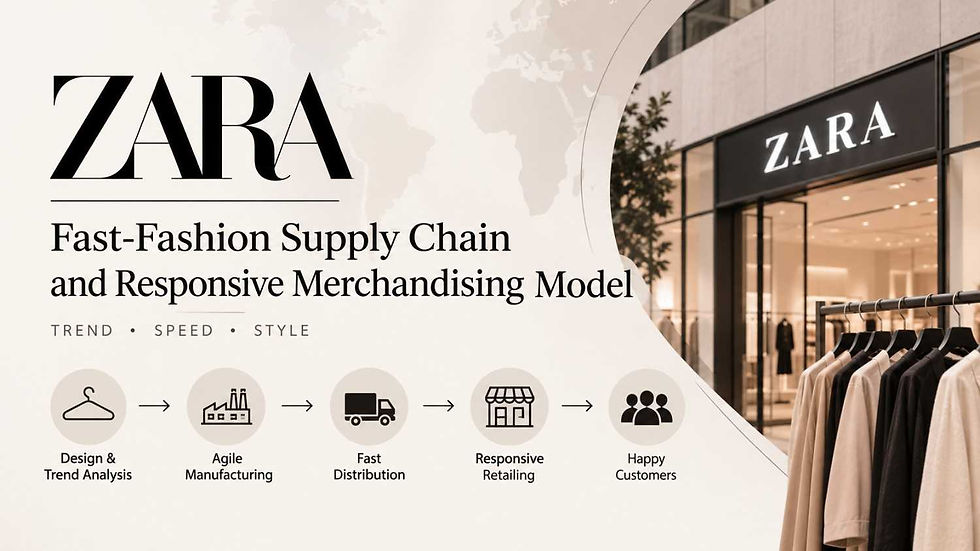
Based on Inditex’s own public disclosures (annual reports and investor materials), the company’s stated strategic priorities for Zara center on: (1) maintaining a highly responsive supply chain that can translate customer demand signals into new products within weeks rather than months or seasons; (2) limiting production commitments early in a selling season so that the majority of a season’s output can be adjusted based on real sales data; and (3) maintaining tight integration between design, sourcing, logistics, and retail operations rather than outsourcing these functions to third parties. Inditex has publicly described this as enabling the company to act as “customer-led,” adjusting what is produced based on what is actually selling in stores rather than on advance forecasts.
Supply Chain Architecture & Execution
Several elements of Zara’s operating model are confirmed through Inditex’s annual reports, investor presentations, and reporting by credible business media (including Reuters, Bloomberg, and the Harvard Business School/Harvard Business Review case literature on Zara, which itself draws on company disclosures).
Vertical integration and proximity sourcing.
Inditex has disclosed that a substantial portion of Zara’s garment production takes place in Spain and nearby countries (Portugal, Morocco, and Turkey), rather than being fully offshored to distant low-cost manufacturing regions. This proximity sourcing is a deliberate trade-off: unit production costs are higher than fully offshored competitors, but lead times are dramatically shorter, which Inditex has stated allows the company to replenish stores faster and reduce dependence on long-range forecasting.
Centralized logistics.
Inditex operates centralized distribution centers in Spain, most notably its logistics hub in Arteixo and additional distribution facilities disclosed in its annual reports, from which garments are shipped to stores worldwide multiple times per week. Inditex has publicly stated that most Zara stores receive new shipments twice a week, a cadence the company has described in investor materials as central to keeping in-store assortments fresh and giving customers a reason to visit frequently.
Small-batch production and limited forecasting.
Inditex’s public disclosures describe a model in which garments are produced in smaller batches than is typical in the industry, with a significant proportion of each season’s collection designed and manufactured after the season has already begun, based on observed early sales data rather than solely on advance forecasts. This reduces the risk of large unsold inventories, a dynamic the company has referenced in its annual reports when discussing inventory management and markdown levels relative to industry norms.
Store-level data feedback.
Inditex has publicly described a process by which store managers and sales data feed information back to designers and commercial teams, informing near-term decisions on reorders, fabric allocation, and new designs. This feedback loop has been described by Inditex executives in company communications and referenced extensively in third-party business press coverage (including Reuters and Bloomberg reporting on Inditex’s operations) as a defining feature of the company’s “test and react” approach, in contrast to competitors that commit to full seasonal lines far in advance.
Technology investment.
Inditex has disclosed in its annual reports significant investment in technology supporting its integrated store and online operations, including RFID (radio-frequency identification) tagging of inventory, which the company has stated improves stock accuracy and supports faster replenishment decisions, and integration between online and physical store inventory to support omnichannel fulfillment.
Positioning & Consumer Insight
Zara’s market positioning, as reflected consistently in its own corporate communications and widely corroborated by business press coverage, is built around offering current fashion trends at accessible price points with limited-edition, frequently refreshed assortments. Rather than relying on heavy advertising spend, Inditex has stated in its annual reports that Zara has historically invested a comparatively low percentage of revenue in traditional advertising relative to many apparel peers, instead directing resources toward store locations, store design, and supply chain speed as the primary drivers of brand experience and customer traffic.
The underlying consumer insight embedded in this model, as described in Inditex’s own communications and widely referenced in business literature on the company, is that scarcity and freshness drive both urgency and repeat visitation: because Zara produces in smaller batches and replenishes frequently rather than restocking identical items in bulk, a specific item may not be available again once sold out. Inditex has publicly characterized this as encouraging customers to purchase when they see an item rather than delay the decision, and as supporting higher store visit frequency compared to conventional retail replenishment cycles.
Media & Channel Strategy
What is publicly documented is that Inditex has described, in its annual reports and investor presentations, an integrated store and digital retail strategy, including investment in its online store platform across the markets in which Zara operates, and described its physical stores as a core “showcase” for the brand, with flagship locations in major global cities. Inditex has also disclosed integration between online and in-store inventory systems to support options such as online ordering with in-store collection, as outlined in its investor communications.
Business & Brand Outcomes
Inditex is a publicly listed company and discloses consolidated financial results, including net sales, gross margin, and store count, in its annual reports and periodic investor presentations, which are publicly available through the company’s investor relations channels. These reports have consistently shown Inditex, with Zara as its largest brand by revenue contribution, generating multi-billion-euro annual net sales and maintaining a global store and online footprint across numerous markets, as detailed in the company’s own filings.
Beyond headline financial figures, Inditex’s annual reports and investor materials have referenced the company’s supply chain responsiveness as a contributor to maintaining lower markdown levels relative to some apparel peers, and to sustaining customer footfall through frequent assortment refreshment. No verified public information is available on specific internal metrics such as exact production lead times for individual garments, exact store replenishment cost savings, or granular profitability by product category, as Inditex has not disclosed these figures publicly.
Strategic Implications
Zara’s case illustrates a structural alternative to the industry-standard forecast-and-produce model in apparel retail. By accepting higher unit production costs in exchange for proximity sourcing and shorter lead times, Inditex has built a system in which the primary constraint on growth and profitability shifts from forecasting accuracy to logistics and production flexibility. This has several implications documented or reasonably drawn directly from Inditex’s own public disclosures:
First, vertical integration and proximity sourcing function as a deliberate cost-versus-speed trade-off rather than a cost-minimization strategy, which differentiates Inditex’s stated approach from many competitors that prioritize low unit production cost through distant offshoring.
Second, the store-level feedback loop described in Inditex’s communications positions physical retail locations not merely as points of sale but as a live data-gathering mechanism that informs near-term production decisions, blurring the traditional separation between retail operations and merchandising/design functions.
Third, the model’s reliance on small-batch production and limited advance forecasting, as disclosed by the company, is directly tied to the inventory and markdown outcomes referenced in Inditex’s annual reports, illustrating how supply chain architecture can directly shape brand economics rather than being a purely operational, back-office consideration.
Finally, because specific internal processes, software systems, and granular performance metrics are not publicly disclosed by Inditex, students and practitioners should treat the publicly available picture of Zara’s model as directionally reliable but incomplete useful for understanding strategic logic and disclosed outcomes, but not a substitute for the proprietary detail Inditex has chosen not to make public.
Discussion Questions
What are the strategic trade-offs Inditex accepts by prioritizing proximity sourcing over lower-cost offshore manufacturing for Zara, and under what competitive conditions might this trade-off become less advantageous?
How does Zara’s store-level data feedback loop, as publicly described by Inditex, change the traditional relationship between retail operations and product design functions in an apparel company?
To what extent can Zara’s responsive merchandising model, as documented in Inditex’s public disclosures, be replicated by competitors that rely more heavily on offshore manufacturing, and what structural barriers might limit replication?
Given that Inditex discloses limited detail on the specific technologies and algorithms underpinning its demand-sensing capabilities, what risks does this lack of public transparency pose for analysts and investors attempting to assess the sustainability of Zara’s competitive advantage?
How might the rise of digitally native fast-fashion competitors with different sourcing and production models (as referenced in public reporting) pressure Inditex to adapt the proximity-sourcing and small-batch production principles it has historically disclosed as core to its strategy?


Comments