Allen Solly Woman: Extending a Workwear Brand into Women's Fashion in India
Industry & Competitive Context
Allen Solly Woman competes in India's branded western-wear market. Aditya Birla Lifestyle Brands Limited (ABLBL), which now owns the brand, estimates that market at Rs 7.5 lakh crore in FY2025-26, growing about 10% a year to Rs 10.9 lakh crore by FY2029-30. Its FY2025-26 annual report puts the branded share at 57% and reports casual wear growing at 11% against 7% for formal wear. The same report says organised retail is roughly 41% of India's apparel market and lists faster fashion cycles as increasingly important in women's western wear. These are company estimates; the report text reviewed does not name an underlying research provider.
Allen Solly sits in the Aditya Birla Group's branded-apparel business, historically Madura Fashion & Lifestyle, alongside Louis Philippe, Van Heusen and Peter England. A 2011 trade report said the other three brands sold mainly formal wear, while Allen Solly served consumers who wanted a range between formal and casual. The corporate structure has since changed twice: Aditya Birla Fashion and Retail Ltd (ABFRL) was formed in May 2015 by consolidating Madura with Pantaloons, and the western-wear brands, Allen Solly included, were demerged into ABLBL in May 2025.
What is documented is overlap inside the portfolio. Business Standard's report on ABFRL's November 2019 results attributed a single growth figure to women's wear for Allen Solly and Van Heusen combined, and ABLBL's FY2025-26 report says womenswear is expected to play an important role in Van Heusen's growth, with Taapsee Pannu as that brand's womenswear ambassador. ABFRL's September 2015 analyst presentation also listed the rising prominence of women's fashion among changing market conditions.
Brand Situation Prior to Campaign
Madura launched Allen Solly in India in 1993, and the company credits the brand's 'Friday Dressing' concept with creating the 'smart casuals' category. The women's range came later. Business Standard reported in March 2006 that it was launched in 2001; some later coverage dates it to 2002, a discrepancy this case does not resolve.
Per that 2006 report, womenswear was about a fifth of brand sales: the article puts brand sales at just over Rs 150 crore and womenswear at about Rs 30 crore. Madura's president, Hemchandra Javeri, wanted womenswear to reach Rs 100 crore in three years. The plan rested on retail. Four exclusive brand stores were open and a fifth was coming in Lucknow; four exclusive womenswear outlets were lined up for the North-east; the company intended to open 20 outlets that year and 70-80 within three years. Evening wear was to be added to a range the report described as sitting between smart casuals and officewear, alongside accessories such as scarves, handbags, sunglasses and watches.
By November 2011, company statements reported by PTI and FashionUnited gave brand sales of Rs 500 crore at retail price for the year to March 2011, up threefold in three years (a 40% compound annual growth rate). Madura said it aimed to double the brand's revenue in three years at 30% a year. It described the women's range as drawing a strong response and expected womenswear growth to outpace menswear that year. Womenswear was sold in about 70 stores, with 25 women-only stores planned over two years. The company planned 40-50 new Allen Solly stores in 2011-12 and 300 stores by 2012-13, at about 1,800 sq ft and Rs 40 lakh of capital each, with company-owned and franchised stores at roughly 70:30.
In 2015 the brand head told PTI that the brand had grown at 34% a year over three years, and that womenswear was 18% of revenue, children's wear 7% and exports 5%, with menswear holding the largest share. He said the brand expected to cross Rs 800 crore that fiscal year and Rs 1,000 crore the next. These were targets, and no verified public information is available on whether they were met. He also said women's and children's collections under the Wimbledon-linked Solly Sport label were planned by April 2016. At brand level, a separate 2015 news report quoted the company as saying exclusive outlets contributed 50% of revenue, multi-brand outlets 46% and online 4%.
The company's own release describes 'Fun at Work' (April 2019) as the first media campaign for the womenswear range, about eighteen years after the 2001 launch reported in 2006. Earlier communication for the range may have existed in other forms; no verified public information is available on it.
Strategic Objective
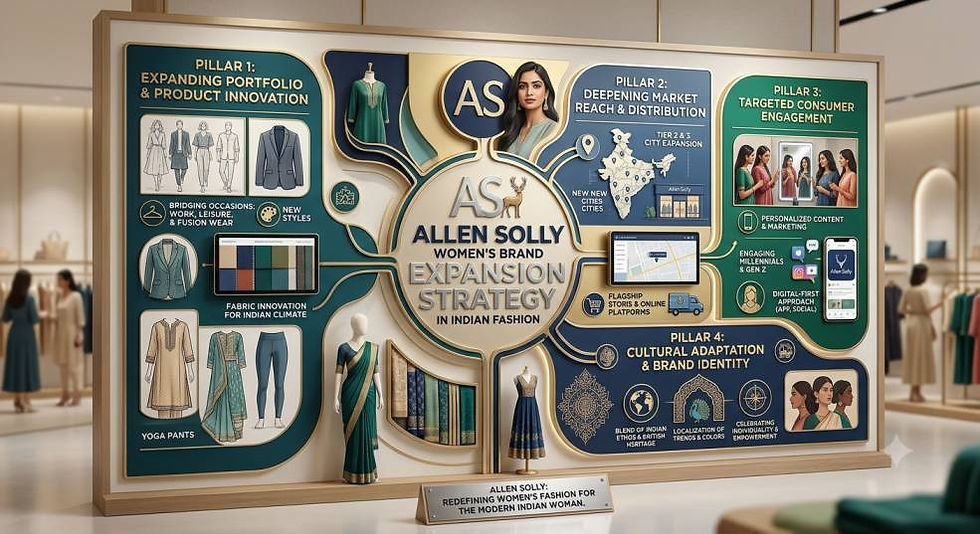
The documents do not contain one continuous statement of objective for Allen Solly Woman, so objectives have to be read across successive disclosures. In 2006 the stated goal was scale: take womenswear from about Rs 30 crore to Rs 100 crore in three years through retail expansion and a wider range. In 2011 it was relative growth: womenswear to outpace menswear, supported by women-only stores and a possible accessories extension. By 2015 the company was planning women's collections under Solly Sport. In 2019 the language moved from stores and revenue to the consumer: the company described 'Fun at Work' as an attempt to re-connect with the new-age woman, and 'Own Your Shape' as an expansion into size-inclusive fashion. In 2025 the stated priority was visibility, with the appointment of the brand's first womenswear ambassador and handbags as the launch category. ABLBL's FY2025-26 report lists womenswear, bags and accessories among the adjacencies where Allen Solly is building sharper propositions.
Read together, the disclosures trace a move from distribution targets toward consumer-facing propositions. That is a pattern in the documents, not a stated strategy.
Campaign Architecture & Execution
'Fun at Work' (22 April 2019). ABFRL's release calls it the first media campaign for the womenswear range. Ogilvy conceptualised a film set in a modern office where young women in Allen Solly clothes play cricket and the brand's Stag mascot serves as umpire. The release ties the idea to the brand's 'Open Work Culture' space and presents the range as dresses that look tailored yet feminine, plus shirts and tops, suitable for work and beyond. The campaign ran on TV, Hotstar, cinema halls and social media.
'Own Your Shape' (30 August 2019). Also created by Ogilvy, this campaign launched a dress range in different sizes. The film uses a measuring tape as a metaphor for fit problems and follows three women of three body shapes. The company framed it as an entry into size-inclusive fashion built on body positivity, and its creative director said the collection extended beyond workwear into casual and evening wear. The release states the brand had over 200 points of sale.
Premium and accessories moves. The Aditya Birla Group's brand page says Allen Solly Women expanded beyond workwear for the modern young working woman, and introduced a premium collection, Edition, with boardroom-appropriate formalwear (the page is undated). On handbags, ABFRL's 'Bag Your Stars' campaign ran in 135 Allen Solly stores until 31 March 2025, with an in-store claw-machine installation. On 30 September 2025, ABLBL announced tennis player Sania Mirza as the first-ever brand ambassador for Allen Solly Woman. Richa Pai, the brand's Chief Business Officer, was quoted in the announcement. The accompanying campaign was reported as the first for Allen Solly bags, a range of totes, satchels, slings and backpacks sold in more than 135 stores and on e-commerce platforms. ABLBL's FY2025-26 report counts the Sania Mirza handbags campaign among the stories that reinforced the brand's relevance.
Analytically, the sequence shows three different creative briefs rather than one platform. The first sold comfort and self-expression within workwear, the second sold fit as a functional benefit, and the third sold an accessory category through a celebrity.
Positioning & Consumer Insight
The company's consistent claim is pioneership: its releases describe Allen Solly as a pioneer of western workwear for women in India. Within that, the documented consumer insights are narrow and specific. For 'Own Your Shape' the company said consumers wanted to "move beyond the one-size-fits-all standard" and that Indian body shapes are unique, which makes the insight about fit, not aspiration. For 'Fun at Work' the stated insight was that working women want workwear that is cool, comfortable and expressive.
The positioning vocabulary also shifted within 2019 releases. The April release describes the brand as India's pioneer in semi-formal dressing; the August release describes it as a pioneer in casual workwear. The brand pages and later releases extend the territory further, to 'work and beyond', evening wear, formalwear under Edition, and handbags. The documents show a brand widening its occasion set while keeping 'workwear' as its anchor word. Whether that widening dilutes or strengthens the proposition is not something the public record answers; the ABLBL report itself frames Allen Solly as moving from corporate dressing toward leisure, travel, festive and youth-led occasions.
Media & Channel Strategy
Documented media choices are limited to what the releases state. 'Fun at Work' used TV, Hotstar, cinema and social media. The 'Own Your Shape' release links a film but does not list platforms. Trade reports on the 2025 handbag campaign describe a rollout across digital platforms and in stores, and one adds print.
Distribution is better documented. The 2006 and 2011 plans were store-led, including women-only outlets, and the brand-level 2015 channel mix was dominated by exclusive and multi-brand stores. By 2019 the brand reported over 200 points of sale. ABLBL's FY2025-26 report gives the Allen Solly network as over 550 stores, and sets a channel plan in which department stores prioritise trousers, handbags and boardroom dressing, while e-commerce and marketplaces use channel-specific assortments and tighter inventory control.
Business & Brand Outcomes
The documented results are thin and mostly indirect. In 2006 womenswear was about Rs 30 crore, or about a fifth of brand sales. In 2011 the company reported strong response to the range without giving women's figures. In 2015 womenswear was 18% of brand revenue. In Q2 FY2020, ABFRL's release said Lifestyle brands revenue rose 15% from Rs 1,090 crore to Rs 1,254 crore, driven by exceptional growth in new initiatives around women and kids wear. Its investor presentation said women's and kids wear were growing 60% and 30%, and Business Standard reported that the 60% figure covered Allen Solly and Van Heusen together, on a smaller base, with the 30% kidswear figure for Allen Solly. Because two brands are combined and no base is given, Allen Solly Woman's own growth cannot be isolated. At portfolio level, ABLBL reported Lifestyle brands revenue of Rs 7,154 crore in FY2025-26.
One comparison is worth flagging. Womenswear was about a fifth of brand sales in 2006 and 18% in 2015, although the company said in 2011 that it expected women's growth to outpace men's. The two figures come from different reports and the basis of each is not stated, so this is an observation, not a measured trend. It does suggest that the published data do not show womenswear gaining share across that period.
Strategic Implications
Distribution led, communication followed. The record shows a range built through stores, product and accessories for years before the company ran a dedicated media campaign for it (2019) or appointed a dedicated ambassador (2025). The sources do not say why. For a case discussion, the point is the sequencing itself: an extension can grow inside a parent brand's equity and retail network, but the company reports no public evidence on what dedicated communication added.
Portfolio reporting limits attribution. When Allen Solly and Van Heusen womenswear are reported together, and Van Heusen is separately building a womenswear franchise with its own ambassador, outsiders cannot judge either brand's women's strategy. Managers face the same problem internally if sibling brands chase the same occasion without separate metrics.
Fit as an extension insight. 'Own Your Shape' anchored the extension in a functional problem, fit, rather than a lifestyle claim. That is a distinct strategic choice from the 2025 ambassador-and-handbag approach, which builds salience through personality and an accessory category. The record shows the company has used both.
The anchor word question. Workwear remains the brand's anchor, yet the documented range now spans casual, evening, premium formal and bags. ABLBL's stated ambition to build India's largest western-wear branded portfolio over five years raises the question of how much breadth one brand name can carry, and the public record does not answer it.
Discussion Questions
Allen Solly's womenswear grew through stores and range extensions long before a dedicated media campaign. What are the strengths and risks of sequencing an extension this way, and what evidence would you need to judge it?
Business Standard reported Allen Solly and Van Heusen women's growth as one combined figure. How should a multi-brand house govern overlapping women's propositions, and which metrics should it track separately?
'Own Your Shape' rested on a fit insight. When does a functional insight make a stronger extension platform than an aspirational one, and what are the limits of a dress-led message for a workwear brand?
The published shares (about a fifth in 2006, 18% in 2015) do not show womenswear gaining ground despite stated intentions. What other explanations are consistent with the data, and what disclosures would let you test them?
In 2025 the company paired its first womenswear ambassador with a handbag launch. Evaluate the logic of using a celebrity to open an accessory category, and propose how success should be measured given the limited public data.


Comments