Matrimony.com and the Persistence of Digital Matrimonial Search
Industry & Competitive Context
India’s matchmaking economy sits at the intersection of two parallel markets: a centuries-old offline tradition of family-led arranged marriage, and a growing digital layer of online matrimony and dating platforms. According to a published RedSeer industry analysis, the online matrimony market in India was estimated at roughly INR 1,200–1,400 crore, growing at a compound annual rate of approximately 10–12%, with the broader offline matrimony market estimated at INR 4,500–5,000 crore and growing more slowly, at 4–5% annually. The same report placed the combined online dating and matrimony opportunity at around 30% of the total addressable market in 2025, projected to exceed 40% by 2030, implying that offline, family- and community-led matchmaking still accounts for the majority of marriages arranged in India even as digital search expands.
Within this landscape, Matrimony.com Limited operator of the flagship BharatMatrimony brand competes most directly with Shaadi.com and Jeevansathi.com in the organised matrimony category. The RedSeer report notes that Shaadi.com and BharatMatrimony lead the category, followed by Jeevansathi, and that users frequently maintain accounts across more than one of these platforms simultaneously, a dynamic that limits the durability of exclusive user loyalty and intensifies the role of brand salience and trust signalling in customer acquisition.
A second and more structurally significant competitive pressure comes from dating applications both global platforms such as Tinder, Bumble, and Hinge, and India-focused entrants such as Betterhalf.ai, Aisle, and QuackQuack which have progressively normalised app-based partner discovery among younger, urban Indian cohorts. The RedSeer analysis also documents an emerging counter-trend within this category: swipe-first dating formats are reportedly losing share, with one unnamed popular dating app recording a 7% year-over-year decline in monthly paying users in the third quarter of 2025, while apps positioned around intent-driven or “serious” relationship-seeking reported a 17% rise in paying users over the same period, alongside survey findings that over 75% of Gen Z app users report “swiping fatigue.” This shift is strategically relevant because it narrows, rather than widens, the positioning gap between matrimony platforms (traditionally oriented toward marriage-intent search) and a segment of the dating-app market now also repositioning around seriousness of intent.
Brand Situation Prior to Campaign
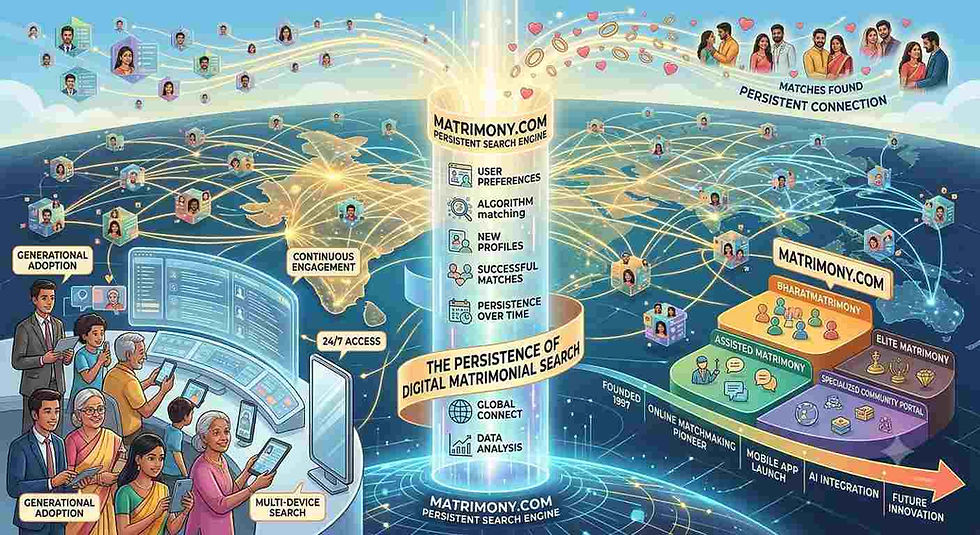
Matrimony.com Limited traces its founding to 1997, when Murugavel Janakiraman launched what would become BharatMatrimony from Chennai. The company subsequently built a portfolio strategy rather than a single-brand strategy: in 2000 it launched a set of community- and language-specific matrimonial websites including BengalMatrimony, MarathiMatrimony, GujaratiMatrimony,PunjabiMatrimony,HindiMatrimony,SindhiMatrimony, KannadaMatrimony, KeralaMatrimony, TeluguMatrimony, and TamilMatrimony reflecting an early recognition that matchmaking preferences in India are strongly mediated by regional, linguistic, and caste-community identity rather than being a single undifferentiated national market. The parent entity, originally named Consim Info, was renamed Matrimony.com in 2013, consolidating the group identity around its best-known consumer brand.
The company also diversified its service tiers over time: an assisted-matchmaking offering (originally BM Privilege, later renamed Privilege Matrimony and then Assisted Matrimony) launched in 2008–2009 for users wanting human-mediated search, and Elite Matrimony, an invitation-only premium matchmaking service for high-net-worth individuals, also launched in 2008. The company additionally built an offline physical-centre network, BharatMatrimony Centres, beginning in 2005, extending its digital model into brick-and-mortar touchpoints a structural choice that distinguishes it from pure-play digital dating competitors and signals an explicit strategy of hybrid trust-building rather than app-only acquisition.
By the mid-2010s, the company was operating in an environment where global dating apps were entering urban India and beginning to shift public discourse around how young adults might meet partners. Matrimony.com went public on the BSE and NSE in September 2017, with its initial public offering priced in a band of INR 983–985 per share, raising approximately INR 497 crore through a combination of a fresh issue of roughly INR 130 crore and an offer for sale of approximately INR 367 crore; the stock listed on 21 September 2017. The IPO prospectus disclosed intended use of proceeds including approximately INR 20 crore for advertising and business promotion and INR 42.58 crore toward purchase of land for a Chennai office, indicating that brand marketing investment was an explicit, disclosed capital priority at the time of listing, alongside infrastructure consolidation and debt repayment.
Strategic Objective
Across the period following its public listing, Matrimony.com’s publicly disclosed marketing activity reflects a consistent strategic objective: reinforcing BharatMatrimony’s relevance as a serious, marriage-intent platform at a moment when digital dating culture was becoming more visible and socially normalised in India, without abandoning the platform’s foundational association with family-involved, community-anchored matchmaking. Statements attributed to founder and CEO Murugavel Janakiraman in company and trade-press coverage describe an intent to “break new ground and change the social perspective about relationships and marriage,” explicitly tying brand communication to a broader social-values narrative rather than a narrower functional product pitch.
This objective manifested differently across specific campaigns and time periods, but the throughline as documented in company statements and press coverage was positioning BharatMatrimony not merely as a search utility but as a platform aligned with evolving, more egalitarian and compatibility-driven expectations of marriage, while retaining its core trust and verification proposition relative to unstructured, open-ended dating formats.
Campaign Architecture & Execution
Three publicly documented campaign efforts illustrate the architecture of this strategy across different formats and time horizons.
In December 2018, BharatMatrimony launched a television commercial titled “Find Your Equal,” featuring cricketer MS Dhoni, conceptualised by agency Planning Room. The campaign’s explicitly stated objective, per company and trade-press statements, was to promote equality in marital relationships and to challenge traditional gender-role expectations, built on the company’s stated view that “marriages are happier and successful when there is equality in the relationship.” Dhoni was quoted endorsing the same theme (“I believe in the woman’s right to equality in the relationship”), and the campaign was structured as an integrated, 360-degree rollout across television, print, radio, and out-of-home media, rather than a single-channel digital push. Arun Pandey, chairman of Rhiti Group (which manages Dhoni’s endorsements), publicly described the campaign as “a very well thought out campaign,” reflecting external third-party characterisation rather than only company self-description.
In 2020, during the IPL cricket season, BharatMatrimony ran a contextual, real-time social media campaign built around live match moments, reported in trade press (Social Samosa) as having been executed by the company’s internal social media team over a six-week preparation window, rather than through an external creative agency. The campaign used hashtags including #RelationshipLessonsFromCricket, #IPLHumour, and #PerfectMatch, drawing humorous parallels between cricketing moments including references to empty, pandemic-era stadiums and relationship or wedding-guest-list themes, concentrated on Twitter where live match-related conversation volume was highest. Reported, documented outcomes from this specific campaign include a stated reach of over 20 million users and more than 1,300 retweets, 3,000 likes, and 1,000 responses, according to the published case study.
In August 2023, the brand launched “Be Choosy 2.0,” developed with agency Wondrlab, built around two newly introduced platform features Hobby and Interest Matching, and Filter Breathers intended to help users identify matches sharing specific interests and priorities rather than relying solely on conventional demographic filters. The creative execution, per trade coverage, depicted couples who share interests but are geographically or circumstantially separated, reconnecting through the platform’s interest-matching functionality; the campaign comprised at least three film executions published on YouTube. Company CMO Arjun Bhatia was reported (in paraphrased rather than direct-quote form) as framing the campaign around encouraging users to be selective in choosing a life partner and positioning the company as continuously innovating its matching technology.
Positioning & Consumer Insight
Read together, these campaigns reveal a positioning strategy built on a specific consumer insight repeatedly referenced in company and executive statements: that the functional value of a matrimony platform (verified profiles, search filters, assisted matchmaking) is necessary but not sufficient to retain relevance against increasingly normalised dating-app alternatives, and that the brand must also carry an evolving social narrative about what marriage itself should look like more egalitarian (“Find Your Equal”), more compatibility-driven and selective (“Be Choosy”), and more culturally fluent and contemporary in tone (the IPL social campaign). This is a positioning strategy of incremental value redefinition rather than category reinvention: each campaign retains the core premise that the platform exists to facilitate marriage-intent matchmaking, while updating the terms on which that matchmaking is framed to track changing social attitudes, particularly around gender equality and personal compatibility, among the urban, digitally engaged cohort the company has publicly targeted.
The RedSeer industry report’s observation that “parents have shifted from sole users to ‘co-pilots’ in the matchmaking process” is also relevant context for interpreting this positioning: it suggests that the consumer insight driving campaigns like “Find Your Equal” and “Be Choosy” individual agency, compatibility, and equality reflects a documented broader shift in how matrimonial decision-making authority is distributed between individuals and families in India, rather than an insight unique to Matrimony.com.
Media & Channel Strategy
The documented campaigns span a deliberately plural media mix rather than concentration in a single channel. “Find Your Equal” was executed as a traditional 360-degree campaign across television, print, radio, and outdoor media channels associated with broad-reach, trust-building brand communication appropriate to a celebrity-endorsed campaign. The 2020 IPL campaign, by contrast, was a lower-cost, real-time social-first execution concentrated on Twitter and built around organic engagement during live sporting events, reflecting a shift toward owned and earned digital channels for topical, lower-production-cost content. “Be Choosy 2.0” was distributed primarily as short-form video content on YouTube, reflecting continued migration toward digital video formats built around feature-specific product narratives rather than broad brand-value messaging alone.
Business & Brand Outcomes
Matrimony.com’s consolidated financial results, as reported in its published annual filings and summarised in stock-exchange-linked financial data aggregators, show consolidated revenue of approximately INR 434 crore in FY2022, INR 456 crore in FY2023, INR 481 crore in FY2024, and INR 456 crore in FY2025, with consolidated net profit of approximately INR 54 crore in FY2022, INR 47 crore in FY2023, INR 50 crore in FY2024, and INR 45 crore in FY2025. Operating margin, per the same filings-derived data, declined from approximately 20% in FY2022 to approximately 13% in FY2025. The company reported a final dividend of INR 5 per share alongside its FY2025 results, with fourth-quarter profit after tax reported by business press (Business Standard) as having declined approximately 30% year-on-year in that quarter. A separate summary of the company’s FY2025 annual report cites consolidated revenue of INR 4,558 million (approximately INR 456 crore, consistent with the filings-based figures above), approximately one million paid subscriptions, and a debt-free balance sheet with cash reserves of approximately INR 3,243 million; this same source also cites newer ventures including ManyJobs, Luv.com, and AstroFreeChat as part of the company’s portfolio, though this summary is itself a third-party aggregation of the annual report rather than the primary filing.
What is documented is campaign-level engagement data for the 2020 IPL social campaign specifically (reach exceeding 20 million users, 1,300-plus retweets, 3,000-plus likes, and 1,000-plus responses, per the published trade-press case study), which represents engagement reach rather than a business outcome such as revenue, registrations, or paid conversions.
Strategic Implications
The documented record suggests several implications relevant to marketing and brand strategy analysis. First, Matrimony.com’s approach illustrates a strategy of narrative adaptation rather than business-model pivot: even as campaign themes moved from equality (“Find Your Equal”) to selectivity and compatibility (“Be Choosy”) to cultural topicality (IPL), the underlying product architecture a portfolio of community-specific matrimony brands, assisted and premium tiers, and a hybrid online-offline service model remained structurally stable across this period, with incremental additions (BharatJodii in 2021 targeting vernacular and lower-income users, and RainbowLuv in 2022 targeting LGBTQIA+ matchmaking) extending segment coverage rather than replacing the core model.
Second, the financial trend of roughly flat revenue alongside declining operating margin between FY2022 and FY2025, as reflected in the company’s own filings, sits alongside an industry context (per the RedSeer report) of continued category growth in online matrimony at a double-digit compound rate and rising competitive intensity from both matrimony peers and repositioned dating apps. This juxtaposition a maturing, visible brand within a still-growing category, but with compressing margins is a pattern worth examining independently of any single campaign’s creative merit, since it raises the question of whether brand communication investment of the kind documented here is primarily serving customer acquisition, customer retention, or broader category-level trust-building that benefits the sector as a whole, including competitors.
Third, the company’s own public statements position its brand campaigns as responses to a changing social consensus around gender equality and partner compatibility, rather than as responses to specific competitive share-shift data. This is a strategically significant choice: it frames BharatMatrimony’s marketing as values-led brand stewardship within the arranged-marriage tradition, rather than as a reactive, share-defence posture against dating apps a distinction that shapes how the brand is likely to be read by its core audience versus how it might be read by a more digitally native dating-app audience the company has, per available public information, not been shown to be directly converting at scale.
Discussion Questions
Matrimony.com’s documented campaigns (“Find Your Equal,” “Be Choosy 2.0,” and the IPL 2020 social effort) each used a different channel mix and creative register, yet reportedly pursued a consistent underlying objective. What are the risks and benefits of maintaining strategic consistency while allowing significant tactical and creative variation across a multi-year brand campaign architecture?
The RedSeer industry data indicates that dating apps positioned around “serious” or intent-driven relationship-seeking have been gaining paying users faster than swipe-first formats. How should a matrimony-focused incumbent like Matrimony.com interpret this trend as a competitive threat, a validation of its core positioning, or both?
Matrimony.com’s revenue remained roughly flat between FY2022 and FY2025 while its operating margin declined, even as the company continued investing in celebrity-led and digital-first brand campaigns. Based only on the publicly available financial and campaign information in this case, what hypotheses can be constructed and what further disclosures would be needed to test them about the relationship between brand marketing investment and financial performance in this business?
The RedSeer report notes that parents have shifted from being the sole decision-makers to “co-pilots” in matchmaking. How does this shift in decision-making structure complicate traditional marketing-funnel thinking (single decision-maker, linear purchase journey) for a platform like BharatMatrimony compared to a single-user dating app?
Matrimony.com has built a portfolio of distinct sub-brands (BharatMatrimony, Elite Matrimony, BharatJodii, RainbowLuv) targeting different demographic and income segments, alongside an offline centre network. What are the strategic trade-offs of this portfolio-and-hybrid-channel approach compared to a single, unified digital-only brand strategy, particularly in a market where, per RedSeer, users often maintain profiles across multiple competing platforms simultaneously?


Comments