Amazon India's Insight into Trust and Reliability: From "Apni Dukaan" to Mission
Industry & Competitive Context
India's e-commerce market in the mid-2010s was one of the most contested digital battlegrounds globally. The overall Indian e-commerce market had grown substantially by 2015, with e-tailing — covering electronics, fashion, and general merchandise — as the fast-growing sub-segment. Amazon launched its Indian marketplace, Amazon.in, in June 2013, entering a category already claimed by homegrown incumbents Flipkart and Snapdeal. Flipkart, founded in 2007, had a multi-year head start and had built its brand on transactional efficiency and aggressive discount-led events, most notably its Big Billion Days sale. The competitive landscape was further characterized by a uniquely Indian set of consumer behaviors: a largely cash-based economy, widespread skepticism about product authenticity online, low familiarity with returns processes, and deep reliance on interpersonal relationships and word-of-mouth as proxies for trust in commercial transactions.
By 2016, Flipkart held approximately 44–45% market share in Indian e-tailing, according to Morgan Stanley data cited by CNBC at the time, compared to Amazon India's approximately 12%. The brand was a distant second in a two-horse race. Jeff Bezos publicly committed to investing an additional $3 billion in India in 2016, bringing total investment commitments to over $5 billion, a figure widely reported by Reuters, CNBC, and Business Standard. Per regulatory filings with India's Ministry of Corporate Affairs, Amazon Seller Services recorded a net loss of ₹36.8 billion in FY2015–16 and a widened net loss of ₹48.3 billion in FY2016–17, reflecting the scale of investment in infrastructure, logistics, and market-building. The strategic imperative was, therefore, dual: significant capital would be deployed operationally, but without consumer trust — particularly in non-metro markets — that capital could not translate into durable brand equity or repeat behavior.
The broader consumer context was equally important. India's Digital India initiative was rapidly expanding internet penetration into Tier 2 and Tier 3 cities. However, as Amazon India itself acknowledged publicly, this wave of new digital consumers came with a distinctive challenge: many were first-generation online shoppers, uncertain about product authenticity, unfamiliar with grievance redressal mechanisms, and susceptible to online fraud. The structural trust gap in Indian e-commerce was not merely a branding problem — it was a category adoption problem.
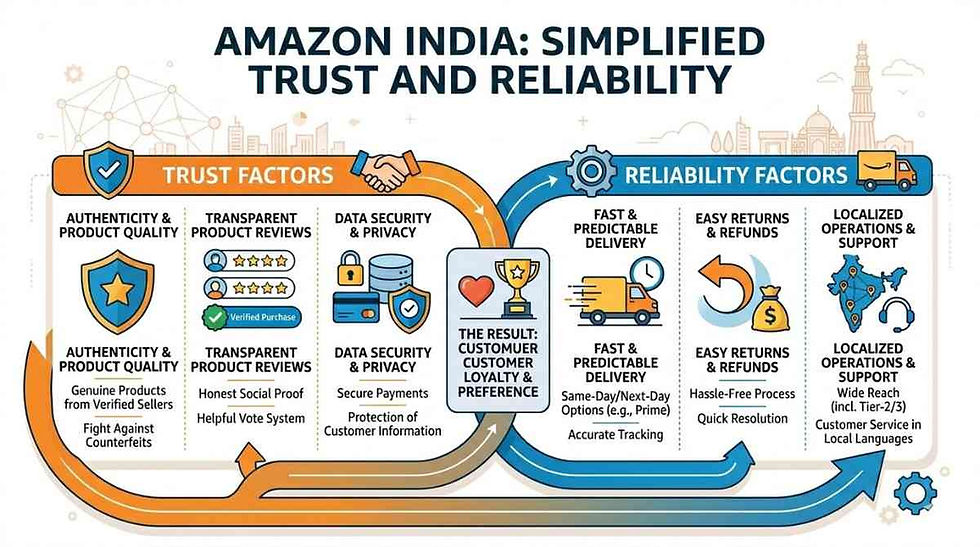
Brand Situation Prior to the Campaign
By early 2016, Amazon India had already executed a documented sequence of single-insight campaigns, each targeting a distinct barrier in the consumer adoption funnel. The "Aur Dikhao" campaign had addressed the consideration barrier by communicating breadth of product selection. "Try Toh Kar" had addressed the trial barrier by encouraging hesitant consumers to simply attempt the experience. "Kya Pehnu" had entered the fashion category with messaging directed at consumers navigating clothing choices. Each campaign was deliberately designed around one clear consumer barrier, a strategic discipline explicitly noted by Sanjay Mehta, Co-CEO of Mirum, in Exchange4Media at the time: Amazon's approach of "pushing one message clearly at a time and not confusing people with too many messages" was itself a differentiating discipline in an Indian advertising environment prone to overloading communication with multiple claims.
Despite this campaign sequence, the category of first-time and semi-urban online shoppers remained substantial, and the core emotional barrier — distrust of an impersonal, digital platform relative to the familiarity of a local physical store — had not yet been directly addressed. The "Apni Dukaan" campaign was Amazon India's response to this gap.
Strategic Objective
The strategic objective of the Apni Dukaan campaign, as articulated by an Amazon India spokesperson in published press coverage at the time of launch, was explicitly to address consumer hesitancy about online shopping by drawing a direct equivalence between the trust and familiarity associated with a local neighborhood store and the Amazon.in platform. The spokesperson stated: "While e-commerce adoption is growing in the country, there is still a large section of population that is hesitant about making purchases online. In order to convey features like easy returns and access to genuine products that essentially build customers' trust and confidence in shopping on Amazon.in, we decided to use a phrase from Indian popular culture 'Yeh Apni Dukaan Hai'. In daily parlance, customers generally use 'Apni Dukaan' in reference to those stores that they are more familiar with and have complete trust in. We want to make people aware that Amazon.in is one such store."
The objective was, therefore, strategic in the precise sense: it was not to communicate a product feature or a price advantage, but to close a psychological distance between the consumer and the platform. Trust, rather than price or convenience, was the chosen competitive differentiator.
Campaign Architecture & Execution
The Apni Dukaan campaign was launched in February 2016 and conceptualized by Orchard Advertising, a part of the Leo Burnett India Group, as documented in Exchange4Media and BestMediaInfo trade coverage. The creative approach centered on relatable, slice-of-life scenarios involving everyday Indian consumers — not celebrities, not aspirational lifestyle imagery — in which the features of Amazon.in resolved common shopping anxieties. Three specific service attributes were embedded into the narrative framework: one-day delivery, easy returns, and Cash on Delivery (COD). The selection of these three features was strategically precise. COD directly countered the fear of digital payment among consumers who had no established trust in online transactions. Easy returns addressed the irreversibility anxiety — the fear that online purchases could not be undone if unsatisfactory. One-day delivery countered the perception that e-commerce was slower and less reliable than a trip to a local store. The campaign was distributed as a 360-degree execution across OOH, radio, digital, social, and on-site channels, accompanied by a jingle designed for recall.
Rather than ending with Apni Dukaan, Amazon India deepened the same brand platform through a sequel campaign, #AdjustNoMore, launched in July 2016 and also covered by Exchange4Media. The #AdjustNoMore execution extended the trust narrative by dramatizing a second dimension of the same consumer truth: not only was Amazon a familiar, trustworthy destination, but with Amazon, Indian consumers no longer needed to accept compromise in their purchases. Neha Contractor, Senior VP and Branch Head at Orchard Advertising Bengaluru, was quoted in BestMediaInfo explaining this as an access narrative: "Indians have adjusted with too many things for far too long."
The brand platform evolved further in subsequent years. The "Apno Ka Saath" campaign, conceptualized by Ogilvy and documented in Exchange4Media coverage from 2019, extended the "Aapki Apni Dukaan" positioning through relationship-trust storytelling, deploying the emotional insight that the benefits of Amazon.in are often introduced to new users by their own circle of trust — friends and family. N. Ramamoorthi, President of Ogilvy Group Companies, South, was quoted in Exchange4Media articulating this: "The several benefits of shopping on Amazon.in are often introduced to someone by his or her circle of trust." The campaign was executed in seven languages — Tamil, Telugu, Kannada, Malayalam, Hindi, Marathi, and Bengali — across TV, Digital, and OOH, as confirmed in the Exchange4Media coverage. The "Ajnabi Shahar Mein Apni Dukaan" campaign of 2018, conceptualized by Ogilvy Bangalore, told stories of people settling into unfamiliar cities and finding support through Amazon, reinforcing the same emotional register of reliability in unfamiliar circumstances. In 2017, the "India ke Sapno Ki Apni Dukaan" campaign, developed by Ogilvy Bangalore for the T20 cricket season, tied the Apni Dukaan brand identity to the aspirations of Indians dreaming beyond their current circumstances, with the campaign distributed through TVCs, digital, OOH, print, and radio. Ravi Arun Desai, Director of Mass and Brand Marketing at Amazon India, was quoted in published coverage on this campaign articulating the brand space explicitly.
Positioning & Consumer Insight
The foundational consumer insight driving the Apni Dukaan brand platform is one of remarkable cultural precision. In everyday Indian household discourse, the phrase "Apni Dukaan" — literally "our own shop" — carries meaning far beyond commercial transaction. It denotes a store where the relationship is personal, where trust is implicit, where one is known by name, and where the shopkeeper's interest in the customer's wellbeing is assumed. This relationship-based model of commerce is the default against which all new commercial forms are measured in India, particularly in Tier 2 and Tier 3 cities where interpersonal community structures remain the dominant social organizing principle.
Amazon's strategic choice to compete on this cultural terrain — rather than on discount depth, product breadth, or technological differentiation — reflects a sophisticated understanding of what consumer behavior theorists call Jobs to Be Done. The functional job of an online purchase was adequately served by existing platforms. The emotional job — the desire to feel personally known, reliably served, and protected in a transaction — was not. By positioning Amazon.in as the digital equivalent of the trusted neighborhood store, the campaign directly addressed the emotional job, not merely the functional one.
This positioning also reflected a deliberate geographic targeting decision. The campaign's primary audience was not the metro consumer already comfortable with online commerce, but the semi-urban and emerging market consumer for whom the first online purchase was still an act of psychological risk.
Media & Channel Strategy
The verified channel deployment across the Apni Dukaan campaign series was consistently multi-platform and regional. The original Apni Dukaan campaign of February 2016 ran across OOH, radio, onsite (Amazon.in), digital, and social channels, as documented in Exchange4Media. The 2017 T20 campaign "India ke Sapno Ki Apni Dukaan" was deployed across TV, digital, social, OOH, print, and radio according to press coverage from MediaNews4U. The Apno Ka Saath campaign was rolled out across TV, digital, and OOH in seven languages. The multilingual deployment — consistently documented across campaign iterations — reflects a structurally important channel decision: in a country with more than twenty scheduled languages and hundreds of dialects, trust communication must be delivered in the consumer's own language to be credible.
No verified public information is available on specific media spend allocation or budget figures for any of the individual Apni Dukaan campaign executions.
Mission GraHAQ: Trust at the Category Level
By 2022, Amazon India had moved beyond brand-level trust communication to invest in what can be described as category-level trust infrastructure. Mission GraHAQ, announced via official press release on November 29, 2022, was described as a multi-phase consumer education campaign focused on safe online shopping practices, with particular emphasis on Tier 2 and Tier 3 cities where digital adoption was accelerating but consumer awareness of rights and fraud risks remained low. The initiative was formally endorsed by Rohit Kumar Singh, then Secretary of the Department of Consumer Affairs, Government of India, who was quoted in the official press release: "As online shoppers in India increase, it is important to ensure their rights are protected to have a safe and trustworthy shopping experience."
The first phase of Mission GraHAQ deployed street plays — Nukkad Naataks — across more than 100 cities in Karnataka, Tamil Nadu, Haryana, Uttar Pradesh, Gujarat, and Delhi, with each performance running eight to twelve minutes and followed by audience feedback sessions. Phase 1 reached over 16 million people, primarily in Tier 2 and Tier 3 areas, according to Amazon's official communications. Phase 2, in 2023, expanded to India's northeastern states, reaching an additional 15 million people through regional radio shows in partnership with All India Radio. By the time of Phase 3 (Mission GraHAQ 3.0), launched at Amazon's SMBhav Summit 2024 and announced via PR Newswire on December 13, 2024, the campaign's goal was to reach 50 million consumers between December 2024 and February 2025. The third phase introduced GraHAQ Chakra — mural installations on chai stalls, auto-rickshaws, and public walls across 30 cities — alongside social media amplification in regional languages. By December 2025, Amazon India's official communications confirmed that the Mission GraHAQ initiative had cumulatively reached more than 60 million people across the country in multiple Indian languages, including eight languages from the northeast.
In 2025, Amazon India also launched #ScamSmartIndia, a collaborative initiative with the Ministry of Home Affairs' Indian Cybercrime Coordination Centre (I4C), conducting 26 workshops for over 5,000 students across four cities and creating co-branded digital content that reached over 285 million views, as documented in Amazon India's official communications on December 24, 2025.
Business & Brand Outcomes
The documented brand and business outcomes associated with Amazon India's trust-led strategy span multiple dimensions. In terms of market position, Amazon India's market share grew from approximately 12% in early 2016 to approximately 27–31% by 2016–2018, as documented through Counterpoint Research and Forrester data cited in multiple news sources including Bloomberg and BloombergQuint. Amazon Seller Services revenues grew 43% to ₹32.56 billion in FY2016–17, per regulatory filings reported by Business Standard. By 2018, a Forrester survey of 2,000 respondents across nine Indian cities found that 80% of metro consumers shopped on Amazon versus 65% on Flipkart, as cited in published coverage.
On brand equity metrics, TRA Research's Brand Trust Report for 2026, reported by Open Magazine, ranked Amazon India as the number one most trusted brand in India — an eleven-rank jump from the previous year. The report's CEO, N. Chandramouli, characterized Amazon's rise as reflecting "the growing role of online marketplaces that now anchor everyday consumer activity." On the Mission GraHAQ dimension, the initiative's cumulative reach of over 60 million people across three phases represents a documented, publicly confirmed scale of consumer engagement on trust and safety education.
No verified public information is available on specific sales impact attributable to individual campaigns within the Apni Dukaan series, or on internal metrics such as first-time buyer growth rates or repeat purchase behavior specifically linked to the trust campaign interventions.
Strategic Implications
The Amazon India case carries implications that extend well beyond the specific campaigns examined here, into the broader principles of consumer insight–led marketing in emerging digital economies.
The first and most important implication is that in markets where e-commerce adoption is still incomplete, trust is not a hygiene factor — it is the primary growth lever. In mature e-commerce markets, trust is largely assumed by consumers who have spent years transacting online. In India in 2016, and even more so in the Tier 2 and Tier 3 cities that represented the next frontier of e-commerce growth, trust was the variable that separated potential customers from actual customers. Amazon's decision to make trust the organizing principle of its brand communication — and to sustain that commitment across a sequence of campaigns over eight years — reflects a structural understanding of the Indian market that purely transactional or price-led competitors could not replicate.
The second implication concerns the strategic difference between product-led and insight-led creative briefs. Each campaign in the Apni Dukaan series was built on a single consumer insight, communicated one message at a time, and targeted one specific adoption barrier. This architectural discipline — noted publicly by industry observers including Sanjay Mehta of Mirum — stands in direct contrast to the cluttered, multi-claim advertising prevalent in Indian FMCG and e-commerce categories. The restraint of single-insight communication is not merely a creative choice; it is a strategic decision to maximize the signal-to-noise ratio in consumer memory encoding.
The third implication is the strategic value of category investment versus brand investment. Mission GraHAQ is not, at its core, an Amazon brand campaign. It is a platform-agnostic consumer education initiative that benefits the entire e-commerce category. Chetan Krishnaswamy, Vice President of Public Policy at Amazon India, explicitly articulated this in the official press release for Mission GraHAQ 3.0: the guidance delivered through the initiative is "platform-agnostic, not just limited to Amazon." The strategic logic here is sophisticated: when category adoption is the binding constraint on growth, the most efficient investment is one that grows the category itself. A more trusting, more digitally literate consumer in Tier 2 India benefits Amazon disproportionately if Amazon is simultaneously the platform they associate with trust through its brand communication.
The fourth implication concerns the role of government partnerships in category-level trust building. Amazon India's documented partnerships with the Ministry of Consumer Affairs, the Indian Cybercrime Coordination Centre (I4C), All India Radio, and multiple civil society organizations — spanning Mission GraHAQ's multiple phases — represent a form of institutional credibility co-borrowing. By associating its trust-building initiatives with government imprimatur, Amazon transforms what could be perceived as a commercial self-interest exercise into a public goods contribution. This co-branding with government institutions is a strategically intelligent maneuver in a market where foreign corporations have historically faced consumer nationalism headwinds.
The fifth implication is about the translation of global brand principles into culturally specific execution. Amazon's foundational corporate value — customer obsession — is a global principle. The execution of that principle in India through the phrase "Apni Dukaan," through street theatre in rural markets, and through campaigns in eight northeastern languages is not a dilution of the global brand; it is precisely how a global brand principle becomes locally operative. This is the essence of what the academic literature on Amazon India's branding strategy, published in the Emerald Emerging Markets Case Studies journal, calls the "GLOCAL" approach — global brand values executed through local cultural intelligence.
Discussion Questions for MBA Students
Amazon India's Apni Dukaan campaign deliberately competed on trust rather than on price or product assortment, even though Flipkart's Big Billion Days discount strategy was the dominant category behavior at the time. Using the concept of positioning theory and consumer Jobs to Be Done, evaluate the long-term strategic merits of Amazon's choice to occupy the trust axis in a market where price sensitivity was well documented.
Mission GraHAQ is explicitly described as a platform-agnostic consumer education initiative — one that benefits all e-commerce players, not just Amazon. How does this category investment strategy reflect Amazon's broader competitive positioning in India, and under what market conditions does category investment deliver superior returns compared to brand investment?
The Apni Dukaan campaign architecture deployed a deliberate single-insight-per-campaign sequence: variety (Aur Dikhao), trial permission (Try Toh Kar), and trust (Apni Dukaan). Analyze this sequential communication design from the perspective of the consumer adoption funnel, and assess whether this approach is scalable for a brand entering a new category in contemporary India, where media consumption is more fragmented than in 2016.
Amazon India's revenue from its Amazon Seller Services unit grew 43% in FY2016–17, even as the company recorded significantly widened losses of ₹48.3 billion in that fiscal year. What does the co-existence of revenue growth and deepening losses reveal about Amazon's theory of competitive advantage in India, and how should marketing investment be evaluated in a business model that deliberately defers profitability?
By 2026, TRA Research ranked Amazon India as the number one most trusted brand in India across all categories. Considering that Amazon entered the country in 2013 as a foreign challenger with no pre-existing brand equity, analyze the strategic decision to anchor brand identity entirely in the cultural language of local trust ("Apni Dukaan") rather than in Amazon's global equity. What are the risks and rewards of this approach for a multinational brand operating in a culturally distinct emerging market?


Comments