Ather Energy’s Retail and Service Ecosystem Strategy
Introduction
Most electric two-wheeler makers in India compete on price, range, or software. Ather Energy has also invested heavily in the physical infrastructure around the vehicle: retail outlets, service centres, and charging points. In the financial year ending March 2026 (FY26), the company doubled its retail network and its service network at the same time. This case examines what is publicly documented about that strategy, what it was meant to achieve, and where the public record stops. It is a network and ownership-experience strategy, not a single advertising campaign, so the required case sections are applied to that programme.
Industry & Competitive Context
India is the world's largest two-wheeler market by volume. Ather's FY26 annual report, citing SIAM data, records domestic two-wheeler sales of 2.21 crore units in FY26, up 10.5%. Scooters were the fastest-growing category, reaching 38.4% of the market. Electric two-wheelers crossed one million annual sales in FY26 and reached about 6.6% of total two-wheeler sales, up from about 6.0% the previous year. The same report says three leading players, Ather among them, accounted for nearly 62% of electric two-wheeler sales that year. CRISIL projects electric penetration of 22 to 25% by FY30.
The policy backdrop shifted during the period. PM E-DRIVE, launched in October 2024 with an outlay of ₹10,900 crore, replaced earlier schemes. From April 2025, the per-vehicle incentive for electric two-wheelers was reduced to ₹2,500 per kWh, capped at ₹5,000. Ather reports that subsidy contributed 16% of its revenue in FY24, 6% in FY25, and 3% in FY26. In its own framing, the industry is moving from incentive-led adoption to product-led demand, where reliability and the ownership experience matter more.
The competitive set includes incumbent manufacturers and new-age electric players. Ather's annual report describes aggressive industry discounting and a proliferation of sub-₹1 lakh offerings in FY26. It states that Ather held its pricing, with average revenue per scooter of ₹1,21,386. Retail strategy differed across competitors. According to Storyboard18, Ola Electric was reducing its physical store network to roughly 550 locations in early 2026. That followed an earlier cut to about 700 stores and an earlier ambition of 4,000. Ather was expanding at the same time. No verified public information is available on the internal reasoning behind either company's decisions.
Brand Situation Prior to the Network Expansion
Ather opened its first Ather Space experience centre in Bengaluru in June 2018, followed by Chennai. By early 2021 it had opened centres in Mumbai, Pune, Hyderabad, and Ahmedabad, and it announced a plan to reach 27 cities during 2021. In November 2021, Chief Business Officer Ravneet Phokela said that intelligent electric vehicles are a new category for which the traditional retail model does not work well. He said the company had spent its first years pioneering an experience-focused model in Bengaluru and Chennai. The same announcement invited dealer partners to open Ather Spaces in other cities, with Ather designing the retail space and experience for them. It also stated that each city would receive fast-charging points before vehicle deliveries began.
That sequencing shows that charging and retail were planned together from an early stage. The partner model was also in place early. Ather's Ahmedabad and Kochi outlets opened in 2021 with the Kataria Group and the Palal Group respectively. In Kerala, Ather announced eight additional centres to reach thirteen in the state, describing the response to the 450X and 450 Plus as the driver. The company said Kerala would then have its largest state-level retail presence.
By the start of the period examined here, the company's own account is of a business anchored in South India. In FY25, Ather had 351 experience centres in India and 277 service centres. Its national market share was 11.7%, the same as in FY24. Its EBITDA margin was negative 23%, and its net loss was ₹812.28 crore. The Ather Rizta, a family scooter launched in April 2024, opened a new customer segment beyond the performance-oriented 450 series. The founders write that in the first quarter of FY25 Ather held a 7.6% share of a market that lived mostly in urban India. That framing describes the strategic problem: a premium product with regionally concentrated distribution, meeting a wider consumer base.
Strategic Objective
Ather's FY26 annual report presents distribution expansion as one of several strategic priorities alongside portfolio expansion, geographic expansion, margin expansion, software monetisation, and brand strengthening. The distribution objective is stated as doubling the retail and service network during FY26 and improving customer access across key markets. The report says the expansion was consciously tilted toward non-South markets to reduce regional concentration risk. It also frames the model as asset-light, with expansion designed to require no capital expenditure from Ather on store build-outs. In mid-2025, Ather publicly announced a target of 700 experience centres by the end of FY26. It reported reaching that number.
The annual report divides India into three zones: South India, Middle India, and Rest of India. South India comprises Andhra Pradesh, Goa, Karnataka, Kerala, Tamil Nadu, Telangana, and several union territories. Middle India comprises Chhattisgarh, Gujarat, Madhya Pradesh, Maharashtra, Odisha, and Dadra and Nagar Haveli and Daman and Diu. Rest of India is everything else. The company's stated approach is to establish the ecosystem in a region, validate the model, and then scale it. No verified public information is available on internal store-level targets, city-selection criteria, or the financial hurdles used to approve new outlets.
Campaign Architecture & Execution
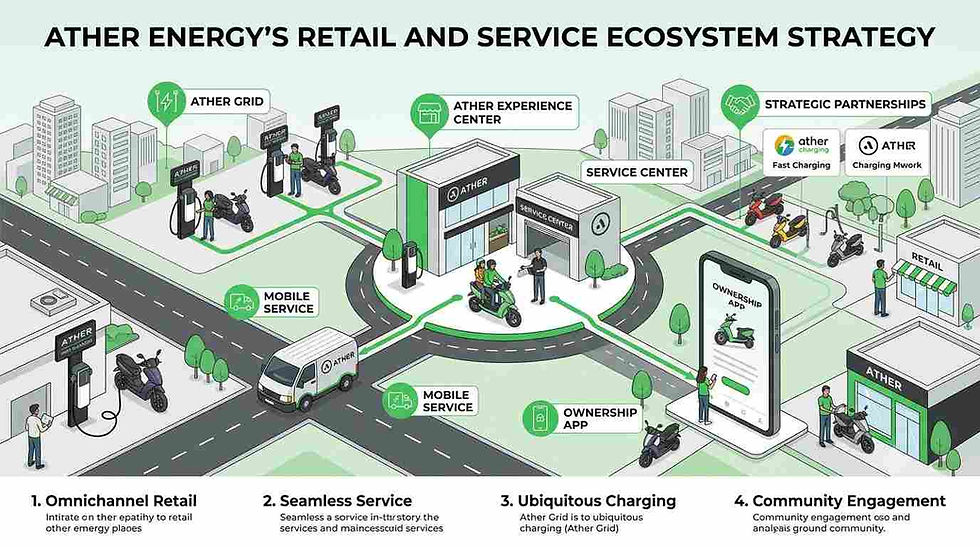
The strategy had three connected components, each documented in the company's filings.
The first is the experience centre network, which grew from 351 to 700 in India during FY26. Ather describes three standardised formats under the Ather Space name. The flagship format is a full showroom with service and accessories. The midsize format offers the complete ownership experience in a compact footprint. The compact format focuses on product discovery and test rides in emerging markets. The annual report states the network is entirely dealer-operated, and that more than 75% of the centres added in FY26 were opened by existing dealer partners. The founders' letter reads this as a sign of partner confidence in the brand and business. The company also states that the newer midsize and compact formats reach breakeven within a few quarters, compared with several years for earlier formats. It attributes this to higher demand density once a product has established itself in a market. That claim is company-reported, and no verified public information is available on per-outlet investment, dealer margins, or dealer profitability.
By geography, the year-end network was 295 centres in South India, 236 in Middle India, and 169 in the Rest of India. The annual report says Middle India received the largest share of new store additions. Third-party reporting in September 2025 noted that new outlets were reaching tier-2 and tier-3 cities, and that Bengaluru remained the largest single-city hub with 18 centres. The network stood at about 600 in December 2025, with 100 added in the fourth quarter alone.
The second component is service. The service network grew from 277 to 548 authorised centres. Gold Service Centres, a designation the annual report lists without defining the criteria, grew from 7 to 24 locations. The company also operates three regional distribution centres in Farukhnagar, Cuttack, and Nashik, plus a warehouse in Bagalur, Karnataka. Ather's product framework lists service network and spare availability among the components of reliability, alongside battery longevity and hardware quality. So the company presents service capacity as part of the product promise rather than a back-office function. No verified public information is available on service turnaround times, customer satisfaction scores from service, or the number of vehicles serviced.
The third component is charging. Ather reports more than 6,000 charging points, with 1,143 added in FY26, up from more than 4,500 in FY25. The company's own footnote says the count includes fast-charging points, including those from Hero MotoCorp's Vida brand and other operators, as well as neighbourhood chargers. That definition matters when comparing the figure over time. The company describes the Ather Grid as India's largest two-wheeler fast-charging network. It also co-founded the Light Electric Vehicle Acceleration Forum with Hero MotoCorp and IPEC India to promote standardised charging infrastructure for electric two-wheelers. Ather positions this as growing the shared network beyond its own assets.
Taken together, the annual report describes an integrated deployment: retail, service, and charging rolled out as a package into new markets. That is consistent with the sequencing announced in 2021, when charging points were to precede deliveries.
Positioning & Consumer Insight
Ather positions itself in the premium segment. The annual report describes the 450 series as anchoring the performance-led premium segment, and the Rizta, priced about ₹20,687 below the 450, as driving mass-premium volume. In the report's telling, the customer decision is shifting from price toward trust, meaning confidence in product performance, ownership experience, and the long-term reliability of the company. The annual report's central theme, "India's Trusted Upgrade," reflects that.
The Rizta is the clearest documented consumer insight. The founders write that the company stopped asking what an electric scooter should be and began asking what a family needs, and that this change reshaped everything downstream. Rizta became the fastest-selling product, with 199,134 units in FY26, or 76% of total sales. The first 100,000 units took 11 months, and the second 100,000 took 7. The strategic significance for the retail network is that a family-oriented product broadened the customer base beyond early adopters. That created the demand density the company says makes new centres viable.
The company also reports brand indicators for FY26: awareness up 100% year-on-year, preference up 50%, and consideration up 31%. It describes itself as the most searched electric vehicle brand in India. The methodology behind these figures is not disclosed, so they should be read as company claims. No verified public information is available on customer segments by outlet, or on the role of test rides in purchase decisions.
Media & Channel Strategy
The physical network is the documented sales channel. Ather stated in 2021 that customers could book test-ride slots on its website before visiting an experience centre, so digital booking and physical retail were linked from early on. The annual report reports a 91% attach rate for its AtherStack Pro software, which ties the app and connected features to the ownership relationship after purchase.
Advertising and marketing expenditure rose to ₹198.69 crore in FY26 from ₹144.59 crore in FY25. The company attributes the increase to brand-building initiatives and marketing campaigns for the Rizta. No verified public information is available on the media mix, agency partners, digital versus offline allocation, or the share of sales originating from online channels versus experience centres. For Q1 FY27 (April to June 2026), the company reported customer enquiries up about 95% year-on-year to roughly 7.07 lakh, and pre-orders up about 158% to roughly 1.5 lakh. The enquiry figures suggest strong top-of-funnel activity, but no verified public information is available on conversion rates or on the source of enquiries.
Business & Brand Outcomes
The FY26 results are documented in the company's annual report. Vehicle sales rose 69% to 262,942 units. Revenue from operations rose 63% to ₹3,671.76 crore. National market share on the Vahan portal rose from 11.7% in FY25 to 17.1% in FY26. On a quarterly basis, national share moved from 7.6% in the first quarter of FY25 to 18.0% in the fourth quarter of FY26. Regional shares moved in the direction the network strategy intended. Middle India rose from 4.1% in the first quarter of FY25 to roughly 17% by the fourth quarter of FY26, a figure the report gives as 17.3% in one section and 17.4% in another. Rest of India rose from 6.5% in the fourth quarter of FY25 to 12.1% in the fourth quarter of FY26. South India's share for FY26 was 23.1%.
Financial performance improved alongside expansion. EBITDA margin improved from negative 23% to negative 7%, and adjusted gross margin rose from 19% to 24%. The net loss narrowed from ₹812.28 crore to ₹517.17 crore. Operating cash flow turned positive at ₹31.89 crore, against negative ₹720.70 crore in FY25. Non-vehicle revenue grew from ₹261.39 crore to ₹480.02 crore, rising from 12% to 13% of revenue. The company attributes growth in stock-in-trade sales, which cover accessories, spares, and merchandise, to the larger base of vehicles on the road. It attributes growth in service revenue, from ₹145.07 crore to ₹278.38 crore, to more customers buying AtherStack features with their vehicles. So the reported service revenue line reflects software rather than workshop labour. No verified public information is available on revenue from repairs, maintenance labour, or extended-warranty claims.
The first quarter of FY27 continued the trend. Revenue from operations rose about 89% year-on-year to ₹1,217 crore, and the net loss narrowed to ₹51 crore from ₹178 crore.
A caution applies to all of these outcomes. The company attributes share gains to stronger products reaching more people through a deeper distribution network, and to the Rizta. Public disclosures do not isolate how much of the improvement came from the retail and service build-out versus the product or the market, so a causal claim cannot be verified. This case reports the outcomes alongside the strategy without asserting that one caused the other.
Strategic Implications
The first implication concerns sequencing. Ather's own account is that product success comes first and distribution investment follows. The annual report says that once a product has established strong demand in a market, investing in distribution becomes lower risk and more capital-efficient. The Middle India expansion, anchored by the Rizta, is the company's main documented example. For managers, the point is that the retail network was scaled after the product-market signal, not before it.
The second implication concerns capital allocation. By using dealer partners and placing no store build-out capital on its own balance sheet, Ather reports that it could double outlets in a year while keeping capital for manufacturing, R&D, and Factory 3.0. The fact that most new outlets came from existing partners is a meaningful signal, but a limited one, because partner economics are undisclosed. The model also makes Ather dependent on partners for the customer-facing experience, a dependency the filings do not discuss.
The third implication concerns integration. Ather treats retail, service, and charging as one deployment and describes them as part of the product. That fits a premium positioning in which reliability and ownership experience justify pricing. It also raises the cost of entering a new region, since each requires several capabilities in parallel. The company's regional playbook of South first, then Middle India, then the rest of India reflects that constraint.
The fourth implication concerns what comes next. The company has stated that the EL platform will target the ₹1 to 1.25 lakh segment, where about half of India's scooter volumes sit and where Ather currently has no product. It says the network it has built will support that move. Whether the network can serve a more price-sensitive customer, and whether the compact format can carry it, cannot be verified from public information. Nor can it be verified how the network will perform once volumes shift toward lower price points.
Finally, the public record has gaps that matter for strategic evaluation. There is no verified public information on customer acquisition cost, retention, service satisfaction, dealer economics, or centre-level profitability beyond the company's breakeven statement. Analysis of this strategy should be read with those gaps in mind.
Discussion Questions
Ather reports that its network expansion followed product success in each region. Under what conditions is it better to build retail and service capacity ahead of demand, and what evidence would a manager need to justify that choice?
The annual report describes the network as entirely dealer-operated and asset-light. Evaluate the trade-offs of this model for a premium brand that treats service quality as part of its product promise. Which risks does the public record leave unaddressed?
Ather's reported service revenue growth is tied to software subscriptions rather than workshop activity. How should a company in this position measure the return on its service network, and which metrics would you need that are not publicly available?
The three-zone geography strategy tilted expansion toward Middle India and the Rest of India. What does the documented regional share data indicate about the strategy, and why can it not establish causation?
The EL platform targets a price segment where Ather currently has no product. Assess whether a network built for a premium customer base can serve a mass-market segment, using only the information in this case, and identify what further information you would seek.


Comments