Cashfree Payments: Embedded Payment Infrastructure Strategy
Industry & Competitive Context
Online payments in India are regulated. The Reserve Bank of India (RBI) introduced its payment aggregator framework in March 2020. It requires payment gateways that onboard merchants to hold an aggregator licence. The RBI introduced the framework in March 2020, requiring gateways to obtain an aggregator licence to onboard merchants. That made licensing a structural entry requirement, not a formality.
The regulator's actions shaped the competitive field. In December 2022, the RBI asked Razorpay and Cashfree to temporarily stop onboarding new customers for their payment processing business. Coverage of the wider episode lists PayU, Paytm and others among the affected aggregators. One payment aggregator official told Mint that Razorpay, PayU and Cashfree had earlier accounted for about 70–80% of new-merchant onboarding. The restriction was lifted in December 2023, when Razorpay and Cashfree said they had received final Payment Aggregator licences and could resume onboarding new merchants.
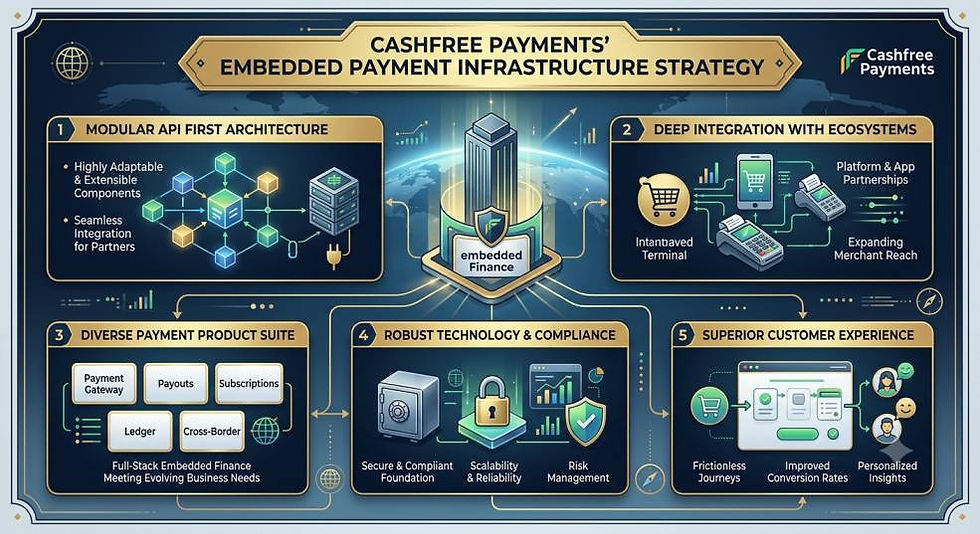
As of mid-2026, Business Standard describes the market as one of heightened competition in India's digital payments market. Embedded payments is a newer segment within it. Software platforms such as ERP, CRM, SaaS and billing tools embed payment acceptance and merchant onboarding into their own products. Cashfree describes this segment's problem in its launch release: platform developers face integration complexity, poor user experience, operational overhead and limited compliance knowledge, so merchants often integrate payments separately.
Brand Situation Prior to the Embedded Payments Launch
Cashfree was founded in 2015 by Akash Sinha and Reeju Datta. It helps businesses collect online payments, make payouts and streamline KYC and fraud detection. In March 2024, its own press-release boilerplate described it as a payment and API banking company. Its offerings then included payment gateways, a split-payment solution for marketplaces, bank-account verification, lending disbursals and a virtual-account product called Auto Collect. The company said it enabled more than 600,000 businesses and led bulk payouts in India with a market share above 50%. That share and the "over 50%" claim come from the company's own release. The release also names its backers: Y Combinator, Apis Partners and State Bank of India (SBI), and says PayPal incubated the company.
Before the launch, Cashfree had gone through a documented growth pause. Its operating revenue rose only 4.7%, to ₹642.7 crore in FY24 from ₹613.8 crore in FY23, and Entrackr attributes the sluggish growth to the RBI onboarding ban. Entrackr also reported that Cashfree had not raised fresh capital since June 2021.
Strategic Objective
The company's stated objective for Embedded Payments is in the March 2024 release. CEO Akash Sinha said the product aligned with the aim of making payments seamless for both businesses and end consumers. The release says the goal is to let software platforms onboard businesses as merchants and manage payments, refunds and settlements through one integration. It also promises compliance with RBI guidelines and a way for platforms to monetise payments.
Later statements show a broader objective. Per the PTI report of the FY26 results, Cashfree's CEO said the focus is to be EBITDA-profitable through FY27 and to scale into a ₹3,000 crore company over two to three years. He said this would be led by SMB growth and cross-border payments. In July 2026 Cashfree announced a target of doubling its SMB base to two million by the end of FY27.
4. Campaign Architecture & Execution
Layer 1: licensed infrastructure. Cashfree's regulatory position underpins the strategy. It holds all three RBI payment licences: Payment Aggregator (PA-PG), Payment Aggregator–Cross Border (PA-CB) and Prepaid Payment Instrument (PPI). In December 2023, Cashfree secured its Payment Aggregator licence, and its spokesperson called it a pivotal moment that affirmed the company's focus on compliance. The Embedded Payments release, dated 7 March 2024, was issued about eleven weeks after that licence and cites compliance with RBI guidelines as a benefit.
Layer 2: the embedded product. Per the release and Cashfree's developer documentation, Embedded Payments lets platforms onboard businesses as merchants. Cashfree's documentation describes automated KYC and compliance checks, payment processing across UPI, cards and wallets, reporting and reconciliation, and tracking of commission earnings with automated invoicing. It also offers a sandbox for testing integrations. The product page adds 180+ ways to accept online payments, PCI DSS compliance, and adherence to master KYC policy. The March 2024 release cited 120+ payment modes. The company describes the product as India's first platform-centric payment solution. Trade coverage of the launch varied, with one outlet reporting "one of India's first".
Layer 3: adjacent expansion. In June 2026, Cashfree announced that its cross-border suite was fully operational across 40 countries. Businesses in those markets can accept payments from Indian consumers through UPI, RuPay, cards and net banking without setting up a local entity. The company projects monthly cross-border volumes of USD 250–300 million, per TipRanks' summary of the release. It says local payment methods lift success rates above 88%, against failure rates near 40% on international cards.
Layer 4: SMB acquisition. In July 2026, Cashfree announced 0% payment gateway fees for new businesses on the first ₹20 lakh of GMV until 31 March 2027, along with go-live within minutes, next-day settlement against a two-day cycle, and a dedicated account manager for each merchant onboarded under the offer. The company frames this around festive-season sales, saying SMBs generate roughly 40% of annual sales in that period.
Positioning & Customer Insight
The company's positioning has changed across documents. In March 2024 it called itself a payments and API banking company. By August 2026, Entrackr described it as a payments infrastructure and intelligence company, and the July 2026 release calls it India's leading AI-native payments company. Cashfree's site also claims an in-house UPI and cards switch that supports higher success rates, a company claim.
The stated customer insights are the company's own. For platforms, the launch release says payments integration is complex and merchants often integrate separately, so embedding removes redirects and drop-offs. For cross-border, the insight is that many Indian consumers lack activated international cards. For SMBs, the insight is festive-season concentration of sales and the cost pressure of discounts. The company also says that about 25,000 companies are set up each month in India and that roughly 20% of them sign up with Cashfree to explore payments.
Media & Channel Strategy
The verified channels are corporate communications and product surfaces, not advertising. The Embedded Payments launch was a PR Newswire release. The product has a dedicated website page, developer documentation, and a company blog post. The SMB offer was communicated through a press release and Business Standard coverage. The cross-border expansion was announced by PR Newswire release.
One verified spending data point exists. Entrackr, citing Registrar of Companies filings, reports that advertising and marketing costs fell 10% year on year to ₹18 crore in FY26.
Business & Brand Outcomes
Documented outcomes are at company level, not product level. Revenue from operations, per filings reported by Entrackr and PTI, ran ₹613.8 crore (FY23), ₹642.7 crore (FY24), about ₹640 crore (FY25) and ₹967.4 crore (FY26). The FY26 figure is a 51% increase. Net loss was ₹154.1 crore in FY25 and ₹118.5 crore in FY26, per the PTI/Business Standard report. Total expenses rose to ₹1,090.9 crore in FY26 from ₹794.7 crore.
Entrackr's FY26 breakdown shows payment gateway commissions of ₹890 crore (up from ₹481 crore), payout commissions of ₹69 crore, and cross-border commissions of ₹8 crore. The CEO said Cashfree achieved EBITDA profitability in March 2026 and that its active merchant base grew 50% year on year across enterprise and SMB segments.
The company's own scale claims have moved over time: more than 600,000 businesses in March 2024, 800,000 businesses in a 2025 Business Standard report, and more than one million in the July 2026 release. The annual volume claim of USD 80 billion appears in both the March 2024 and July 2026 boilerplate. It is unchanged across those two years, so it should not be read as a trend.
Strategic Implications
First, compliance is a strategic asset, not just an overhead. The 2022–23 restriction froze new-merchant onboarding for a year. Licences now anchor Cashfree's positioning and its embedded proposition, which promises platforms a way to offload compliance work. The company's product logic depends on that regulatory standing, so a future regulatory action would have outsized consequences.
Second, embedded payments trade direct control for distribution. The design gives platforms the user interface and a share of the economics, while Cashfree keeps the licence, risk and infrastructure. The public record does not show whether that trade has produced material volume.
Third, the growth narrative has shifted toward SMB and cross-border. The FY26 numbers show gateway commissions driving the recovery, and the CEO's reported priorities are SMB and cross-border. A zero-fee offer for new merchants is an aggressive move in a market described as highly competitive. It shifts the pricing question to what happens after the ₹20 lakh waiver ends, which the sources do not answer.
Finally, disclosure limits external evaluation. Cashfree discloses company-level financials through filings and press reports, but not product-level economics. An outside analyst can assess the strategy's logic, not its returns.
Discussion Questions
Cashfree's Embedded Payments gives software platforms onboarding, compliance and monetisation while Cashfree retains licences and risk. Analyse the value split between Cashfree and its platform partners. What conditions would make this model attractive or unattractive to each?
The December 2022 RBI restriction paused new-merchant onboarding for about a year. How should a payments company's strategy account for regulatory dependence? Use Cashfree's documented licence sequence to evaluate its response.
Cashfree offers 0% gateway fees on the first ₹20 lakh of GMV for new merchants until March 2027. Evaluate this as a pricing and acquisition strategy in a market described as highly competitive. Which public metrics would you monitor to judge success?
The company's CEO named SMB and cross-border payments as the FY27 growth drivers, while Embedded Payments was not named in the reported statement. Should an infrastructure company sequence its growth bets this way? What would you need to know about the product's contribution to decide?
Cashfree's public descriptor has moved from "payments and API banking" to "payments infrastructure and intelligence" and "AI-native payments". How should a B2B payments brand manage positioning drift, and what evidence would show whether the new positioning is working?


Comments