BMW's Performance-Led Brand Positioning in Luxury Automobiles
Executive Summary
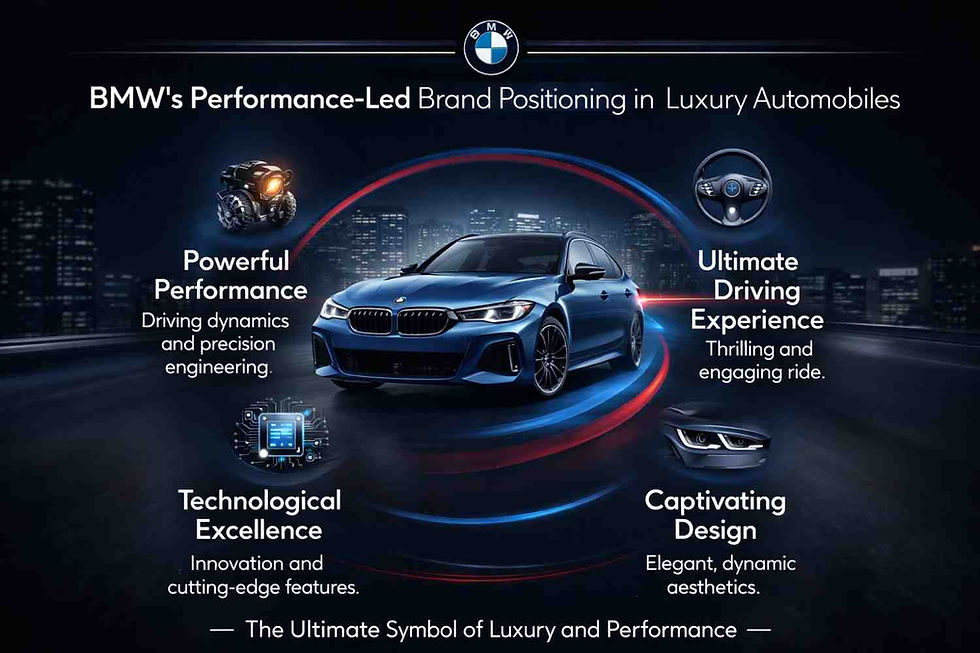
BMW (Bayerische Motoren Werke AG) represents one of the most studied and consistently executed cases of performance-led brand positioning in the global luxury automobile industry. Over a period of five decades, the company constructed and defended a singular brand idea — sheer driving pleasure — across product design, advertising, product architecture, and digital communication. This case examines how BMW built and sustained that positioning, the strategic logic behind it, the campaigns that operationalized it, and the evolving challenge of maintaining a "driver-centric" identity in an era of electrification and autonomous mobility.
Company Background
BMW was founded in Munich, Germany, in 1916 as an aircraft engine manufacturer — Bayerische Motoren Werke, translating literally to Bavarian Motor Works. The company began producing automobiles in 1922 (according to publicly available company history on bmwgroup.com). Over the following decades, it developed a reputation for engineering precision and driving dynamics rooted in its German manufacturing ethos. By the early 1970s, however, BMW's presence in the United States — one of the world's most lucrative automobile markets — remained limited and poorly differentiated. As of December 31, 2023, the BMW Group employed 154,950 people and operated production sites across more than 30 locations worldwide, with a global sales network spanning more than 140 countries (BMW Group Annual Report 2023, press.bmwgroup.com).
The Strategic Challenge: Defining the Category
The Market Context (Early 1970s, US)
In the early 1970s, BMW found itself competing in a US automotive market where luxury was defined by American standards — large, plush vehicles from Cadillac and Lincoln. European entrants like Mercedes-Benz had already established a foothold on the axis of prestige and engineering quality. BMW, by contrast, had limited sales in the United States and lacked a distinctive identity. As Martin Puris, co-founder of the advertising agency Ammirati & Puris, recalled publicly: "People didn't know anything about the cars. Or they mistook it for the British Motor Works" (St. John's University, Ammirati & Puris Archive). The strategic problem was a two-axis dilemma. Luxury car buyers of the era perceived luxury as comfort-focused and performance cars as lacking sophistication. BMW occupied neither pole clearly. Any positioning strategy would require BMW to either compete within an existing category or create a new one.
The Positioning Decision: Straddle Positioning
BMW chose a third path. According to publicly available marketing analysis from the IMI New Delhi (LinkedIn, September 2023), citing established positioning theory, BMW deployed what can be classified as straddle positioning — using both Points of Parity (POPs) and Points of Difference (PODs) against two competitor reference frames simultaneously. BMW established:
A Point of Difference on performance versus US luxury cars like Cadillac (where it achieved parity on luxury)
A Point of Difference on luxury versus US performance cars like the Chevrolet Corvette (where it achieved parity on performance).
This created a new umbrella category: the premium performance automobile. The creative translation of this strategic position became one of the most enduring taglines in advertising history.
"The Ultimate Driving Machine": Campaign Origins and Strategic Logic
The Birth of the Tagline (1974)
In 1974, Bob Lutz, then Executive Vice President of BMW Global Sales and Marketing, hired the newly formed New York agency Ammirati & Puris — founded by Martin Puris and Ralph Ammirati — to redefine BMW's brand in the American market. At the time, BMW was selling approximately 13,000 cars per year in the United States (St. John's University, Ammirati & Puris Archive). The tagline "The Ultimate Driving Machine" was written by agency co-founder Marty Puris. As Puris himself has publicly stated, "The ultimate driving machine was always the best line" (Branding Strategy Insider, July 2023). The campaign was directed not at the general luxury consumer but specifically at Baby Boomers who were, according to BMW's own blog (cited in course material archived at CourseHero), "out of college, making money and ready to spend their hard-earned dollars." The first execution was deliberately restrained. The inaugural BMW print advertisement was a photograph of the car accompanied solely by the declaration, "The ultimate driving machine." No product features, no specifications — only a category claim. The first television commercial, shot by art director Clem McCarthy (Branding Strategy Insider, July 2023), showed the front of a BMW disappearing and reappearing over rolling hills, never revealing the full car until the final scene. The creative philosophy was performance through implication.
Why the Tagline Worked Strategically
From a marketing theory standpoint, the line functioned on multiple dimensions simultaneously. It was a positioning statement, a brand promise, and a category creation device. The word "ultimate" preempted the entire performance axis for BMW, leaving competitors no room to claim equivalence without appearing to acknowledge BMW's primacy. "Driving machine" — rather than "car" or "automobile" — shifted the product from a commodity to an experience, reinforcing the emotional register of the brand. Critically, the tagline was not just advertising language. BMW backed it with product architecture: the 3 Series as the driver's performance benchmark in its class, the 5 Series as the mid-executive performance sedan, the 7 Series as the full luxury flagship, and — most importantly — the M Division (BMW M GmbH) as the halo line that continuously validated the brand's performance claims.
Brand Architecture: The M Division as Proof of Positioning
BMW M GmbH, the performance division of BMW, plays a structurally critical role in sustaining the brand's positioning. It is not a segment for high-volume sales but a credibility mechanism — the engineering proof that "The Ultimate Driving Machine" is not merely a slogan. According to BMW Group's official press release (Q3 2023), BMW M GmbH sold 48,978 units globally in Q3 2023 alone, representing a year-on-year increase of 13.2%, driven in part by the introduction of the new BMW XM. For the full year 2023, BMW M GmbH achieved record global sales of 202,530 performance and high-performance cars, an increase of 14.3% (BMW Group press release, January 2024). The M line — which includes cars like the M3, M4, M5, and the XM — continues to function as the brand's most performance-intensive statement. Each model in the M range goes through development at BMW's Motorsport division, and the brand uses motorsport participation as an ongoing proof source. No specific motorsport expenditure or internal R&D allocation by model is publicly disclosed in BMW's annual reports, so no such figures are included here.
The "The Hire" Campaign: Digital Storytelling Before Its Time (2001)
Background
By the year 2000, BMW of North America had grown sales to 189,423 cars, up from just 53,343 in 1991 — a recovery attributed in part to effective advertising by Fallon agency and a product push led by BMW NA President Vic Doolan (BMW NA 50th Anniversary, BMW Group press archives, press.bmwgroup.com). In 2001, faced with a thin new product pipeline, BMW and Fallon conceived a campaign that would prove historically significant.
Execution
"The Hire" was a series of short action films released on the internet — a medium in its infancy as a content distribution platform in 2001. The films were directed by acclaimed filmmakers including John Frankenheimer (Ambush, released April 26, 2001), Ang Lee (Chosen, released May 10, 2001), Wong Kar-Wai (The Follow), Guy Ritchie, and Alejandro González Iñárritu, among others. All films starred British actor Clive Owen as "The Driver," an unnamed character who operated BMW vehicles through high-intensity cinematic scenarios (BMW Group press archives; IMDB film listings). The campaign was conceived with a deliberate brief, as described by Patrick McKenna, BMW NA's marketing executive, in the company's own 50th Anniversary press archives: "When we were telling Fallon what we wanted, we told them it needed to be cinematic, it needed to be cool, and that we wanted people to be talking about it at work on a Monday morning. They looked at The French Connection, Le Mans, Ronin, and said, 'What if we could make the car the star?' It started with that premise."
Strategic Significance
"The Hire" is now considered a landmark in the development of branded content and digital marketing. It demonstrated — years before YouTube existed — that brand communications could generate voluntarily sought-out engagement rather than passive viewership. The car was the constant protagonist: its driving dynamics, handling, and performance were embedded into the narrative itself rather than stated as product claims. This was a creative operationalization of the core positioning — the car as the ultimate driving machine, shown rather than told. The campaign also established an important precedent: that luxury brands could leverage entertainment content as a primary marketing vehicle without diluting brand premium. BMW's subsequent product placement in the James Bond film series, beginning with the Z3 roadster's debut in GoldenEye (1995), was an earlier iteration of the same philosophy — using cinema to associate the brand with aspirational performance contexts (BMW Group press archives, bmwgroup.com).
Portfolio Evolution and the Electric Transition
Maintaining Positioning Across an Expanding Portfolio
BMW's product range has grown substantially since the 1970s. The company now offers vehicles across sedans, SUVs, coupes, convertibles, plug-in hybrids, and fully electric models. According to the BMW Group Report 2023 and associated press releases, the BMW brand delivered 2,253,835 vehicles to customers worldwide in 2023, a new all-time record for the brand and a 7.3% increase from the prior year.
The Electric Challenge to Performance Positioning
The rise of electric vehicles presents BMW with its most complex brand positioning challenge since the 1970s. BMW's response has been to reframe electrification not as a departure from performance but as its next expression. The BMW i4 and the iX were positioned as electric vehicles that preserve driving dynamics; the BMW i5 M60, launched in 2023, was explicitly introduced as a fully electric M model — the clearest signal that the M halo is being extended into the electric portfolio. According to BMW Group's Q3 2023 press release, BMW described the i7 M70 and i5 M60 as "combining fully-electrified M Power with the highest level of elegance, luxury and comfort." In the full year 2023, BMW's fully electric vehicle deliveries reached 330,596 units for the BMW brand alone, a growth of 92.2% year-on-year (BMW Group press release, January 2024). The company's broader electrification strategy targets BEVs representing at least 50% of total deliveries by 2030. The "Neue Klasse" platform — BMW's next-generation EV-only architecture — is scheduled to begin production at the Debrecen Plant in Hungary in the second half of 2025, followed by the Munich plant in 2026 (BMW Group Report 2024 homepage, bmwgroup.com). BMW's R&D investment reached €7,538 million in 2023, as reported by Mobility Outlook (March 2024), citing BMW Group financial disclosures. For the brand positioning question, the challenge is fundamental: electric vehicles inherently dampen some of the sensory cues — engine sound, gear shifts, mechanical feedback — that historically made BMW "the ultimate driving machine." Whether BMW can transfer those emotional associations to an electric platform is not yet empirically established. No independent third-party study with verified methodology on this specific brand perception question has been located in publicly available sources.
BMW's Global Premium Segment Leadership
According to BMW Group's official press releases across 2023, the BMW brand retained its position as the global leader in the premium automotive segment for that year — a claim repeated across multiple BMW Group communications. No verified independent research report quantifying this segment leadership by methodology has been identified for citation here; the claim is sourced from BMW Group's own press communications. BMW M GmbH's record 202,530 units sold in 2023 is a meaningful data point: it suggests that consumers are not just purchasing the brand for prestige or status but are actively gravitating toward the highest-performance variants, reinforcing the internal coherence between brand positioning and consumer purchasing behavior.
Limitations
Several dimensions of this case cannot be analyzed due to the absence of publicly verifiable data:
Internal brand tracking data: BMW does not publish proprietary brand health surveys, Net Promoter Scores, or brand equity indices in its public filings.
Advertising expenditure by campaign: While BMW's overall marketing spend is referenced directionally in annual reports, campaign-level budgets (including "The Hire" production costs) are not publicly disclosed in detail.
Consumer perception research: No independent, peer-reviewed academic study on BMW's brand perception shifts as a result of specific campaigns has been identified for citation in this case study.
Electric brand perception gap: No verified consumer insight study on whether BMW's "driving machine" positioning is transferring successfully to its EV portfolio is publicly available.
India-specific brand positioning strategy: BMW India's sales for H1 2023 — 5,476 units for BMW brand and 391 for MINI, totaling 5,867 units, representing 5% year-on-year growth — are confirmed via BMW Group press releases. However, BMW India has not publicly disclosed a distinct country-level positioning strategy document.
Key Lessons
On Positioning: BMW's most important strategic decision was not choosing a product attribute but choosing a consumer relationship — the bond between driver and machine. This made the positioning emotionally durable and difficult for competitors to dislodge without imitating BMW directly.
On Consistency: The "Ultimate Driving Machine" tagline has been in continuous use since 1974. Across fifty years, marketing leadership, agency relationships, and product categories have all changed. The positioning has not. This consistency itself became a brand equity asset.
On Product-Communication Alignment: BMW's positioning was not held together by advertising alone. The M Division, the 3 Series' handling reputation, and the company's motorsport involvement continuously validated the claim at the product level. Without product proof, the tagline would have become hollow.
On Branded Content Innovation: "The Hire" campaign (2001) demonstrated that content quality and narrative relevance can generate brand engagement that interruption advertising cannot. The campaign pre-dated the concept of "content marketing" as an industry term.
On the Electrification Tension: BMW's current brand challenge — preserving a performance identity through an electric transition — represents an unresolved strategic tension. The company's decision to extend the M badge to EVs suggests a preference for continuity over reinvention. Whether consumers will accept this equivalence remains an open empirical question.
Discussion Questions
Positioning Theory Application: BMW used "straddle positioning" in the early 1970s to occupy the intersection of performance and luxury simultaneously. What are the risks of straddle positioning? Under what product and market conditions does it succeed versus fail?
Brand Architecture and Credibility: The M Division functions as a credibility anchor for BMW's broader brand positioning. How does a company balance the need for an exclusive halo line with the commercial pressure to extend that halo more broadly? Where should BMW draw the line on M badges?
The Digital Content Precedent: "The Hire" campaign was released in 2001 on the internet, predating the era of digital content marketing. What principles from this campaign remain applicable to branded content strategy today? What has changed structurally in how audiences discover and consume branded content?


Comments