Brooke Bond Red Label’s Insight into Social Connection Through Tea
Industry and Competitive Context
India occupies a structurally unique position in the global tea industry. As documented in trade and industry sources, India is the second largest producer and fourth largest exporter of tea in the world, with the domestic tea industry contributing approximately 30 percent of global tea production and providing employment to more than 1.1 million workers. The Indian tea market has been estimated at approximately ₹23,000 crore in total value, of which around ₹12,000 crore is accounted for by the packaged and branded segment, with the remainder constituted by loose, unbranded tea that continues to dominate in rural and semi-urban markets.
The branded tea segment in India has historically been anchored by a fierce competitive dynamic, primarily between two dominant players: Hindustan Unilever Limited (HUL) and Tata Global Beverages. As reported by the Economic Times and cited by WARC, HUL's value share in the packaged tea market grew from 20 percent in 2016 to 21.2 percent in 2017, briefly overtaking Tata's share of 21 percent in the same period. Both companies have traded leadership positions, making the category one of the most competitively contested in Indian FMCG. Other significant players in the category include Wagh Bakri, Duncan Industries, and Lipton — the latter also a Unilever brand.
Within this context, price, color, aroma, and regional taste profiles serve as the primary purchase drivers in mass-market segments, making product-attribute differentiation structurally difficult to sustain over time. Advertising and brand equity consequently become critical levers for value-share gains, operating on the well-established consumer behavior principle that emotional identification with a brand reduces price sensitivity and likelihood to trade down. This dynamic made the Indian packaged tea category unusually competitive in terms of the ambition and cultural reach of its advertising by the early 2010s. Tata Tea's long-running "Jaago Re" campaign, launched in 2008, had already established a precedent — demonstrating that purpose-led advertising could generate significant brand salience by linking the act of drinking tea to civic consciousness and social awakening. This precedent defined the strategic terrain on which Brooke Bond Red Label would subsequently compete.
Brand Situation Prior to the Campaign
Brooke Bond Red Label was launched in British India in 1903 and is formally described by its parent company, Hindustan Unilever Limited, as one of India's largest selling tea brands. It operates as the flagship and oldest brand under the Brooke Bond umbrella portfolio, which also includes Taj Mahal, Taaza, and Three Roses. As documented in trade data, Red Label has historically been positioned as an affordable, everyday tea — a mass-market product competing primarily on taste, affordability, and widespread distribution.
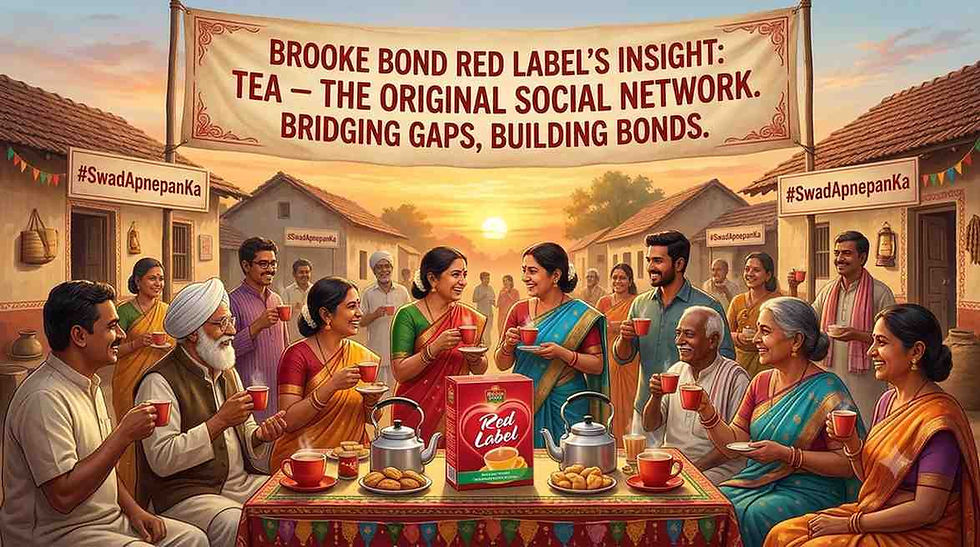
In its earlier communications, Brooke Bond Red Label relied on conventional FMCG messaging centered on family values, product quality, and the warmth of shared tea moments. The brand's taglines evolved through distinct phases — from "Piyo Toh Jaano" to "Jiyo Mere Lal" to "Pyaar Ka Pyaala" — before arriving at "Swad Apnepan Ka," which translates broadly as "Taste of Togetherness." These early iterations, while resonant, were rooted in a relatively functional and emotionally generic brand promise that several competitors could credibly claim.
The competitive pressure from Tata Tea's "Jaago Re" platform, which aggressively positioned tea as a vehicle for civic engagement, presented HUL's marketing leadership with a specific strategic challenge: Red Label needed not merely a new advertising campaign, but a durable, ownable, and culturally specific brand platform. According to multiple documented public statements by Shiva Krishnamurthy, then Vice President for Tea and Foods at HUL, the articulated brand purpose was formally defined as making India more inclusive. This was communicated not as a transient campaign theme, but as the brand's foundational reason for being.
Strategic Objective
The strategic imperative that emerges from verified public communications was threefold. First, to reposition Brooke Bond Red Label from a mass commodity defined primarily by taste and price to a brand with a coherent, culturally resonant social purpose. Second, to generate long-term brand salience in a category where advertising recall is difficult to sustain given product homogeneity. Third, to use the brand's unique cultural insight — that tea functions as India's primary social lubricant — as the connective tissue for a multi-year, multi-issue purpose-driven platform.
Critically, this strategic repositioning was built around a single underlying consumer insight, described by Harshad Rajadhyaksha and Kainaz Karmarkar, Chief Creative Officers at Ogilvy India, as being over thirteen years old at the time of its most recent public deployment. That insight, as they stated in a documented press release on the occasion of the 2023 "India's Favourite Social Network" campaign, is this: a cup of tea is the original social network — the medium through which Indians have always made friends, rekindled relationships, and bridged differences. The durability of this insight across more than a decade of brand communication is itself a strategic signal worth examining.
Campaign Architecture and Execution
The Brooke Bond Red Label brand platform did not evolve as a single campaign, but as a sequence of strategically linked executions united by the "Swad Apnepan Ka" brand purpose. Each execution addressed a distinct social fault line in Indian society, using tea as the mediating agent through which those divisions were dissolved.
The first major cause-marketing departure from conventional product advertising came in 2014, when Red Label ran a campaign addressing Hindu-Muslim unity — positioning a shared cup of tea as the moment of connection across one of India's most historically charged religious divisions. This was documented as the brand's first deliberate step into the domain of social commentary, and it established the pattern that would define the platform.
The most awarded and widely analyzed execution was the 6 Pack Band, launched in January 2016 in partnership between Brooke Bond Red Label, Mindshare India, Mindshare Fulcrum, and Y-Films (the content arm of Yash Raj Films). The campaign conceptualized and produced India's first transgender music band, comprising six members from India's transgender community. The campaign operated across music, digital video, television, and radio, and was made available on live streaming platforms including Saavn, Gaana, and Hungama. The band released multiple music tracks featuring notable Bollywood artists including Hrithik Roshan, Sonu Nigam, Neha Kakkar, Vishal Dadlani, Karan Johar, Arjun Kapoor, and Tiger Shroff, extending its entertainment reach significantly. The campaign was also supported by recognition from UNAIDS and UN Women, lending it international institutional credibility.
The brand subsequently deployed purpose narratives around Alzheimer's disease and social alienation through the "T For Togetherness" and "Forgotten" campaign, which addressed how individuals living with memory loss face social exclusion. During the COVID-19 pandemic, Brooke Bond Red Label launched a campaign extending the "Taste of Togetherness" platform with a television commercial conceptualized by Ogilvy, addressing pandemic-era social hostility and isolation. As documented in an official press release carried by Impact On Net, Shiva Krishnamurthy stated the brand's core message as: "We can be socially connected even while we are physically distant." In March 2024, the brand released a new film under the #SwadApnepanKa platform, as documented by Exchange4media, featuring a narrative set in a local train compartment in which a visually impaired individual demonstrates the trust that sighted passengers were unable to extend to a stranger — with tea as the medium of connection.
The most recent major execution was the "India's Favourite Social Network" campaign released on World Social Media Day in June 2023. Conceptualized by Ogilvy and confirmed through an official press release carried by Afaqs, the film drew a parallel between social media terminology — likes, shares, friend requests, reposts, and trends — and the everyday moments of connection facilitated by a cup of Red Label tea. As stated in the official release, the brand's Vice President for Food and Beverages at Unilever South Asia, Shiva Krishnamurthy, described the campaign's central proposition: "Tea is India's favourite Social Network."
Positioning and Consumer Insight
The strategic positioning of Brooke Bond Red Label rests on a single, well-documented insight that has remained consistent across more than a decade of brand communication: tea in India is not a beverage category so much as a social institution. This insight is both ethnographically robust and commercially consequential. Tea is the occasion for conversation across income levels, professions, religions, genders, and generations. It is served at moments of grief, celebration, business negotiation, neighborhood dispute resolution, and romantic reconciliation alike.
What makes the Red Label brand platform analytically interesting is how it operationalizes this insight not as a sentimental observation about beverage culture, but as a strategic statement about India's social fabric. By consistently positioning tea as the medium through which difference collapses — whether the difference is religious, gender-based, generational, or rooted in physical ability — the brand claims ownership of the emotional territory of social reconciliation. This is a form of positioning that is fundamentally difficult for a competitor to contest without appearing derivative.
Ogilvy's CCOs confirmed in documented communications that the core creative strategy is to keep the brand voice "simple, honest and warm" — reflecting, in their words, the qualities of a cup of tea itself. This tonal consistency across wildly varying social subjects — transgender inclusion, interfaith harmony, Alzheimer's awareness, pandemic compassion, disability — is itself a strategic achievement, because it allows the brand to expand its topical range without losing its emotional register.
Media and Channel Strategy
Based on verified public information, Brooke Bond Red Label's media strategy has evolved from a primarily television-centric approach to a multi-platform model integrating digital video, social media, music platforms, and earned media. The 6 Pack Band campaign in particular demonstrated a deliberate architecture: original music tracks were distributed on YouTube, music streaming services, and television music channels, while brand films were circulated across social platforms. The campaign's digital-first distribution was validated by its performance on YouTube and by its crossover into Radio Mirchi Music Awards, where the band was invited to perform live.
The creative lead agency for the majority of the documented brand campaigns has been Ogilvy India, while Mindshare Mumbai and Mindshare Fulcrum handled the 6 Pack Band's media conception and deployment. The selection of taboo social subjects as creative territory — rather than conventional product or lifestyle messaging — functioned as a deliberate earned media strategy. Subjects such as transgender acceptance, interfaith relations, and Alzheimer's social stigma are inherently shareable and debatable, generating organic distribution that extends the campaign's effective reach beyond its paid media footprint. This approach has been characterized in documented industry commentary as treating social controversy not as a reputational risk to be managed but as a media asset to be cultivated.
No verified public data is available on specific paid media budgets, channel-level spending allocation, or programmatic targeting parameters for any of the documented campaigns.
Business and Brand Outcomes
The most extensively documented set of outcomes relates to the 6 Pack Band campaign of 2016. As reported across official press releases and credible trade publications including Afaqs and BestMediaInfo, and as confirmed in the brand's official Cannes Lions submission materials:
The campaign reached more than 25 million people through various platforms and brand handles. Music videos garnered over 8 million views on YouTube, with organic viewership exceeding 35 percent, against an industry benchmark of 11 percent. The engagement rate on campaign videos exceeded 2 percent, against an industry benchmark of 1.07 percent. The Red Label Facebook page content during this period achieved an engagement score of 981 out of 1,000 — described in trade sources as a first for the brand. The campaign generated earned public relations coverage valued at INR 100 million (approximately USD 1.5 million), as cited in the brand's official Cannes Lions presentation.
On the awards front, the 6 Pack Band campaign won the Glass Lions Grand Prix at the 63rd Cannes Lions International Festival of Creativity in 2016 — the highest recognition in a category introduced to honor creative work that positively impacts gender inequality, imbalance, or injustice. As reported by Ad Age and confirmed by Cannes Lions, the campaign was conceived by Mindshare Mumbai and made history as India's first campaign to win in this category. The band subsequently performed live at Cannes Lions 2017, the first time a brand-linked Indian act had performed on that international stage. The campaign was also recognized as a best-in-class example of Unilever's global "Unstereotype" initiative, which was formally launched at Cannes 2016.
At the market level, as reported by WARC and sourced from the Economic Times, HUL's value share in the Indian packaged tea market grew from 20 percent in 2016 to 21.2 percent in 2017, surpassing Tata Tea's share of 21 percent in the same period. While this market share gain cannot be directly attributed to the Red Label campaign in isolation — given HUL's broader multi-brand tea portfolio — the correlation between the brand's sustained purpose-driven communication investment and the company's market share recovery has been noted in publicly available trade commentary.
No verified public information is available on specific sales volume changes attributable exclusively to the Red Label social connection campaigns, nor on consumer acquisition or retention metrics tied to individual campaign periods.
Strategic Implications
The Brooke Bond Red Label case offers at least four strategic implications relevant to MBA-level analysis of brand management in competitive commodity categories.
The first is the strategic function of durable insight. The insight that tea is India's original social network was identified, according to documented public statements by Ogilvy's leadership, as far back as 2010. The brand has returned to it repeatedly, across wildly different social contexts, without the insight ever appearing exhausted. This suggests that genuinely elastic cultural insights — ones that can accommodate multiple topical expressions over time — are among the most valuable assets a brand can possess, because they allow the brand to remain culturally current without abandoning its strategic identity.
The second is the use of purpose as a competitive moat. By consistently occupying the intersection of tea and social inclusion for over a decade, Brooke Bond Red Label has created a positioning that is structurally difficult for competitors to claim without appearing derivative. This moat is durable precisely because it requires long-term creative commitment and institutional courage — attributes that a competitor cannot replicate with a single campaign.
The third is the deliberate architecture of earned media through social controversy. The campaign's consistent selection of socially sensitive subjects — subjects that generate organic debate, sharing, and cultural commentary — represents a disciplined approach to treating controversy as a media channel rather than a reputational liability. The 6 Pack Band's documented 35 percent organic viewership rate, against an industry benchmark of 11 percent, illustrates the commercial payoff of this approach.
The fourth is the relationship between brand purpose and corporate risk. The 2019 social media backlash following an HUL tweet about elderly abandonment at Kumbh Mela — which triggered the trending hashtag #BoycottHindustanUnilever — illustrates that purpose-led positioning elevates both the brand's cultural authority and its exposure to public scrutiny. A brand that positions itself as a vehicle for social inclusion is held to a higher standard of consistency across all its communications, not just its campaign films. This is a risk dimension that any organization adopting purpose-driven strategy must assess with rigor.
MBA-Style Discussion Questions
Brooke Bond Red Label has sustained the same core brand insight — tea as social glue — across more than a decade of campaigns addressing diverse social issues. What criteria should brand managers use to determine when a cultural insight has become exhausted versus when it remains strategically productive?
The 6 Pack Band campaign used entertainment and music — rather than conventional advertising — as its primary medium. How does the choice of an entertainment format rather than an advertising format change the strategic calculus around audience engagement, earned media, and brand risk?
HUL operates a portfolio of tea brands simultaneously, including Brooke Bond Red Label, Taj Mahal, Taaza, and Three Roses. What are the strategic trade-offs between investing in a purpose-driven social identity for a single brand versus building an overarching corporate social narrative across the entire portfolio?
The 2019 Kumbh Mela controversy demonstrates that purpose-led brands are exposed to heightened public accountability. How should organizations manage the reputational risk that accompanies purpose-driven brand strategy, particularly when that risk emerges outside the formal campaign framework?
Red Label's campaign architecture treats social subjects — transgender inclusion, interfaith harmony, pandemic compassion, disability — as creative territory. From an ethical standpoint, at what point does cause marketing cross the line from genuine social purpose to opportunistic brand association with social issues, and how should marketers operationally distinguish between the two?


Comments