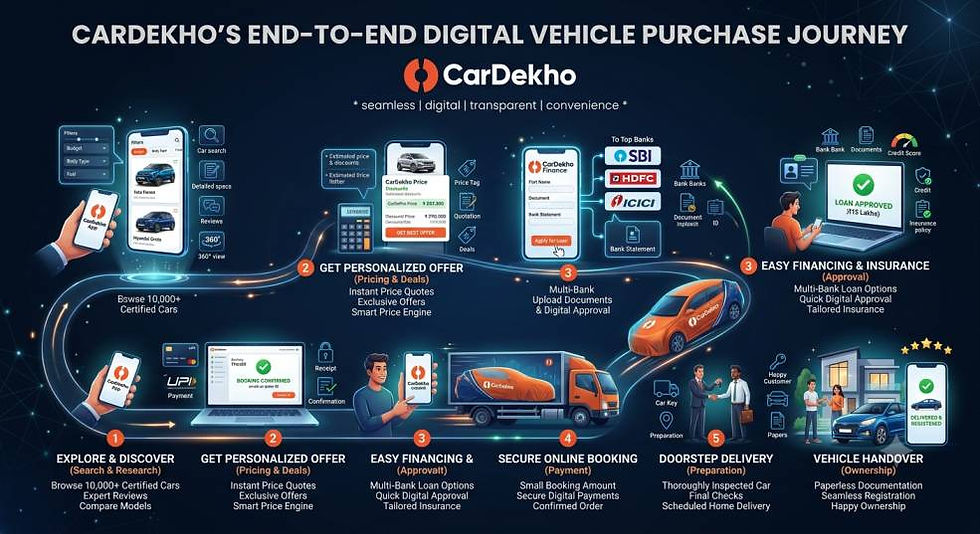
CarDekho’s End-to-End Digital Vehicle Purchase Journey
Industry and Competitive Context
India’s pre-owned vehicle market is large, fast-growing and structurally disorganised a combination that has attracted successive waves of venture capital into digital auto retail. Redseer Strategy Consultants estimated in 2026 that the market covering retail passenger-vehicle transactions stood at roughly USD 35 billion in FY26 and would approximately double to around USD 70 billion by FY31, with annual retail volumes rising from about 6 million units to 9–10 million units over the same period. Redseer also projected that India, currently the fifth-largest used-car market globally, would move to third position behind the United States and China by the end of the decade.
The strategically important figure in that same body of research is the share of transactions that remain outside organised channels. Redseer put the unorganised share at approximately 80 per cent, against an unorganised dealer base estimated at 47,000–52,000 dealers versus roughly 2,500–3,000 branded outlets, and projected that organised players could account for close to 30 per cent of the market by FY31. The consultancy characterised the used-car business as simultaneously a sourcing, pricing, inspection, refurbishment, financing and documentation business noting that classified platforms improve discovery but do not control the full transaction.
That last observation defines the competitive problem CarDekho set out to solve. India’s digital auto sector split into two models. On one side sat classifieds and lead-generation platforms CarDekho, BikeDekho and ZigWheels under Girnar Software; CarWale, BikeWale, OLX India and Shriram Automall under the listed CarTrade Tech monetising dealer subscriptions and OEM advertising. On the other sat inventory-owning full-stack retailers, principally Cars24 and Spinny, buying, refurbishing and reselling vehicles on their own balance sheets. Both models were capitalised heavily between 2020 and 2022, and the strategic question of the period was whether a platform business could move down the value chain into transactions without inheriting retail’s cost structure.
Brand Situation Prior to the Initiative
CarDekho was founded in 2008 in Jaipur by brothers Amit Jain and Anurag Jain under parent company Girnar Software. Its original franchise was informational: reviews, specifications, comparisons, pricing and dealer discovery, supported by immersive product tools the company describes on its own site, including a 360-degree “Feel The Car” viewer, and by tie-ups with automakers, more than 4,000 car dealers and financial institutions.
The move toward transactions began offline. From 2019 the group scaled CarDekho Gaadi stores a consumer-to-business network where owners sold vehicles into a dealer auction, with the company handling RC transfer, loan closure, payment and inspection; the company publicly reported crossing 50 such stores within about three months of a rapid expansion push. In August 2020 CarDekho entered certified pre-owned retail through a franchise model, launching its first CarDekho Gaadi Trustmark showroom in Jaipur, announcing plans to open 50 exclusive franchise stores and 200 retail Trustmark locations in FY 2020-21, and stating an investment plan of USD 20 million for that year in the used-car segment. Amit Jain framed the demand case at the time around the pandemic-driven shift to personal mobility, citing 1.3 used-car transactions for every new-car transaction in FY20.
The capital backdrop mattered. CarDekho raised a Series E round in October 2021 that took it to unicorn status at a valuation reported at USD 1.2 billion, with the raise pitched substantially on scaling used-car and financial-services transactions. Consolidated revenue from operations grew 81 per cent to ₹1,598 crore in FY22 from ₹884 crore in FY21. The brand entered its full-digital retail push, therefore, with unusually strong top-of-funnel assets, a newly built physical network, and investor expectations tied explicitly to transaction growth.
Strategic Objective
The publicly stated objective was to convert an audience that already researched vehicles on CarDekho into buyers who transacted on CarDekho closing the gap Redseer later described between discovery and transaction control. In the January 2022 launch announcement of its online pre-owned retailing service, Amit Jain positioned the goal as importing mainstream e-commerce expectations into a category that had never offered them, describing the offering as the first pure e-commerce platform for used-car retailing in India and framing the consumer need as ease and safety as transactions moved online.
Two structural objectives sat behind the consumer-facing one. First, capture the adjacent financial-services value pools financing and insurance that attach to almost every vehicle purchase. Second, build a transaction data asset that a classifieds business alone cannot generate. The company has since disclosed that close to 75 per cent of car buyers on its platform opted for a financing option, which is the clearest public articulation of why the financing layer, rather than the vehicle margin, became the strategic prize.
Campaign Architecture and Execution
The architecture had three layers, and the most instructive part of the case is that the company later dismantled one of them.
Layer one: the inventory-led digital retail proposition (2022–2023)
The January 2022 launch offered an AI/ML-driven end-to-end discovery and buying experience in which customers could search more than 5,000 certified used cars by manufacturer, model, variant, year, kilometres driven and budget, and complete the purchase online. The trust architecture was deliberately specified and unusually generous for the category: a 217-point quality check, a “no questions asked” seven-day money-back guarantee allowing the buyer to test-own the vehicle with a full refund, a six-month comprehensive warranty, pan-India roadside assistance, company-handled RC transfer, and bundled insurance. Fulfilment offered home delivery or pickup from company delivery centres. Availability at launch covered Delhi NCR, Mumbai, Bengaluru, Pune, Ahmedabad, Chandigarh, Agra, Lucknow and Kanpur.
Read strategically, each element is a substitute for a trust signal the unorganised market cannot provide. The money-back guarantee removes the irreversibility of a used-car purchase; the inspection score standardises quality; bundled documentation removes the administrative friction that historically forced buyers into relationship-based local dealing.
Layer two: the reversal (May 2023)
CarDekho shut its business-to-consumer used-car retail operation in 2023. In an interview with Entrackr, Amit Jain stated that the company had been in used-car retail for about two and a half years and had continuously lost money, that running a retail business was costly because of high burn on parking, showrooms and manpower, and that the cost of capital gave no reason to continue. In the same interview he disclosed that at peak the business sold around 800 cars a month and that roughly USD 20–25 million had been invested in the vertical.
The financial trace of the exit is visible in filed results. Revenue from products fell 81 per cent to ₹176.64 crore in FY24 from ₹952.22 crore in FY23, and consolidated operating revenue declined 3.49 per cent to ₹2,250.43 crore, while total expenses fell 8.62 per cent to ₹2,669.39 crore.
Layer three: the reconstructed journey as an ecosystem (2023 onward)
Rather than abandoning the end-to-end ambition, CarDekho re-expressed it without owning inventory. Ownership of the vehicle moved back to dealers; ownership of the decision layers stayed with the platform. Rupyy, the group’s digital lending and used-car financing platform, was disclosed as holding a 15 per cent market share in used-car loans in FY24 with an annualised run rate exceeding USD 2 billion and more than 36 banking partners; the company reported approximately ₹16,000 crore in loan disbursements facilitated during FY25. InsuranceDekho recorded ₹3,000 crore in premium in FY24 with a network of 150,000 agents across more than 1,500 cities, covering 98 per cent of India’s pin codes and serving more than 9 million customers. Dealer-side tooling stock management, lead management and walk-in tracking through a dedicated dealer application extended the platform into the supply side of the transaction.
The technology narrative was refreshed rather than retired. At the Bharat Mobility Global Expo in January 2025, CarDekho showcased AI-driven immersive technology, analytics engines for personalised insight, AR/VR experiences and multilingual AI voice assistants intended to serve consumers, OEMs and dealerships. Mayank Jain, CEO of the group’s New Auto business, framed AI as the cornerstone of user experience and customer acquisition for the industry going forward.
Positioning and Consumer Insight
The documented consumer insight is trust asymmetry, not convenience. Redseer’s framing of the category reach and familiarity in the unorganised channel, but weakness on standardised inspection, warranty, price transparency, documentation and post-sale assurance describes precisely the gaps the 2022 proposition was engineered to close. CarDekho’s own published positioning for the Gaadi network echoed the same diagnosis, repeatedly citing the largely unorganised state of the Indian used-car market as the reason for building standardised processes around payment, RC transfer and loan closure.
The repositioning after 2023 is subtler and more interesting. The company stopped promising to be the seller and began promising to be the system: discovery, valuation, credit, insurance and documentation, with the vehicle itself supplied by a dealer network. That is a shift from a merchant proposition to an infrastructure proposition. It preserves the consumer-facing claim of an end-to-end journey while transferring inventory risk, refurbishment cost and real-estate cost to partners who already carry them at lower marginal cost.
Media and Channel Strategy
CarDekho has not publicly disclosed media budgets, channel mix, agency arrangements or campaign-level media plans for this strategy, and no such disclosure appears in credible reporting. The one channel fact the company has released is structurally significant: it reported that its auto vertical reached 60 million monthly users with 90 per cent of traffic generated organically.
That figure is the economic foundation of the entire approach. A platform whose demand is overwhelmingly organic built on more than fifteen years of editorial content, reviews, pricing tools and search equity acquires intent at a materially different cost structure from a retailer that must purchase it. It explains why monetising that intent through financing and insurance distribution proved viable while monetising it through vehicle margin did not. Owned and earned media are, in effect, the company’s primary channel strategy; physical retail was the paid-media equivalent that failed the payback test.
Business and Brand Outcomes
In FY24 the group reported net revenue of ₹2,074 crore, a 54 per cent increase from ₹1,347 crore in FY23 on a basis adjusted for the discontinued used-car sales business, attributing growth principally to InsuranceDekho and Rupyy. It delivered its first full-year standalone profitability, a profit of approximately ₹37 crore before exceptional items against a loss of ₹143 crore in FY23, and reduced consolidated losses from ₹562 crore to ₹340 crore. The group raised approximately USD 80 million in growth capital during the year and reported a cash reserve of ₹1,600 crore. Group CFO Neelesh Talathi linked the portfolio expansion including the acquisitions of Revv and Carrum and investments in BiUP and Girnar AI Innovations Lab to the group’s stated IPO readiness.
In FY25 consolidated operating revenue rose 24 per cent to ₹2,795 crore from ₹2,250 crore. Consolidated losses narrowed marginally to ₹266 crore from ₹276 crore before exceptional items and share of losses in associates, which the company attributed largely to growth-stage losses in its insurance and Southeast Asia businesses. The standalone entity housing auto classifieds and vehicle financing remained profitable for a second consecutive year with revenue crossing ₹1,000 crore, and the company reported that profitability from the auto classifieds segment increased 60 per cent, citing higher dealer subscriptions, improved conversion efficiency and demand across used and new vehicle categories. Net cash reserves stood at ₹1,177 crore as of March 2025.
Strategic validation of the reset also arrived from the market. In November 2025 CarTrade Tech disclosed to the stock exchanges that it was in preliminary discussions with Girnar Software regarding consolidation of the CarDekho and BikeDekho classifieds businesses a transaction reported at over USD 1.2 billion before both parties confirmed on 27 November 2025 that they had mutually decided not to proceed at that stage. Reporting in 2026 by the Economic Times and Inc42 indicated that Girnar Software was preparing a draft red herring prospectus for an IPO of approximately ₹3,000–3,500 crore at a targeted valuation of ₹13,000–15,000 crore; these figures were attributed to sources rather than confirmed by the company.
Strategic Implications
The first implication concerns where value accrues in a transaction journey. CarDekho attempted to capture the vehicle margin and found it structurally unattractive; it captured the credit and insurance decisions instead and reached profitability in its core entity. In categories with a high-ticket, low-frequency purchase and a mandatory financing attachment the company’s own disclosure that close to 75 per cent of its buyers took financing is the key datum the ancillary decision may be a better monetisation point than the asset itself, because it carries no inventory risk and recurs across the ownership lifecycle.
The second concerns the discipline of reversal. Raising USD 250 million partly on a transaction-scaling thesis and then closing that business within roughly two years is an expensive public correction. The instructive element is not that the company exited but that it exited on a clearly articulated economic test cost of capital against demonstrated unit economics and redeployed toward verticals where its organic demand advantage was defensible. The subsequent return to standalone profitability suggests the reversal was better strategy than persistence would have been.
The third concerns the durability of informational equity. Ninety per cent organic traffic across 60 million monthly users is an asset that a competitor cannot replicate with marketing spend, and it compounds. Physical retail, conversely, scaled linearly with capital and did not compound. The case suggests that platform-native businesses should extend into transactions only where the extension is powered by the compounding asset rather than requiring a second, non-compounding one alongside it.
The fourth is a caution about “end-to-end” as a strategic frame. An end-to-end customer experience does not require end-to-end ownership of the value chain. CarDekho’s post-2023 architecture delivers a comparably integrated consumer journey research, valuation, financing, insurance, documentation while holding almost none of the underlying assets. The consumer-facing promise and the balance-sheet decision are separable, and conflating them is what made the first attempt expensive.
Discussion Questions
CarDekho’s 2022 proposition bundled a 217-point inspection, a seven-day money-back guarantee, a six-month warranty and bundled insurance. Evaluate whether these trust guarantees created defensible differentiation or merely raised the cost base of an already unviable model. What would you have tested before scaling them nationally?
The company disclosed that close to 75 per cent of buyers on its platform opt for financing, and that 90 per cent of its 60 million monthly users arrive organically. Construct the strategic argument for why these two facts together made the financing-led model more defensible than the inventory-led one and identify what would have to change for that argument to break.
Redseer projects that organised players may reach only about 30 per cent of the Indian used-car market by FY31, with around 80 per cent of transactions currently unorganised. Does CarDekho’s asset-light intermediation model accelerate or slow the organisation of this market relative to full-stack operators such as Cars24 and Spinny? Argue both sides.
Assess the reputational and investor-relations dimensions of reversing a publicly announced, capital-backed strategy within roughly two years. Under what conditions should a management team absorb that cost rather than attempt to fix the unit economics of an existing business?
CarTrade Tech and Girnar Software ended consolidation talks in November 2025, with CarDekho subsequently reported to be preparing an independent listing. Which path consolidation of classifieds assets or independent listing of a diversified auto-tech and fintech group better serves the end-to-end journey strategy, and what evidence would you require to decide?



Comments