Pantene’s Insight into Hair Fall Concerns Among Urban Consumers
Industry & Competitive Context
India's shampoo and hair-care market has long been shaped by a duopoly-like rivalry between Hindustan Unilever (HUL), whose portfolio includes Sunsilk, Clinic Plus, and Dove, and Procter & Gamble (P&G), whose India hair-care lineup has included Pantene, Head & Shoulders, and, at various points, Rejoice. Domestic and value-tier players such as Dabur (Vatika) and CavinKare have historically competed at the mass and sachet end of the market, where affordability drives format decisions.
In 2004, P&G's Country Marketing Manager, Rahul Malhotra, disclosed at a press briefing that Pantene held a 7.5% share of the Indian shampoo market, with the shampoo business generating an annual turnover of Rs 200 crore against P&G India's total turnover of Rs 800 crore at the time. Later that year, P&G Executive Director Ashok Chhabra stated the company was targeting a 25% share of India's Rs 1,100-crore hair-care market, noting that the category was growing at roughly 7% annually and that urban India accounted for 61% of the hair-care market even though sachets a format associated with price-sensitive, broad-based consumption made up about 70% of total sales volumes. These figures, drawn from contemporaneous Exchange4media reporting, place Pantene at that stage as a distant challenger to HUL's category leadership, competing in a market where hair fall was already established as one of the largest generic consumer concerns addressed across price tiers.
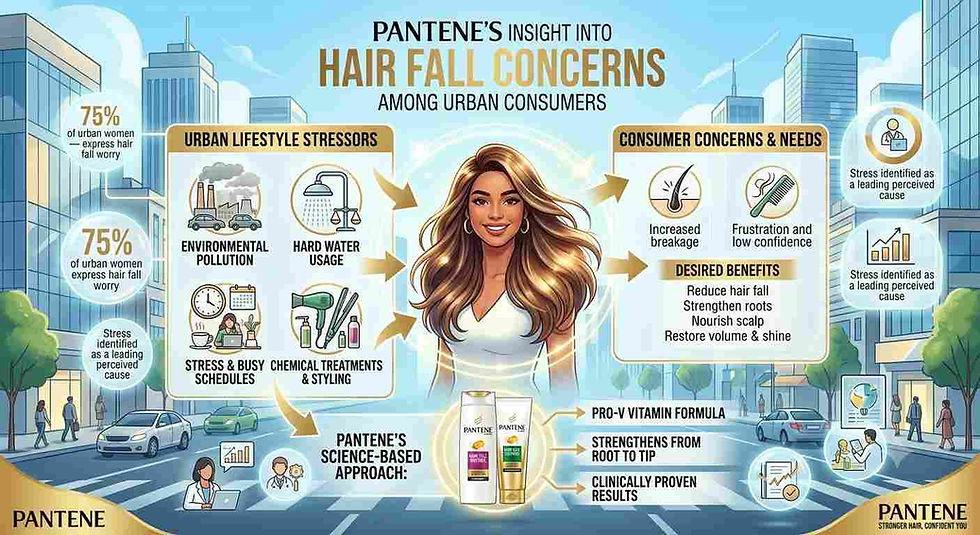
Hair fall has, over time, functioned less as a niche sub-segment and more as a recurring category entry point that multiple brands multinational and domestic alike have used to enter or re-enter consumer conversations, since it is a widely shared, emotionally resonant concern rather than a narrow demographic need.
Brand Situation Prior to Campaign
By the early-to-mid 2000s, Pantene operated as a challenger brand in India, positioned against HUL's Sunsilk, with a single-digit market share and a shampoo business turnover a fraction of the size of the broader category. To stimulate volume, P&G cut Pantene bottle prices by 15–20% in early 2004, a move reported by Exchange4media at the time as part of an active "shampoo war" with HUL, which had itself run a buy-one-get-one-free promotion on Sunsilk and Clinic Plus. Against this backdrop of price competition, P&G chose to differentiate Pantene functionally rather than purely on price, launching the Pantene Hair Fall Control variant in April 2004. The product was formulated with Pro-Vitamin B5 and conditioning agents positioned to work on the hair shaft, and the launch campaign deliberately avoided celebrity endorsement in favour of what Malhotra described as a "normal Indian middle-class model" a casting choice aimed at relatability over aspiration.
Fifteen years later, by 2019, Pantene's marketing organisation in India, under Marketing Director Binu Ninan, again identified hair fall as the central problem to solve, but this time the framing had shifted from a product-technical claim to a social and behavioural insight. According to statements reported by Exchange4media and Afaqs at the time, the brand had spent 18 months listening to young Indian girls through in-depth interviews before arriving at the insight it would build a new campaign around.
Strategic Objective
The publicly stated objective behind the 2019 #FreedomHair campaign was to reposition Pantene from a functional hair-care brand into one connected to a broader emotional and social narrative relevant to young Indian women, while using a reformulated product to make that narrative credible. Binu Ninan stated that the brand had learned that "the biggest obstacle preventing women from leaving their hair open was hair fall," and that this finding motivated the creation of a new formulation the Pantene Advanced Hair Fall Solution explicitly designed, in the brand's words, "so that Indian girls can have more open hair days."
This objective mirrors the logic of the 2004 launch in one respect: in both cases, a reformulated product was paired with a campaign designed to convert a widely felt, generic problem (hair fall) into a source of brand differentiation. What changed between the two periods was the register of the communication from a rational, ingredient-and-price-led claim in 2004 to an emotionally and socially framed insight in 2019.
Campaign Architecture & Execution
The #FreedomHair campaign, which went on air on 13 October 2019, was built around the idea that young Indian women are caught between traditional expectations around dress, career, marriage, and even how they wear their hair and a desire to define their own paths. Pantene's stated insight was that "young girls might not have all the answers to the challenges they face, but they seek to lead their lives differently versus the earlier generation." This was translated into the tagline "your life is an open-ended story; it starts with open hair," anchored to the hashtag #FreedomHair.
The centrepiece film featured eight women from varied fields who were described as making their mark in unconventional or defiance-coded paths, including professional athlete and LGBT-rights activist Dutee Chand, who appeared in the campaign discussing resistance she faced pursuing her athletic career and the support she received from her mother and sister. The film combined lyrics written by Javed Akhtar with a reworked version of Pharrell Williams's song "Freedom," and the brand's own reporting noted that the tone and creative territory were similar to an earlier international Pantene campaign built around the same song in partnership with Selena Gomez.
The campaign was explicitly positioned as being "supported by a full product line revamp": the Pantene Advanced Hair Fall Solution was launched alongside the film rather than as a separate initiative, tying the emotional narrative directly to a functional product claim about reduced hair fall.
Positioning & Consumer Insight
The consumer insight underlying #FreedomHair was two-layered. At the surface level, it was a functional finding: that fear of hair fall was the single biggest reason young Indian women kept their hair tied up rather than wearing it open. At a deeper level, the brand connected this functional barrier to a generational and social theme that today's young women want to write their own story rather than follow prescribed paths, and that the freedom to wear one's hair open (or however one chooses) became a small but symbolically loaded expression of that larger autonomy.
This is consistent with a broader, independently observable shift in Indian FMCG advertising during this period, away from purely rational product claims and toward purpose- or identity-driven storytelling. The case does not assert that Pantene's approach was unique in making this shift only that its own two campaigns, fifteen years apart, illustrate the industry-wide movement from an ingredient-led claim (2004) to an emotional, socially framed insight anchored in a functional product benefit (2019).
To extend the campaign beyond media spend into tangible social action, Pantene partnered with Sattva, described in company materials as "a mission-driven organisation that creates scalable solutions for social impact." Through this partnership, Pantene stated it would work with Sattva to run workshops and internships for young girls across India "across diverse careers and passion areas," positioning the brand's role as enabling real-world choices rather than only running an advertising message.
Media & Channel Strategy
Public reporting on the #FreedomHair campaign confirms that the core asset was a long-format brand film released on 13 October 2019, distributed through television and digital channels, and built around original music and lyrics. No verified public information is available on the specific media mix, channel-wise spend allocation, or paid-versus-earned distribution split for the #FreedomHair campaign. Similarly, no verified public information is available on independently disclosed reach, impression, or engagement metrics specific to this campaign; the brand's own campaign microsite describes the creative concept and the Sattva partnership but does not publish quantified media performance data.
Business & Brand Outcomes
Documented, sourced business outcomes specific to the #FreedomHair campaign are limited in the public domain. No verified public information is available on Pantene India's market share, sales volumes, or revenue change attributable to the #FreedomHair campaign or the Advanced Hair Fall Solution relaunch following 2019. No verified public information is available on any award recognition specific to the #FreedomHair campaign in India.
What is publicly documented is the earlier, comparable 2004 episode: following the launch of Pantene Hair Fall Control, P&G's stated ambition, articulated by Ashok Chhabra later that year, was to move Pantene and P&G's broader hair-care portfolio toward a 25% share of the Indian hair-care market, up from Pantene's own 7.5% shampoo-specific share disclosed earlier that year. No verified public information is available confirming whether this 25% target was subsequently achieved, nor is there verified public information tying that later performance specifically to the Hair Fall Control launch as opposed to other factors such as the broader Wella and Clairol brand acquisitions referenced in the same P&G statement.
At a corporate level, P&G's India business has periodically disclosed aggregate financial results — for example, reporting sales growth aided by rural expansion and new product introductions, alongside a rise in net profit attributed to a focus on higher-margin portfolio segments — but these figures apply to P&G India's overall FMCG business and are not broken out by brand or by campaign, so they cannot be attributed specifically to Pantene's hair fall positioning or to the #FreedomHair campaign.
Strategic Implications
Viewed across a fifteen-year span, Pantene's India strategy shows a consistent pattern: hair fall has repeatedly served as the brand's chosen entry point for reformulating its product line and refreshing its communication, rather than functioning as a one-time positioning experiment. In 2004, this took the form of a price-competitive, ingredient-led launch aimed at converting a generic concern into a specific, purchasable solution. In 2019, the same underlying concern was reframed as an emotional and social barrier the reason women avoid wearing their hair open and paired with a purpose-driven narrative and an NGO partnership designed to extend the brand's relevance beyond the product category itself.
This evolution is instructive for a few reasons. First, it illustrates how a challenger brand competing against a category leader with a larger portfolio and distribution footprint can use a widely shared, low-differentiation consumer problem (hair fall affects users across income and geography) as a recurring platform for renewal, rather than searching for a new problem each cycle. Second, it shows the limits of what is publicly verifiable in FMCG marketing case analysis: while campaign narratives, product claims, and market-context figures are often disclosed through press briefings and campaign launches, granular attribution of sales, share, or ROI to a specific campaign is rarely made public, which constrains how confidently outcomes can be linked to strategy in open-source case writing. Any analysis of this case should therefore treat the creative and positioning strategy as well documented, while treating commercial impact as, at best, partially observable through indirect, company-wide disclosures.
Discussion Questions
Compare Pantene's 2004 Hair Fall Control launch with its 2019 #FreedomHair campaign. What does the shift from an ingredient-led claim to an emotionally framed social insight suggest about how FMCG brands in India adapted their playbooks over that period?
Pantene chose to use the same generic consumer concern hair fall as the platform for two campaigns fifteen years apart. What are the strategic advantages and risks of returning repeatedly to the same core problem rather than identifying a new one?
In the absence of publicly disclosed sales, share, or ROI data tied specifically to a campaign, what alternative public indicators (press disclosures, award recognition, executive statements) can a marketing analyst reasonably use to assess campaign effectiveness, and what are the limitations of relying on them?
Pantene paired its #FreedomHair brand narrative with a tangible partnership (Sattva) offering workshops and internships. What role does this kind of structural partnership play in making a purpose-driven positioning credible, as opposed to a campaign that relies on advertising alone?
As a challenger brand competing against HUL's larger portfolio and distribution scale in India, what does Pantene's approach suggest about how a smaller-share competitor can compete on narrative and product reformulation rather than price or distribution reach alone?


Comments