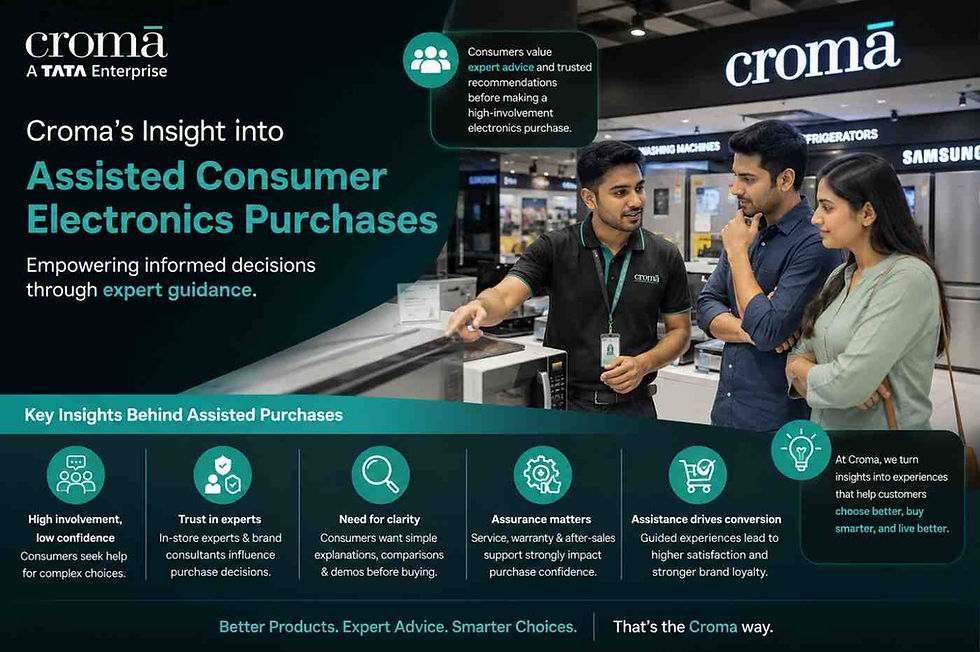
Croma’s Insight into Assisted Consumer Electronics Purchases
- 7 hours ago
- 11 min read
Industry and Competitive Context
India's consumer durables and electronics retail sector has historically been shaped by fragmentation. For decades before organized retail arrived, the market was dominated by independent regional dealers and small format multi-brand stores that competed almost exclusively on price. There was no meaningful effort to understand the complexity of the buying experience for electronics consumers or to invest in structured guidance at the point of sale. This created a structural gap between what consumers needed, which was informed decision-making support, and what the market was actually offering, which was largely transactional interactions at the lowest possible price.
The broader organized retail wave that began transforming Indian commerce in the early 2000s eventually created conditions for a specialist entrant. Yet even as modern trade expanded, consumer electronics remained an under-invested category in terms of the in-store experience. Competitors including Reliance Digital and regional chains operated on a similar product-centric model. The e-commerce threat, while not fully visible in 2006, would emerge powerfully by the early 2010s through platforms like Amazon and Flipkart, which compressed margins further and raised consumer expectations around convenience and price discovery.
Against this backdrop, the consumer electronics category poses a distinct challenge. Unlike impulse categories, high-value electronics purchases are fundamentally research-intensive, multi-touchpoint journeys. A Google-Ipsos study of Indian consumers in 2023 found that 96 percent research products online before completing a purchase, and 46 percent verify inventory online before visiting a physical store. This behavioural pattern, where digital research is universal but the final commitment often happens in person, makes the quality of in-store assistance a decisive competitive variable.
Brand Situation Prior to the Assisted Purchase Model
Infiniti Retail Limited, a wholly owned subsidiary of Tata Sons, launched Croma in October 2006 with its first store at Juhu in Mumbai. The entity received technical and strategic sourcing support from Woolworths Group of Australia, one of the world's leading retailers at the time. Croma was positioned from inception as India's first large-format specialist retail chain for consumer electronics and durables, a claim the company has consistently made in its official communications.
Before Croma formalized its assisted-purchase positioning, the company's founding team undertook an analysis of the existing competitive landscape. That analysis, documented through Tata Group communications and industry publications, revealed that the market was dominated by price-focused local players with limited effort to understand and meet all the needs of the consumer. There was no single player offering a one-stop shop for technology products across brands, price points, and product ranges to suit consumers from different strata of society. More importantly, existing formats did not offer trial areas for testing sophisticated gadgets, had no structured product display environments, and had no trained staff capable of providing support and actual demonstration of product use.
This gap was not a minor operational shortcoming. It represented a fundamental misalignment between what the market offered and what electronics buyers actually needed during one of the most cognitively demanding purchase journeys in retail. The complexity of product specifications, the speed of technology change, the significance of post-purchase service, and the high financial value of most electronics purchases all combined to make the buying process genuinely difficult for the average Indian consumer. This was the latent consumer tension that Croma chose to build its entire business model around.
Strategic Objective
Croma's strategic objective, as articulated in official Tata Group communications and the company's own public positioning, was to enter the market with a differentiated offering that addressed the latent needs of consumers rather than competing solely on price. The company aimed to position itself not as a vendor of electronics but as a trusted guide through the purchase process. The intent was to convert the complexity of technology buying from a point of friction into a source of brand equity.
This objective required the strategy to operate simultaneously at the level of retail format design, staff capability, product assortment, and brand communication. A price-matching strategy alone would not have justified the investment in large-format stores of 10,000 to 20,000 square feet and the training infrastructure needed to develop knowledgeable in-store advisors. The strategic bet was that a well-executed assisted-purchase model would not only differentiate Croma from regional competitors but would also create resilience against the e-commerce threat, since digital platforms could replicate pricing and selection but could not easily replicate the quality of in-person expert guidance.
Campaign Architecture and Execution
The translation of the assisted-purchase insight into a market-facing strategy rested on four operational pillars, each of which is documented through official company communications and publicly available sources.
The first pillar was the retail format itself. Croma stores were designed as large-format environments with open floor plans that allowed consumers to interact physically with products before purchase. This "touch and feel" experience, as described in the company's own communications, was deliberately built to address the information asymmetry that consumers experienced elsewhere. Trained staff were positioned not to sell but to demonstrate, explain, and guide. The official brand philosophy that emerged from this design choice was stated publicly as: "We won't sell, we help you buy."
The second pillar was product range depth. Croma's value proposition, as stated in its official retail presentations, was built on offering more than 6,000 products across 200 brands at launch, subsequently expanding to over 20,000 products across 500 brands as confirmed by the company's current official website. This breadth served the assisted-purchase model by giving in-store advisors the ability to help consumers navigate genuine alternatives rather than steering them toward a limited selection. The communications segment, comprising smartphones and related devices, became the single largest category, contributing between 40 and 50 percent of overall net sales according to CARE Ratings press releases based on audited financial filings.
The third pillar was staff capability development. Croma invested significantly in training its retail workforce as product knowledge advisors rather than traditional sales personnel. This distinction is documented in Tata Group's official editorial coverage of Croma's journey, which records that with the rapid evolution of consumer technology, the company re-aligned its training team to category merchandisers rather than the earlier practice of aligning training to geographic store clusters. This structural change in the training architecture reflected the company's understanding that technology expertise needed to be organized around product knowledge domains, not geographic territories, to remain current and useful to consumers.
The fourth pillar was the extension of the in-store assisted-purchase model into the digital environment. Croma launched cromaretail.com in 2012, becoming one of the earliest electronics retailers in India to offer an online portal, and subsequently integrated it with an omnichannel architecture. According to TCS press releases and official Tata Group communications, Croma executed a significant technology transformation beginning in 2019 in partnership with Tata Consultancy Services. In August 2024, TCS enabled 100 percent in-store mobile checkout for all Croma stores, described as a first in the retail industry in India, through TCS OmniStore, an AI-powered unified composable commerce platform. This enabled consumers to complete transactions through any channel without friction at the point of final commitment.
Positioning and Consumer Insight
The consumer insight at the core of Croma's positioning is precise and publicly documented. Croma recognized that electronics purchases are structurally different from most retail categories because the knowledge gap between the consumer and the product is significant, the financial stakes are meaningful, and the consequences of a wrong purchase are difficult to reverse. In the absence of credible, expert guidance, consumers either default to the safest-sounding option, delay the purchase, or buy on price alone. None of these outcomes serves the consumer well, and none of them builds brand loyalty for the retailer.
Croma's response was to make itself the party that eliminates that knowledge gap. The brand's official tagline, "We help you buy," is not a promotional message but an operational commitment. In official Tata Group communications, it is stated that this philosophy is closely aligned to the way employees are recruited, inducted, trained, assessed, and rewarded. The same documentation notes that this philosophy of helping rather than selling makes Croma the highest average selling price retailer for most high-end brands, because consumers who receive credible guidance feel equipped to choose higher-end product ranges that better meet their actual needs.
This insight also has a structural implication for category dynamics. While the communications segment, a largely market-pull category where consumers already know what they want to buy, contributes the largest share of revenues, the large appliances category, which is more guidance-dependent, represents a distinct strategic opportunity. According to CARE Ratings filings, home and kitchen appliances contribute approximately 25 to 30 percent of net sales. The Croma model argues that in guidance-intensive categories, the quality of human assistance at the point of sale is a more durable competitive advantage than price.
Croma's own-label strategy, launched in 2008 under the brand Croma Life Accessories and later expanded to include televisions and other durables, also reflects the assisted-purchase logic. By offering products under its own brand, Croma was able to strengthen the advisor role of its staff by giving them a product line they could recommend with full product knowledge and confidence. This positioned in-store staff as genuinely expert guides rather than agents of a third-party brand.
Media and Channel Strategy
No verified public information is available on Croma's specific media spend allocation, channel-by-channel advertising budget, or agency briefing documents that would allow a precise reconstruction of its paid media strategy as it relates specifically to the assisted-purchase positioning.
What is publicly documented is the structure of the omnichannel architecture within which Croma's communication operates. Croma.com serves as the brand's owned digital commerce and content platform, and the Tata Neu super-app, into which Croma is formally integrated, functions as a cross-category loyalty and engagement mechanism. According to official Tata Group communications, Croma's then-CEO Ritesh Ghosal described the cross-category engagement enabled by Tata Neu as a significant competitive advantage that no single-category player could easily replicate. The Tata Neu credit card provides an additional stickiness layer for high-spend customers within this ecosystem.
Croma's integration of WhatsApp for paperless receipts, service updates, and post-purchase communication, as documented in TCS official case materials, reflects a channel choice driven by the penetration of WhatsApp in India rather than by broadcast media logic. This approach to post-purchase communication extends the assisted-purchase model beyond the store visit and into the ownership experience, reinforcing the brand's positioning as a long-term guide rather than a one-time transaction partner.
The company has also used television and online advertising campaigns such as "Things Happen at Croma," documented by Adgully in 2021, which drew on lifestyle-based consumer insights about the occasions that prompt electronics purchases. These campaigns were described in official commentary from the brand's agency as being built around the insight of celebratory moments and lifestyle transitions, consistent with the broader positioning of Croma as a partner in significant life decisions rather than a price-led destination.
Business and Brand Outcomes
The following outcomes are drawn exclusively from CARE Ratings press releases based on audited filings with the Registrar of Companies, Tata Group official communications, and Tata-group-attributed reporting by credible news outlets including the Economic Times.
Infiniti Retail's total operating income approximately doubled in FY2023, rising from Rs. 8,274 crore in FY2022 to Rs. 15,943 crore. The company recorded further growth of approximately 12 percent in FY2024, taking total operating income to approximately Rs. 17,932 crore, and approximately 7 percent further growth in FY2025, according to CARE Ratings. CARE Ratings attributed the robust revenue growth to the addition of approximately 319 new stores across the three fiscal years prior to FY2026.
Croma achieved EBITDA breakeven and positive operating cash flow in FY2024, as reported by the Economic Times citing Registrar of Companies filings accessed through Tofler. This was the company's first positive PBILDT position under Indian Accounting Standards. According to the CARE Ratings press release dated July 2026, the company reported positive PBILDT on a pre-Ind AS basis for the first time in FY2026, supported by cost optimization initiatives and the rationalization of underperforming stores. Same-store sales growth improved to 6.1 percent in FY2026 from essentially flat growth in FY2025. Sales productivity per square foot improved to Rs. 41,593 in FY2026 from Rs. 36,856 in FY2025.
As of March 31, 2026, Croma operated 563 stores across 220 cities in India, according to the CARE Ratings July 2026 press release. The official Croma website records the brand's footprint at over 540 stores across more than 200 cities. CARE Ratings also noted that Croma accounts for approximately 10 percent of Apple's business in India, which reflects the effectiveness of the assisted-purchase model in premium and high-complexity product categories where consumer guidance is most valuable and where margin contribution is strongest. Digital sales contribute between 8 and 10 percent of revenues, according to CARE Ratings.
Strategic Implications
Croma's assisted-purchase model carries several implications that are relevant to the broader study of retail marketing and brand positioning in high-consideration categories.
The first implication concerns the durability of service-led positioning against a price-led competitive environment. Croma's early years coincided with the explosive rise of Indian e-commerce, which placed significant pressure on the company's margins. Yet rather than responding with deep online discounting, Croma eventually made a documented strategic choice, described in Economic Times reporting citing company filings, to reset its online strategy away from negative contribution margins. This decision, which cost Croma a quarter of its online sales volume in FY2024, reflected a deliberate prioritization of profitability over volume, consistent with a brand positioning that is built on expertise and trust rather than price. The result, at least as evidenced by CARE Ratings data, was the company's first move into positive PBILDT territory.
The second implication concerns the conditions under which staff capability becomes a sustainable competitive advantage in retail. Croma's investment in category-aligned training, documented through Tata Group official communications, was not primarily a cost-containment exercise but a strategic response to the fact that technology changes faster than traditional store-based training cycles allow. Re-aligning training by product category rather than geography was a structural solution to a structural problem. For retailers in other high-complexity categories, this approach offers a transferable model.
The third implication is about the role of ecosystem integration in extending a service-led positioning into the digital channel. Croma's integration into the Tata Neu super-app and the WhatsApp-based post-purchase communication infrastructure represent an attempt to replicate the coherence of the in-store guided experience across digital touchpoints. The challenge for any retailer operating this model is that the human element of in-store guidance is difficult to digitize, and the 8 to 10 percent digital sales contribution reflects both the structural stickiness of the in-person model and the remaining opportunity to extend guided experiences online.
The fourth implication addresses the question of how assisted-purchase models interact with premiumization. CARE Ratings documentation that Croma is among the highest average selling price retailers for several high-end brands, combined with its significant Apple business share, suggests that effective assistance at the point of sale actively shifts the price distribution of consumer decisions upward. This has a direct implication for retail gross margins and for the broader argument that service investment is not merely a brand cost but a revenue-generating mechanism.
Finally, the pace at which Croma scaled from approximately 100 stores in 2015 to over 560 stores by FY2026 raises questions about the limits of maintaining a consistent advisory service quality at significant scale. CARE Ratings notes that same-store sales growth was flat in FY2024 and FY2025 despite strong headline revenue growth, which was driven almost entirely by new store additions. This gap between volume growth and organic quality growth is one of the defining strategic tensions facing any service-led retailer during rapid expansion.
Discussion Questions
Croma's "We help you buy" positioning was conceptualized in 2006 when e-commerce was minimal in India. In an environment where Indian consumers now research products almost universally online before purchase, as documented by the 2023 Google-Ipsos study, how should Croma evolve the assisted-purchase model to remain relevant when the research journey increasingly begins and ends outside the physical store?
CARE Ratings data shows that the communications segment, a category where consumer intent is largely formed before the store visit, contributes between 40 and 50 percent of Croma's net sales. How does this category mix tension challenge the commercial logic of the assisted-purchase positioning, and what category strategy would you recommend to better align revenue composition with the brand's core differentiation?
Croma's decision to reduce online discounting in FY2024, resulting in a 25 percent fall in digital sales volume but improved contribution margins, reflects a deliberate trade-off between scale and profitability. Evaluate the long-term brand implications of this choice, particularly in the context of a competitive landscape where Amazon and Flipkart continue to compete aggressively on price in the electronics category.
The company's path to PBILDT positivity was supported not only by revenue growth but also by the rationalization of underperforming stores. What does this suggest about the minimum viable footprint required for a service-led electronics retailer to sustain the quality of its in-store experience, and how should Croma think about store count optimization versus market coverage?
Croma's integration into the Tata Neu ecosystem offers loyalty and cross-category engagement benefits that no standalone electronics retailer can replicate. However, it also positions Croma as one brand within a larger platform rather than an independent consumer relationship owner. Assess the strategic trade-offs of this ecosystem dependency for Croma's long-term brand equity and consumer relationship management.


Comments