Engage's Brand Strategy in the Deodorant Category
- 33 minutes ago
- 9 min read
Industry & Competitive Context
At the time of Engage's launch, the Indian deodorant market was valued at approximately Rs 2,300 crore and was one of the fastest-growing sub-segments within personal care, a category that industry coverage noted was growing significantly faster than FMCG at large. The market was dominated by Vini Cosmetics' Fogg, Hindustan Unilever's Axe, McNROE Consumer Products' Wildstone, and J.K. Helene Curtis' Park Avenue, alongside global entrants such as P&G's Old Spice and Beiersdorf's Nivea. Industry data compiled by Nielsen India and cited in contemporaneous reporting also indicated that men's deodorants accounted for roughly 69–70% of category volume, with women's deodorants at 30–31% and considered an under-penetrated, high-potential segment.
The category's dominant communication idiom at the time centred on a "man attracts woman" trope deodorant as a tool of male sexual conquest most visibly associated with HUL's Axe. Trade press coverage of the period (Outlook Business, Economic Times) noted that this positioning had become commoditised across multiple brands, with limited differentiation in either product claims or price. Competitors like Marico (which had acquired Set Wet and Zatak from Reckitt Benckiser in 2012) and Wipro Consumer (which relaunched Yardley in 2010) were also actively expanding in the category, intensifying competitive pressure at the time ITC entered.
ITC's entry into deodorants was part of its broader Personal Care Products Business, which the company had built out over the preceding decade alongside brands such as Fiama Di Wills, Vivel, Superia, and Essenza Di Wills, leveraging what ITC's own Annual Report descriptions characterise as "internationally benchmarked" product development anchored in consumer and market research.
Brand Situation Prior to Campaign
Engage had no prior market presence; it was a greenfield brand launch rather than a repositioning or turnaround exercise. ITC's Personal Care Products Business had, in the years preceding Engage's launch, been a loss-making segment within the ITC portfolio a fact acknowledged in the company's own financial reporting for FY2013, which noted narrowing but continuing losses in the non-cigarette FMCG business prior to product launches including deodorants. Deodorants and personal care variant extensions (face wash, body lotion) were explicitly cited by Business Standard as part of the portfolio expansion undertaken by ITC's Personal Care division during this period.
Strategic Objective
Based on ITC's official press communications at launch, the stated strategic intent was twofold: first, to establish a credible, differentiated entry into a fast-growing personal care sub-category for a company whose non-cigarette FMCG business had, until recently, been loss-making; and second, to break from the category's dominant "man attracts woman" communication convention by building a proposition around mutual, equal attraction between partners.
Sandeep Kaul, then Chief Executive Officer of ITC's Personal Care Products Business, stated in ITC's official launch press release that deodorants were "experiencing swift and dynamic growth" within personal care, and that Engage was "uniquely poised to leverage this opportunity and carve a significant consumer mindshare" through "a simple yet modern proposition of romance." This framing signals a positioning objective rather than a narrowly performance-metric-driven one consistent with a brand-building mandate for a still-nascent FMCG portfolio within a diversified conglomerate.
Campaign Architecture & Execution
Product Architecture
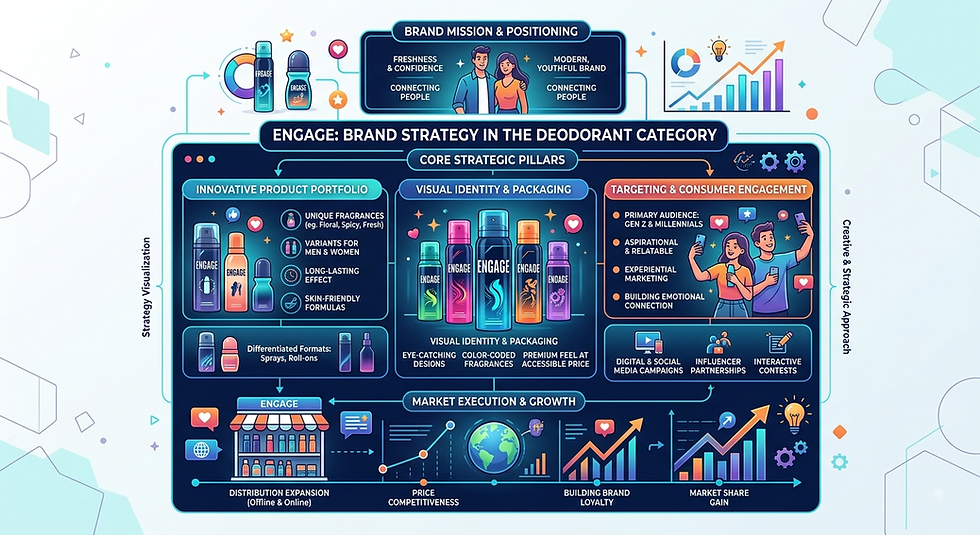
At launch, Engage comprised a range of 16 deodorant variants eight fragrances each for men and women sold in three explicitly paired formats: Rush (male) and Blush (female), Mate (male) and Spell (female), and Urge (male) and Tease (female). This paired-fragrance architecture was itself a structural expression of the brand's "couple" positioning: rather than developing separate, unrelated men's and women's ranges (the industry norm), Engage built its SKU architecture around complementary pairs designed to be used, and marketed, together. Products launched at a stated price of Rs 160 for a 165 ml bottle and were distributed, per ITC's press release, through "all leading retail outlets in India."
Brand Identity and Design
According to FoleyDesigns, the design agency publicly credited by ITC with developing the Engage brand identity, the creative brief centred on the absence of any fragrance brand in the Indian market that addressed men and women "equally" within a single concept. The agency's account describes a design system built around interlinking silhouettes depicting a "dance of attraction" between couples, a differentiated capital-"G" logo mark for the men's line and lower-case "g" for the women's line, and a vibrant colour palette intended to visually encode the "playful chemistry" proposition across packaging.
ITC's own press communications corroborate this design logic, describing "Silhouettes" as the pack's key design element, each illustrating "a distinct playful, uninhibited moment couples 'Engage' in."
Campaign Extensions Over Time
Engage's architecture was extended in subsequent years through verified product launches: Engage Cologne Sprays (launched September 2014, described as carrying higher fragrance dosage and "0% Gas"), Engage ON pocket perfumes for youth consumers (a TVC directed by Abhinay Deo, with music by Dhruv Ghanekar, created by J. Walter Thompson), and Engage L'Amante, a premium France-inspired perfume range launched in 2019. The L'Amante launch, per a published Social Samosa case study, used an influencer- and PR-led activation strategy including an on-ground brand event, actress Tara Sutaria as a brand association, and the participation of the Consulate General of France in India in place of conventional mainline media, under the campaign hashtag #LoveLikeLamante. The same case study reports that the campaign's media and influencer outreach reached "90% of the media universe set out at the beginning of the outreach," though no independent, quantified engagement or sales metrics for this specific campaign were located in public sources.
Most recently, ITC's own reporting on FY2025–26 personal care performance describes the rollout of Engage Brazilian Maracuja Eau de Parfums and an expansion into the anti-perspirant roll-on segment using "Fresh-Encap technology," alongside "high-impact influencer advocacy campaigns," reflecting continued category and format expansion more than a decade after launch.
Positioning & Consumer Insight
The consumer insight underlying Engage's positioning, as publicly described both by ITC executives and by its design agency, was that the deodorant category's prevailing "man attracts woman" framing left no room for a fragrance brand that treated men and women as equal participants in attraction rather than one gender as the target of the other's pursuit. Kaul's 2014 remarks to the Economic Times made this explicit: "Most brands portray deodorant as a male phenomenon. Instead, Engage has focused on engagement and playful chemistry between two partners who are equals."
From a positioning standpoint, this represents a category re-framing move rather than a simple attribute-based differentiation: Engage did not primarily compete on functional claims (longevity, anti-perspirant efficacy, fragrance intensity) in its founding creative, but on an emotional and relational territory mutual romantic playfulness that had not been claimed by an established player at the time. The paired product architecture (Rush/Blush, Mate/Spell, Urge/Tease) operationalised this positioning at the SKU level, giving retail and packaging cues a direct link to the brand's relational narrative, rather than treating men's and women's lines as separate businesses under one master brand.
Media & Channel Strategy
Verified public information on Engage's media strategy is available primarily at the level of individual campaign or product-extension launches rather than as a comprehensive, disclosed always-on media plan:
The original 2013 launch was supported by distribution through general trade retail outlets nationally, per ITC's official press release.
The Engage ON pocket perfume launch (exact year not independently confirmed in the sources reviewed) used a television commercial as the lead vehicle, created by J. Walter Thompson and directed by Abhinay Deo.
The 2019 Engage L'Amante launch used an influencer- and PR-led model on-ground event activation, celebrity association (Tara Sutaria), and earned media/newswire outreach explicitly in place of "mainstream media" support, according to the Social Samosa case study on the launch.
ITC's FY2025–26 personal care commentary references "quick-commerce and e-commerce platforms" as sales-momentum channels for newer Engage formats (EDPs, roll-ons), alongside "influencer advocacy campaigns," indicating a shift toward digital-first and modern-trade/e-commerce channel emphasis in the brand's current phase, consistent with broader FMCG channel trends in India.
Business & Brand Outcomes
The most robust, independently sourced outcome data available is from Nielsen India market-tracking figures reported by the Economic Times in July 2014, roughly a year after launch:
Engage held an 8.1% volume share across India's urban markets (which the report states account for approximately 90% of the overall deodorant market), placing it in second position by volume, behind market leader Fogg (Vini Cosmetics) at 12.5%, and ahead of HUL's Axe and McNROE's Wildstone, which were tied at 6.9% each.
By value, the same Nielsen data placed Engage at approximately 6.6%, behind Fogg (17.8%), Wildstone (6.7%), but narrowly ahead of Axe (6.5%).
ITC's Kaul stated that Engage had achieved distribution covering "almost 75% of the market within four months of the launch," and that in specific cities Kolkata, Kanpur, and Kochi Engage was reported as the largest brand by both value and volume as of May 2014.
Trade press (Economic Times) described this as ITC's "first major success in the personal-care space" at that point in the company's diversification history.
A separately sourced 2016 Nielsen-based industry deck (publicly hosted, marked "internal circulation only" by its original compiler, and therefore of lower verifiability than the Economic Times/Nielsen figures above) indicates Engage's men's category share grew from a 0% base in 2013 to approximately 5% by 2016, and its women's category share grew from 0% to approximately 4% over the same period, with retail outlet reach expanding from roughly 37,100 to 225,700 outlets. These figures are presented here as directionally indicative of continued growth but should be treated with more caution than the Nielsen-via-Economic-Times data, given the source's stated internal-circulation status.
ITC's Annual Report descriptions of its Personal Care portfolio (e.g., FY2015) characterise Engage's "playful chemistry" proposition as reflected in an "increasingly popular portfolio of colognes and deodorants," without disclosing brand-level revenue, profit, or market-share figures consistent with ITC's practice of reporting personal care performance at a segment level rather than a brand level in its statutory financial disclosures.
Strategic Implications
Several strategic lessons can be drawn from Engage's documented trajectory, interpreted through established marketing frameworks:
Category re-framing as a market-entry strategy. Rather than entering the deodorant category on the dominant competitive dimension (male sexual-conquest messaging, as pioneered by Axe), Engage's founding insight treating attraction as mutual and equal between partners represents a Blue Ocean-style move within an otherwise commoditised, attribute-competing category. This is consistent with positioning theory's emphasis on owning an unclaimed perceptual space rather than out-executing incumbents on shared attributes.
Architecture as positioning reinforcement. The paired-SKU structure (Rush/Blush, Mate/Spell, Urge/Tease) is a notable example of product architecture being used as a positioning delivery mechanism rather than a purely operational or manufacturing decision every purchase touchpoint (shelf, pack, fragrance name) reinforced the "couple" narrative, reducing reliance on advertising alone to carry the brand idea.
Speed of distribution as a share driver. The reported 75% market coverage within four months of launch, leveraging ITC's pre-existing FMCG distribution infrastructure (built through Classmate, Bingo!, Sunfeast, and other portfolio brands), illustrates how an established conglomerate's route-to-market assets can compress the time-to-scale for a new entrant relative to a standalone challenger brand a structural advantage not available to most new category entrants.
Evolving channel mix over the brand's lifecycle. The shift documented in ITC's own FY2025–26 commentary from general trade-led distribution at launch to quick-commerce, e-commerce, and influencer-advocacy-led growth for newer formats over a decade later reflects the broader structural shift in Indian FMCG go-to-market strategy, and shows a legacy-positioned brand adapting its channel strategy to changing retail formats without necessarily abandoning its founding brand idea.
Limits of public disclosure for brand-level performance assessment. A material constraint on any external assessment of Engage's long-run commercial success is that ITC does not disclose brand-level revenue or profitability; the strongest verifiable outcome data available (Nielsen-sourced share figures) is now over a decade old. This is a common analytical limitation across many FMCG brand case studies in the Indian market, where segment-level rather than brand-level disclosure is the corporate norm, and is worth flagging explicitly rather than filling with inferred figures.
Discussion Questions
Engage entered a commoditised deodorant category by reframing the emotional territory of the category (mutual attraction) rather than competing on functional product attributes. Using positioning theory, evaluate the risks and durability of an emotionally-differentiated positioning strategy in a category where competitors can potentially imitate the messaging without imitating the paired-SKU product architecture.
Engage's paired-fragrance product architecture (Rush/Blush, Mate/Spell, Urge/Tease) embeds the brand's positioning into the SKU structure itself. Discuss the trade-offs of using product architecture as a positioning delivery mechanism versus relying primarily on advertising and communication to carry a brand idea.
ITC's existing FMCG distribution infrastructure allowed Engage to reach an estimated 75% of the market within four months of launch. To what extent can distribution speed, rather than creative differentiation, explain early category share gains in a fast-moving-consumer-goods launch, and how would you design a research approach to separate these two effects using only public data?
Compare Engage's 2013 launch communication strategy (mainline TV-led, general trade distribution) with its stated FY2025–26 approach (quick-commerce, e-commerce, and influencer advocacy). What does this shift suggest about how legacy brand positioning should or should not be adapted as retail channel structures evolve?
ITC does not publicly disclose Engage's brand-level revenue or market share beyond occasional Nielsel-sourced figures reported in the press. As a strategy consultant advising a competitor, what publicly available proxy indicators would you use to estimate Engage's current competitive position, and what are the limitations of each proxy?

Comments