TradeIndia's Lead Management Platform Strategy
- 3 minutes ago
- 5 min read
Industry & Competitive Context
India's business-to-business e-commerce sector sits atop one of the world's largest bases of micro, small, and medium enterprises (MSMEs). According to IBEF, India's B2B digital marketplaces have emerged as a critical enabler connecting Indian manufacturers to global buyers across sectors such as engineering goods, chemicals, textiles, pharmaceuticals, agriculture, and industrial components, with policy support for digital trade and export facilitation expected to reinforce this momentum.
Within this sector, the dominant early competitive structure was documented by a 2009 study conducted by the Internet and Mobile Association of India (IAMAI) on ICT adoption among MSMEs, reported by the Economic Times. That study found IndiaMART.com held roughly 60% market share among online B2B marketplaces in India, with approximately 85% of surveyed B2B suppliers naming IndiaMART.com as their first choice, followed by TradeIndia.com as the next-preferred platform. This establishes, from a credible contemporaneous source, that TradeIndia has long operated as the principal challenger to IndiaMART in India's directory-and-lead-generation B2B marketplace category a two-player core market that publicly available industry commentary continues to describe in similar terms, alongside newer transaction-oriented and vertical-specific entrants such as Udaan, Power2SME, and Infra.Market, which operate a materially different full-stack (procurement, logistics, financing) business model rather than a pure lead-generation model.
Brand Situation Prior to Campaign
TradeIndia operates as a subscription-based online B2B marketplace. Publicly available company-provided descriptions of the platform consistently state that it was established in 1996 and is operated by Infocom Network Private Limited, headquartered in the Delhi-NCR region (Noida, Uttar Pradesh). Company profile information attributes the platform's founding to Bikky Khosla, who is also described in public company material as editor of SME Times, a trade and business publication.
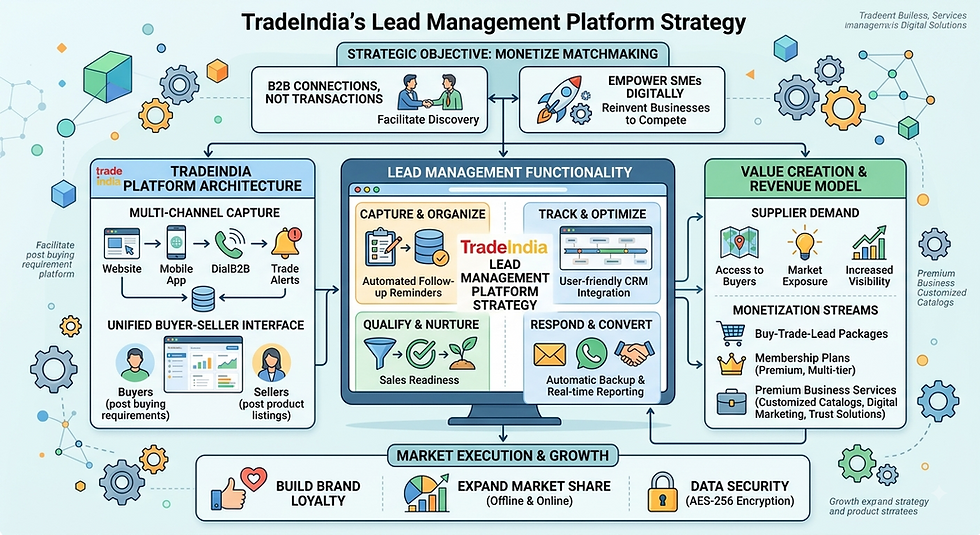
TradeIndia's own platform descriptions state that its core offerings include online business catalogs and product listings, trade leads and buyer inquiry alerts, a communication tool referred to as DialB2B, membership/subscription tiers, credit reports, and information on trade shows and networking events. This self-described feature set indicates that lead generation and inquiry management have been positioned as central, rather than peripheral, to the platform's value proposition from an early stage i.e., the company's own descriptions treat "trade leads" as a named, core marketplace feature rather than a secondary tool.
Strategic Objective
What can be stated on the basis of publicly available, company-described platform architecture is a directional inference, clearly separated here from documented fact: a marketplace that structures its own offering around "trade leads," inquiry alerts, tiered membership plans, and dedicated communication infrastructure (DialB2B) is, by the nature of that architecture, oriented toward monetizing the generation and delivery of qualified buyer inquiries to paying suppliers, rather than around per-transaction commission. This is an interpretation of the platform's documented structure, not a claim about a stated corporate strategy, and should be read as such.
Campaign Architecture & Execution
What is publicly documented, per TradeIndia's own platform descriptions, is the existence of specific product features associated with lead handling: trade lead posting and browsing, inquiry alerts, and DialB2B as a buyer-supplier communication mechanism. Beyond naming these features, no verified detail is publicly available on how leads are scored, routed, prioritized, or audited internally, nor on any technology partnership, vendor, or in-house engineering initiative behind these features, since TradeIndia has not published such detail through official channels.
Positioning & Consumer Insight
TradeIndia's publicly stated positioning describes the platform as connecting Indian manufacturers, exporters, wholesalers, and distributors with buyers, with an emphasis on serving small and medium enterprises seeking market access. This positioning is consistent with the broader industry rationale described by IBEF: that digitisation and the need for efficient market access are structural drivers pushing India's MSME manufacturing base toward B2B digital marketplaces, and that such marketplaces are expected to evolve over time from transaction platforms into longer-term trade partners for manufacturers.
The underlying consumer (supplier) insight implied by this positioning that a small manufacturer's core need from such a platform is a reliable stream of qualified buyer inquiries rather than transactional infrastructure is consistent with, but not confirmed by, any published TradeIndia market research, customer survey, or insight study.
Media & Channel Strategy
Public company-linked material references general marketing activity including participation in MSME-focused offline events (for example, an MSME Connect event organized with the All India Forum of MSMEs, referenced in third-party business-data listings) and a brand film reported in trade press to feature a television personality but none of this material is presented, in credible sourcing, as being specifically tied to a lead management platform strategy, and precise dates, budgets, and measured results for these activities are not publicly available.
Business & Brand Outcomes
As a private company, TradeIndia does not publish revenue, profitability, lead volume, conversion, retention, or supplier-renewal data through audited or investor-facing channels, and no credible news outlet, regulatory filing, or industry report reviewed for this case discloses such figures.
The only outcome-adjacent, independently sourced data point available is the 2009 IAMAI/Economic Times study cited in Section 1, which positioned TradeIndia as the second-most-preferred B2B marketplace among surveyed Indian suppliers at that time. This is a market-position data point, not a lead management performance metric, and it predates any specific platform initiative addressed in this case by more than a decade.
Strategic Implications
In the absence of disclosed performance data, the strategic implications that can be responsibly drawn are structural rather than evidentiary. A durable challenger position in a two-player-dominated marketplace category as documented for TradeIndia relative to IndiaMART as of 2009 typically requires differentiation on a dimension other than raw scale, since the market leader in such categories generally compounds a traffic and network-effect advantage over time. Publicly available platform descriptions suggest TradeIndia has pursued differentiation through the depth and configurability of its lead-related tooling (trade leads, inquiry alerts, DialB2B, tiered memberships) rather than through disclosed claims of superior scale. Whether this differentiation has translated into sustained competitive share, revenue growth, or supplier retention cannot be assessed on the basis of currently available public information, and any claim to that effect would constitute unsupported inference.
For MBA analysis purposes, this case is therefore best used to illustrate two distinct points: first, how a lead-generation-oriented B2B marketplace structures its product architecture around inquiry monetization as a stated design choice; and second, the practical constraints analysts face when a privately held company does not disclose the performance data ordinarily required to evaluate a platform or marketing strategy's actual effectiveness a limitation that is itself a relevant strategic observation about transparency and evaluability in India's private B2B marketplace sector.
Discussion Questions
Given that TradeIndia does not publicly disclose lead volume, conversion, or retention data, what alternative, publicly observable indicators could an analyst reasonably use to assess the effectiveness of a lead-generation-based B2B marketplace's strategy?
How does structuring a core product offering around "trade leads" and inquiry alerts rather than transaction commissions change a marketplace's incentives regarding data transparency toward both suppliers and external analysts?
In a category where the 2009 IAMAI study found IndiaMART held roughly 60% share with TradeIndia as the next-preferred alternative, what structural strategic options are available to a durable "number two" platform, and which of these can be pursued without disclosed financial resources?
What are the risks and benefits, from a supplier's perspective, of subscribing to a tiered lead-generation platform whose lead quality and volume are not independently audited or publicly benchmarked?
As India's B2B marketplace sector shifts toward full-stack models (financing, logistics, procurement) exemplified by entrants such as Udaan and Infra.Market, what strategic pressure does this place on a pure lead-generation incumbent like TradeIndia, and how might it credibly respond without abandoning its core positioning?


Comments