Firefox Bikes: Premium Cycling Brand Strategy in India
Industry & Competitive Context
India's bicycle industry has historically been a volume-driven, low-price market dominated by utilitarian, mass-market cycles. According to trade reporting, the overall Indian bicycle market grew from an estimated $3 billion before the Covid-19 pandemic to approximately $4 billion in 2021, of which the premium bicycle category accounted for roughly $100 million a small but fast-growing slice of the total (Indian Retailer, 2022). Within this premium segment, Firefox Bikes has been named alongside competitors such as Cannondale Cycles and KTM Bicycles as one of the recognized premium players (Indian Retailer, 2022), while an independently published industry presentation also references Hi-Bird Cycles and Track and Trail as competing premium brands (SlideShare/Firefox Bikes presentation, source unverified beyond this document).
The competitive dynamic in this segment is defined less by price and more by brand experience, product engineering, and retail specialization a marked departure from the traditional Indian cycle trade built around unbranded, price-led distribution through general hardware and cycle shops. Firefox's own positioning statements describe itself as "India's leading premium bicycle brand" and "India's premium cycling brand" (PR Newswire, 2021; The Drum, 2021), a claim consistently repeated across its owned and earned media rather than derived from independent, syndicated market-share data.
Brand Situation Prior to the Strategic Shift
Firefox Bikes was established in 2005, founded by Shiv Inder Singh and Pradeep Mehrotra (ICRA rating rationale, credit report). In June 2006, the company entered into an exclusive distribution partnership with Trek Bicycle Corporation (USA) for the Indian market, a relationship later expanded in 2010 to include the Gary Fisher collection (company distributor material, Bikes Station). The same period saw Firefox add complementary categories Finish Line lubricants and Slime puncture-resistant products in 2010, Tern folding bikes in 2012, and a components distribution partnership with Shimano in 2012 (Bikes Station).
This phase built Firefox's credibility as a specialist multi-brand premium retailer rather than a single manufacturer, positioning it distinctly from mass-market Indian cycle makers. In September 2015, Hero Cycles described in industry press as the world's largest bicycle manufacturer acquired Firefox Bikes as part of a stated strategy to strengthen its position in India's premium cycling segment (Bike Europe, 2015). Firefox has since operated as a wholly owned subsidiary of Hero Cycles Limited (ICRA credit rationale; CRISIL Ratings, 2024).
Prior to the acquisition, Firefox operated a modest company-owned and franchise retail footprint. One third-party industry presentation cites a network of 8 company-owned outlets and over 100 franchisee outlets at an unspecified point in the company's history (SlideShare presentation; unverified independent detail, included for context only). By the time of later CRISIL/ICRA rating disclosures, Firefox's distribution network had scaled to approximately 700 dealers and 18,000–20,000 retail outlets nationally, alongside seven company-owned, company-operated (COCO) stores (ICRA rating rationale).
Strategic Objective
Following the acquisition, and particularly through the Covid-19 pandemic period, Firefox's publicly stated strategic objective centred on capturing the accelerated, pandemic-driven consumer shift toward cycling as a health, sustainability, and personal-mobility choice, and converting that demand into premiumization of the category rather than volume commoditization.
CEO Sukanta Das stated in an interview that the company aimed to be recognized as "a leader in the premium segment," citing an internal (non-syndicated) estimate of "close to about 25 percent market share in the premium industry, maybe slightly more," while explicitly acknowledging the absence of independent data to verify this (Indian Retailer, 2022). Das further stated that the premium bicycle industry grew approximately 50% in 2021 versus 2019, while Firefox itself grew approximately 100% over the same period again presented as a company claim rather than an audited or independently verified figure (Indian Retailer, 2022).
Firefox's head of marketing, Manika Sharma, articulated the underlying strategic logic in an interview with The Drum: the brand's approach centred on "creating great customer journeys and engagement, starting with discovery," framed against a broader consumer shift in which people were "more health-conscious, more concerned about addressing environmental challenges, and more committed to changing their behavior to advance sustainability" (The Drum, 2021). This framing positioned Firefox's objective not merely as selling bicycles, but as building an experience-led retail and brand ecosystem to capture value in a category that had, for the first time in India, developed genuine premium-price willingness.
Campaign Architecture & Execution
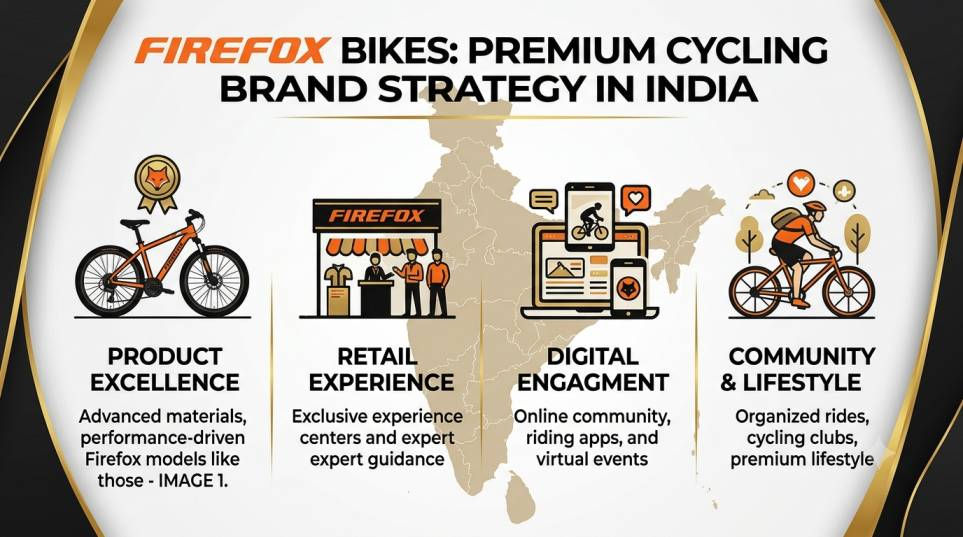
Firefox's principal, publicly documented strategic initiative in this period was physical retail transformation through its "Experience Centre" format. The company opened its first branded Experience Centre in Mumbai, followed by a second in Delhi's Pitampura locality, inaugurated in November 2021 (PR Newswire, 2021). According to the official press release, the Delhi Experience Centre was designed to "completely redefine the bike buying experience," combining "technology, biking and experiential retail under one roof," with digital engagement features including virtual reality (VR) and gamification elements intended to help customers navigate Firefox's different bike segments (PR Newswire, 2021).
Beyond the two confirmed Experience Centres (Mumbai and Delhi), Firefox publicly announced plans to open 35 new customer experience centres across India, covering metro and Tier I cities (Indian Retailer, 2022).
Alongside the retail-format initiative, the company stated plans to launch six new entry-level bicycle models by January (year not specified precisely in the source but reported in a 2021/2022 article), aimed at broadening its portfolio beyond the premium price band (Indian Retailer, 2022). CEO Das also referenced ongoing work on an IoT-based "smart bike" solution and stated the company was investing in SaaS-based customer systems and a direct-to-consumer (D2C) website journey (Indian Retailer, 2022).
On sourcing and supply chain, Das referenced Hero Group's investment in a "cycle valley" manufacturing cluster near Ludhiana, which he stated would give Firefox "priority access" to manufacturing capacity (Indian Retailer, 2022). This is corroborated at a corporate level by CRISIL's 2024 rating rationale, which notes that Firefox's management "optimized its working capital cycle" partly by "domestically sourcing bikes through its parent, Hero Cycles" (CRISIL Ratings, July 2024).
Positioning & Consumer Insight
Firefox's public positioning consistently frames the brand around premium quality, engineering credibility (inherited in part from its historical Trek/Gary Fisher/Shimano partnerships), and an aspirational, adventure-oriented lifestyle identity. The brand's own retail-partner description characterizes Firefox as standing for being "adventurous, non-conformist with a purpose and passion," built on "the love of biking" since its bikes "hit the road in 2005" (Cycle Republic/Firefox brand page).
The consumer insight underpinning the post-2020 strategy, as articulated by marketing head Manika Sharma, was that the pandemic had converted cycling from a niche recreational activity into a mainstream expression of three converging consumer motivations: physical health, environmental consciousness, and behaviour change toward sustainable, personal (non-shared, outdoor) mobility (The Drum, 2021). This insight is consistent with though not identical to the CEO's framing of cycling as "a smart mobility choice" adopted to "maintain social distance" during the pandemic (Indian Retailer, 2022).
Price architecture data from company statements indicates that Firefox's most popular price bands were ₹12,000–₹15,000 and ₹20,000–₹30,000 (Indian Retailer, 2022), while a separate industry aggregator source lists Firefox retail pricing spanning approximately ₹7,000 to ₹40,000 across its range (Carbike360, industry aggregator; independently unverifiable pricing detail). These figures are presented for context but are not drawn from an audited company disclosure such as an annual report or investor presentation.
Media & Channel Strategy
Firefox's verifiable channel strategy centres on physical retail: a multi-tier network combining wide-reach traditional trade (approximately 700 dealers and 18,000–20,000 outlets per ICRA's rating rationale) with a small number of directly operated, experience-format flagship stores (seven COCO stores, per the same source) designed to build brand engagement and premium perception in metro markets.
An independently published industry presentation states that Firefox's "marketing strategy focuses on promoting biking culture through guerrilla tactics and social media" (SlideShare presentation). This source also references a corporate social responsibility collaboration with Volunteer4India on a program named "#EverydayAbility," aimed at promoting inclusivity and employability for persons with disabilities (SlideShare presentation; corroborated in general terms by Firefox's brand page on Cycle Republic, which references the same CSR collaboration).
Separately, a distributor-authored company history references Firefox's support for grassroots cycling culture through sponsorship of National School Cycling Championships, school quiz contests, inter-school sports competitions, and cycling events such as Road and Track Nationals, mountain-bike (MTB) events, BMX competitions, and cross-country rides (Bikes Station, company distributor material).
Business & Brand Outcomes
Verifiable financial performance is available through credit-rating agency disclosures (ICRA and CRISIL), which rate Firefox Bikes Private Limited's bank facilities and therefore require standardized financial disclosure:
For the first quarter of FY2023, Firefox reported selling 18,000 cycles and generating revenue of ₹22.5 crore (Indian Retailer, 2024, citing Firefox-disclosed figures).
CRISIL Ratings reported that Firefox's revenue declined 19% year-on-year to ₹63 crore in fiscal 2024, down from ₹78 crore in fiscal 2023 (CRISIL Ratings, July 2024).
ICRA's rating rationale noted that Firefox's operating performance was "subdued" in FY2023, attributed to muted post-pandemic demand for bicycles as economic activity resumed and consumer preferences shifted, resulting in excess inventory carried over from the pandemic-era demand peak, higher fixed operating costs, increased reliance on discounting to move stock, and greater dependence on external borrowing (ICRA rating rationale).
ICRA further noted that this financial pressure translated into negative cash flows, a stretched liquidity position (with working-capital limits "almost fully utilised"), and a moderation in debt-protection metrics, partially offset by management actions such as sourcing bikes domestically through parent company Hero Cycles (ICRA rating rationale).
At the parent-company level, Hero Cycles Limited reported operational revenue exceeding ₹500 crore for the fiscal year ending March 31, 2023, with EBITDA growth of 323.07% year-on-year and net worth growth of 8.77% (Indian Retailer, 2024, citing Hero Cycles financial disclosures). This figure is at the consolidated Hero Cycles level and is not specific to the Firefox subsidiary.
Firefox's retail footprint, per ICRA's rating disclosure, comprised approximately 700 dealers, 18,000–20,000 outlets, and seven COCO stores at the time of that rating exercise.
These disclosures collectively indicate that the pandemic-era demand surge that motivated Firefox's premiumization and experience-retail investments (2020–2021) was followed by a documented post-pandemic demand correction and financial strain in FY2023–FY2024, as bicycle demand normalized once alternative mobility and outdoor-activity options (including a return to in-person work and unrestricted social activity) became available again.
Strategic Implications
Several analytically distinct implications emerge from the verified public record, independent of any embellishment beyond disclosed facts.
First, Firefox's strategy illustrates a classic premiumization play executed through channel and retail-experience investment rather than through a conventional mass-media brand campaign. In the absence of any documented advertising campaign of scale, the primary lever available to a subsidiary of a legacy volume manufacturer (Hero Cycles) for building premium credibility was direct control of the customer's purchase environment the Experience Centre format supplemented by heritage partnerships (Trek, Shimano, Gary Fisher) that pre-dated the Hero acquisition and lent international engineering credibility to a domestically distributed product.
Second, the acquisition rationale disclosed by Hero Cycles in 2015 diversification into the premium segment reflects a broader pattern among legacy Indian manufacturers of acquiring smaller, brand-differentiated players rather than building premium sub-brands organically. ICRA's rating rationale independently confirms that Hero Cycles pursued this acquisitive strategy further, also acquiring Insync and BSH in the cycling space, indicating that Firefox was one component of a wider premiumization and portfolio-diversification program at the parent-company level, not an isolated brand initiative.
Third, the documented financial deterioration in FY2023–FY2024 (revenue decline, inventory overhang, and rising leverage per ICRA and CRISIL) demonstrates the structural risk of demand-driven premiumization strategies that are contingent on an exogenous shock (the pandemic-era mobility and health behaviour shift) rather than a durable underlying change in category penetration. The same pandemic tailwind that justified aggressive store-network expansion plans in 2021 (35 new Experience Centres) appears, based on subsequent credit disclosures, not to have been sustained at the same demand level once normal mobility patterns resumed a case-relevant caution against extrapolating crisis-period demand into permanent capacity and channel commitments.
Fourth, Firefox's repeated public emphasis on unverified, self-reported market-share figures (25% premium segment share, cited by the CEO with an explicit caveat about the absence of syndicated data) is itself a strategically relevant observation: in the absence of independent, third-party category measurement for India's premium bicycle segment, brand positioning claims in this space rely substantially on company narrative rather than externally audited market data a common characteristic of nascent or under-measured premium categories in emerging markets.
Fifth, the shift in stated 2021–2022 strategy toward also launching entry-level models (six new entry-level bikes) suggests a subsequent recalibration from pure premiumization toward a broader portfolio architecture spanning both premium and volume price points consistent with the broader post-pandemic demand normalization later confirmed in the FY2023–FY2024 financial disclosures.
Discussion Questions
Given that Firefox's premiumization strategy relied heavily on physical retail experience (Experience Centres) rather than mass advertising, what are the scalability limits of an experience-led brand-building strategy in a market where the vast majority of the company's ~18,000–20,000 outlets remain traditional trade channels rather than owned flagship stores?
Hero Cycles' acquisition of Firefox (2015), alongside its later acquisitions of Insync and BSH, reflects a portfolio-based approach to premiumization. What are the trade-offs between acquiring distinct premium brands versus building a single unified premium sub-brand from within an existing mass-market manufacturer?
Firefox's CEO publicly cited an unverified 25% premium-segment market-share estimate while explicitly noting the lack of syndicated data. What risks and opportunities does this data vacuum create for both incumbents and challengers seeking to claim premium-category leadership in emerging retail categories in India?
The documented FY2023–FY2024 financial disclosures show revenue decline and inventory-driven margin pressure following the pandemic-era demand surge. How should a management team distinguish between a durable structural shift in category demand versus a temporary, crisis-driven demand spike when committing to capital-intensive channel expansion (such as a 35-store rollout)?
Firefox's strategy combined heritage international partnerships (Trek, Shimano, Gary Fisher) with local manufacturing backed by its parent's "cycle valley" investment. What does this suggest about how Indian premium consumer brands can balance imported credibility with domestic cost and supply-chain control, and what risks does increased dependence on a single parent-company supply source (as noted in CRISIL's 2024 rationale) introduce?


Comments