From Global Insight to Local Truth: KitKat India and the "Break Better" Campaign
Industry & Competitive Context
India's chocolate and confectionery market is one of the most contested fast-moving consumer goods (FMCG) arenas in the country, with the broader segment estimated at approximately USD 6 billion and growing at a strong pace driven by rising disposable incomes, premiumization, and expanding modern trade and e-commerce penetration. The category is dominated by Mondelez India, whose Cadbury portfolio commands the largest market share, followed by Nestlé India, and smaller but persistent challengers including Amul, Mars Wrigley, and the Hershey Company. Within this competitive field, the wafer-chocolate sub-segment — KitKat's native territory — occupies a distinct position. It bridges impulse confectionery and snacking, appealing to both children and young urban adults. The impulse purchase dynamic makes brand salience and distribution width disproportionately important competitive levers. In an environment where shelf presence and mental availability often determine the transaction, the brand that most strongly owns a culturally resonant emotional territory holds a durable structural advantage. Nestlé India has historically competed on the strength of iconic brands — Maggi, Munch, and KitKat being the most significant. KitKat's entry into India came through the Nestlé–Rowntree's inheritance post the 1988 acquisition of Rowntree's by Nestlé globally. For much of its history in India, KitKat was a secondary brand in Nestlé's chocolate portfolio, well behind Munch in the value-accessible wafer segment.
Brand Situation Prior to Campaign
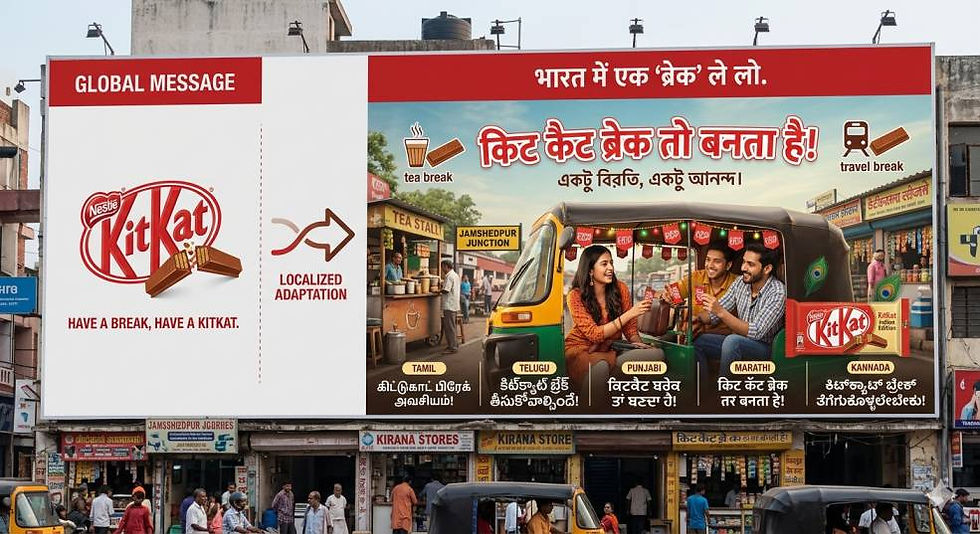
KitKat's global equity rests on one of the most durable brand platforms in advertising history: "Have a Break, Have a KitKat," a tagline that has been in continuous use since 1958 in the United Kingdom. Over more than six decades, the slogan became a culturally embedded mental shortcut linking the act of taking a break with the physical act of snapping and eating a KitKat. This association gave the brand substantial earned memory structures — what Byron Sharp's mental availability framework would call a strongly pre-built "brand cue." Yet as of the early 2020s, Nestlé's own global brand leadership recognized that while the break platform remained architecturally sound, it needed a contemporary refresh. The brand's global team, working with creative agency VML, hypothesized that the generation most in need of breaks — Gen Z — was paradoxically the least likely to take them or to find their breaks genuinely restorative. This was not merely an intuition; it became a research hypothesis to be validated across markets. India presented a particular challenge. A decade ago, India ranked tenth globally in KitKat sales. According to Nestlé India's annual report for FY2023–24, the country had by that point risen to the second-largest market globally, with 4,200 million KitKat fingers sold in the fiscal year. This trajectory reflected genuine commercial momentum, but also exposed a strategic gap: the global creative execution of the break platform was not resonating with Indian consumers with the same intensity as in Western markets, largely because the cultural meaning of "taking a break" had not been sufficiently interrogated or adapted for India. #10 India's global rank for KitKat sales a decade ago (pre-campaign era) 4.2B KitKat fingers sold in India in FY2023–24 (Nestlé India Annual Report) 34% Consumers globally who rated their breaks as "high quality" (Kantar/Human8 research, 2023)
Strategic Objective
Nestlé's strategic objective was dual in nature. At the global level, the goal was to reinvigorate KitKat's iconic break positioning for a new generation — specifically Gen Z — across a diverse range of markets, while maintaining the brand's long-accumulated equity. At the India-specific level, the objective was to overcome the documented failure of the global creative execution to resonate locally, by developing a localized adaptation of the campaign that preserved the universal human truth while speaking to India's culturally specific relationship with rest, interruption, and workplace fatigue. Critically, this was not a repositioning exercise. The brand was not attempting to change what KitKat meant — it was attempting to deepen that meaning by making the concept of "a better break" feel lived-in and culturally authentic to Indian consumers rather than borrowed from a Western commercial context. The strategic challenge was therefore a classic glocalization problem: how to build a single global campaign architecture that could be locally activated without losing coherence, brand consistency, or creative impact.
Positioning & Consumer Insight
The campaign's insight infrastructure was unusually rigorous for a FMCG brand, involving a multi-phase, multi-method research design conducted with external partners Human8 and Kantar across five markets: India, the United Kingdom, France, Brazil, and Saudi Arabia. In the first phase, Human8 conducted a six-day online qualitative community with Gen Z consumers (aged 18–30) across the five markets, comprising 80 participants in total. The research was designed to unearth a universal human truth around the concept of breaks. The key finding was striking in its simplicity: most respondents acknowledged taking sufficient breaks, but only 34 percent of the 1,500-consumer validation survey believed their breaks were of genuinely high quality. The primary reasons cited were loss of control over personal schedules, the inability to mentally disengage from ongoing tasks, and constant interruption from digital and workplace demands. Human8 described this as a "universal and meaningful insight" that resonated across all five markets. However, Kantar's subsequent ad testing using its LINK+ survey tool — which tested animatics of the creative execution across markets — revealed a significant market-specific finding: in India, "lack of cultural nuance surrounding breaks was shown to be holding back local response to the global execution." This was a documented failure signal from pre-launch testing, not a post-hoc rationalization. The global execution, rooted in a Western office context and visual idiom, did not automatically land in India, where the lived experience of work stress, break rituals, and the social meaning of pausing carry different cultural frequencies. This finding is strategically significant because it illustrates the limits of "universal human truth" as a campaign foundation when the cultural expression of that truth varies substantially across markets. The psychological pain of an unrestful break may be universal; the cultural cues, settings, and personalities that make that pain feel real and relatable are emphatically not.
Campaign Architecture & Execution
The global campaign, titled "Break Better," was created by VML and officially launched on September 2, 2024, via a press release from Nestlé. The hero film features a young office worker who, overwhelmed by the physical manifestations of his workload — papers, sticky notes, and office technology clinging to him as if magnetized — walks out of his office in pursuit of a genuine break. The metaphor of the office worker as a human magnet, unable to disengage from his professional environment, was a creative externalization of the research insight that workers struggle to "switch off." The film is set to Queen's "I Want to Break Free," a musical choice that, according to Kantar's AI-assisted testing via its LINK AI tool, was identified as the soundtrack with the broadest cross-market appeal from among several alternatives tested. The operative connection between the Queen song's title and KitKat's "break" platform created a layered cultural reference point that worked globally. The campaign rollout followed a phased geographic sequence: it launched first in the United Kingdom, followed by the rest of Europe, Canada, and Australia, before being adapted for further markets including India. Per Nestlé's official campaign communications, the India execution featured local celebrities — a documented adaptation element noted across market versions — and the campaign framework was described as a "fully integrated" campaign spanning television, online video, out-of-home (OOH), social media, and influencer channels. For India specifically, Kantar's published case study confirms that the granular insights from pre-launch LINK+ testing "helped the team shape and produce a localised version of the campaign which overcame the limiting factors identified during testing." The India localization therefore involved not cosmetic adaptation — simply dubbing or subtitling a Western creative — but a substantive reconfiguration of the creative's cultural context, casting, and situational references to reflect India-specific break culture and workplace environments. The India market's engagement was also extended through platform partnerships. Nestlé's official 90th anniversary brand communication confirmed that KitKat "teamed up with Netflix and Spotify in India," embedding the brand's break positioning into entertainment consumption contexts — moments when consumers are deliberately seeking leisure and disconnection. This represented a channel strategy that aligned brand meaning (the restorative break) with consumer behavior (streaming as a break activity), rather than simply purchasing media impressions.
Media & Channel Strategy
Per Nestlé's official campaign documentation and the Ads of the World submission filed by VML, "Break Better" was structured as a fully integrated campaign: TV and broadcast video-on-demand (BVOD) anchored the campaign's reach, with online video amplifying frequency among younger audiences. OOH placements extended visual brand presence in high-traffic urban environments, while social and influencer activations drove engagement and cultural conversation. The campaign ran across 60 countries, making it — in Nestlé's own description — KitKat's first truly global campaign at this scale of geographic synchronization. The soundtrack selection process itself was a documented element of the media strategy. Kantar's LINK AI tool was used to test multiple soundtrack options against the animatic globally before the final cut was produced. This AI-assisted optimization step was cited by Kantar as having generated cost savings of 60 percent over a traditional quantitative research approach for the soundtrack testing phase, allowing the team to move quickly while still grounding the creative decision in consumer data rather than instinct.
Business & Brand Outcomes
The documented outcomes of the campaign and Nestlé's broader India strategy for KitKat are among the most commercially significant in the brand's global history. According to statements made by Nestlé India Chairman and Managing Director Manish Tiwary in May 2026, India had by that point become the largest market globally for KitKat — overtaking Japan, Brazil, and leading European markets. This represented a climb from the tenth position globally just a decade earlier. Nestlé India's Director of Confectionery and Cereals, Jagatheesan Gopichandar, attributed the performance to "strong increase in core penetration and also entry into new consumer demand spaces." In FY2025, Nestlé India sold approximately 3,950 million KitKat fingers, which, per company leadership statements, corresponded to a doubling of KitKat's market share in India. By FY2026, Nestlé India's confectionery product group delivered high double-digit growth in both value and volume. KitKat became only the second brand in Nestlé India's portfolio — after Maggi — to reach the position of the company's largest global market for that brand. At the campaign effectiveness level, the "Break Better" campaign placed second in Kantar's 2025 Creative Effectiveness Awards for the TV category — an award selected on the basis of consumer research across thousands of ads tested globally. Kantar specifically cited the campaign's "skillful use of humor and compelling storytelling." Separately, in Kantar's own pre-launch assessment, the campaign delivered "top 10% results for the critical brand KPIs of brand distinctiveness and long-term impact" in its LINK testing, and ranked as a top 10 finisher in Kantar's Creative Effectiveness Awards for 2024. #1 India's global rank for KitKat sales by May 2026 3,950M KitKat fingers sold in India in FY25 2nd Kantar 2025 Creative Effectiveness Awards, TV category 60% Cost saving on soundtrack testing via AI vs. traditional quant It is important to note that India's ascent to the position of KitKat's largest global market reflects a multi-year strategic investment in the brand, encompassing product innovation (gifting formats like KitKat Celebreak, nibbling formats like KitKat Pops, and premium variants including Salted Caramel and Hazelnut in the KitKat Delights range), distribution expansion including a visicooler program to improve cold-chain presence in both urban and rural trade, and manufacturing investment (a third confectionery unit at Nestlé's Sanand, Gujarat facility commissioned to produce KitKat). The "Break Better" campaign and its India localization must therefore be understood as one significant element within a broader brand-building system, rather than as the sole causal driver of commercial outcomes.
Strategic Implications
The limits of universal truth as a creative foundation. The KitKat India case is a rare documented instance where pre-launch ad testing formally surfaced a cultural misfit in a global creative execution — and where the brand responded not by overriding the finding, but by developing a substantive India-specific adaptation. This challenges the popular assumption that a powerful emotional insight automatically transcends cultural geography. In India's case, the cultural semantics of "taking a break" — including social permission structures around pausing, the visual codes of workplace stress, and the identity of the person seeking respite — required active localization, not passive translation.
Insight-led localization as a competitive strategy. Nestlé and VML's decision to invest in a nine-month, multi-method research program before committing to a global creative treatment represents a meaningful departure from the conventional model of developing a global TVC and retrofitting it to local markets. The research architecture — qualitative community, AI-assisted stimulus testing, quantitative validation — created a structured decision pathway that justified both the global creative direction and the India-specific adaptation. For brand strategy teams, this process models how to balance efficiency (a single global platform) with effectiveness (market-specific relevance).
Brand platform durability and renewal. The "Have a Break" platform, now in its seventh decade, demonstrates that brand platforms do not become obsolete simply by aging — they become obsolete when they fail to connect their foundational human truth to the contemporary experience of their target consumer. KitKat's strategic challenge was not to replace the platform but to re-earn its relevance for a generation that faces a structurally different relationship with rest, productivity pressure, and digital saturation. The "Break Better" evolution represents what might be called a platform upgrade: same territory, refreshed cultural proof.
Channel-meaning alignment in India. The Netflix and Spotify partnerships in India are noteworthy not merely as media buys but as meaning-reinforcement vehicles. By placing the KitKat brand inside the contexts where Indian consumers actually take digital breaks — streaming entertainment, listening to music — Nestlé moved beyond claiming ownership of "the break" in advertising to being present within the break experience itself. This is a contextual targeting strategy with strong brand-behavior congruence, and it reflects an understanding of how Indian urban consumers have migrated their break behaviors into digital leisure environments.
Long-term brand equity investment as a market creation strategy. India's trajectory from the tenth-ranked global KitKat market to the largest is not a story about a single campaign. It is a story about a decade-long compounding of brand investment, distribution infrastructure, product portfolio expansion, and culturally informed communication. The "Break Better" campaign represents the communication apex of that investment cycle — but only because the underlying brand infrastructure had been built to absorb and amplify it. This sequencing — build the market, then invest in brand salience — offers a replicable model for Nestlé's other confectionery brands in emerging markets.
Discussion Questions
Kantar's pre-launch testing identified that the global "Break Better" execution lacked cultural nuance for Indian consumers. From a brand management perspective, what decision criteria should determine whether a brand develops a locally adapted creative versus deploying the global execution with minor adjustments? At what point does localization risk diluting global brand consistency?
KitKat's India ascent from the tenth to the first global market involved simultaneous investment in product innovation, distribution expansion, manufacturing capacity, and brand communication. Using the concept of brand equity as a strategic asset, analyze how each of these levers contributes differently to short-term volume growth versus long-term mental availability — and which is most defensible against competitive response from Mondelez India.
The "Break Better" campaign used a nine-month insight-to-execution process integrating qualitative communities, AI-assisted stimulus testing, and quantitative validation. Evaluate the strategic trade-off between this evidence-intensive model and faster, instinct-driven creative development. Under what competitive or category conditions would each approach be more appropriate?
KitKat partnered with Netflix and Spotify in India to embed the brand within actual break experiences. Drawing on the concept of contextual congruence in advertising effectiveness, assess the strategic logic of this approach relative to conventional media buying. What risks does platform dependency introduce for a brand that positions itself as the universal companion to rest?
KitKat's "Break Better" insight — that only 34% of consumers feel their breaks are high quality — identifies a category-level problem that KitKat alone cannot solve through a chocolate bar. Evaluate how KitKat's creative execution navigates this tension between the aspirational brand promise and the functional product reality, and whether this positioning strategy creates a sustainable long-term differentiation advantage or opens the door for well-being or mindfulness brands to compete in KitKat's emotional territory.


Comments