IFB Industries: Building a Home-Appliance Brand on Technology and After-Sales Service
Industry and Competitive Context
IFB Industries began as Indian Fine Blanks in 1974, in collaboration with Switzerland’s Heinrich Schmid AG (Screener.in company profile). It operates two businesses: consumer durables and fine-blanked engineering components (Business Standard, 16 October 2024). The appliance portfolio spans front- and top-load washing machines, dryers, air conditioners, microwave ovens, dishwashers, modular kitchens and chimneys. In fiscal 2024, home appliances contributed roughly 78% of revenue and engineering 22% (Business Standard, citing CRISIL).
India’s washing machine market is concentrated. Mordor Intelligence lists LG, Samsung, Whirlpool, IFB and Haier as the players that together hold a significant share. It also notes that premium platforms with AI-enabled fabric care and remote diagnostics have deepened differentiation against semi-automatic machines. CRISIL, quoted by Business Standard, expected consumer-durables revenue growth of 8–10% in FY25, with demand for premium appliances with smart technologies a growth driver. The same article reports that the washer category was flat or declined industry-wide in the June 2024 quarter.
IFB’s position within this market is hard to quantify. Keynote Capitals’ June 2024 initiating-coverage report put IFB’s domestic front-load share at about 35% and its top-load share at about 8%. In August 2026, however, Sandeep Joseph Abraham, MD and CEO of the Home Appliances Division, told investors that no consolidated source captures market share because online and offline sales are tracked separately. He said IFB believes its share is rising and that it is “definitely” in the top two in front-loaders, but he declined to give a number. Business Standard’s description is more cautious: among the top five washing-machine players, with a strong front-load position.
Brand Situation Prior to the Strategy
IFB’s consumer-appliance identity is anchored in front-load washers. Keynote Capitals reported that front-load machines accounted for 37% of the Home Appliances Division and top-load 14%, with top-load share far below front-load share. Wikipedia reports a 1989 agreement with Bosch-Siemens Hausgeräte to produce fully automatic washing machines. This is a secondary source, and I did not locate primary corroboration.
Profitability has been thin. IFB’s FY25 standalone PBDIT margin was 6.5% and its profit after tax 2.6% of revenue (company figures presented on the Q4 FY26 earnings call). In October 2024, management said a new range of inverter and Wi-Fi washers was under development as a growth platform for FY25 (Business Standard).
Taken together, IFB’s pre-existing assets were a strong sub-segment franchise and a long engineering heritage. The constraint was scale and margin against larger rivals.
Strategic Objective
The objectives management has stated publicly are narrower:
Home Appliances growth of about 20% (Q1 FY27 call, 14 August 2026).
An aspiration to reach double-digit share in washers, as reported in a summary of the Q4 FY26 call. The summary does not define the scope of “washer segment,” so it cannot be reconciled with the earlier front-load share estimates.
An aspiration of 7–10% share in air conditioners.
PBDIT “early double digit” over time, per the CEO.
On service, IFB’s own consumer website states the intent plainly. A December 2021 post titled “The IFB Advantage” says the team set out to solve the post-purchase problems customers face and to offer what it calls India’s best warranty programme. The service objective is therefore documented in consumer-facing communication, though not as a financial target.
Strategy Architecture and Execution
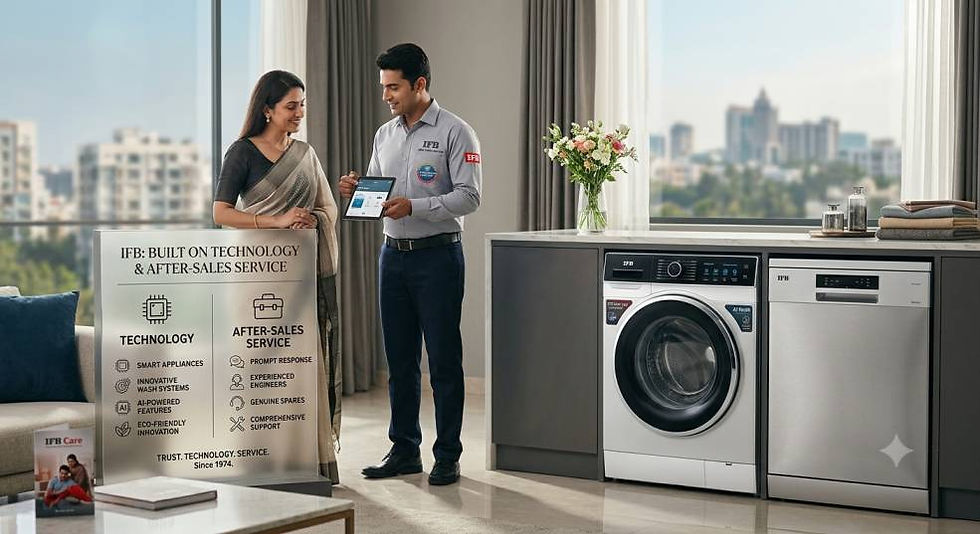
The warranty programme (TriShield). IFB’s website describes TriShield Protection as three commitments: a four-year machine warranty, a ten-year motor warranty, and a written ten-year commitment on spares support. Customers can add two more years with four free services. IFB describes itself as the only brand offering this combination. That is a company claim, which I did not independently verify. The terms and conditions on IFB’s site add that the ten-year motor warranty requires servicing exclusively through IFB’s authorised service partners, and that service beyond city limits attracts a fixed charge.
Technology cues. IFB’s site describes a “patented” Aqua Energie water-softening device, an in-built heater with 40°C and 60°C options, and a claim of removing up to 99.99% of germs. These are company claims, and I found no independent test data.
Service as an organised business. On the Q1 FY27 call, IFB had a dedicated Executive Director for its Service Business (Amar Singh Negi). He described three product lines within it: essentials, accessories and service. He said the unit grew about 17%, also services refrigerators, and is captured fully in IFB’s accounts. He said it is profitable at a double-digit PBT level but declined to disclose the figure. IFB’s website lists product registration, annual maintenance contracts, ticket-status tracking and a franchisee page under Support.
Portfolio simplification. Management said it cut front-load models from roughly 55–57 to about 24–25, and washer SKUs from nearly 9,500 to about half that. It framed this as simplification (easier counter briefing, manageable inventory, faster manufacturing changeovers) rather than a cost initiative.
Quality guardrail. The CEO stated that cost programmes will not be allowed to reduce quality or customer experience.
Positioning and Consumer Insight
The only documented consumer insight comes from IFB’s own communication. The “IFB Advantage” post argues that service and technical support are the “lost conversation” in appliance buying. In its account, most companies focus on the product alone and leave customers to dealers and independent repair shops, with warranties that are confusing to compare. IFB positions itself against that gap by pairing product-technology claims with a long, structured service commitment.
Interpretive analysis. Read strategically, a ten-year motor warranty and a written spares commitment are costly signals. A manufacturer that promises to repair for a decade is implicitly staking its cost base on the reliability of its own engineering. The warranty therefore functions as both a service promise and a technology claim, and it lets IFB compete on perceived total cost of ownership rather than on feature lists alone. The tension is that the signal only holds if service delivery matches the promise.
Media and Channel Strategy
The documented channel facts are these. As of FY24, Keynote Capitals reported 850+ multi-brand outlet counters and 465 exclusive “IFB Points.” On the Q1 FY27 call, management said it is increasing the number of counters covered by in-store promoters rather than cutting them. On the Q4 FY26 call, per a published summary, it said it is strengthening digital reach and improving promoter productivity. An analyst on the Q1 FY27 call put IFB’s trade schemes and discounts at about ₹1,800 crore. Management did not dispute the magnitude, called such schemes standard in the industry, and said it would look for leakages.
Business and Brand Outcomes
Management reported FY26 standalone revenue of about ₹5,476 crore, up 10% from ₹4,977 crore. PBDIT was ₹334 crore (6.1% of revenue) against ₹325 crore (6.5%). Standalone profit after tax was ₹133.34 crore against ₹128.79 crore. On a consolidated basis, PTI reported FY26 net profit up 20.72% to ₹143.56 crore, with Q4 profit more than doubling to ₹42.67 crore.
In Q1 FY27 (June 2026 quarter), revenue rose 16.65% to ₹1,529 crore, and the Home Appliances Division grew 18%. PBDIT was ₹88.46 crore (5.79% of revenue), up 26.46%. Management reported front-load volume growth of about 9–10%, top-load above 20% and air conditioners 6–8%.
Margin pressure is also documented. Gross margin fell about 160 basis points in Q1 FY27. Management said it had not been able to pass commodity and foreign-exchange cost increases through to customers while staying competitively priced. On the Q4 FY26 call, import content was reported at roughly 30–39%, with plans to reduce it through indigenisation.
Strategic Implications
The following is interpretive analysis, not company-documented fact.
Service as a differentiator carries a fixed-cost burden. A decade-long spares and motor commitment is a liability that persists long after revenue is booked. IFB’s thin consolidated margins and the inability to pass through input costs suggest the service promise is being funded from a margin structure with little slack. The documented profitability of the service business is therefore strategically important. It is the one part of the model where the promise may be self-funding, but only management can show whether it is.
Simplification is a hidden service-strategy move. Halving SKUs reduces counter complexity and inventory, and plausibly also eases spares forecasting and repair training. Management framed it as portfolio simplification, so the service link is an inference, not a stated rationale.
The positioning is exposed to a measurement gap. IFB’s strongest competitive claim, leadership in front-load, rests on estimates that management itself says cannot be verified from published data. For a brand whose story is trust, the absence of independent service-quality evidence is a vulnerability.
Breadth tests the proposition. IFB is pursuing double-digit share in washers and air conditioners, and 20% growth, in categories where its distinctive technology and service claims are less established. Whether a service-led brand promise transfers to categories with different failure modes and competitors is an open question the public record does not answer.
Discussion Questions
IFB reports thin net margins alongside a long warranty and spares commitment. How would you assess whether the service investment is being adequately monetised, using only the metrics IFB discloses?
The ten-year motor warranty requires authorised-service-only repairs. Evaluate this as a brand-trust mechanism versus a customer-lock-in mechanism. What evidence would distinguish the two?
Management says no consolidated market-share data exists. How should a brand that positions on trust and leadership manage claims it cannot independently substantiate?
IFB halved its washer SKUs while targeting 20% growth. What are the strategic trade-offs between portfolio simplification and market coverage in a premiumising category?
If IFB extends its service-and-technology positioning into air conditioners and refrigerators, where it reports low single-digit share, what must be true about customer behaviour and service economics for the strategy to transfer?


Comments