The Sleep Company’s D2C-to-Store Expansion Model
Industry and Competitive Context
India's mattress category is large, fragmented and still dominated by unbranded and legacy supply. One industry research estimate puts the Indian mattress market at roughly USD 2.4 billion in 2025, growing at a compound annual rate of about 8.6 percent toward 2031. Reporting on the sector's structure indicates that just under a third of the market is organised, and that more than half of the organised segment is held by legacy brands such as Sheela Foam (Sleepwell) and Duroflex. Sheela Foam reported operating revenue of about Rs 2,982 crore in FY24, the highest in its peer set. Newer D2C entrants, including Wakefit, The Sleep Company and SleepyCat, compete for a smaller slice. Wakefit generated more revenue in FY24 than The Sleep Company, SleepyCat, Wooden Street and Pepperfry combined, which makes it the most relevant scale benchmark.
Estimates of channel mix vary widely. Commercial research providers put the offline share of mattress sales anywhere between roughly 56 and 78 percent. Because the figures conflict, this case treats the offline-dominant nature of the category as directionally supported but not precisely quantified.
The competitive response to this structure has been convergent. Duroflex, a legacy manufacturer with a dealer network, launched online sales and its own experience centres during the pandemic. Wakefit entered company-owned retail in 2022, and its offer documents, as reported, show growth from a single store in FY22 to 98 stores by December 2024 and 125 stores by September 2025. The strategic situation, then, was not a choice between online and offline. Digitally native brands needed physical proof of a product that is expensive and infrequently purchased, while legacy brands needed direct consumer relationships. The Sleep Company's expansion has to be read against this two-sided convergence.
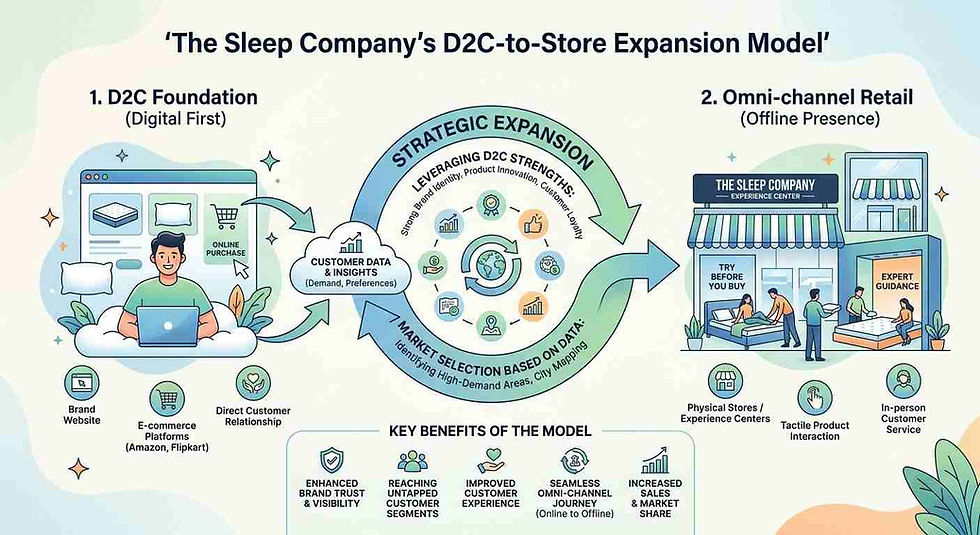
Brand Situation Prior to Store Expansion
The Sleep Company was founded in 2019 by Priyanka Salot and Harshil Salot and is operated through Comfort Grid Technologies Pvt Ltd. Its core proposition is SmartGRID, a patented grid structure made from a stretchable polymer, which the company positions against traditional memory foam. The company sold through its own website and e-commerce marketplaces such as Amazon and Flipkart, and it later described its original model as purely D2C.
Before it opened stores, the brand had already invested in mass-market communication. Its first brand campaign, #GoSmartGRID With AK!, launched in 2021 with actor Anil Kapoor as brand ambassador. The film was created with brand studio Anomalous and production house Another Idea, and it demonstrated the product through a raw egg test, a physical proof device meant to make an abstract material claim visible. A second campaign in 2022, "Forget Memory Foam, Get SmartGRID Home," used a comedy roast format. The company stated that its purpose was to educate consumers on how memory foam mattresses can cause sleep problems.
Financing and growth preceded the retail push. The company raised Rs 13.4 crore in a pre-Series A round and Rs 177 crore in a Series B in November 2022 from Premji Invest Opportunity Fund and Fireside Ventures, with venture debt from Alteria Capital. At the time of the Series B it had only three stores, and it said it would use the funds to add 22 more by March. The company later stated that annual recurring revenue (ARR), its own run-rate metric, grew from Rs 60 crore in November 2021 to over Rs 350 crore by September 2023. ARR is a company-defined, unaudited measure and should be read as a management claim.
No verified public information is available on the company's online-only customer acquisition cost, conversion rates or channel-level margins before its stores opened.
Strategic Objective
The company's stated rationale for stores rests on one consumer behaviour claim. At its first store launch in June 2022, co-founder Priyanka Salot said that nearly 85 percent of consumers still prefer buying mattresses offline because the purchase depends on touch and feel. The company later gave this behaviour a name, ROPO, short for Research Online, Purchase Offline. Harshil Salot described it as consumers researching products online, experiencing them in a store and then buying.
The documented objectives expanded in stages. At the first store launch, the company announced plans for more than 25 stores within six months. At the Series B, it committed to adding 22 stores by March. At the Series C in December 2023, it said it would broaden SmartGRID into additional product categories. At the Series D in August 2025, it named deeper offline presence, manufacturing capacity, new categories, research and development, and talent as priorities, and said more than Rs 100 crore of the round would go toward brand-building.
Read together, these statements describe an objective that is as much about conversion as reach. The store was positioned as the place where an online-built claim about a new material could be tested by touch, which is a role that advertising alone could not perform.
Campaign Architecture and Execution
The expansion followed a sequence that the company documented at several milestones.
June 2022: First store, a flagship in Koramangala, Bengaluru.
November 2022: Three stores at the time of the Series B.
December 2022 onward: The company said it opened roughly one store every four to five days.
December 2023: The 60th store, across 20 cities.
Mid-2024: 100 company-owned, company-operated (COCO) stores, which the company described as the fastest D2C brand to reach that number within two years of its first store.
August 2025: The 150th store.
The most strategically significant execution choice is the ownership model. The stores were company-owned and company-operated, which means the company, not a dealer, controls the sales environment, the product range and the customer relationship. The company also stated that it operates two manufacturing sites, in Mumbai and Bengaluru. Controlling both manufacturing and retail is consistent with the company's own description of the traditional industry as dominated by distributors and dealers. The company also stated that all of its stores have been EBITDA profitable since the beginning of their operations. This is a management claim. The underlying store-level financials are not public.
The company described its stores as designed to educate consumers about sleep and the benefits of SmartGRID, and in its Series D announcement it spoke of immersive in-store experiences and a shift toward experiential retail. In 2024 it also broadened its range under a "House of Brands" approach, adding ErgoSmart office chairs, which suggests the stores were built to carry more than one category.
Positioning and Consumer Insight
The brand's positioning has been consistent across campaigns: a patented new technology against an older incumbent material. The 2022 campaign framed memory foam as a 1950s-style technology. A later campaign, #RetireMemoryFoam, built its premise on the point that memory foam dates back to 1966, which the company's chief marketing officer described as 58-year-old technology. The execution used a narrating mattress to personify the incumbent as outdated.
The consumer insight that links the campaigns to the stores is a trust gap. A claim about material science is hard to evaluate in an advertisement, and the first campaign addressed this with a physical demonstration. A store extends the same logic. It lets a consumer apply the test personally, which turns a claim into an experience.
A 2024 giveaway campaign illustrates how the company used stores as a marketing venue. The company distributed free mattresses worth about Rs 1 crore at designated stores in Delhi, Mumbai, Chennai and Hyderabad, and reported that more than 6,000 individuals visited those stores to claim them. The footfall figure is a company statement. How many of those visitors became paying customers has not been disclosed.
Media and Channel Strategy
The documented channel structure has three layers: company-owned stores, the company's own website, and third-party marketplaces. The proportions have shifted. The company stated that stores had reached about 50 percent of its business within a year of opening, and that offline retail contributed 70 percent of total revenue by August 2025. It described this ROPO approach as a driver of conversion and loyalty.
On media, the documented record is limited to campaign formats and the commitment of more than Rs 100 crore of the Series D to brand-building, including high-impact campaigns, new markets and in-store experiences. The campaigns themselves combined a celebrity ambassador, comedic and narrative film, and in-store promotional events.
No verified public information is available on the split of media spend between digital, television and other channels, on media return, or on the share of store traffic attributable to any individual campaign.
Business and Brand Outcomes
Public disclosures show rapid revenue growth alongside continuing losses. The company stated that revenue grew 2.6 times in the 12 months to December 2023. Provisional financial statements, as reported, show revenue rising from Rs 312 crore in FY24 to Rs 499 crore in FY25, growth of 60 percent. Reported figures for earlier years vary slightly across data aggregators, so this case relies on the figures drawn from the company's provisional filings. Over the same period, total costs rose 46 percent to Rs 550 crore, and EBITDA losses narrowed by 34 percent to Rs 39 crore. In the Series D announcement, the company said it had passed an ARR of Rs 700 crore, doubled monthly revenue since its previous raise, and grown its team from 650 to over 1,500 employees.
Capital followed these milestones. The Series C in December 2023 raised Rs 184 crore from existing investors Premji Invest and Fireside Ventures. The Series D in August 2025 raised Rs 480 crore, led by ChrysCapital and 360 ONE Asset.
Two points deserve careful reading. First, in mid-2024 the company said it was aiming for profitability by the end of FY25, and the FY25 filings show an EBITDA loss of Rs 39 crore. Second, the company described its growth as capital-efficient while its filings show costs exceeding revenue. These statements are not contradictory, but they describe different measures, and an analyst should not treat store-level profitability as equivalent to company-level profitability.
No verified public information is available on audited FY26 results, on same-store sales, on store payback periods, or on customer retention and repeat purchase.
Strategic Implications
The first implication concerns sequencing. The Sleep Company did not enter retail as an unknown. It spent two years building awareness of a new material through ambassador-led advertising and product demonstrations before opening a store. The documented record supports an interpretation in which advertising created the question and stores supplied the answer, though the company has not published data that isolates this effect.
The second implication concerns control. By choosing company-owned stores over dealers, the company kept pricing, presentation and customer data in-house. The cost is that every store adds fixed commitments to a business that was already reporting losses at the company level. The company's statements about store-level profitability and the filings' company-level losses can both be true, and the difference is where overhead, brand investment and manufacturing sit.
The third implication concerns the nature of the D2C model itself. The company's own account of the shift, from a purely D2C start to a business in which most revenue is offline, suggests that for a considered, high-ticket category the digital channel functions as a discovery and research layer rather than the main point of sale. This is the company's interpretation of its own data, and it should be tested against competitors that report different channel mixes.
The fourth implication concerns competitive durability. Wakefit scaled a comparable COCO network in the same period and reported larger revenue, while legacy players have moved toward direct models. A patented material is the company's stated point of differentiation, but a store network can be replicated by competitors with more capital or scale. The strategic question is whether the proposition rests on the technology, the store experience or the combination.
Discussion Questions
The company justified retail expansion with the claim that most mattress buyers prefer to buy offline. How would you evaluate the strength of that evidence, and what additional data would you need before committing capital to stores?
The Sleep Company opened its stores after building awareness through ambassador-led campaigns. Would the same sequence work for a D2C brand without a patented product? What changes if the differentiation is weaker?
Company-owned, company-operated stores give control but add fixed commitments. Compare this with a franchise or dealer model for a brand at this stage, and identify which risks each model transfers.
The company says its stores have been EBITDA profitable since inception, while its consolidated filings show a loss. Explain how both statements can be true, and what disclosures an investor should request to reconcile them.
Competitors including Wakefit and legacy manufacturers are converging on the same hybrid model. Where, if anywhere, can The Sleep Company build a durable advantage, and how should its strategy evolve over the next three years?


Comments