IKEA India's Digital Room Planning Experience: Bridging Online Commerce and Physical Retail
- 47 minutes ago
- 8 min read
Industry & Competitive Context
India's organised home furnishings market has historically lagged behind other retail categories in digital penetration, in part because furniture purchases involve high consideration, spatial uncertainty ("will this fit and look right in my room?"), and a strong preference among Indian consumers to physically inspect large-ticket items before buying. IKEA entered India relatively late relative to its global footprint: it opened its first Indian store in Hyderabad in August 2018, having originally targeted a July 19 opening that was pushed back so the company could meet its own quality commitments to customers and co-workers. Subsequent stores followed in Navi Mumbai/Bengaluru, with a smaller-format city-centre store opening in Mumbai in December 2021 and a second Mumbai format in July 2022.
Unlike IKEA's traditional big-box, store-led model in mature markets, IKEA India adopted what CEO Susanne Pulverer has publicly described as a "hybrid omni-channel strategy," in which online sales are frequently launched in a city or region before a physical store is built there. This makes India one of the few markets in the IKEA system where e-commerce, rather than the store network, has led market entry a structural difference from the historically store-first, drive-to-store logic of European and North American IKEA operations.
Brand Situation Prior to the Digital Design Initiative
By the time IKEA globally introduced its AI-driven design tool, IKEA India was already leaning heavily on digital channels to reach customers ahead of physical stores. According to Adosh Sharma, IKEA India's country commercial manager, cited in Forbes India (September 2024), online sales at the time contributed "over 20 percent" of total revenue a figure the company described as well above what it characterised as an 11 percent industry average for the category in India. By February 2025, IKEA India's CEO Susanne Pulverer told Business Standard and other outlets that online deliveries, including remote selling, had grown to represent nearly 30 percent of the company's total India sales, with the online channel growing faster than offline stores.
This growing online dependence created a specific commercial problem that IKEA has itself identified at the global level: in the words of its own newsroom communications accompanying the 2023 UK launch of IKEA Kreativ, "87% of our customers say that they want to feel good about their home, but only half of them know how to make it happen," and "when buying online in particular, customers feel unsure if their products will fit or look nice together in their space." For a company expanding into new Indian cities online-first ahead of any showroom where a customer could physically test layouts this uncertainty was a structural barrier to conversion that a catalogue-style e-commerce site could not resolve on its own.
Strategic Objective
At the global (Ingka Group) level, the stated objective for IKEA Kreativ, as declared in the company's own launch communications, was to give customers "the confidence, ability, and control to create functionally designed and attractive spaces in a simple, time-saving experience," and to help them "go from inspiration to reality" when designing their homes. The tool was explicitly framed as a way to "break down barriers to shopping for home furnishing."
Applied to the Indian market, IKEA has publicly linked the same technology to its India-specific commercial priorities. In the company's own press release announcing IKEA's online expansion into North India (Delhi-NCR and nine additional cities, effective March 1, 2025), IKEA stated that "the introduction of IKEA Kreativ, an AI-driven tool that lets customers virtually redesign their living spaces with IKEA products, will further enrich these insights, especially given the market's strong affinity for design." This positions the tool not merely as a shopping aid but as a mechanism to compensate for the absence of a nearby physical store in newly launched online-only markets, and as a means of gathering customer preference data ahead of eventual store investment decisions.
Campaign Architecture & Execution
IKEA Kreativ is not an India-specific product build; it is a globally developed AI and mixed-reality design platform that IKEA has progressively rolled out across markets. Its core technology originated from Geomagical Labs, a Silicon Valley computer-vision and AI company that Ingka Group (IKEA's largest retail franchisee) acquired in April 2020. Ingka Group has publicly stated that Kreativ uses "state-of-the-art AI and computer vision technologies, similar to those used by self-driving cars, to make sense of customers' home spaces," and that the underlying capability was piloted with roughly one million customers as early as April 2021 before formal launch, according to comments reported by TechCrunch.
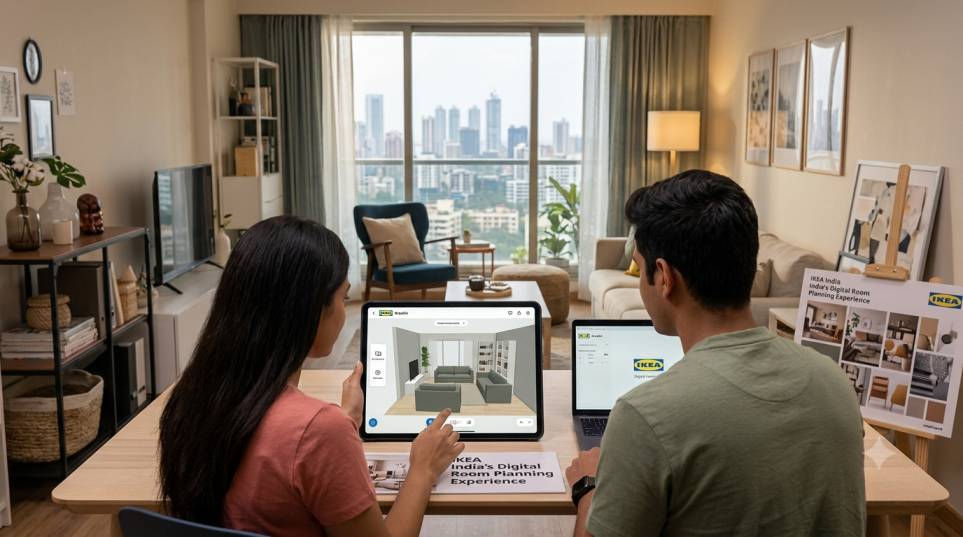
Ingka Group formally launched IKEA Kreativ on June 22, 2022, first for iOS and desktop users in the United States, with Android support and additional-country rollouts planned for FY23. The UK launch followed on February 13, 2023, and IKEA Canada launched its version on June 20, 2023. Functionally, as described in IKEA's own materials, Kreativ lets customers scan or select a room, digitally "erase" existing furniture, and then design and visualise IKEA products within that space via computers, smartphones, and the IKEA app, drawing on a library of 3D showrooms available on IKEA.com.
In the Indian market, Forbes India (September 2024) reported the tool's availability and quoted CEO Susanne Pulverer describing the consumer experience directly: "Users can dive into a seamless mixed-reality adventure where they get to play interior designer with just a drag-and-drop interface and cutting-edge AI," adding that users could download their designs or co-create them with family and friends. Pulverer is quoted as saying this "helped IKEA transform its online channel from being transactional to experiential.
Positioning & Consumer Insight
The consumer insight underpinning IKEA Kreativ, as stated by IKEA itself, is a gap between aspiration and capability: most customers want a home they "feel good about," but only about half know how to achieve that outcome, and this uncertainty is heightened specifically in online purchase contexts where customers cannot physically verify fit and aesthetic coherence. IKEA's positioning of Kreativ is therefore not as a novelty AI feature but as a trust-building and risk-reduction mechanism for online furniture buying a category where the cost of a wrong decision (an oversized sofa, a mismatched shelving unit) is materially higher than in categories like apparel or groceries.
In India specifically, this positioning intersects with the company's stated strategic emphasis described by Susanne Pulverer in IKEA's North India launch release on designing for "unique life at home needs in India... whether it's multi-generational living, low-cost living, raising children, or optimizing small spaces." IKEA has framed India as a market with a "strong affinity for design," suggesting that Kreativ's positioning locally leans on aspirational home design and space optimisation for smaller Indian urban dwellings, rather than purely on convenience.
Media & Channel Strategy
Publicly available information indicates that IKEA Kreativ is distributed exclusively through IKEA's own owned digital channels the IKEA app (iOS and, from later in the rollout, Android) and IKEA.com rather than through third-party media or paid advertising campaigns. IKEA's public disclosures do not describe a discrete paid-media or influencer campaign built specifically around Kreativ in India; the tool is instead referenced as an embedded feature within IKEA India's broader e-commerce and digital-first market-entry communications, such as the March 2025 North India online launch release, and within earned media coverage (Forbes India, IndianRetailer.com, Business Standard) generated by IKEA executives discussing the company's wider digital strategy.
The broader North India digital launch with which Kreativ has been publicly associated was supported by tangible infrastructure investment: IKEA's own press materials describe the opening of its first central distribution Centre in Gurugram (180,000 square feet) to support e-commerce operations in the region, and Forbes India reported a logistics partnership with Rhenus Group to support IKEA's e-commerce expansion in Delhi. IndianRetailer.com additionally reported that close to one lakh (100,000) customers signed up for the IKEA Family loyalty programme in Delhi-NCR ahead of the official March 1, 2025 online launch, though this figure is attributed to the overall market-entry campaign rather than to the Kreativ tool specifically.
Business & Brand Outcomes
No verified public information is available on IKEA-Kreativ-specific outcome metrics in India such as the number of room designs created, tool adoption rates, conversion uplift attributable to the tool, average basket size for Kreativ users versus non-users, or return-rate impact. IKEA has not published such figures for the Indian market in its press releases, in Ingka Group's newsroom disclosures, or in the business and trade press reviewed for this case.
What is documented publicly is the trajectory of IKEA India's overall digital channel, within which Kreativ operates as one feature. Online sales (including remote selling) were reported at "over 20 percent" of total revenue in September 2024 (Forbes India, citing IKEA India country commercial manager Adosh Sharma) and at "nearly 30 percent" of total sales by February 2025 (Business Standard, Mint/Upstox, and IKEA's own March 2025 press release, all citing CEO Susanne Pulverer), with online growing faster than physical-store sales. Separately, according to a Registrar of Companies filing reported by FashionNetwork India (February 2025), IKEA India's losses widened to ₹1,299.4 crore in financial year 2024; Pulverer is quoted stating the company expects operational profitability to take "a couple of years" under a structured, cost-focused plan. These financial figures describe the company's overall India operations and are not attributed by any source to the Kreativ tool or to digital room planning specifically, and should not be read as a measure of the tool's own performance.
Separately, Harvard Business Publishing's Ivey case "IKEA India: Expansion Strategy Dilemma" (published May 13, 2025) documents that IKEA India closed its first small-format store in Mumbai in February 2024, a decision the case attributes to design and location challenges as the company balanced accessibility, urban density, and real estate costs in its store-format strategy. This is documented as a store-format and real-estate decision; no public source connects it causally to the performance of the digital design tool.
Strategic Implications
Three points can be drawn strictly from the documented record. First, IKEA India's channel structure online launch preceding physical stores in most new geographies creates a functional dependency on digital tools that can substitute for in-store spatial reassurance; IKEA's own communications frame Kreativ as serving exactly this function in newly opened online-only markets such as North India. Second, IKEA has consistently avoided publishing tool-level performance metrics for Kreativ in any market, including India, making it analytically difficult to isolate the design tool's contribution from the broader e-commerce, logistics (distribution centre, logistics partnerships), and loyalty-programme investments that accompanied the same market launches. Third, the coexistence of a strategically important online channel (approaching 30% of sales, per company statements) with continued reported losses at the country level (₹1,299.4 crore in FY24, per regulatory filings) indicates that digital tools such as Kreativ should be read, on current public evidence, as contributing to customer experience and channel differentiation rather than as a demonstrated driver of near-term profitability a distinction IKEA India's own leadership has implicitly acknowledged by tying profitability to broader structural cost initiatives rather than to any single digital feature.
Discussion Questions
Given that IKEA India frequently launches online sales in a city before opening a physical store, what specific role can a tool like IKEA Kreativ play in reducing purchase risk that a conventional e-commerce catalogue cannot?
IKEA has not disclosed adoption or conversion metrics for Kreativ in India. What alternative, publicly observable indicators (e.g., channel mix trends, store-format decisions, loyalty sign-ups) might an analyst reasonably use to infer the tool's strategic contribution, and what are the limits of that inference?
IKEA India reported both a growing online sales share (nearing 30% of total sales) and widening losses (₹1,299.4 crore in FY24) in the same period. How should a marketing leader interpret digital-experience investment when top-line channel metrics and bottom-line profitability move in different directions?
IKEA Kreativ's underlying technology (from Geomagical Labs) was developed globally and deployed with minimal apparent market-specific customisation before its Indian rollout. What are the trade-offs of deploying a globally standardised digital tool into a market with the space, density, and lifestyle constraints IKEA itself describes for India (multi-generational living, small-space optimisation)?
The Ivey case on IKEA India documents the closure of a small-format Mumbai store on design and location grounds. If digital design tools are meant to substitute for physical showroom experience in new markets, what criteria should guide IKEA's decision on when a market still requires a physical store versus when digital tools are sufficient?


Comments