Jaquar Group: The "Complete Bathroom and Lighting Solutions" Communication Strategy
- 46 minutes ago
- 9 min read
Industry & Competitive Context
Jaquar operates in India's organised bathware and sanitaryware industry, a category in which the company is commonly described in trade and business press as a market leader alongside rivals such as Hindware and Kohler. The category has two structural features relevant to communication strategy. First, distribution runs almost entirely through an extensive dealer and retailer network rather than direct-to-consumer channels, a characteristic explicitly noted in Jaquar's own corporate documentation and reiterated by the company's marketing leadership in a 2026 interview with Mint (Livemint), where the influence of dealers and architects on the buying decision was described as a distinct complication for brand communication. Second, bathware is a low-frequency, high-involvement durable-goods purchase rather than a repeat FMCG purchase; Jaquar's own marketing head has publicly characterised the category as one where advertising's role is to build brand expression and recall rather than drive immediate transactions, since consumers typically only engage with the category when a specific need renovation, new construction, or replacement arises (afaqs!, 2022).
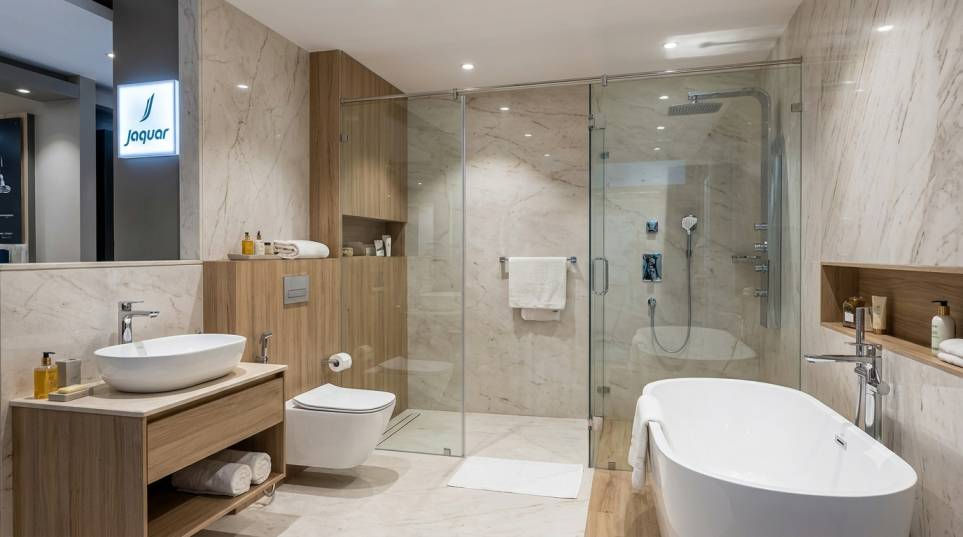
Jaquar's public materials describe the group as present in over 55 countries across Europe, the Middle East, Asia-Pacific and Africa, operating manufacturing facilities in India and South Korea, and running one of the world's largest branded showroom networks for the category, comprising more than 40 "Jaquar World" flagship stores globally and over 20 company-owned "Orientation Centres" in India (Jaquar Group corporate website; Wikipedia, sourced timeline).
Brand Situation Prior to the Positioning
Jaquar Group traces its origins to 1960, when founder N. L. Mehra established the Essco bath-fittings brand; the Jaquar brand itself was launched in 1986 by Mehra's sons, Rajesh, Ajay and Kishan Mehra, and named after their grandmother, Jai Kaur (Wikipedia, citing multiple contemporaneous business-press profiles including Forbes India and India Infoline). Through the 1990s and 2000s the company progressively widened its product base from faucets into sanitaryware, showers, wellness products (whirlpools, steam cabins, saunas), shower enclosures, and water heaters, and in 2016 entered the lighting category, building a dedicated manufacturing unit in Manesar (Wikipedia; Business Today, March 2018).
This diversification created a specific brand-management problem that Jaquar's own marketing leadership has publicly acknowledged: consumer perception remained anchored almost entirely to bath fittings, even as the company's manufacturing and product portfolio expanded well beyond that category. In a 2022 interview with afaqs!, Sandeep Shukla, Jaquar Group's head of marketing and communications for global operations, stated that the brand was strongly identified with bathroom products, and that entering an adjacent category such as lighting required deliberate communication effort because that pre-existing category association did not automatically transfer. This is the specific brand situation that the broader "Complete Bathroom and Lighting Solutions" positioning was built to address: converting a single-category reputation (taps and fittings) into a multi-category, one-stop-destination reputation spanning bath, sanitaryware, wellness, and lighting, sold across three tiered brands Essco (value), Jaquar (premium) and Artize (luxury) (Jaquar corporate "About" pages; The CEO Magazine, 2021).
Strategic Objective
Drawing only from what Jaquar's marketing leadership and official materials have stated publicly, the positioning strategy appears to pursue three parallel, documented objectives rather than a single campaign goal:
Category-breadth communication — shifting consumer perception from "faucet/bathroom-fittings company" to "complete bathroom and lighting solutions provider," a phrase used consistently and verbatim across Jaquar's press releases, corporate "About" pages, and product-line messaging over multiple years (Jaquar Group press releases, jaquar.com).
Trust and premiumisation — reinforcing a design-led, quality-led image rather than competing on price, a stated shift that a 2019 TVC campaign for water heaters ("Beautiful bathrooms deserve beautiful water heaters," produced with agency Crescent Communications) was explicitly built around, per Exchange4media's reporting of Shukla's and Crescent Communications' comments at launch.
Occasion- and technology-led relevance — using specific functional or seasonal triggers (hygiene during the COVID-19 pandemic, IPL cricket-season media windows, festive lighting) to keep the "complete solutions" umbrella current, as seen in the 2020 "Sensor and Sensibility" touch-free products campaign and the 2022 IPL lighting campaign described below.
Campaign Architecture & Execution
Publicly documented sub-campaigns executed under the Complete Bathroom and Lighting Solutions umbrella include:
a) Water Heater TVC (2019). Jaquar Group's first television campaign dedicated to its water heater range used the line "Beautiful bathrooms deserve beautiful water heaters" and was created with agency Crescent Communications. Exchange4media reported that the creative brief centred the product's design and appearance as the primary message, with technological features positioned as a secondary, supporting benefit a design-first approach consistent with the group's broader premiumisation objective (Exchange4media, January 2019).
b) "Sensor and Sensibility" (2020). Launched during the COVID-19 pandemic and conceptualised by digital agency AdLift, this campaign promoted a range of touch-free, sensor-based bath, sanitaryware and lighting products (including the Opal Prime and Kubix Prime sensor faucets) for both residential and high-footfall commercial spaces such as airports, hospitals and malls. Coverage in afaqs! and ET BrandEquity/Adgully quoted Shukla framing the campaign around hygiene, sustainability, and functionality, extending the "complete solutions" positioning into a pandemic-relevant technology narrative that spanned both the bath and lighting categories simultaneously (afaqs!, September 2020; Adgully/ET BrandEquity, August 2020).
c) Essco "#EsscoNaBhoolPaoge" (2021). A digital campaign for the group's value-tier brand, Essco, which by the company's own account has a retail footprint of more than 4,000 outlets across India. Exchange4media reported that the campaign centred on themes of quality and trusted service, targeting the value segment separately from the premium Jaquar and luxury Artize communication (Exchange4media, September 2021).
d) Jaquar Lighting IPL Campaign (2022). Conceptualised by Enormous Brands, with media planning by Crescent Communications, this campaign used humour to leverage the brand's existing bathware credibility to build awareness for its comparatively newer lighting range, covering home, office, and outdoor lighting use-cases across three separate films. In comments to afaqs!, Shukla described the underlying strategic logic explicitly: because "Jaquar" was already synonymous with bathroom products in consumers' minds, the campaign needed to convert that existing trust into credibility for an adjacent category rather than build lighting awareness from zero (afaqs!, May 2022). Communications consultant Karthik Srinivasan, cited in the same afaqs! article, publicly assessed the creative as effective at implicitly transferring the brand's bathware quality reputation to its lighting products through a recurring visual gag across the three films.
e) Sobhita Dhulipala / QLOUD Campaign (2024). Actress Sobhita Dhulipala featured in a Jaquar India campaign for the QLOUD thermostatic shower mixer, as reported by Adgully in May 2024 an example of the company using celebrity talent for a premium, design-led wellness product rather than for the mass "complete solutions" corporate message itself.
f) Deepika Padukone, Lighting Brand Ambassador. Jaquar Group's Wikipedia-documented corporate history states that actress Deepika Padukone was announced as brand ambassador for the group's lighting segment; the specific launch date and campaign creative for this association were not confirmed in the sources reviewed for this case.
Across all of these, the constant is the underlying umbrella claim "Complete Bathroom and Lighting Solutions" which appears in Jaquar's official press-release boilerplate essentially unchanged since at least the early 2010s (Jaquar Group press releases page; Economic Times, 2012, cited via Wikipedia's sourced timeline), while individual sub-campaigns rotate seasonally and by product line underneath it.
Positioning & Consumer Insight
The consumer insight underlying the architecture, as publicly articulated by Jaquar's own marketing leadership, is that bathroom and lighting purchase decisions in India have become progressively more design-conscious, considered, and multi-stakeholder. In the 2026 Mint interview, Shukla stated that the home-interiors category had changed substantially since the COVID-19 pandemic, with consumers spending more time at home, builders increasingly delivering fitted interiors, and fittings decisions becoming joint decisions involving multiple household members rather than a single purchaser a shift he described as elevating bathware into a "high-involvement category."
This insight supports the "complete solutions" positioning logic: if a consumer (or an architect, interior designer, or builder specifying on their behalf) is making a coordinated design decision for an entire bathroom rather than buying a single tap, a brand that can supply faucets, sanitaryware, showers, wellness products and lighting under one coordinated aesthetic has a structural advantage over single-category competitors. Jaquar's own product messaging makes this explicit, describing its offering as allowing customers to conceptualise "your entire bathroom with matching fittings and fixtures" rather than assembling disparate products from different vendors (Jaquar Group official website, Complete Bathroom Solution page).
The three-tier brand architecture Artize (luxury), Jaquar (premium) and Essco (value) allows this same "complete solutions, one roof" insight to be applied across different price points and consumer segments, rather than being confined to a single affluent target audience (The CEO Magazine, 2021; Jaquar Group corporate materials).
Media & Channel Strategy
Documented, source-attributable media details are limited to specific campaigns rather than the positioning as a whole:
For the 2022 IPL lighting campaign, Shukla told afaqs! that Jaquar advertised across both television and OTT platforms during the tournament, and disclosed that approximately 20 percent of that campaign's media mix was allocated to OTT, citing OTT's ability to deliver strong reach and impressions without over-exposing the audience compared with television alone (afaqs!, May 2022).
The "Sensor and Sensibility" campaign was communicated via a television commercial together with supporting digital activity from agency AdLift (afaqs!, September 2020).
The Essco #EsscoNaBhoolPaoge initiative was reported specifically as a digital campaign (Exchange4media, September 2021).
Beyond paid media, the company's owned-channel infrastructure the Jaquar mobile app (covering the full catalogue of more than 1,000 products across 14 categories, with CAD/PDF drawing downloads and project-estimation tools) and the physical "Jaquar World" and "Orientation Centre" showroom network functions as a persistent, always-on communication channel for the "complete solutions" message, independent of any single ad campaign's flight dates (Jaquar Group official blog and website).
Business & Brand Outcomes
Verifiable brand-recognition outcomes reported in public sources include:
A 2013 Nielsen survey, as referenced in Jaquar's own corporate materials and cited in Wikipedia's sourced company timeline, reported Jaquar as India's most trusted bath-fittings brand.
Jaquar's official "About" pages state the brand has been recognised as a "Superbrand" for 12 consecutive years and describe it as India's most searched bathroom brand on Google, though the underlying methodology or publishing body for the search-ranking claim was not independently verified in the sources reviewed.
The group's revenue grew from approximately Rs. 3,588 crore in FY2018-19 to a reported Rs. 8,703 crore in FY2025-26 according to Wikipedia's infobox (sourced to company disclosures), alongside a stated turnover of roughly $670 million (Rs. equivalent) for FY2021-22 per Jaquar's own press-release page. These are company-wide revenue figures across all product categories and geographies; they are not campaign-attributable sales results.
The 2022 IPL lighting campaign was publicly assessed favourably by an independent communications commentator (Karthik Srinivasan, cited in afaqs!) for successfully using a consistent creative device to build lighting-category awareness through borrowed bathware credibility, though no quantified pre/post brand-recall or sales-lift data for that campaign was found in public sources.
Strategic Implications
Three implications can be drawn strictly from the documented record, without extrapolation beyond what company spokespeople and trade press have stated:
First, in a dealer-mediated, low-frequency durable-goods category, Jaquar's public statements suggest that brand communication is understood internally as serving an awareness- and trust-building function rather than a direct-response function consistent with Shukla's stated view (afaqs!, 2022) that, unlike FMCG, bathware purchases are not triggered by seeing an advertisement but occur when renovation or construction need arises, making sustained "share of mind" the objective rather than immediate conversion.
Second, the company's own account of its category-diversification challenge (moving audience perception from "bathroom" to "bathroom and lighting") illustrates a recognised branding principle: an umbrella positioning statement alone does not automatically transfer trust across categories, and the 2022 IPL campaign's creative device deliberately reminding audiences of Jaquar's existing bathware credibility while introducing lighting was publicly described by both the company and an outside commentator as the specific mechanism used to manage that transfer.
Third, per Shukla's 2026 comments to Mint, the company continues to describe traditional and dealer-facing marketing tools as important even as it explores AI-enabled marketing and sales tools, reflecting the structural reality that architects, interior designers, plumbers, and dealers remain key influencers in the purchase journey a channel dynamic that differentiates bathware communication strategy from more purely consumer-direct categories.
Readers should treat these as descriptive strategic patterns evidenced in the public record, not as an evaluative claim that the strategy has been proven effective by independent, quantified measurement no such measurement was found in the sources reviewed for this case.
Discussion Questions
In a category where distribution runs primarily through dealers, architects and plumbers rather than direct-to-consumer channels, how should a brand allocate communication investment between influencer-facing (trade) engagement and end-consumer mass media?
Jaquar's marketing leadership has described the challenge of extending a single-category reputation ("bathroom fittings") into an adjacent category ("lighting"). What general conditions determine whether a brand-extension communication strategy of this kind is likely to succeed or dilute the parent brand?
The "Complete Bathroom and Lighting Solutions" claim has been used consistently in Jaquar's corporate messaging for over a decade, while individual campaigns (Sensor and Sensibility, the IPL lighting films, Essco's digital campaign) rotate beneath it. What are the trade-offs of maintaining a stable umbrella positioning statement versus refreshing it periodically?
Given the tiered brand architecture of Essco (value), Jaquar (premium) and Artize (luxury) under one parent group, how should communication strategy differ across tiers to avoid cannibalising or confusing brand equity between them?
In the absence of publicly disclosed recall, conversion, or ROI data, what alternative public indicators (e.g., trade-press commentary, awards, survey rankings, revenue trends) can a marketing analyst reasonably use and with what limitations to assess whether a long-running corporate positioning strategy is working?


Comments