In-app “home-screen” inventory is becoming a new premium ad surface
In-app “home-screen” inventory is emerging as a distinct, higher-value layer of mobile advertising.
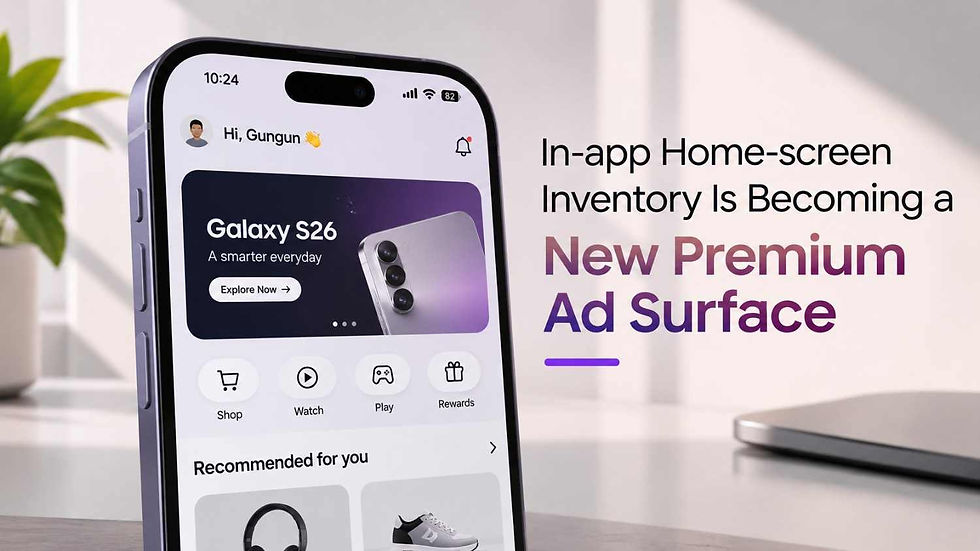
Rather than treating every ad slot inside an app as interchangeable, publishers and platforms are beginning to package the first screen a user sees—whether an app’s landing screen, a device lock screen, or a smart-TV home screen—as scarce, high-attention real estate that can command premium pricing.
What “home-screen” inventory means
In advertising, inventory is the available space or time a publisher offers for sale; in mobile apps, it includes banners, native units, interstitials, and video placements. Premium inventory is generally defined as high-demand, highly visible inventory that tends to attract higher CPMs because of its visibility and audience quality.
“Home-screen” inventory narrows that idea to the entry point of an experience. In a mobile app, it can be the first content screen after launch; on a smartphone, it may include a lock-screen or glanceable content surface; on connected TV, it is the operating-system home screen where viewers choose what to watch. These placements are structurally different from a mid-article banner or an ad shown after several minutes of gameplay because they sit at the beginning of a session, often before the user has made a choice about what to consume.
The distinction matters commercially. Premium inventory is commonly associated with high-visibility positions, strong context, and greater attention, while lower-value or unsold inventory is often handled through broader programmatic channels. A home screen can therefore be positioned as a “front door” placement: limited in number, highly visible, and potentially more valuable than ordinary in-app supply.
Why it is becoming premium
Several forces are converging to make home-screen inventory more attractive to advertisers.
First, attention is scarce. A home-screen placement is encountered at a natural decision point, when a user opens an app, unlocks a phone, or turns on a television. That does not automatically make the ad effective, but it can give the placement an advantage over ads that appear after the user has already become absorbed in content or is trying to complete a task.
Second, supply can be limited. An app has many potential ad slots across feeds, articles, videos, and transitions, but usually only one primary home screen. Scarcity in premium mobile and connected-TV placements is one reason auction competition and pricing can rise. If a platform controls the home screen across a large installed base, it can offer advertisers a concentrated, repeatable reach opportunity rather than a fragmented collection of low-visibility units.
Third, the environment is increasingly brand-safe and measurable. In-app advertising has benefited from better contextual signals, AI-based optimization, and measurement tools, especially after Apple’s App Tracking Transparency framework reduced the availability of some cross-app identifiers. Industry commentary describes a shift toward curating higher-quality supply and using contextual signals to make in-app buying more effective.
Fourth, premium app environments are expanding. Liftoff has observed that high-quality, widely used apps—including AI products and major publisher games—are introducing advertising models, creating premium environments where users spend meaningful time and where brands increasingly want presence. That changes the perception of in-app advertising from a predominantly performance-driven channel into one that can also support brand campaigns.
The mobile home screen
On mobile, the most prominent example of this trend is the lock screen or “glanceable” content surface. These surfaces appear before a user opens a specific app and can combine news, weather, short videos, widgets, and advertising. Their value rests on frequency of exposure: a user may see the screen many times a day, even without deliberately launching an app.
InMobi’s Glance is a notable example. The company describes Glance as a consumer platform operating across mobile and connected-TV lock-screen and home-screen surfaces, and says it reaches about 300 million global active devices. InMobi also says its broader mobile advertising offering can reach roughly 2 billion mobile users globally.
Those figures should be read as company-reported reach claims rather than independently audited audience measurements. Still, they illustrate why platforms view these surfaces as strategically important: they combine scale, frequent exposure, and a position in the user interface that ordinary in-app banners do not occupy. InMobi has also framed Glance’s app and lock-screen inventory as valuable because it is scarce and contextually distinct.
The commercial challenge is to preserve that value. If a home screen becomes cluttered with generic display ads, users may perceive it as intrusive, and advertisers may receive less attention than the placement’s position implies. The more credible version of the opportunity is curated, native, contextually relevant advertising—for example, a sponsored content card, a branded utility widget, or a high-quality video unit—rather than an endless sequence of interruptive banners.
The connected-TV parallel
The same logic is even more visible in connected TV. A smart-TV home screen is the first interface many viewers encounter when they turn on the television. It is a high-attention, non-skippable surface, and it sits upstream of the apps and content the viewer ultimately selects.
Nexxen has built a business around this idea through its TV Home Screen product, which it describes as the industry’s first programmatic solution for smart-TV home-screen advertising. The company reports adoption by platforms and agencies including The Trade Desk, V, StackAdapt, and Basis, and says it has secured programmatic access to TCL’s native home-screen inventory globally, including exclusivity on selected native placements in the United States and Canada. It also reports access to TiVo Ads’ native home-screen inventory in North America and the United Kingdom.
In its third-quarter 2026 earnings commentary, Nexxen said it launched standardized smart-TV home-screen inventory specifications across OEMs, intended to remove barriers to programmatic scale and monetization. It named VIZIO, TCL, and TiVo Ads among sources of premium inventory, with additional OEMs reportedly in testing or active discussions.
This is important because it signals a shift from bespoke, manually negotiated OEM deals toward more standardized programmatic access. If home-screen placements can be described, targeted, transacted, and measured through common specifications, advertisers can buy them more easily at scale. That does not make every home-screen impression premium by definition, but it makes it possible for platforms to package select placements as premium supply.
What advertisers may buy
Home-screen inventory is unlikely to replace conventional in-app formats. Instead, it is likely to become a separate layer in media plans.
Brand advertisers may use it for awareness, launch campaigns, seasonal messaging, and reach among frequent app or device users. The placement’s value is its position at the start of a session, not necessarily immediate click-through performance. Performance advertisers may also use it, particularly where the surface supports direct response, app installs, commerce, or personalized recommendations, but they will need to test whether the higher price is justified by downstream conversions.
The buying mechanism matters. Premium inventory is often sold through direct deals or private marketplaces with negotiated pricing and audience guarantees, while open exchanges are more commonly associated with broad, auction-based access. A publisher that wants to protect home-screen value may use floor prices, private marketplace deals, or programmatic guaranteed arrangements rather than allowing every impression to clear at the lowest available open-market rate.
Risks and unanswered questions
The biggest risk is overstatement. “Home screen” does not automatically mean “premium.” A placement can be visually prominent yet ignored, especially if it repeats too often, interrupts a task, or shows irrelevant advertising. Attention, viewability, engagement, and conversion outcomes must be measured rather than assumed.
Privacy is another constraint. Home-screen platforms often have rich first-party signals, including device, app, location, and behavioral data. That can improve relevance, but it also raises the stakes for consent, transparency, and data minimization. Advertisers should not treat first-party data as an unrestricted targeting asset; its use depends on the platform’s privacy practices, applicable regulation, and user permissions.
There is also a supply-quality issue. As more platforms label inventory “premium,” buyers will need clearer definitions: Is the placement actually above the fold? Is it exclusive? How often is it shown to the same user? What share of impressions is genuinely viewable? What is the ad format, and can it be skipped? Without those answers, “home-screen premium” could become a marketing label rather than a meaningful pricing category.
Finally, user experience will determine durability. Home screens are personal spaces. Platforms that monetize them responsibly—through limited frequency, relevant creative, clear labeling, and useful formats—are more likely to sustain advertiser demand. Platforms that flood them with low-quality ads risk damaging both engagement and the premium pricing they are trying to establish.
Outlook
In-app home-screen inventory is becoming a new premium ad surface because it combines scarcity, early-session visibility, and increasingly sophisticated programmatic infrastructure. Mobile lock-screen platforms such as Glance and smart-TV home-screen products such as Nexxen TV Home Screen show that the concept is already being commercialized, although the evidence for superior performance remains largely supplier- and platform-reported rather than independently standardized.
The likely outcome is not that every home-screen impression becomes expensive, but that a defined subset—high-quality, high-frequency, brand-safe, and well-measured placements—will be sold separately from ordinary in-app supply. For publishers, the opportunity is yield management: identify the most valuable entry-point placements and protect their pricing. For advertisers, the opportunity is attention: reach users at the beginning of a session in a format that feels native rather than interruptive. For users, the test is simpler: whether the home screen remains useful, relevant, and respectful of their attention.
Sources
Amazon Ads — “What is Ad Inventory? Key Aspects, Importance, Management”: https://advertising.amazon.com/library/guides/ad-inventory
Nexxen — “Nexxen Reports Record First Quarter 2026 Financial Results”: https://markets.businessinsider.com/news/stocks/nexxen-reports-record-first-quarter-2026-financial-results-1036149511
Liftoff — “Madison Avenue is missing out on in-app advertising”: https://www.liftoff.ai/blog/madison-avenue-is-missing-out-on-in-app-advertising/
Airbridge — “Ad Inventory: What It Is and How to Evaluate It”: https://www.airbridge.io/en/glossary/ad-inventory
InMobi / Business Wire — “InMobi Advertising Launches First Agentic Seller, Opening Mobile and Exclusive CTV Ad Inventory to AI Buying Agents”: https://www.businesswire.com/news/home/20260603665789/en/InMobi-Advertising-Launches-First-Agentic-Seller-Opening-Mobile-and-Exclusive-CTV-Ad-Inventory-to-AI-Buying-Agents
Epom — “Ad Inventory Management Guide for Publishers”: https://epom.com/blog/publishers/ad-inventory-management
Xapads — “Types of Programmatic Advertising Deals: The Complete Guide”: https://blog.xapads.com/types-of-programmatic-advertising-deals/
Benzinga — “Nexxen International Q3 2026 Earnings Call Transcript”: https://www.benzinga.com/news/26/11/63195457/nexxen-international-q3-2026-earnings-call-transcript
Adlook — “In-app advertising that follows the moment”: https://adlook.com/blog/in-app-advertising-beyond-walled-gardens/


Comments