JioMart’s Integration Strategy with Kirana Stores
- 2 hours ago
- 10 min read
Industry & Competitive Context
India's retail sector is among the largest in the world by volume, yet it remains structurally distinct from Western markets. Approximately 90 percent of the country's retail trade flows through unorganised channels, with an estimated 12 million kirana stores — small, owner-operated neighbourhood grocery shops — forming the primary point of purchase for hundreds of millions of Indian households. These stores are not simply legacy infrastructure; they represent entrenched consumer trust, hyperlocal product knowledge, and last-mile delivery capability that no purely digital platform has been able to replicate at scale.
Against this backdrop, the early 2020s saw intensifying competition for the Indian grocery and essentials market. Amazon India had scaled its Prime Now and pantry delivery offerings. Flipkart's Supermart was growing in major metros. Quick-commerce entrants such as Blinkit (formerly Grofers), Zepto, and Swiggy Instamart were investing aggressively in dark-store networks to offer ten-to-thirty minute delivery. Each of these models positioned the kirana store as an entity to be displaced rather than integrated. Reliance Industries, through its digital commerce arm JioMart, chose a fundamentally different competitive posture: rather than building parallel infrastructure to compete with kiranas, it designed a strategy to make them the infrastructure.
Brand Situation Prior to Launch
JioMart's institutional foundation rested on two pillars within the Reliance Industries ecosystem. First, Reliance Retail — at the time already the largest retailer in India by revenue — provided an extensive physical supply chain, deep supplier relationships, and established wholesale procurement capabilities. Second, Jio Platforms, the telecommunications and digital services arm, had, since its 2016 launch, grown into the country's largest mobile network with hundreds of millions of subscribers, providing an unmatched digital distribution surface.
The combination created a strategic resource base that no pure-play e-commerce competitor could easily match. Where Amazon or Flipkart needed to construct cold chains, dark stores, and logistics networks from scratch, Reliance could leverage assets already at operational scale. The internal challenge was not supply-side capability but market-side execution: how to translate those assets into a coherent consumer proposition that could acquire and retain customers at speed, particularly in Tier 2 and Tier 3 cities where organised retail penetration remained low.
At Reliance Industries' Annual General Meeting in August 2019, Chairman Mukesh Ambani publicly announced the upcoming launch of JioMart, describing it as a platform that would "bring together two revolutions, one in connectivity and one in commerce." The company's FY 2019–20 Annual Report formally characterised JioMart as a "new commerce" model — a deliberate conceptual framing that set the platform apart from conventional e-commerce and signalled an intent to operate as a bridge between digital demand and physical fulfilment.
Strategic Objective
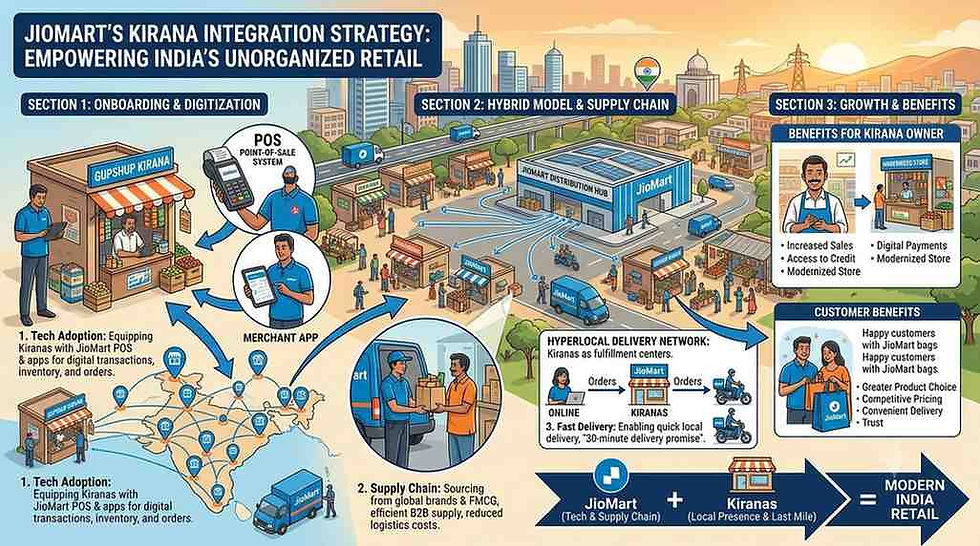
JioMart's core strategic objective was to build an online-to-offline (O2O) commerce model that would simultaneously serve two constituencies: consumers seeking convenient, affordable access to daily essentials; and kirana merchants seeking the digital tools, supply chain access, and customer reach to remain economically viable in an increasingly platform-dominated retail environment. The tagline officially communicated to merchant partners — "Customer Apka, Support Hamara" (The customer is yours, the support is ours) — encapsulates the strategic intent: Reliance would digitise the backend of kirana commerce while leaving the consumer relationship in the hands of the local merchant.
This dual-sided value proposition was strategically important for a reason that extends beyond altruism. By making kirana stores the fulfilment and last-mile delivery layer, JioMart could achieve nationwide geographic coverage without building the dense warehouse-and-rider networks that its quick-commerce competitors required. The model was inherently capital-light in its physical expansion phase, substituting organisational complexity and technology deployment for capital expenditure on warehousing infrastructure.
At the June 2021 AGM, Mukesh Ambani stated the company's ambition explicitly: "We will onboard over one crore merchant partners over the next three years. This will trigger a socio-economic transformation on an extraordinary scale in India, especially when coupled with our mission of employment generation." The statement established a public accountability benchmark and signalled to the market that JioMart's kirana integration was not a peripheral feature but the primary growth engine of its new commerce strategy.
Campaign Architecture & Execution
JioMart soft-launched in December 2019, beginning with a beta rollout in Thane, Kalyan, and Navi Mumbai within the Mumbai Metropolitan Region. The controlled initial geography allowed the company to stress-test its O2O supply chain mechanics before scaling nationally. The platform formally expanded in early 2020, accepting orders across a growing number of cities including Delhi, Kolkata, Bengaluru, Chennai, Pune, Ahmedabad, and dozens of Tier 2 markets.
The architectural logic of the kirana integration operated across three tiers. At the first tier, the JioMart Partner App enabled any kirana merchant to digitally register and begin placing wholesale inventory orders from Reliance's distribution network, with a core value proposition of better procurement pricing and free next-day delivery on stock orders. This alone gave small merchants a supply chain advantage without requiring them to accept any consumer-facing digital role. At the second tier, merchants who adopted the JioPOS device — a point-of-sale technology offered against a refundable security deposit — gained inventory management capability, digital payment acceptance, and more granular access to Reliance's wholesale catalogue. At the third tier, once a merchant demonstrated consistent ordering volumes and the operational capacity for home delivery, they became eligible to be integrated into the consumer-facing JioMart app as a JioSmart Kirana Store — receiving neighbourhood orders placed by consumers directly through the JioMart platform.
This tiered architecture was strategically significant. It allowed merchant onboarding to proceed at different levels of digital sophistication without requiring all partners to immediately commit to the full model. It also created a natural progression pathway: merchants who experienced procurement benefits at the first tier had strong economic incentives to climb to the second and third tiers where fulfilment fees and increased customer traffic provided additional revenue streams.
A pivotal enabler of the channel strategy was the April 2020 announcement of a $5.7 billion investment by Facebook — acquiring a 9.99 percent stake in Jio Platforms. As part of the partnership, JioMart was positioned to connect with kirana stores through WhatsApp, leveraging the messaging platform's more than 400 million Indian users at the time. Ambani publicly stated that the partnership would empower nearly three crore small Indian kirana shops to digitally transact with customers in their neighbourhoods. While the depth of the WhatsApp commerce integration evolved over time, the announcement was strategically important in establishing JioMart's access to India's most widely used digital communication channel as both an ordering interface and a merchant communication tool.
In parallel, Reliance operationalised a physical hub network to support its kirana partners. By the end of FY 2021–22, the company had established 21 smart hubs and 34 staples hubs across India. These served as intermediate distribution nodes connecting Reliance's central procurement to kirana stores in surrounding catchment areas, shortening replenishment cycles and enabling region-specific product assortment. In high-traffic partner stores, Reliance also installed Jio Signage TV screens — in-store digital advertising displays through which supplier brands could target localised promotional content at consumers in real time. This introduced an additional monetisation layer for kirana partners beyond product margin, as well as a media inventory play for Reliance itself.
Positioning & Consumer Insight
JioMart's positioning rested on a consumer insight that distinguished it from its quick-commerce competitors: for a large segment of Indian consumers — particularly those outside major metros — the kirana store was not a problem to be solved but a relationship to be digitised. The corner kirana was trusted, offered informal credit, stocked locally preferred brands, and was geographically proximate in a way that dark-store delivery networks could not replicate at comparable economics in smaller cities and towns. A platform that enhanced rather than eliminated this relationship had the potential to capture consumer affinity alongside merchant loyalty.
The "Desh Ki Nayi Dukaan" (New Store of the Nation) framing — used by Reliance to describe the JioMart vision — reinforced this positioning by anchoring the brand in cultural familiarity rather than technological disruption. It communicated modernity and access without implying that existing commercial relationships were obsolete. This was strategically important in markets where consumer trust in local merchants was high and scepticism of large corporate e-commerce platforms remained significant among first-time internet users.
The B2B dimension of the platform also carried a distinct positioning logic. By offering MSME vendors access to JioMart's merchant network — enabling them to reach over a million merchants with more than 1,200 unique SKUs, as documented in Reliance's FY 2022–23 Annual Report — JioMart positioned itself as a distribution amplifier for smaller suppliers who had historically struggled to achieve national retail reach. This embedded the platform within multiple layers of the supply chain simultaneously, increasing switching costs at both the merchant and vendor levels.
Media & Channel Strategy
JioMart's channel architecture was deliberately multi-layered and designed to meet merchants and consumers at different points on the digital adoption curve. For consumers, the primary interface evolved across the JioMart app, a web platform, and a WhatsApp-based ordering flow. The integration into the MyJio ecosystem — announced through press releases covered in The Economic Times and Business Standard in 2022–23 — meant JioMart became accessible to Jio's existing subscriber base without requiring separate app downloads, reducing consumer acquisition friction at scale.
For merchant partners, the JioMart Partner App functioned as both a procurement tool and a communication channel, enabling Reliance to distribute promotional campaigns, regional assortment updates, and training resources directly to the partner base. The Jio Signage TV network within kirana stores created an ambient retail media channel — digitally controlled, regionally segmented, and capable of carrying brand communications from FMCG suppliers and local advertisers. According to reporting by Business Today based on Reliance's Q4 FY22 earnings disclosures, TV screens were installed in over 1,000 JioMart kirana stores, with Reliance signalling plans to scale further.
Geographic expansion followed a sequence that prioritised urban and semi-urban markets first before systematically extending into rural catchments. The deployment of merchandising teams in rural and semi-urban markets — confirmed by Reliance Retail's Head of Strategy and Business Development in the Q4 FY22 earnings call — indicated that the channel strategy was supported by a ground-level field force responsible for local assortment curation and merchant relationship management, not solely by digital tools.
Business & Brand Outcomes
The documented trajectory of JioMart's kirana integration shows consistent upward movement across the metrics that Reliance has chosen to disclose publicly. In the period following the platform's formal launch, Mukesh Ambani stated at the June 2021 AGM that Reliance had achieved a three-times growth in kirana orders and a two-times growth in order frequency from the merchant partner base. Over 3 lakh merchants across 150 cities were enabled within the first phase of the new commerce rollout, as confirmed through an official Reliance Retail press release regarding the Guwahati rollout of the JioMart Partner programme.
By Q4 FY 2021–22, the kirana merchant base on the JioMart platform had grown four times year-on-year, as reported in Reliance Industries' Q4 earnings disclosures and subsequently confirmed in the company's quarterly results call. In Q3 FY 2023–24, JioMart expanded its merchant base three times year-on-year and grew its product catalogue by 84 percent year-on-year. In the same quarter, digital and new commerce businesses collectively accounted for 19 percent of Reliance Retail's total revenue, with the retail segment recording gross revenues of Rs 83,063 crore — a 23 percent year-on-year increase. By Q4 FY 2023–24, JioMart's seller base had grown 94 percent year-on-year and live product selection on the platform expanded 32 percent year-on-year, with JioMart's average daily orders rising meaningfully, as per Reliance's quarterly financial disclosures.
In FY 2023–24, Reliance Retail's overall gross revenues grew 17.8 percent to Rs 3,06,848 crore. The new commerce division's merchant partner base expanded 20 percent year-on-year. By Q4 FY 2024–25, JioMart's average daily orders had risen 62 percent year-on-year, and the platform had extended its quick 30-minute hyperlocal delivery capability to more than 4,000 pincodes spanning over 2,100 stores. Digital and new commerce continued to account for 18 percent of Reliance Retail's total revenue. In Q1 FY 2025–26, JioMart's quick hyperlocal deliveries registered 175 percent year-on-year growth in daily orders and 68 percent growth quarter-on-quarter, per earnings disclosures reported by Upstox and covered in financial media.
No verified public information is available on specific customer acquisition costs, lifetime value metrics, individual city-level penetration rates, or the proportion of JioMart's consumer-facing GMV attributable specifically to kirana-fulfilled orders versus orders from Reliance's own retail stores.
Strategic Implications
JioMart's kirana integration strategy is instructive for several reasons that extend beyond its specific execution in India. The first implication concerns the logic of asset leverage in platform competition. Reliance did not attempt to win the quick-commerce race on its competitors' terms — faster dark stores, more riders, lower delivery windows — at least not in the initial phases of its strategy. Instead, it identified structural assets that its competitors could not easily replicate: a national supply chain, a telecommunications network with hundreds of millions of subscribers, and a manufacturing and procurement base that allowed it to offer kiranas better procurement terms than they could access through traditional distributors. The platform was built atop these advantages rather than in spite of the asset-heavy nature of the parent business.
The second implication is about the strategic value of ecosystem lock-in in B2B channel design. By offering kiranas progressively deeper benefits — procurement savings, POS technology, consumer order flow, advertising revenue from Jio Signage TVs, and access to Reliance's brand portfolio — JioMart created a bundled value proposition that became increasingly difficult for merchants to disentangle and exit. Each additional service layer raised the switching cost for the merchant without requiring Reliance to compete exclusively on price. This is a classic platform encirclement strategy applied to informal retail.
The third implication concerns the underexplored power of a phased digital adoption model in emerging markets. By designing a three-tier onboarding architecture that allowed merchants to enter at varying levels of digital readiness, JioMart solved a genuine market entry problem: how to build scale quickly in a heterogeneous market without requiring universal capability compliance upfront. Merchants who could only manage digital procurement were welcomed; those who could manage consumer-facing delivery were upgraded. This patience in the go-to-market cadence reflected a long-horizon strategic logic that is atypical in the VC-funded quick-commerce category.
The fourth implication is about the dual risk embedded in the model. JioMart's performance is structurally tied to the sustained engagement of millions of small, operationally fragile merchant partners. If kirana stores are disrupted by competing platforms offering merchants better economics, or by consumer shifts to dark-store quick-commerce, the fulfilment infrastructure of the JioMart model is weakened. The company's disclosed pivot toward building its own quick 30-minute hyperlocal delivery capability — reaching over 4,000 pincodes by Q4 FY25 — suggests Reliance is hedging against precisely this structural dependency, progressively layering its own rapid delivery infrastructure alongside the kirana partnership model rather than relying on it exclusively.
Discussion Questions
JioMart chose to integrate kirana stores as distribution partners rather than competing against them, as most e-commerce platforms have done. Evaluate the long-term sustainability of this cooperative positioning. Under what market conditions might the co-dependence between JioMart and its kirana partners become a strategic liability rather than an advantage?
The Facebook–Jio Platforms investment of $5.7 billion was partly predicated on the JioMart–WhatsApp integration for kirana commerce. How does platform convergence of this kind reshape the traditional boundaries between telecommunications, social media, and retail — and what governance or regulatory risks does this convergence create?
JioMart's three-tier merchant onboarding architecture (Partner App → JioPOS → JioSmart Kirana) is designed to accommodate varying levels of digital readiness. Apply the diffusion of innovations framework to assess the effectiveness of this design, and identify the critical inflection point at which a kirana merchant's cost of adoption becomes prohibitive relative to the value offered.
Reliance has disclosed that digital and new commerce collectively account for 18–19 percent of Reliance Retail's revenue. Given the absence of disclosed segment-level profitability for the new commerce division, how would you construct a strategic assessment of whether the kirana integration model is generating economic value — and what information would you need from management to complete that assessment?
JioMart's simultaneous move into quick 30-minute hyperlocal delivery across 4,000+ pincodes suggests a shift away from exclusive reliance on the kirana fulfilment model. How should a firm manage the transition from a partnership-dependent growth model to a hybrid model without undermining the trust and commitment of its existing merchant partner base?

Comments