Kissan’s Family-Oriented Brand Strategy in Packaged Foods
Industry & Competitive Context
Kissan competes in India’s packaged ketchup, sauces, jams and spreads categories. The brand’s own history, as told on kissan.in, begins in the British era, when trains passing through Punjab stopped at a fruit-processing unit where farmers sold freshly picked produce. The UB Group acquired the business from Mitchell Bros. in 1950. In 1993 it was acquired by Brooke Bond India, and it is now part of Hindustan Unilever Limited (HUL). A Just Food profile of Unilever’s Indian operations dates HUL’s acquisition of the Kissan business from the UB Group to 1993 as well. Kissan’s product range was described there as jams, squashes, tomato ketchup, sauces, purees and cooking pastes.
The competitive landscape is documented most clearly in agency award submissions. In its Cannes Lions entry, Lowe Lintas + Partners described Kissan’s ketchup growth as constrained by category growth of 4.4%, with the brand receiving little investment. The Jay Chiat Awards case summary, published through WARC, describes a “de-growing ketchup category” with the rise of cheaper sauces and private labels. It also cites homemade chutneys and pickles that consumers perceive as fresh and healthier. In the Cannes entry, Lowe Lintas described competing against Maggi, which “dominated minds with media money”, and “at least 20 discount brands” that dominated the aisles. WARC’s “Kissan Roll” case separately records that ketchup consumption in India declined consistently in 2012, and describes Kissan as the category’s second-largest player at that time.
This context shapes the strategic problem. Ketchup is a low-involvement, accompaniment-type product in a category where the product itself looks similar across brands. The competitive question was therefore less “how do we win new shoppers?” than “how does a brand earn a reason to be chosen, and used more often, inside households that already buy sauces?”
Kissan’s current standing is brand-reported. Its pack labels describe it as “India’s No.1 Ketchup Brand”, citing Euromonitor International retail value sales data, with the detail published on www.kissan.in. This case uses that statement as the company’s claim, not as an independently audited market-share figure.
Brand Situation Prior to Campaign
Kissan’s pre-campaign position had three documented elements.
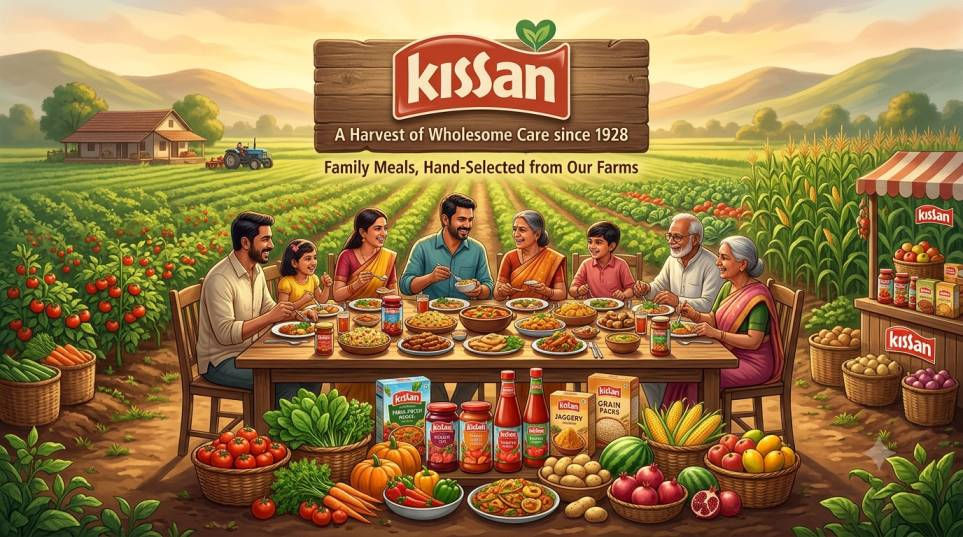
A heritage tied to farmers. The brand’s name and origin story rest on farmers as suppliers of fresh produce. Kissan’s website states that its name reflects “the dedicated Kisans of India” and that its commitment is to stand by them.
A family-and-child brand purpose. In a WARC-published case for “Kissan Tiffin Timetable” (lead agency Mindshare India), the brand is described as being “about kids eating happily and, in turn, growing happily.” The same entry states that Kissan “has always endeavoured to support mothers in making healthy and delicious food items for their kids.” This is the closest primary statement of a family-oriented brand purpose in the sources reviewed. It positions the mother as the primary audience and the child’s eating as the emotional territory.
A credibility gap on the core product claim. Kissan had been communicating that its ketchup is “made from 100% real tomatoes.” According to the WARC-published Jay Chiat case summary, loyal users knew and valued this, but non-users were not convinced. The APAC Effie case summary adds that ketchup is perceived as artificially preserved and coloured, which created a perception barrier to consumption.
Strategic Objective
The documented objectives vary by campaign, but share a common thread: increasing consumption and conviction among mothers and families, not simply broadcasting a product claim.
For Kissanpur, the APAC Effie entry states the aim as increasing consumption among both new and current users, by driving conviction in “Made from 100% real tomatoes” through lived experience, not plain advertising. The Cannes Lions entry framed the key objective as convincing mothers that a Kissan ketchup bottle is made from real tomatoes, in a cost-effective way. For Kissan Tiffin Timetable, WARC’s summary records that Kissan needed to increase its relevance to the country’s most popular dishes, in a low-involvement, low-penetration category, and decided to target mothers.
Campaign Architecture & Execution
Kissan Roll (documented by WARC as a 2012-era case). WARC identifies Hindustan Unilever Limited as brand owner and Lowe Lintas & Partners as lead agency. The abstract states that the task was twofold: to arrest the decline in ketchup consumption and, by the abstract’s framing, to go further. The publicly visible portion records the channels as television, consumer magazines, newspapers, in-store point-of-purchase and events/experiential, with a media budget band of “up to 500k.”
Kissanpur / Little Farmers of Kissanpur (documented from 2013 onward). Trade magazine Directions dates the work to February 2013, and award recognition followed in 2014. The mechanics are consistent across the Cannes Lions entry, the Directions write-up and the WARC abstracts:
A tomato-shaped bottle cap carried tomato seeds and, when inverted, doubled as a small pot for planting.
A fictitious farming town, “Kissanpur,” framed participation. According to Directions, “Kissan” means farmer and “pur” is a common suffix for Indian villages.
A contest let the best growers have their photos featured on Kissan bottles. WARC’s Asian Strategy summary says the top 100 growers would receive personalised ketchup bottles.
Per Lowe Lintas’s Cannes entry, the tomatoes the children grew were collected and used in Kissan bottles, and the growers’ faces were put on bottles. The entry also records that participants uploaded their plants to Facebook.
WARC’s Innovation Awards abstract adds that some 2.5 million households received tomato seeds sampled on the front page of a leading publication. It also records a learning programme across 55 schools in which over 25,000 children planted tomatoes and visited tomato farms.
The Cannes entry states that the cap cost “just 5 cents (euros)”. This is a company-and-agency claim and not an audited cost figure.
Kissan Tiffin Timetable (WARC, published November 2018). WARC records that, following social listening, Kissan created one of the largest online tiffin recipe repositories, curated by well-known Indian chefs, aimed at mothers. WARC lists Mindshare India as lead agency and Hindustan Unilever as brand owner.
Other family-themed Kissan campaigns, including hashtag-led “togetherness” initiatives, are described on secondary marketing blogs.
Positioning & Consumer Insight
Read together, the documented campaigns show a consistent logic: Kissan treats the family, and mothers in particular, as the point where trust is built, and uses children as the route to the mother’s conviction. The sources do not use that exact framing, so what follows is analysis built on the documented evidence.
Kissanpur converted a product claim into a family activity. WARC’s summary states that Kissanpur targeted urbanised consumers whose children are largely limited to indoor games and virtual worlds, and that the idea was to help kids and mums grow tomato plants at home. Directions records the rationale that growing plants would bring children closer to the natural world than any gadget could. The strategic move is that the claim “100% real tomatoes” was no longer asserted to the mother. She watched it happen on her own balcony. The campaign therefore addressed non-users’ scepticism through participation, and the family unit became both the audience and the proof.
The insight shifts across the portfolio, but the audience does not. In Kissanpur the child is a participant and the mother is the person to be convinced. In Tiffin Timetable, per WARC, the mother is the target and the occasion is the daily meal for the child. In both, the brand’s purpose, supporting mothers in feeding children well, stays constant. The tone differs, from playful to practical, while the audience remains the household’s meal-maker.
Farmer credentials support the family-trust story. Kissan’s website states that in 2019, 76% of tomatoes used in Kissan ketchup were from sustainable sources, and that HUL continued a buy-back guarantee for farmers’ produce. It also states that around 8,000 farmers across the country cultivated tomatoes for HUL in 2019, and describes a tomato varietal harvested in 90 days versus 150 to 180 days for traditional varieties. The sources reviewed do not explicitly link this sourcing programme to the Kissanpur campaign. A strategist can note the thematic consistency between a consumer story about real tomatoes and a supply-side story about farmers, but the sources do not document the two as a single integrated programme.
Media & Channel Strategy
The documented channel choices differ by objective. For Kissan Roll, WARC records mass and in-store channels: television, newspapers, consumer magazines, point-of-purchase and events. For Kissanpur, WARC records sampling through a newspaper front page, school-based activity, and print advertorials, radio, digital, social media and PR sustained across the roughly three months a tomato plant takes to grow. Lowe Lintas’s Cannes entry emphasises the physical pack as the main medium, along with Facebook sharing by participants.
For Tiffin Timetable, WARC lists content marketing, livestreaming, packaging and design, search marketing, social media, websites and microsites, and word of mouth, with a budget band of 1 to 3 million (WARC does not state the currency in the summary reviewed). The shift is notable. Where Kissanpur used the physical product as the experience, Tiffin Timetable used owned and searchable content to meet the mother’s recurring need for recipes.
The Cannes entry’s statement that the brand “had to spend nothing” conflicts with the paid sampling and advertorial activity described by WARC, and should be read as an agency-framed claim about incremental spend, not as an audited budget.
Business & Brand Outcomes
All campaign results below come from agency or client award submissions and WARC summaries. They are self-reported and have not been independently audited in the sources reviewed.
Kissanpur. The Cannes Lions entry records that the tomato cap had 6.17 million mothers “bringing Kissan home,” that those households’ children ate 2.5 times more Kissan ketchup than the category, and that Kissan grew 14.6% against category growth of 4.4%. Directions additionally reports that Kissan outscored the market leader Maggi and other ketchup brands on “naturalness” and “made from best quality tomatoes” in Millward Brown brand tracking research. The sources do not disclose that study’s sample or methodology. The campaign was an APAC Effie winner in the Media Innovation category and has a Jay Chiat Awards case on file. Social Samosa reports that the campaign won over 35 awards in India, that Kissan is the only Indian brand to win a Grand Prix at Spike Asia, and that it was the first Indian brand to win a Silver at the Jay Chiat Awards.
Two figures in the record measure different things and should not be conflated. The 2.5 million households is a WARC figure for households that received tomato seeds through newspaper sampling. The 6.17 million mothers figure is the Cannes entry’s count for purchase of the cap pack. The sources do not reconcile the two. Some blog posts circulate further figures for Kissanpur, such as an 8.5 million reach figure.
Kissan Tiffin Timetable. WARC’s summary reports 11 million organic views on YouTube and Facebook, reach of 42 million on Twitter, and conviction scores on ketchup that moved up by 2,000 basis points, along with a 140 basis point improvement in penetration. The underlying measurement base is not public.
Strategic Implications
First, the family can be a proof mechanism, not just a target. In a category where products look alike, Kissan’s documented response to a believability problem was to let mothers and children generate the proof themselves. The self-reported growth against a 4.4% category rate suggests the approach worked commercially, though the evidence is agency-reported.
Second, a consistent audience allows tactical variety. Across a 2012–13 campaign and a 2018 content programme, the documented target stays the mother feeding her child. The formats changed from a bottle cap to an online recipe repository without the brand’s purpose changing. This is a useful illustration of a stable positioning supporting different execution formats.
Third, a family brand carries concentration risk. The sources reviewed show a brand built on the mother-child relationship. Whether this audience focus limits relevance as household roles change is not addressed in any verified source, so it is offered as a question for discussion, not a finding.
Fourth, the evidence base is itself a lesson. The strongest documentation is award-submission material, and the figures it reports are self-reported. A rigorous analyst separates these from audited company disclosures, which, for Kissan’s brand-level economics, are not publicly available.
Discussion Questions
Kissanpur treated a credibility gap in a “100% real tomatoes” claim by letting families produce the proof. Under what category conditions does experiential proof outperform claims-based advertising, and when would it fail to scale?
Kissan’s documented target stays constant (mothers feeding children) while its tactics shift from physical pack to digital content. What are the benefits and risks of holding the audience fixed over several years?
The Cannes entry reports 6.17 million mothers buying the cap pack, while WARC reports 2.5 million households receiving seeds. How should an analyst treat metrics that measure different stages of a campaign when they are reported side by side?
The Cannes entry says the campaign “had to spend nothing,” yet WARC records sampling and sustained media across three months. How would you assess the true cost-effectiveness of a campaign when self-reported spend is ambiguous?
Kissan’s website describes a farmer sourcing programme alongside a consumer-facing “real tomatoes” message. What would a brand need to show publicly to demonstrate that supply-chain investment genuinely underpins its marketing claims?


Comments