Matrimony.com’s Multi-Brand Matrimonial Business Model
Industry & Competitive Context
The Indian online matrimonial industry emerged in the late 1990s and early 2000s as internet penetration grew among Indian households and the Indian diaspora. The category sits at the intersection of two deeply entrenched Indian institutions: arranged marriage, which remains the dominant mode of marriage formation across most Indian communities, and the internet’s ability to widen and formalize the traditional process of matchmaking that was historically handled by family networks, local brokers, and community priests. Early entrants in this space included Shaadi.com (launched by People Group) and BharatMatrimony (launched by Chennai-based entrepreneur Murugavel Janakiraman), which together became the two largest branded players in the category. A third significant competitor, Jeevansathi.com, operated under the Info Edge umbrella.
Matrimony.com Limited, the parent company of BharatMatrimony, is listed on both the National Stock Exchange of India (NSE: MATRIMONY) and the Bombay Stock Exchange (BSE: 540704), having completed its initial public offering in September 2017 through a book-built issue of approximately ₹497 crore. The company is headquartered in Chennai and reports its results as a public company, which makes its financial and operational disclosures a matter of public record through NSE/BSE filings, investor factsheets, and annual reports.
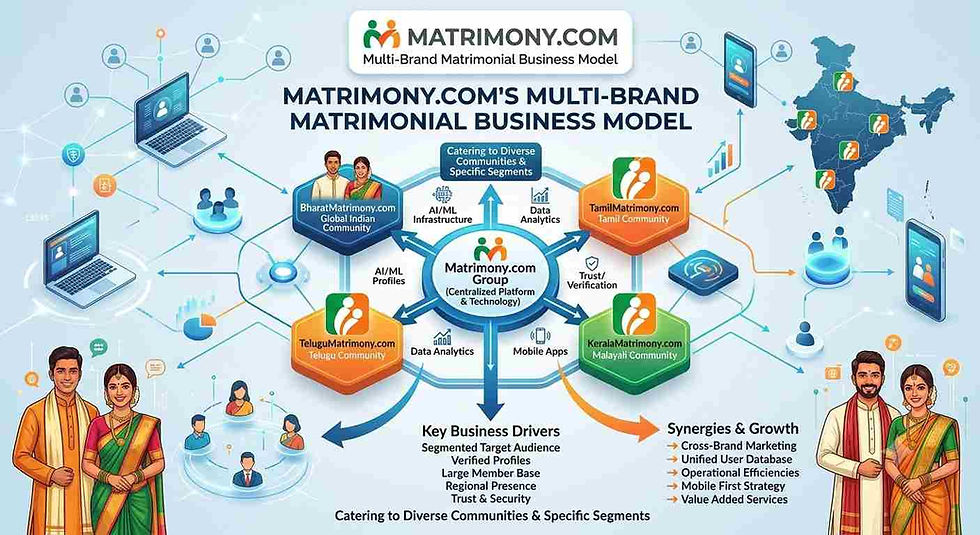
A defining structural feature of the Indian matchmaking market, and one that is central to this case, is its fragmentation by religion, caste, language, and region. Unlike Western online dating markets, where a single broad platform can serve most users, Indian matrimonial preference data historically shows strong within-community matching behavior. This structural reality shaped Matrimony.com’s foundational business decision: rather than building one undifferentiated matchmaking platform, the company built a portfolio of distinct, community-specific and purpose-specific brands operating under a shared technology, data, and operations backbone.
Brand Situation Prior to the Multi-Brand Strategy
Murugavel Janakiraman founded the business as Consim Info Private Limited around 2000–2001, initially launching Tamil Matrimony as a community portal aimed at the Tamil diaspora seeking matrimonial connections online. The success of this single-community site revealed the underlying insight that would define the company’s subsequent strategy: Indian matrimonial search is rarely generic. A user searching for a spouse is typically searching within defined boundaries of community, language, religion, and sometimes caste or sub-caste, and a platform addressing that need with a community-specific brand name and user base could generate stronger trust and relevance than a single generalized matrimonial website.
Building on this insight, the company expanded through the 2000s by launching additional community- and language-specific portals, including BengalMatrimony.com, MarathiMatrimony.com, GujaratiMatrimony.com, PunjabiMatrimony.com, HindiMatrimony.com SindhiMatrimony.com, KannadaMatrimony.com, KeralaMatrimony.com, and TeluguMatrimony.com, among others. In 2013, Consim Info was renamed Matrimony.com Limited, consolidating the corporate identity of the group while retaining BharatMatrimony as the pan-India flagship consumer brand and the individual community sites as a distinct product layer beneath it.
Strategic Objective
The strategic objective underlying Matrimony.com’s brand architecture, as evidenced by its subsequent product launches and its own investor disclosures, has been to maximize addressable market coverage across India’s fragmented matrimonial preference structure while consolidating technology, data, and operational infrastructure under a single corporate entity. Rather than competing purely on scale with a single mass-market brand (the approach taken by rival Shaadi.com), Matrimony.com pursued a strategy of brand proliferation matched to the segmentation logic of its market, supplemented by diversification into adjacent services connected to the marriage lifecycle.
This objective manifests in three identifiable strategic threads documented in the company’s own investor materials: first, deepening community and language coverage through the Community Matrimony portfolio; second, extending along the customer’s willingness to pay and need for high-touch service through Assisted Matrimony and Elite Matrimony; and third, extending beyond matchmaking into the broader wedding and marriage services ecosystem through ventures such as Mandap, WeddingBazaar, and MakeMyWedding.
Campaign Architecture & Execution (Brand Portfolio Architecture)
Matrimony.com’s execution of its multi-brand strategy can be read as a tiered portfolio architecture rather than a single advertising campaign, since the company’s public disclosures describe it in those terms.
At the top of the portfolio sits BharatMatrimony, the flagship, pan-India brand that serves as the primary consumer-facing identity and the brand most associated with the company in national advertising and public recognition. Beneath this sits the Community Matrimony layer, which according to the company’s own investor factsheets comprises more than 300 community-focused websites, including the major regional and linguistic portals built around identities such as Tamil, Telugu, Kannada, Malayalam, Marathi, Gujarati, Punjabi, Bengali, Hindi, and Sindhi-speaking communities, among others. The company states that Bharat Matrimony itself comprises 17 regional portals within this structure.
Beyond free and self-service matchmaking, the company built two service tiers addressing different customer needs and willingness to pay. Assisted Matrimony, which traces its origins to a 2008 offering initially called BM Privilege and later renamed Privilege Matrimony before adopting its current name, provides relationship-manager-assisted matchmaking for customers seeking more guided support than a self-service website offers. Elite Matrimony, also launched in 2008, is positioned as an invitation-based, premium matchmaking service for high-net-worth individuals, charging a matchmaking service fee and operating on a different access model than the mass-market portals.
The company has also launched newer, demographically targeted products reflecting shifts in its understanding of the Indian matchmaking market. The Jodii application, launched in vernacular languages (the company states nine vernacular languages), targets blue-collar and lower-income segments of the population who had been underserved by the company’s original, more urban and English/regional-literate user base. RainbowLuv, launched in 2022, was introduced to serve the LGBTQIA+ community, reflecting a further segmentation of the company’s addressable market following India’s 2018 decriminalization of consensual same-sex relations.
Finally, the company has diversified into adjacent marriage-lifecycle services, which it reports separately from its core matchmaking business. These include Mandap, a venue-booking service the company states covers a network of more than 40,000 mandaps, banquet halls, and convention halls; WeddingBazaar, a wedding vendor marketplace; and MakeMyWedding, a premium vendor service. According to the company’s investor disclosures, this Marriage Services segment is supported by a vendor network exceeding 300,000 vendors across more than 40 cities, though the company’s own reporting indicates this segment contributes a small proportion (around 1%) of total business, with Matchmaking Services accounting for approximately 99% of the business mix.
Positioning & Consumer Insight
The consumer insight underlying this architecture, as evidenced by the pattern of brand launches itself, is that trust and relevance in Indian matrimonial search are strongly tied to perceived in-group understanding. A user is more likely to trust and engage with a platform that explicitly signals it understands their community’s customs, language, and matrimonial norms than with a generic, undifferentiated platform. This is distinct from a pure network-effects argument (where a single large platform would be preferred for maximum choice); instead, it reflects a preference-matching argument, where users self-select into community-specific environments that reduce perceived search friction and signal cultural fit.
The positioning for BharatMatrimony itself has centered on scale and trust, with the company’s own communications emphasizing its standing as a pioneer in the category and, in its investor materials, a stated leadership position with the highest pan-India market share among organized matchmaking services, a company-reported figure of approximately 60%, including a dominant position in South India. This is a company-stated claim rather than an independently verified industry statistic, and should be read as such.
Separately, Matrimony.com’s offline retail presence, which the company describes as BharatMatrimony Centres and which it states began in 2005, reflects a positioning insight specific to the Indian context: that a meaningful segment of the matrimonial-seeking population, particularly in Tier 2 and Tier 3 towns and among older or less digitally native users, prefers or requires human-assisted, physical-location-based service even when the underlying database and matching technology is digital. The company’s most recent investor factsheet states an on-ground retail presence of more than 130 outlets.
Media & Channel Strategy
Verified public information on Matrimony.com’s specific media and channel strategy is limited primarily to what the company has disclosed regarding its distribution structure rather than granular advertising campaign details. The company operates through a combination of digital channels (its network of websites and the Jodii and other mobile applications) and physical retail centres under the BharatMatrimony Centres format, described above. The company’s historical public record includes a 2006 entry in the Limca Book of World Records recognizing BharatMatrimony for facilitating the highest number of documented online marriages in India at that time, which reflects an early public-relations and credibility-building channel rather than a paid-media campaign.
Business & Brand Outcomes
Matrimony.com’s financial disclosures, reported in its investor factsheets, provide a documented record of the multi-brand model’s commercial outcomes over recent fiscal years. Consolidated operating income was reported at approximately ₹4,345 million in FY22, ₹4,558 million in FY23, ₹4,814 million in FY24, and ₹4,558 million in FY25. EBITDA margins across this period were reported at approximately 20.6% (FY22), 16.4% (FY23), 15.2% (FY24), and 13.8% (FY25), indicating a gradual margin compression over the period even as revenue remained broadly stable to modestly growing. Profit after tax was reported at approximately ₹536 million (FY22), ₹467 million (FY23), ₹496 million (FY24), and ₹453 million (FY25), with diluted earnings per share moving from approximately ₹23.39 (FY22) to ₹20.56 (FY25).
On subscriber metrics, the company reported paid subscriptions of approximately 0.89 million (FY22), 0.99 million (FY23), 1.07 million (FY24), and 1.00 million (FY25), with the company highlighting that paid subscriptions crossed the 1 million mark during this period. The company has also disclosed a zero-debt balance sheet position, cash and investments of approximately ₹3,243 million, and a share buyback of approximately ₹72 crore executed in the third quarter of FY25, alongside a dividend payout ratio of approximately 24.58%.
Strategic Implications
Matrimony.com’s multi-brand architecture illustrates a market-segmentation strategy built around a structural feature of its home market rather than a borrowed international playbook. Where a single-brand, undifferentiated platform strategy might maximize short-term marketing efficiency through one unified brand message, Matrimony.com’s documented approach traded some of that efficiency for deeper penetration into segments defined by language, community, income level, and service-tier willingness to pay, while retaining centralized technology and operational infrastructure under one listed corporate entity. This allowed the company to address the trust and relevance barriers specific to Indian matrimonial search without requiring each sub-brand to independently build technology or back-end operations.
At the same time, the company’s own financial disclosures show that revenue growth has been modest and margins have compressed over FY22–FY25, even as the brand portfolio and subscriber base have expanded, which raises a genuine strategic question about whether continued brand and service-line proliferation (Community Matrimony’s 300+ sites, Jodii, RainbowLuv, and the Marriage Services diversification into Mandap and WeddingBazaar) is translating into proportionate commercial returns, or whether the core matchmaking category itself faces structural headwinds from competing modes of partner discovery, including mainstream dating applications and informal social-network-based introductions, in urban India.
The Marriage Services diversification also represents a strategically logical extension of customer lifetime relationship, moving from matchmaking into the adjacent and transactionally larger wedding-services market, but the company’s own disclosure that this segment contributes only approximately 1% of the business mix suggests this diversification remains in an early or sub-scale stage relative to the core matchmaking business, at least based on the most recent publicly available figures.
Discussion Questions
Under what market conditions does a multi-brand, segment-specific portfolio strategy (as pursued by Matrimony.com) create more shareholder value than a single, unified brand strategy (as pursued by a competitor like Shaadi.com), and what structural features of a market should a company assess before choosing between these approaches?
Matrimony.com’s EBITDA margin declined from approximately 20.6% in FY22 to 13.8% in FY25 even as its brand portfolio and paid subscriber base expanded. What hypotheses would you construct to explain this divergence, and what additional public or company-disclosed data would you need to test them?
How should a company evaluate whether continuing to launch new community- or demographic-specific brands (such as Jodii or RainbowLuv) is value-accretive, given that such brands may fragment marketing spend and operational focus even as they expand addressable market coverage?
Matrimony.com’s Marriage Services segment (Mandap, WeddingBazaar, MakeMyWedding) reportedly contributes only around 1% of total business despite several years of investment. What criteria would you use to decide whether a company should continue investing in such an adjacent diversification, scale it more aggressively, or divest it?
Given that a significant share of Matrimony.com’s documented market-leadership claims (such as its stated ~60% market share) are company-reported rather than independently audited industry figures, how should an investor or strategist weigh such claims when evaluating competitive position in a largely unlisted, privately held competitive set?


Comments