Meta’s AI ad tools can surface unapproved discounts
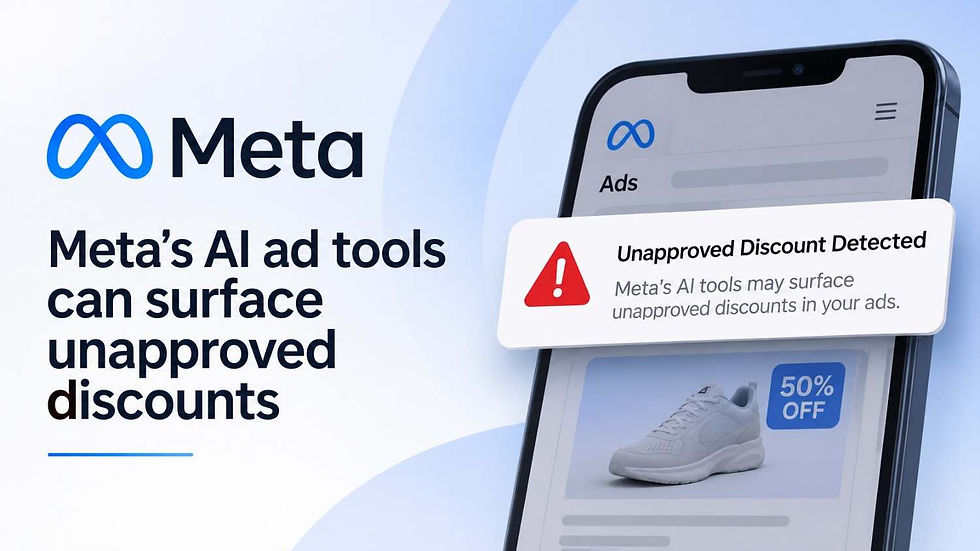
Meta’s automated advertising tools have been reported to display discount offers on Facebook and Instagram ads even when an advertiser had turned promotions off for the ad being copied. The issue appears tied to Meta’s Commerce Manager “Detected offers” setting, which can allow offers identified on a business’s website or ads to appear across its Meta advertising.
What happened
The report originated with digital marketing advisor Bram Van der Hallen, who described the behavior in a LinkedIn post. According to his account, Meta may automatically detect offers on an advertiser’s website and use them in Meta ads, including in a duplicated ad where the advertiser had disabled promotions.
The reporting does not establish that Meta intentionally added discounts without advertiser consent, nor does it document a platform-wide outage or a confirmed number of affected advertisers. What it does establish is a specific configuration risk: when the option to display offers detected from a website and ads is enabled in Commerce Manager, Meta may show those detected offers in ads.
This is important because the promotion may have been intended for a particular campaign, audience, product, or time period. If Meta’s system surfaces it elsewhere, a customer could see a discount that the advertiser did not intend to offer in that context.
How the setting works
The reported mechanism is not necessarily an AI model inventing a new price or discount. Instead, Meta can detect promotional content on a business’s website and ads, then display those offers in Meta advertising when the relevant Commerce Manager setting is enabled.
Van der Hallen said that advertisers can control the issue by updating Commerce Manager settings so that Meta does not use detected offers in other campaigns. In practical terms, an advertiser running several promotions should ensure that a discount intended for one campaign cannot automatically appear in another.
The distinction matters: an advertiser may have turned promotions off on the original ad, but that ad-level action may not prevent Meta from using an offer detected elsewhere in the account when the broader Commerce Manager setting is active.
Why advertisers are concerned
For a business, an unexpected discount is not merely a cosmetic error. It can create a mismatch between what the ad promises and what the business is prepared to fulfil, potentially affecting margins, inventory, customer service, and the accuracy of its promotional messaging.
The concern is especially acute for businesses with more than one live offer. PPC Land noted that a discount meant for one campaign or audience could appear somewhere else, creating the possibility that a limited or targeted promotion reaches customers for whom it was never intended.
There is also a brand-control issue. Advertisers generally expect to decide which commercial incentives appear in their paid ads. Automated systems can optimize creative, targeting, placements, and delivery, but inserting or surfacing a price promotion changes the commercial terms being communicated to potential customers.
What is confirmed—and what is not
The confirmed elements are limited but clear. A digital marketing advisor publicly described the behavior; PPC Land reported it; and Marketing Dive’s “Sociable” column subsequently covered the report. The reported fix is a Commerce Manager setting that can prevent detected offers from being used in other campaigns.
The available reporting does not say how many advertisers were affected, whether Meta has formally acknowledged the issue, or whether Meta plans a product change. It also does not establish that this affected every Meta advertiser or every type of promotion. Claims that Meta “confirmed” the issue, issued a formal fix, or acknowledged a broad problem go beyond what the cited reporting supports.
Likewise, it would be inaccurate to describe this as proof that Meta’s AI is autonomously creating unauthorized discounts from nothing. The reported issue concerns detected offers already present on an advertiser’s website or ads being displayed in ads where the advertiser did not want them.
The broader automation question
Meta has been expanding automation across its advertising products, using AI-driven systems to improve campaign performance and reduce manual work for advertisers. Marketing Dive noted that Meta recently said improvements to its ads ranking system drove an increase of more than 8% in ad clicks and a 15.7% uplift in conversions on Facebook in the second quarter of 2026.
Those performance gains explain why advertisers use automated tools: they can test variations, allocate delivery, and identify effective creative at a scale impossible to manage manually. But the reported discount issue illustrates the trade-off. Automation can optimize toward engagement and conversions, while an advertiser’s priority may include margin protection, promotion eligibility, legal accuracy, and campaign-specific messaging.
The issue therefore is not simply whether AI advertising works. It is whether advertisers retain sufficiently clear and granular control over commercially significant claims—especially prices, discounts, and eligibility conditions.
What advertisers should do
Advertisers using Meta’s Commerce Manager should review their offer-merchandising settings and determine whether Meta is permitted to display offers detected from their website and ads. Businesses running multiple promotions should be particularly careful, because the reported risk is that one offer can surface in a campaign where it was not intended.
A sensible precaution is to audit live promotions, identify which discounts are public versus campaign-specific, and confirm that Commerce Manager settings match the intended use of each offer. Advertisers should also review duplicated ads and campaigns after making changes, since the reported issue involved a copied ad where promotions had been turned off.
Until Meta provides a clearer public explanation or product-level control, the practical response is caution: treat detected-offer settings as a material advertising control, not a minor preference. A discount displayed in the wrong campaign can create customer confusion and commercial exposure even if the underlying promotion was genuine.
Sources
Marketing Dive — “Sociable: Meta’s AI ads included unapproved discounts,” November 12, 2026: https://www.marketingdive.com/news/sociable-metas-ai-ads-included-unapproved-discounts/874525/
PPC Land — report on Meta ad tools displaying website discounts in ads with promotions off, cited by Marketing Dive: https://ppcland.com/ (original article linked through Marketing Dive’s coverage)
Social Media Today — “Meta’s AI ads included unapproved discounts,” November 8, 2026: https://www.socialmediatoday.com/news/metas-ai-ads-included-unapproved-discounts/772988/
Bram Van der Hallen — LinkedIn post describing the detected-offers behavior and Commerce Manager control, as reported by Marketing Dive: https://www.linkedin.com/ (specific post identified in Marketing Dive’s reporting)



Comments