Tata CLiQ’s Marketplace Strategy in Fashion and Lifestyle Commerce
Industry and Competitive Context
Tata CLiQ entered Indian e-commerce in May 2016 through Tata UniStore, a Tata Group venture. Public reports at the time described a market where Amazon and Flipkart were engaged in an intense price war. A 2019 report put Flipkart Group's FY18 revenue at INR 30,164 crore and Amazon Seller Services' at INR 5,018 crore, against Tata UniStore's total income of INR 41.7 crore in the same year. The gap in scale between the incumbents and the Tata entrant is the defining feature of the competitive context.
Tata's structural position in this market was unusual. The Group is a century-old conglomerate with a strong public reputation. It also owns offline retail assets, and Trent (Westside, Star Bazaar, Landmark) was a minority shareholder in Tata UniStore at launch. Tata CLiQ was therefore not a pure-play startup. It was a corporate-backed entrant that could draw on trust, brand equity and physical retail, but that also had to justify continued capital allocation from a parent group.
Later competitive commentary identifies Myntra and Reliance's AJIO as the principal rivals in the fashion segment, particularly in the premium tier. No verified public information is available on Tata CLiQ's market share in Indian fashion e-commerce.
Brand Situation Prior to the Strategic Shifts
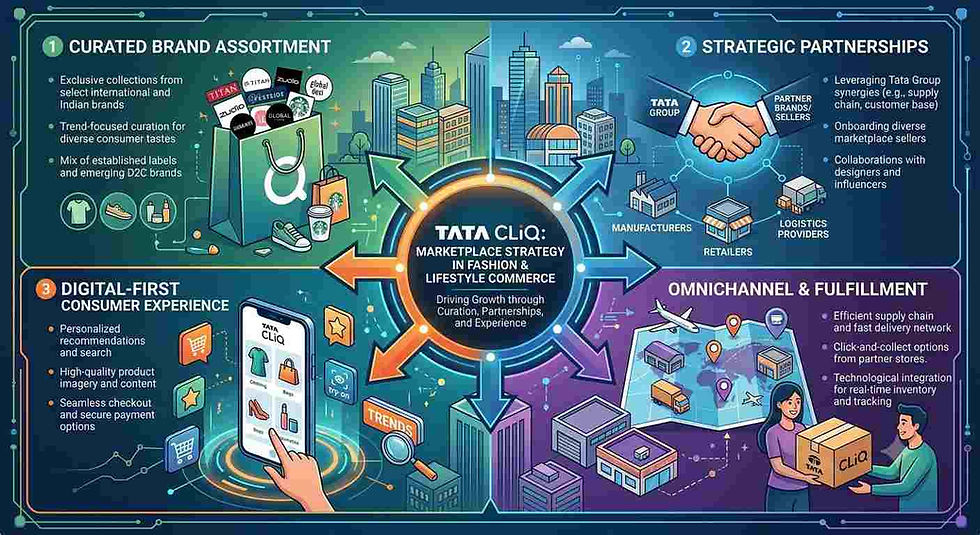
At launch, Tata CLiQ positioned itself as a curated marketplace rather than an open one. Public coverage of the launch described it as a platform where not every brand or product could sell. Its stated model was "phygital," combining digital shopping with physical retail networks. Company executives argued this could improve post-purchase service, such as handling defective products and returns, through physical store touchpoints.
The brand also faced a perception problem. Roughly a year after launch, a Tata Industries executive said that more than 75 percent of the brands sold on the portal were non-Tata brands. Because the company had done no advertising, however, many people believed Tata CLiQ was a Tata-only site. Management stated that this perception needed to change. The case is therefore not one of weak brand awareness. It is one of a trusted corporate name that misrepresented the marketplace's actual proposition.
Financially, Tata UniStore reported net losses of INR 208.4 crore in FY18 and INR 246.75 crore in FY19, the latter a rise of about 18 percent. Public reports linked these losses to heavy capital infusion and operating expenditure. Company commentary at the time expressed expectations of stronger financials as Indian consumers adopted e-commerce.
Strategic Objective
Public statements across the period point to several objectives. The first was to build a curated, trust-led marketplace that competed on assortment and experience rather than on discounting. At the launch event, executives said discounts would be used tactically and not strategically, a direct response to questions about whether Tata CLiQ would copy the deep-discounting playbook of larger rivals.
The second objective was category expansion. In 2017, management indicated plans to add nearly 400 brands and categories such as jewellery, home furnishings and children's garments. A senior executive also suggested that Tata CLiQ could eventually become bigger than Trent. No verified public information is available on whether that ambition was met.
The third objective, which emerged later, was focus. Following the creation of Tata Digital as the Group's consolidated e-commerce holding structure, Tata CLiQ exited consumer electronics in mid-2022. Public reports describe the electronics business as being integrated with Croma, Tata's electronics retail chain, and describe the exit as a way to avoid conflict with the Tata Neu super app. Tata CLiQ was acquired by Tata Digital from Tata Industries in December 2022. The objective moved from broad multi-category marketplace to specialisation in fashion, lifestyle, luxury and beauty.
Campaign Architecture and Execution
The case is better understood as a sequence of strategic moves than as a single campaign. Four stand out.
The first was the curated, omnichannel marketplace model at launch. By restricting who could sell, Tata CLiQ traded breadth for brand quality and consumer trust. This also fit Tata's reputation. A company executive noted in 2016 that many newcomers to digital shopping lacked trust in online sites and sought household names, and the Tata name was positioned as an advantage.
The second was the early partnership with Genesis Luxury, which gave the platform access to international luxury brands, followed by the launch of Tata CLiQ Luxury in December 2016. A separate luxury vertical was a deliberate move away from mass-market marketplace competition. It aligned the platform with a premium assortment and a different customer segment from that served by value-driven rivals.
The third was integration with the wider Tata ecosystem. Public interviews with Tata CLiQ leadership describe the omnichannel strategy as a key differentiator, built on an extensive assortment from leading brands. Westside is described as selectively available on both Tata CLiQ and Tata Neu, and Tata CLiQ shoppers can use Neu Coins, the Tata Neu loyalty currency, across multiple Tata offerings. This turns a standalone marketplace into one node in a loyalty network.
The fourth was vertical expansion into beauty. Tata CLiQ Palette was launched as the beauty vertical, and actor Kriti Sanon was signed as its brand ambassador. Public reports also describe the launch of a standalone Palette app and two physical beauty stores, in Navi Mumbai and Pune. In parallel, the platform has been rebranded in some public references as Tata CLiQ Fashion, signalling its narrowed focus. No verified public information is available on the precise date and rationale of this rebranding beyond these references.
Positioning and Consumer Insight
Tata CLiQ's positioning rests on a single bet: that a segment of Indian online shoppers values trust, authenticity and curation more than the lowest price. The company's own commentary supports this reading, citing the reassurance that a household name provides to first-time online buyers and the importance of a "magical shopping experience" as the cornerstone of its marketing approach.
Strategically, this is a differentiation play against scale players. Amazon, Flipkart, Myntra and AJIO compete heavily on breadth and price. Tata CLiQ chose to compete on curation, luxury and omnichannel service. The positioning has a logical coherence, but it also carries a tension. Curation limits assortment, and a premium orientation narrows the addressable customer base. A marketplace that rejects deep discounting must justify its price points through experience and brand quality, and public documentation of how customers perceive that trade-off is limited.
The early awareness gap is also instructive. A brand with strong parent equity still had to invest in communicating that it was an open marketplace with a majority of non-Tata brands. No verified public information is available on consumer research, brand-tracking results or customer segmentation data for Tata CLiQ.
Media and Channel Strategy
Verified public information on media strategy is limited. The only documented media choices are two: an early period of minimal advertising, acknowledged by management, and the use of a celebrity ambassador for the Palette beauty vertical. Public coverage also notes the use of social media monitoring and analytics to assess market sentiment and improve the platform, and a partnership with Adobe on digital shopping experience.
The channel strategy is better documented than the media strategy. Tata CLiQ operates across its own digital platform, physical beauty stores for Palette, and cross-listing within the Tata Neu super app. No verified public information is available on media spend, channel mix, advertising effectiveness or campaign-level performance.
Business and Brand Outcomes
The documented financial record shows a business that shrank sharply before recovering modestly. Public reports of Tata UniStore's filings put annual revenue at INR 844 crore in FY22, INR 430 crore in FY23 and INR 247 crore in FY24. The FY23 and FY24 declines followed the exit from electronics. Revenue then rose 19.2 percent to INR 294.4 crore in FY25, a rise reported alongside an expanded brand portfolio, and reached INR 354.4 crore in FY26, according to reports on Tata Sons' annual report.
Net losses narrowed over the same period, from INR 391 crore in FY24 to INR 314 crore in FY25 and INR 252.8 crore in FY26. Tata CLiQ nonetheless remains loss-making. In 2022, regulatory filings showed the Tata Group infusing INR 1,600 crore into Tata UniStore. At the Tata Digital level, FY26 revenue rose 11.9 percent to INR 35,990 crore, and the unit reported a loss of INR 4,974 crore. Most Tata Digital verticals were loss-making.
No verified public information is available on Tata CLiQ's gross merchandise value, customer numbers, repeat purchase behaviour, seller count, brand count or profitability timeline. No verified public information is available on the standalone financial performance of Tata CLiQ Luxury or Tata CLiQ Palette.
Strategic Implications
The first implication concerns scale versus focus. Tata CLiQ's early model was broad: apparel, footwear and electronics, with plans to add categories. Its revenue trajectory suggests that breadth did not translate into durable scale. The shift to a narrower fashion, luxury and beauty identity reduced revenue in the short term, but the subsequent two years of growth and narrowing losses are consistent with, though not proof of, a strategy that is stabilising. Causation cannot be established from public data.
The second implication concerns parent-company patience. A marketplace without deep-discount economics, competing against scaled incumbents, depends on sustained capital support. The documented equity infusions show the Group's willingness to fund it. They also illustrate how a corporate-backed entrant's strategic freedom is shaped by its parent's capital allocation and ecosystem priorities, as seen in the electronics exit driven by Tata Neu and Croma.
The third implication concerns ecosystem leverage. Neu Coins and Westside's selective availability connect Tata CLiQ to a wider loyalty and retail network. This could be a source of differentiation that pure-play rivals cannot easily copy. Whether it produces measurable advantage is not publicly documented.
The fourth implication concerns the cost of positioning. Declining to compete on price is a coherent differentiation choice, but it requires sustained investment in brand communication, assortment quality and service. The early awareness gap shows that even a trusted name does not automatically convey a marketplace proposition.
Discussion Questions
Tata CLiQ chose a curated, trust-led marketplace over a deep-discounting model. Under what market conditions does this positioning create sustainable advantage, and under what conditions does it become a constraint on scale?
The exit from electronics reduced revenue sharply but sharpened category focus. How should a corporate-backed marketplace evaluate the trade-off between near-term revenue and long-term positioning clarity?
Tata CLiQ operates within a broader ecosystem that includes Tata Neu, Croma and Westside. Evaluate the strategic benefits and risks of integrating a marketplace into a parent group's loyalty and retail network.
Management acknowledged early on that consumers perceived Tata CLiQ as a Tata-only site despite a majority of non-Tata brands. How should a marketplace brand manage the tension between parent-brand trust and a distinct marketplace identity?
Revenue has grown and net losses have narrowed over two consecutive years, yet the business remains loss-making and key metrics are undisclosed. What additional information would you need before judging whether the strategy is succeeding, and how should investors and the parent group weigh patience against accountability?



Comments