Wakefit’s Insight into Sleep Wellness Awareness
Industry and Competitive Context
Wakefit competes in India's home and furnishings market. The Redseer report cited in the company's IPO prospectus puts the total addressable market at ₹2.8–3.0 trillion in 2024, growing to ₹5.2–5.9 trillion by 2030. Coverage of the prospectus describes a fragmented structure: roughly 71 percent of the market in calendar 2024 sat with the unorganised sector. Within that market, mattresses are a small segment, about 5 percent according to those summaries, and furniture is the largest at about 66 percent. The same coverage lists wellness awareness among the drivers of mattress growth. This is the structural logic behind a sleep-awareness strategy. If a category grows partly as consumers come to value sleep as wellness, an organised player has a commercial reason to shape that awareness.
Coverage of the prospectus names The Sleep Company, Duroflex, Kurlon and Sleepwell as competitors. Competitors also use sleep awareness as a marketing theme. Trade coverage of World Sleep Day 2023 records Duroflex's "India's Sleepiest Page" campaign, which addressed the effect of late-night social media use on sleep. World Sleep Day itself was established in 2008 by the World Sleep Society, so it gives every brand in the category a shared annual moment. The strategic implication is that the occasion is not proprietary to Wakefit. Any advantage has to come from what the brand does with it.
The Redseer report places Wakefit among the top three organised mattress companies by revenue in fiscal 2024 and calls it the largest D2C home and furnishings company in India by revenue that year. It also says Wakefit is the only D2C company in the segment to have scaled mattresses, furniture, and furnishings and décor to over ₹100 crore each in fiscal 2024. No verified public information is available on Wakefit's exact share of the Indian mattress market.
Brand Situation Prior to the Campaign
Wakefit was incorporated in March 2016 by Ankit Garg and Chaitanya Ramalingegowda. Press coverage in 2019 described it as an online, research-and-innovation-driven sleep solutions company selling mattresses, pillows, bed frames, mattress protectors and comforters. The prospectus describes a vertically integrated model covering design, engineering, manufacturing, distribution and customer engagement. This matters strategically. A company that controls its own supply chain and sells mainly through its own website and stores is exposed to rising demand for the category itself, because it captures the margin when demand grows.
The earliest audited financials in the prospectus coverage reviewed are for fiscal 2023, when revenue from operations was ₹812.62 crore and the net loss was ₹145.68 crore. No verified public information is available on Wakefit's brand awareness, consideration or sales at the time the Sleep Internship launched in November 2019. Any claim about the starting position of the programme would be speculation.
The prospectus identifies two risks that frame the strategic problem. Wakefit earns a substantial share of its revenue from mattresses, and from its own channels (website and company-owned stores). It also recorded net losses in each of the three fiscal years before the filing. A brand in this position needs demand-creation that does not depend on paid performance spending alone.
Strategic Objective
Wakefit has not published a quantified objective for its sleep-awareness programme, and no verified public information is available on internal targets. The objectives documented are the ones the company states publicly.
When launching the Sleep Internship in 2019, the company said the initiative was meant to bring the focus back to sleep health. In the 2024 edition of its survey, co-founder Chaitanya Ramalingegowda described a belief in research-led educational content in byte-sized, digestible formats. In 2025 and 2026 the company said the survey aims to raise awareness and encourage better choices. The company's 2026 statement for World Sleep Day framed the preceding decade as a commitment to helping India sleep better through products and through conversations about sleep.
The objective documented in public statements is therefore category education and a brand association with sleep itself. The prospectus adds a commercial dimension: ₹108.4 crore of the IPO's fresh issue is earmarked for marketing and advertising over three years, to strengthen brand visibility and awareness.
Campaign Architecture and Execution
The programme combines four instruments, each with a different job.
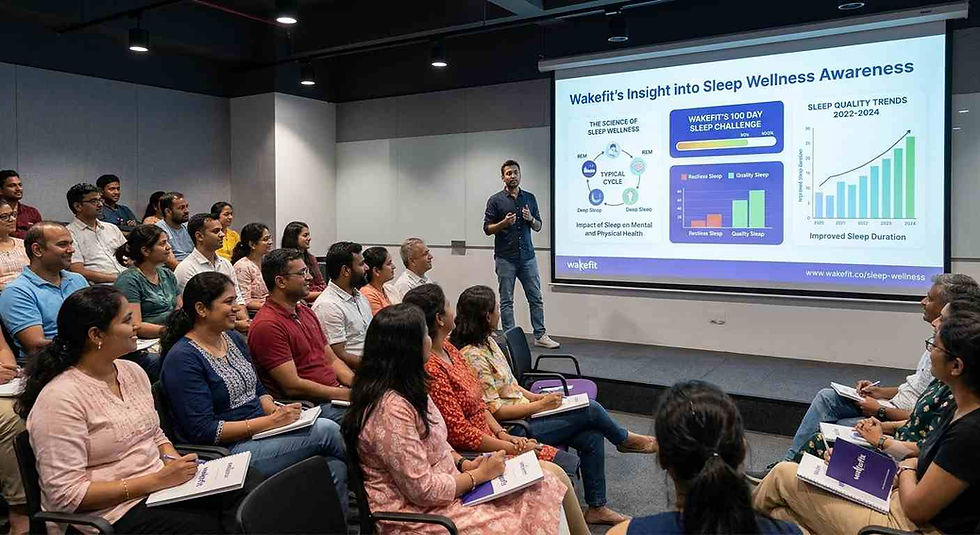
The Great Indian Sleep Scorecard is the research backbone. The company calls it an in-house survey and publishes it around World Sleep Day. The 2026 edition is the ninth. The company's 2024 statement said seven editions had drawn close to 2.5 lakh respondents. The documented sample sizes by edition are:
- 2022 edition: over 30,000 responses (March 2021–February 2022)
- 2024 edition: over 10,000 responses (March 2023–February 2024)
- 2025 edition: over 4,500 responses (March 2024–February 2025)
- 2026 edition: over 2,500 responses (January 2025–March 2026)
Indian media outlets have regularly republished the findings, and some regional outlets carry city-level breakdowns.
The Sleep Internship launched in November 2019. Selected interns were paid ₹1 lakh to sleep on a Wakefit mattress for nine hours a night over 100 nights at home. Each received a sleep tracker, and the company said it would provide access to sleep counselling. Press reports said interns' sleep journeys would be shared on social media to promote the importance of sleep. Later coverage reported a third edition with a ₹10 lakh prize, and by March 2026 the company said it had run four seasons. A trade-press report from an earlier phase describes a national sleep championship developed with agency Spring Marketing Capital. It rewarded people for getting adequate sleep, using data synced from sleep trackers.
Workplace signalling is the third instrument. Press reports in March 2023 said Wakefit had introduced a "Right to Nap" policy the previous year, allowing employees a 30-minute nap at work. In March 2023 it announced an optional company holiday for World Sleep Day, called "Gift of Sleep," which the company shared publicly on LinkedIn. These actions put the brand's message into its own employment practice.
World Sleep Day advertising is the fourth. In March 2025 Wakefit released #SleepStrikesBack, an ad film in which the co-founder stands at a press-conference-style setting and cites the 2025 survey. It named binge-watching as a leading cause of late nights, positioned OTT streaming as India's biggest sleep disruptor without naming a platform, and announced limited-period mattress discounts. In March 2026 it released "Dhamki Squad," conceived by agency The New Thing and featuring comedian Md Anas. Trade coverage reported a ₹50,000 prize for participants and noted that the film moved away from mattresses toward the "maa ki dhamki" (a mother's scolding) cultural trope.
The analytical reading is that these four instruments work as a system. The survey generates a data-backed claim, the internship generates a story, the workplace actions give the brand credibility as a believer in its own message, and the World Sleep Day film turns the data into a mass-media moment. No verified public information is available on how Wakefit internally sequences or governs these elements.
Positioning and Consumer Insight
The survey's own findings are the documented consumer insight. The 2022 edition reported that 88 percent of respondents used a phone before bedtime and 59 percent went to bed after 11 pm. The 2025 edition reported 84 percent phone use before bed, and 51 percent of respondents attributed late nights to binge-watching and scrolling. The 2026 headline was that nearly nine in ten Indians use phones before bedtime. It also reported that 29.1 percent experience compressed sleep, sleeping late and waking early for work, which yields only five to six hours. It named Chennai the top-ranked city and Mumbai the most sleep-deprived.
The more interesting finding for strategists is what respondents say would help. In the 2025 edition about 38 percent said unplugging from screens would improve sleep and 31 percent were working toward a consistent routine. In 2026, 29.5 percent cited a consistent sleep routine. The 2024 edition, as reported by IANSlife, split by age: 37 percent of 18–30-year-olds believed keeping devices away would help, while 33 percent of those over 45 leaned toward a better mattress.
These data suggest a positioning tension. The problems and remedies respondents name are largely behavioural, and only in the older cohort does a product feature as the answer. Wakefit's advertising reflects this. Both recent films foreground behaviour and culture, and the 2026 film moves away from product. The brand positions itself as an advocate for sleep first and a seller of mattresses second. That is a coherent way to build category ownership, but the company's own survey does not show the connection to product purchase. The commercial hand-off appears only in specific offers, such as the discounts attached to the 2025 film.
There is also a measurement caution. The documented sample fell from over 30,000 to over 2,500 across editions, and the collection window changed. The 2026 release describes urban Indians. No verified public information is available on the survey's sampling design, weighting or respondent recruitment. Year-on-year comparisons of the headline percentages should therefore be treated carefully, and the survey is best read as a company-generated indicator, not an independent national measure.
Media and Channel Strategy
The verified channel picture is partial. Documented channels include ad films, social media content, wire-distributed press releases and company blog posts around World Sleep Day, LinkedIn for the 2023 holiday announcement, and national media republication of the survey. The company's sales channels are its website and company-owned stores. Market coverage of the prospectus reports that the store count rose from 105 at the end of fiscal 2025 to 125 by the first half of fiscal 2026.
On spending, the draft prospectus coverage reports advertising and business promotion expenses of ₹82.6 crore in the first nine months of fiscal 2025. The IPO earmark of ₹108.4 crore over three years was noted above. No verified public information is available on the media mix, the share of marketing spend allocated to sleep-awareness initiatives, campaign budgets, reach, or any attribution of sales to a specific campaign.
Business and Brand Outcomes
The documented results come from the prospectus and the market debut. Revenue from operations grew from ₹812.62 crore in fiscal 2023 to ₹986.35 crore in fiscal 2024 and ₹1,273.69 crore in fiscal 2025, a rise of about 29 percent in the latest year. Net losses were ₹145.68 crore, ₹15.05 crore and ₹35 crore respectively. In the first half of fiscal 2026, revenue from operations was ₹724 crore and profit after tax was ₹35.57 crore. Mattresses contributed ₹604.18 crore, or 62.2 percent of operating revenue, in the first nine months of fiscal 2025, which shows how much of the business sits in the category the awareness programme addresses.
Wakefit's IPO ran from December 8 to 10, 2025. It raised ₹1,288.89 crore through a fresh issue of ₹377.18 crore and an offer for sale of ₹911.71 crore, at a price band of ₹185–195. It was subscribed about 2.52 times overall. Shares listed on December 15, 2025 at ₹195 on the NSE, flat to the issue price, and ₹194.10 on the BSE. Market reports said they fell as much as 9 percent in early trade. The Redseer report adds that Wakefit is the top-rated player across the two largest horizontal marketplaces across its mattress, furniture and furnishings categories, based on ratings data as of November 2025.
None of these outcomes has a documented causal link to the sleep-awareness programme. No verified public information is available on awareness lift, search or social metrics, customer acquisition, or revenue attributable to the Sleep Internship, the Scorecard or World Sleep Day advertising. The results above are the business context in which the programme operated, not evidence that it caused them.
Strategic Implications
First, the programme shows a way to substitute owned, data-led content for some paid persuasion. A company that publishes its own research annually, and has it republished by mainstream media, creates recurring editorial attention around a theme it hopes to own. The cost is that the evidence is self-generated. As the sample sizes and undisclosed methodology show, its credibility rests on brand trust rather than external validation.
Second, category advocacy is not proprietary. Duroflex ran a World Sleep Day campaign in 2023, and World Sleep Day is open to every competitor. If awareness lifts the category, the benefit is shared, and the return to Wakefit depends on whether the brand becomes the default association with sleep. The documented evidence shows consistency of effort over eight-plus years, but not whether that association has been achieved.
Third, the survey's behavioural findings pull against a product-led conversion story. Respondents blame screens, work and routine, not their mattresses. A strategy that educates on behaviour must still find a credible bridge to a purchase. The 2025 discount offer is one documented bridge. The 2026 film shows a willingness to keep the brand in the conversation without a product pitch.
Fourth, as a listed company, Wakefit now operates under public-market disclosure obligations. Future filings and investor communications may eventually reveal how the company itself views the contribution of brand-building to growth. Until then, any claim of return on sleep-awareness investment remains undocumented.
Discussion Questions
1. Wakefit's awareness programme uses a survey, a participation event, workplace policy and mass-media advertising. Which instrument carries the greatest strategic weight, and what evidence from the case supports your view?
2. The company's own survey suggests that respondents see behavioural remedies more often than product remedies. How should a mattress company reconcile category education with commercial conversion? Evaluate the 2025 and 2026 films as two different answers.
3. Sample sizes in the Great Indian Sleep Scorecard fell from over 30,000 to over 2,500 across editions, and the methodology is not publicly detailed. How does this affect the credibility of the survey as a brand asset, and what disclosures would you recommend?
4. Competitors such as Duroflex also use World Sleep Day. Under what conditions does category advocacy benefit the leading advocate rather than the whole category? How would you assess whether Wakefit has captured that benefit?
5. No causal link between the programme and business results is publicly documented. Design a measurement framework that a listed company could disclose, and discuss which metrics Wakefit would be willing to make public and why.


Comments