The New Marketing Funnel: What Happens When AI Enters the Buying Journey
Industry & Competitive Context
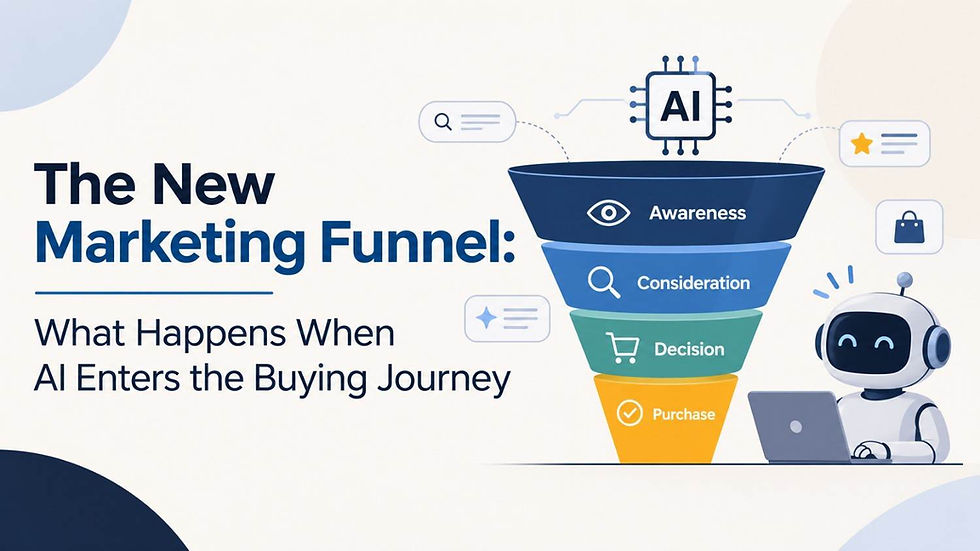
For two decades, the digital marketing funnel ran on a predictable architecture: a consumer typed a query into a search engine, clicked through a list of blue links, compared offerings across retailer and brand websites, and converted on a product page or in an app. Google’s search results page, Amazon’s product listings, and retailer-owned websites were the primary “shelves” on which discovery and purchase decisions were made. Marketing organizations built entire disciplines search engine optimization, pay-per-click bidding, conversion rate optimization around winning visibility and clicks within that architecture.
Beginning in 2024 and accelerating through 2025, generative AI tools began inserting themselves directly into this journey, rather than merely answering informational queries. Google rolled out AI Overviews inside its core search results. Amazon deployed a native AI shopping assistant, Rufus, inside its own app and website. OpenAI moved ChatGPT beyond conversation into transacting, launching an Instant Checkout capability built on an open payments protocol co-developed with Stripe. Each of these moves was disclosed through official company channels earnings calls, press releases, or product announcements rather than leaked or speculative reporting, and together they mark a structural shift in where discovery, evaluation, and purchase now occur.
Independent research organizations have documented the scale of this shift. McKinsey’s AI Discovery Survey, fielded in August 2025 on a representative panel of 1,927 U.S. consumers, found that 44% of AI search users now consider AI search their primary and preferred source of purchase-related insight ahead of traditional search (31%), retailer or brand websites (9%), and review sites (6%). More than 70% of AI search users use the tool for top-of-funnel category and product questions, though McKinsey noted usage extends across the full decision journey. Adoption, per the same survey, spans all age groups, including a majority of baby boomers already using AI-based search.
On the supply side, Adobe Analytics which tracks transactions across trillions of website visits for its holiday shopping reports found that during the November 1 to December 31, 2025 shopping season, traffic to U.S. retail websites originating from generative AI tools rose 693.4% year over year, and rose 670% specifically on Cyber Monday. Adobe was explicit in its own release that this is growth from a modest base of users, not a claim that AI-referred traffic has overtaken other channels. Total U.S. online holiday spend for that period reached $257.8 billion, up 6.8% year over year and a record for the category, with mobile transactions accounting for 56.4% of the total.
Brand Situation Prior to the Shift
Before generative AI entered the funnel, brands and retailers competed for visibility primarily through two levers: organic search ranking (SEO) and paid search placement. A website’s position on a Google results page, or a product’s position in Amazon’s search results, functioned as the dominant proxy for discoverability. Marketing budgets, content strategies, and keyword investments were built around optimizing for these ranking systems, which were largely transparent in their mechanics (backlinks, relevance signals, bid auctions) even if imperfectly understood.
This system began to show strain as AI-generated answers started displacing the click-through model itself. Research firm Similarweb, in data shared with and reported by Press Gazette in July 2025, examined the 100 largest global news and media websites and found that when a Google AI Overview appeared for a given search term, the “zero-click” rate searches that end without the user clicking through to any website was consistently higher than each site’s overall zero-click rate. Mail Online’s zero-click rate was 68.8% for AI Overview-triggered searches in May 2025, versus 54.9% overall; People.com’s was 71.2% versus 65.6% overall. Across Similarweb’s full dataset of global news publishers, organic traffic fell from a peak of over 2.3 billion visits to under 1.7 billion. This pattern being “answered” by an AI system rather than “visited” by a user represented a direct threat to the traffic-dependent business model that SEO-driven brand marketing had relied on.
At the same time, McKinsey’s analysis found that a brand’s own website makes up only 5 to 10% of the sources that AI search systems draw on when constructing an answer about that brand’s category; the remainder comes from affiliate sites, independent publishers, and user-generated content such as reviews and forum posts. In categories such as CPG and financial services, more than 65% of AI search sources were third-party publishers, affiliates, or user-generated content rather than brand- or retailer-owned properties. McKinsey’s September 2025 survey of roughly 30 Fortune 500 consumer brand CMOs found that only 16% of brands were systematically tracking their performance inside AI search results at all indicating that marketing measurement infrastructure had not yet caught up to where consumer attention was moving.
Strategic Objective
For the platform companies at the center of this shift, the objective was not incremental it was to own a new layer of the funnel before competitors did. Amazon’s goal, as described by CEO Andy Jassy on the company’s Q3 2025 earnings call (October 30, 2025), was to embed an AI assistant directly into the shopping experience that could answer product questions, compare options, and nudge purchase intent without the customer leaving Amazon’s own environment defending Amazon’s position as the default destination for product search against the rise of conversational alternatives.
Google’s objective with AI Overviews was to keep users within Google’s own ecosystem by answering queries directly on the results page, even as doing so measurably reduced the click-through volume that had historically flowed to third-party websites, including the news and e-commerce content Google itself indexes.
OpenAI’s objective, by contrast, was expansion rather than defense: to convert ChatGPT from a conversational research tool into a transactional commerce surface, competing directly with Google’s and Amazon’s existing discovery dominance by capturing the final “buy” step itself, not just the research step preceding it.
Campaign Architecture & Execution
Amazon’s Rufus, which launched in beta in February 2024 according to Amazon’s own newsroom, was built on Amazon’s full product catalog, customer reviews, community question-and-answer content, and external web information, per Amazon’s official description. It launched first in the U.S. and was subsequently expanded to the UK, India, France, Germany, Italy, Spain, and Canada. In late October 2025, Amazon added a “Help Me Decide” feature to extend Rufus’s role further into the comparison and decision stage of the funnel, rather than limiting it to basic product Q&A.
On the Q3 2025 earnings call, Jassy disclosed several operating metrics directly: approximately 250 million shoppers used Rufus over the course of 2025; Rufus’s monthly active users rose 140% year over year; interactions with the assistant rose 210% year over year; and customers who engaged with Rufus were 60% more likely to complete a purchase than those who did not engage with it. Jassy also stated that Amazon expects Rufus to generate over $10 billion in annual incremental sales for the company a figure Amazon derives from an internal “downstream impact” model that uses a seven-day rolling attribution window to credit purchases that follow a Rufus interaction. Amazon’s own earnings call is the primary source for these figures; no independent third party has audited the attribution methodology.
OpenAI’s architecture took a different form. On September 29, 2025, OpenAI launched Instant Checkout inside ChatGPT for U.S. users, built on the Agentic Commerce Protocol, an open-source payments standard co-developed with Stripe. The protocol creates an encrypted token for a user’s payment details and supports conventional API calls, allowing it to be adopted across different AI platforms and payment processors, though OpenAI noted it is easier to integrate for merchants already using Stripe. At launch, Etsy sellers were immediately live on the feature, and OpenAI stated that Shopify’s more than one million merchants including named brands such as Glossier, Skims, Spanx, and Vuori would follow. OpenAI explicitly stated in its announcement that “product results are organic and unsponsored, ranked purely on relevance to the user,” and that merchant selection depends on factors including availability, price, quality, and whether a merchant is the primary seller a deliberate design choice to separate ranking from advertising revenue, at least in the feature’s initial form. OpenAI’s monetization instead comes from a small transaction fee charged to the merchant per purchase.
OpenAI extended this architecture further on December 8, 2025, with a partnership with Instacart, described in OpenAI’s own announcement as the first app to offer full checkout from cart-building through payment inside ChatGPT. A user asking ChatGPT for help with a recipe or meal plan can be surfaced the Instacart app, connect an existing Instacart account, have ChatGPT assemble a cart from local retailers, and complete payment without leaving the chat interface; Instacart then fulfills the order through its existing delivery network. Instacart’s CTO, Anirban Kundu, and OpenAI’s VP and Head of ChatGPT, Nick Turley, both issued statements confirming the mechanics of the integration in the official release.
Positioning & Consumer Insight
The consumer insight underlying all three companies’ moves is the same: a meaningful share of buyers now prefer to ask a question and receive a synthesized answer rather than browse a list of links and evaluate options themselves. McKinsey’s finding that AI search has overtaken retailer and brand websites, and nearly overtaken review sites, as a trusted source of purchase insight even though it still trails traditional search as the single most-used channel signals that the “research” phase of the funnel is migrating to conversational interfaces across categories as varied as consumer electronics, travel, grocery, wellness, apparel, beauty, and financial services, where McKinsey found adoption in the 40–55% range.
This shift reframes the competitive battleground for brands. Rather than optimizing primarily for keyword relevance and backlink authority (classical SEO), brands must now consider “generative engine optimization” ensuring their products and claims appear within the sources an AI system actually draws upon, which, per McKinsey’s analysis, are disproportionately third-party reviews, publisher content, and user-generated discussion rather than brand-owned pages. McKinsey’s analysis also found that the GEO (generative engine optimization) visibility of category-leading brands in sectors like credit cards, hotels, electronics, and apparel can trail their traditional SEO visibility by 20 to 50%, meaning being the top-ranked result in classic search no longer guarantees being the brand an AI assistant actually recommends.
For platforms, the positioning differs. Amazon is positioning Rufus as a retention and conversion tool within an already-dominant marketplace using AI to deepen engagement with existing high-intent shoppers rather than to attract net-new traffic. OpenAI is positioning Instant Checkout and its Instacart integration as a distribution and trust play: by publicly committing to unsponsored, relevance-ranked product results, OpenAI is attempting to position ChatGPT as a neutral shopping assistant in contrast to search engines and marketplaces whose results are shaped, in part, by advertising. Google, meanwhile, is positioned defensively its AI Overviews keep users inside Google’s own properties, a choice that, per Similarweb’s data as reported by Press Gazette, has measurably reduced referral traffic to the publisher and content ecosystem that has historically depended on Google search for distribution.
Media & Channel Strategy
Unlike a traditional advertising campaign, these initiatives were not executed through paid media buys but through product and platform distribution. Amazon distributed Rufus natively across its own app and mobile website, embedding it directly in the shopping flow rather than requiring a separate download or opt-in destination. Google distributed AI Overviews as a default, non-optional layer within existing search results pages, meaning adoption was instantaneous and universal among Google Search users rather than something marketed separately. OpenAI distributed Instant Checkout through ChatGPT’s existing user base which the company has stated, per Fortune’s September 2025 reporting on the announcement, is approximately 700 million weekly users globally and expanded its retail footprint through direct merchant partnerships (Etsy, Shopify, and later Instacart) rather than through advertising to end consumers.
This represents a broader shift in channel strategy for the funnel as a whole: the “channel” increasingly is the AI interface itself, not a page a brand or retailer controls. Visibility is earned through data structure, review volume and sentiment, and presence across the third-party content AI systems ingest not through a media plan a brand’s marketing team directly executes.
Business & Brand Outcomes
Amazon’s figures the 250 million Rufus shoppers in 2025, the 140% rise in monthly active users, the 210% rise in interactions, the 60% higher purchase likelihood among engaged users, and the projected $10 billion in annual incremental sales all come directly from Andy Jassy’s statements on Amazon’s Q3 2025 earnings call and are Amazon’s own internal measurements; they have not been independently audited, and the $10 billion figure in particular rests on an internal attribution model rather than a directly observed transaction count.
Adobe Analytics’ figures on AI-referred retail traffic (693.4% year-over-year growth over the 2025 holiday season, 670% on Cyber Monday) are drawn from Adobe’s own analytics tracking across the retail sites it measures, and Adobe’s release was explicit that this growth comes off a small base meaning AI-referred traffic remains a minority channel even after this increase, despite the scale of the percentage gain. Adobe did not disclose a corresponding conversion rate for AI-referred traffic specifically.
On the cost side of this shift, Similarweb’s data as reported by Press Gazette shows a real and measurable decline in referral traffic to publishers as a direct consequence of AI Overviews: a rise in average zero-click rates across the top 100 global news and media sites from 50.5% to 52.7% over one year, and declines in total organic visits to this publisher set from over 2.3 billion to under 1.7 billion. This is a documented outcome on the losing side of the funnel shift traffic and the advertising and subscription revenue historically tied to it has been directly affected, even as Google has stated publicly, per the same reporting, that it does not trigger AI Overviews for hard news queries and that it still sends billions of clicks to websites daily.
OpenAI’s Instant Checkout and Instacart integrations are too recent, relative to this case study’s writing, for independently reported revenue or adoption outcomes to exist in the public record; what is verifiable is the architecture, partner list, and stated design principles at launch, not yet a performance outcome.
Strategic Implications
Three implications follow directly from the documented facts above, without extrapolation beyond them.
First, the funnel’s “research” stage is migrating from brand- and retailer-controlled properties to AI-mediated interfaces that draw disproportionately on third-party sources. McKinsey’s finding that brand-owned sites represent only 5 to 10% of what AI search systems cite means marketing organizations cannot rely solely on owned-channel content strategy; influence over reviews, publisher coverage, and user-generated content now carries outsized weight in whether an AI system surfaces a brand at all.
Second, measurement infrastructure within brands has lagged behind the shift in consumer behavior. McKinsey’s finding that only 16% of surveyed Fortune 500 CMOs systematically track AI search performance indicates a visibility gap at the marketing-leadership level brands may be losing or gaining share within AI-mediated discovery without the internal dashboards to detect it, a gap analogous to the early years of SEO before rank-tracking tools matured.
Third, the “buy” step of the funnel is becoming contestable in a way it was not before. For years, discovery and purchase were often split across different companies (a search engine for discovery, a retailer for purchase). OpenAI’s Instant Checkout and Instacart integration, and Amazon’s Rufus, both represent attempts to collapse discovery and purchase into a single, AI-mediated interaction controlled by one company. Whichever companies succeed in owning this combined discovery-to-purchase moment rather than just the discovery moment stand to capture a disproportionate share of both consumer attention and transaction revenue in the years ahead, a dynamic already visible in Amazon’s internal projection that Rufus alone could add $10 billion in annual incremental sales, even as that figure remains self-reported and model-dependent rather than independently confirmed.



Comments