upGrad’s B2C and Enterprise Learning Model
Industry and Competitive Context
India’s edtech and corporate upskilling sector sits at the intersection of two distinct but converging markets: direct-to-consumer online higher education, and enterprise learning and development (L&D). The consumer segment, dominated by platforms offering degree and certificate programs in technology, data science, and management, has matured considerably since 2020, with growth moderating from the pandemic-era surge as consumers became more selective about outcomes and return on tuition spend. Competitors in this space include global players such as Coursera and Udemy, and India-focused players such as Great Learning and Simplilearn.
A parallel but structurally different opportunity exists in enterprise workforce upskilling, where organizations procure training as a recurring operating expense rather than individuals self-funding career development. This market is characterized by longer sales cycles, relationship-based renewals, and demand that is comparatively less sensitive to consumer sentiment or discretionary spending cycles. Players competing for enterprise L&D budgets include Eruditus and its NexStream/Emeritus-adjacent offerings, alongside global corporate training providers. upGrad is one of the few Indian-origin edtech companies to have built scaled operations in both markets simultaneously, which is the specific subject of this case.
Brand Situation Prior to Enterprise Expansion
upGrad was founded in 2015 and is headquartered in Mumbai. Its co-founders are Ronnie Screwvala, previously the founder of the UTV Group, who serves as Chairman; Mayank Kumar, Co-founder and Managing Director, previously Vice President of Education at Bertelsmann; along with Ravijot Chugh and Phalgun Kompalli, both of whom came from The Parthenon Group. The company’s original proposition was built around direct-to-consumer online degree and certificate programs delivered in partnership with academic institutions, including IIIT Bangalore, BITS Pilani, MICA, IIT Madras, Duke Corporate Education, and Cambridge Judge Business School, across subject areas such as data science, machine learning, digital marketing, and management.
By August 2021, upGrad had raised a cumulative $185 million and achieved unicorn status. Over time, the company pursued a series of acquisitions aimed at building capability outside pure consumer education. In 2020 it acquired Rekrut India and The Gate Academy. In December 2021 it acquired Talentedge, a B2B edtech platform. In January 2022, it acquired Work Better, a Mumbai-based enterprise learning and development company founded in 2008 that specialized in sales training, leadership development, and soft-skills programs; that deal brought more than 300 corporate clients and over 250 trainers into the upGrad fold, with Work Better’s team folded into “upGrad For Business.” In July 2022, upGrad acquired Harappa Education for approximately Rs 300 crore in a combination of cash and stock; Harappa, co-founded by Pramath Raj Sinha and Shreyasi Singh, offered self-paced “thrive skills” programs in cognitive, social, and behavioral capability, and counted around 100 mid-sized and large organizations as active clients at the time of acquisition. In September 2022, upGrad acquired Centum Learning, a Delhi-headquartered corporate training provider founded in 2007 and previously affiliated with Bharti Enterprises, through a share-swap transaction; Centum brought more than 3,000 L&D specialists, a claimed training reach of over 2 million people, and delivery relationships with more than 400 corporates across India and Africa.
Through 2022 and 2023, these acquisitions operated with a degree of independence inside the broader upGrad group, each carrying its own client relationships and delivery teams, rather than functioning as a single, unified enterprise business line.
Strategic Objective
In April 2024, upGrad consolidated its various business-to-business efforts into a single unit named upGrad Enterprise, under CEO Srikanth Iyengar. The explicit strategic objective, as articulated by Iyengar in a December 2024 interview, was to grow the enterprise business from roughly 20 to 25 percent of upGrad’s total revenue at the time to approximately 40 percent within a couple of years, while sustaining year-on-year growth of at least 30 to 40 percent within the enterprise segment itself. This objective reflected a broader company-wide push toward profitability: Iyengar described the B2B skilling business as “profit accretive” and expected to carry a higher margin than the consumer business, even though the consumer segment remained larger in absolute scale.
The objective was therefore not simply revenue diversification, but a rebalancing of upGrad’s business mix toward a segment viewed internally as more predictable and margin-accretive, without abandoning its original consumer education franchise.
Business Model Architecture and Execution
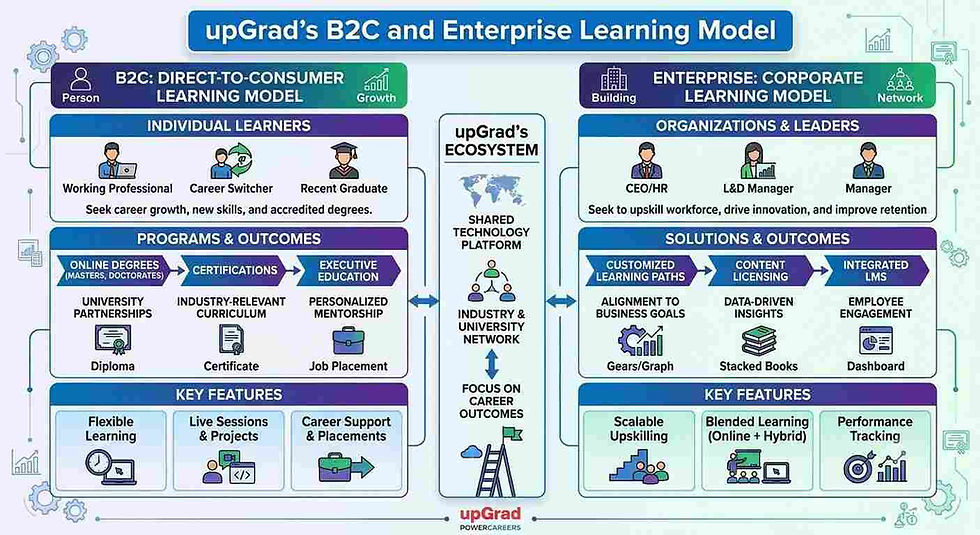
upGrad’s dual model operates as two commercially distinct motions under one corporate umbrella. The B2C arm continues to sell degree, diploma, and certificate programs directly to individual learners, generally working professionals or early-career job seekers, who enroll and pay for programs in subjects spanning management, data science, technology, and digital marketing, often in partnership with accredited universities and business schools.
The enterprise arm, upGrad Enterprise, sells workforce upskilling as a service to organizations rather than individuals. Its offerings, as described by its CEO, include corporate executive upskilling programs covering both technical and leadership topics, generative AI-centric modules aimed at both entry-level staff and mid-level managers, and delivery formats built around small-group activities, project-based learning, virtual labs, sandbox environments using synthetic data, localized case studies, capstone projects, and one-on-one mentorship. A notable execution detail is upGrad’s partnership with HCL Tech to co-create generative AI content and virtual lab environments for enterprise learners, an example of the company pairing in-house content development with a technology partner’s infrastructure capability.
The enterprise unit, as of the FY25 reporting period referenced by its CEO, had trained more than 350 clients, a client base described as including large Indian corporates with global operations, major Indian technology services firms, and a number of Fortune 500 companies. Client retention is a structurally important feature of the business architecture: 60 to 70 percent of enterprise revenue was reported to come from returning clients, which supports the “profit accretive” characterization of the segment, since repeat enterprise contracts typically carry lower incremental acquisition cost than new consumer enrollments.
Organizationally, upGrad employed roughly 4,000 people in total as of the CEO interview, with approximately 500 dedicated to the enterprise unit. The company reported hiring 54 people into the enterprise unit since its April 2024 formation, a quarter of them into leadership roles, alongside senior sales and marketing leadership additions, indicating that the consolidation of the B2B business was accompanied by deliberate organizational investment rather than being purely a reporting or structural change.
Positioning and Market Insight
The strategic insight underlying upGrad’s dual model, articulated explicitly by its enterprise CEO, is that B2C and B2B upskilling are complementary rather than competing lines of business, described in the interview as being “in some ways Yin and Yang.” The underlying logic is that consumer-facing education builds content depth, instructional design capability, and subject-matter credibility that can then be repackaged and sold into enterprise contexts, while enterprise relationships provide revenue that is comparatively insulated from individual consumer sentiment, since corporate training budgets are planned and renewed on predictable cycles tied to organizational workforce planning rather than discretionary personal spending.
This insight was reinforced by an external observer quoted in the same reporting, Anil Joshi, Managing Partner at Unicorn India Ventures, who characterized enterprise revenue in edtech as more predictable than consumer revenue because it is demand-driven at the organizational level. For upGrad specifically, positioning its enterprise offering around both “hard” technical and AI skills (its original consumer-education strength) and “soft” skills such as leadership and behavioral training (acquired through Harappa and Work Better) allowed the company to market itself to enterprise buyers as a single vendor capable of addressing a fuller spectrum of workforce capability needs, rather than requiring clients to procure technical and soft-skills training from separate vendors.
Geographically, the enterprise unit’s positioning extended beyond India: as of the CEO interview, roughly a quarter of enterprise business originated from outside India and three-quarters from within, with active expansion into the United States, United Kingdom, and Europe, and the Middle East, specifically Saudi Arabia, Abu Dhabi, and Dubai, identified as an emerging growth market. The stated internal target was for at least 40 percent of enterprise learners to be based outside India within two years, positioning upGrad Enterprise as a vehicle for the parent company’s broader internationalization rather than a purely domestic business line.
Go-to-Market and Channel Strategy
Publicly available information on upGrad’s specific media mix, advertising channel allocation, or digital marketing spend split between its B2C and Enterprise businesses is limited. What is verifiable is that upGrad’s FY24 consolidated marketing and advertising expenditure was Rs 340 crore, down from Rs 387 crore in FY23, though this figure is reported at the whole-company level and not broken out by B2C versus Enterprise segment. For the enterprise business specifically, the CEO interview noted that the company had onboarded senior sales and marketing leadership into the unit and was “selectively investing in branding and marketing” for Enterprise, with business development occurring substantially through direct sales, account-based relationship management with existing clients (consistent with the reported 60 to 70 percent repeat-client revenue share), and the credibility conferred by its roster of large corporate and Fortune 500 clients.
Business and Brand Outcomes
upGrad’s consolidated financial results for the fiscal year ended March 2024 showed total income of Rs 1,547 crore, up roughly 30 percent year-on-year from Rs 1,194 crore in FY23. Within this, the enterprise business was reported to have grown nearly 50 percent year-on-year in FY24, a faster rate than the company’s overall growth, though no absolute enterprise revenue figure in rupees was disclosed in the available reporting. The company’s net loss for FY24 was reported at Rs 560 crore, a significant reduction from a loss of Rs 1,142 crore in FY23, while its EBITDA loss, inclusive of one-time costs, narrowed to Rs 285 crore from Rs 558 crore the prior year. Cost lines also moved in the company’s favor during this period: marketing and advertising spend fell from Rs 387 crore to Rs 340 crore, and content delivery costs fell from Rs 240 crore to Rs 226 crore, even as product and technology spend rose from Rs 40 crore to Rs 77 crore, consistent with continued investment in platform and AI-related capability. upGrad was reported to be targeting a topline of approximately Rs 2,400 crore for the following fiscal year.
On the capital markets side, Temasek invested an additional $60 million into upGrad at a valuation of $2.25 billion, taking its stake to approximately 20.5 percent; the Screwvala family was reported to hold around 45 percent of the company. Cumulative capital raised since founding stood at $320 million as of the period covered by this reporting.
At the segment level, by the time of the December 2024 interview, the enterprise business represented 20 to 25 percent of upGrad’s total revenue, with an internally stated target of reaching approximately 40 percent within a couple of years.
Strategic Implications
upGrad’s trajectory illustrates a broader pattern applicable to subscription- and enrollment-based education businesses operating in markets where consumer demand is cyclical and acquisition costs are rising: diversification into an enterprise or B2B channel, built substantially through acquisition of specialist capability rather than purely organic development, can shift a company’s revenue mix toward a segment viewed as structurally more predictable and potentially higher-margin, without requiring the company to exit its original consumer franchise. The sequencing is instructive: upGrad first built scale and brand credibility in B2C higher education, then used acquisition to assemble enterprise-specific capability across technical skilling (Talentedge, Centum Learning) and behavioral or soft-skills training (Work Better, Harappa Education), and only later, in April 2024, consolidated these acquired assets into a single, named, centrally led business unit with its own CEO and go-to-market organization.
This raises a strategic question relevant to any multi-business-line company: whether a unified brand and consolidated management structure unlocks value that a looser federation of acquired businesses cannot, by enabling cross-selling of a fuller capability suite to large enterprise clients, clearer accountability for growth targets, and more coherent international expansion. upGrad’s stated ambition to shift nearly half of its revenue mix toward enterprise within a short window also signals a bet that corporate upskilling budgets, tied increasingly to generative AI adoption inside organizations, represent a durable, multi-year demand driver distinct from the individual consumer’s discretionary decision to pursue a degree or certification.
At the same time, the available public record does not yet include independently audited, segment-level financial statements isolating Enterprise profitability, nor third-party verification of client retention or satisfaction metrics beyond what the company’s own executives have disclosed. Any assessment of the long-term success of this dual-market strategy should therefore be treated as provisional pending further disclosure, particularly audited segment reporting that would allow comparison of unit economics between the B2C and Enterprise businesses on a like-for-like basis.
Discussion Questions
What are the structural differences between selling education to individual consumers and selling workforce upskilling to enterprises, and how do these differences explain why upGrad’s enterprise segment might carry a different margin profile than its consumer segment?
upGrad built its enterprise capability substantially through acquisition (Talentedge, Work Better, Harappa Education, Centum Learning) rather than organic development. What are the trade-offs of an acquisition-led versus organically built enterprise learning strategy, and what integration risks does an acquisition-heavy approach introduce?
Why might a company choose to operate acquired businesses with a degree of independence for several years (as upGrad did from 2022 to early 2024) before consolidating them into a single unified business unit? What organizational and go-to-market benefits might the April 2024 consolidation into “upGrad Enterprise” have been designed to capture?
Given that 60 to 70 percent of upGrad Enterprise’s revenue reportedly comes from returning clients, what does this imply about the appropriate allocation of resources between new client acquisition and account expansion within existing clients, and how might this influence sales organization design?
upGrad has set a public target of growing enterprise revenue from roughly 20 to 25 percent to approximately 40 percent of total company revenue within a couple of years. What risks does this kind of public, time-bound segment-mix target create for a company, particularly one that remains loss-making at the consolidated level, and what would need to be true operationally for this target to be achievable without compromising the B2C business?


Comments