Why Growth Marketing Is Replacing Traditional Marketing Approaches
Industry and Competitive Context
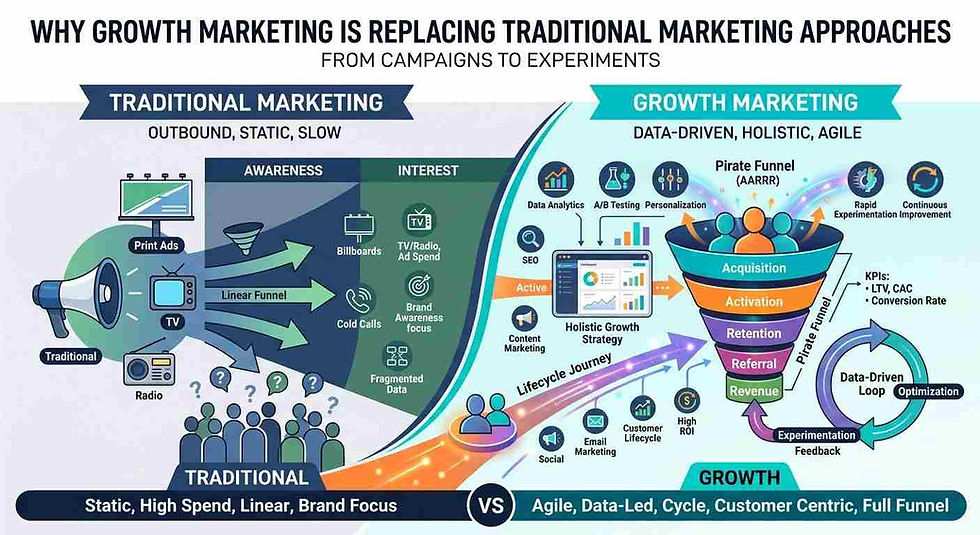
For most of the twentieth century, marketing organizations were built around a funnel of mass reach: television, print, outdoor, and trade promotion, planned in annual cycles and judged by awareness and brand tracking. The digital era changed the economics of that model. Advertising became measurable at the level of the click, the install, and the purchase, and the largest platforms built auction-based businesses on that measurability.
Recent survey evidence shows a function under budget pressure while being asked to deliver growth. Gartner's 2024 CMO Spend Survey, based on 395 CMOs and marketing leaders in North America and Northern and Western Europe, found that average marketing budgets had fallen to 7.7 percent of company revenue, down from 9.1 percent in 2023. Gartner noted that in the four years before the pandemic, budgets averaged 11 percent of revenue. Sixty-four percent of respondents said they lacked the budget to execute their 2024 strategy. The respondents were largely large enterprises, with the vast majority reporting median annual revenue above 5.3 billion dollars, so the findings should not be read as describing small businesses.
Within the shrinking envelope, Gartner reported that paid media accounted for 27.9 percent of 2024 budgets, and that digital took 57.1 percent of paid media spend, up from 54.9 percent in 2023. Marketing technology fell to 23.8 percent of budgets, the lowest level Gartner had recorded in a decade.
Two competitive forces sit behind these numbers. The first is cost scrutiny: when budgets tighten, spend that cannot be tied to an outcome becomes harder to defend. The second is customer expectation. McKinsey's 2021 Next in Personalization research reported that 71 percent of consumers expect companies to deliver personalized interactions, that 76 percent said personalized communications were a key factor in prompting them to consider a brand, and that 78 percent said such content made them more likely to repurchase. McKinsey also found that faster-growing companies drive 40 percent more of their revenue from personalization than slower-growing counterparts. This is a correlation reported by the consultancy, not proof that personalization alone causes faster growth.
Brand Situation Prior to the Shift
This case examines three organizations at different points in their relationship with traditional marketing. Their situations before each documented shift are described below.
Dropbox built its business on a freemium model. In its 2018 IPO filing, the company reported more than 500 million registered users, of whom more than 100 million had signed up since the beginning of 2017. It reported 11 million paying users and revenue of about 1.1 billion dollars for 2017. The filing states that the company generated over 90 percent of its revenue from self-serve channels, meaning users who purchase a subscription through the app rather than through a sales force.
Airbnb entered 2020 with a substantial paid marketing operation alongside its brand. Its 2020 IPO filing describes a marketing strategy that included brand marketing, communications, and performance marketing, and reports that direct and unpaid channels represented 77 percent of its traffic in 2019.
Meta, the parent of Facebook and Instagram, operated one of the largest performance advertising platforms in the world. Its model depended on advertisers' ability to target and measure ads, which in turn depended on user-level signals available through mobile operating systems.
Strategic Objective
The three organizations did not share a single stated objective, and the case does not impose one. What they have in common is a documented effort to reduce dependence on a particular kind of paid reach.
Dropbox's filing describes an objective of acquiring users efficiently and at relatively low cost, then increasing the conversion of registered users to paid plans. Airbnb's filing describes a decision to rely less on performance marketing and more on the strength of its brand and its direct and unpaid channels. Meta's objective in this episode was defensive: to continue delivering measurable advertising results after a platform change restricted the data it relied on.
Campaign Architecture and Execution
Dropbox's filing identifies the mechanics of its acquisition model. New users arrive through word-of-mouth referrals, direct in-product referrals, and the sharing of content, and those users often collaborate with people who are not yet registered, which draws new sign-ups into the network. Dropbox's referral program rewarded users with additional free storage for inviting others. The company's filing describes registered users as its best salespeople, which is a revealing choice of words: the customer base is treated as a distribution channel rather than as the endpoint of a campaign.
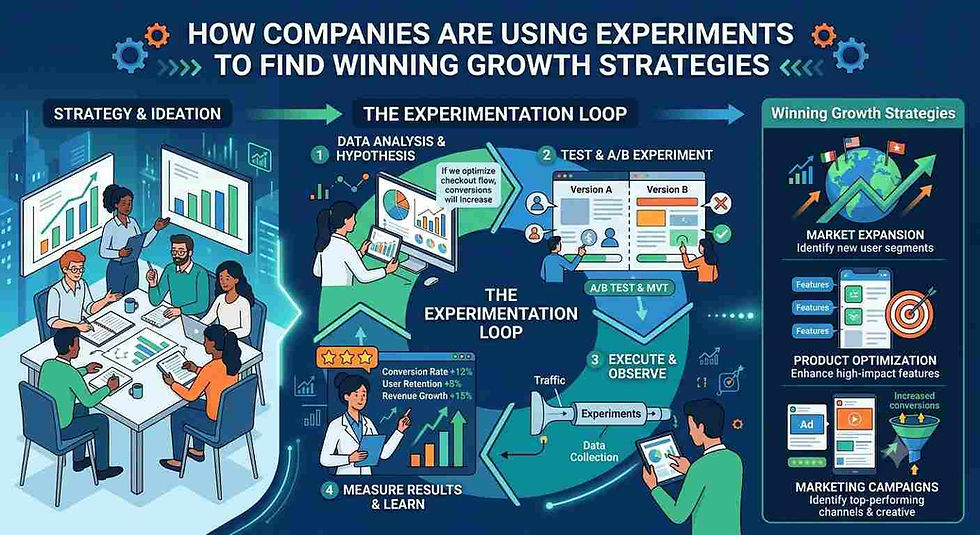
Conversion to paid plans is handled through a different set of tools. The filing lists in-product prompts and notifications, time-limited free trials of paid plans, email campaigns, and lifecycle communications, and states that the company analyzes usage patterns and runs hundreds of targeted marketing campaigns to encourage paying users to upgrade. The filing also states that aggregate user activity metrics have not been leading indicators of revenue or conversion, which signals that Dropbox treats measurement as an analytical problem rather than a reporting exercise. No verified public information is available on Dropbox's customer acquisition cost, lifetime value, or referral conversion rates.
Airbnb's execution is documented in its IPO filing and subsequent earnings commentary. In March 2020, the company paused its performance marketing spend and its investments in new sales and marketing initiatives. The filing states an expectation that any future increase in brand marketing spend relative to 2019 would be smaller than the reduction in performance marketing spend. It also describes a shift of internal resources toward strengthening the infrastructure behind unpaid channels.
Meta's execution was reactive. Apple introduced App Tracking Transparency with iOS 14.5 in April 2021, which requires apps to ask users for permission before tracking them across other apps and websites. In February 2022, Meta's chief financial officer told analysts that the overall impact of iOS changes was a headwind to its 2022 business on the order of 10 billion dollars. He characterized this as an estimate and said the company could not be precise. No verified public information is available on how Meta's advertisers adjusted their individual campaigns in response.
Positioning and Consumer Insight
Dropbox's positioning rests on an insight about trust and utility: a user who has stored files and shared folders with colleagues has a reason to stay and a reason to bring others in. Its filing frames the product itself as the primary marketing asset. The referral reward, additional storage, was a product benefit rather than a cash incentive or a discount, which kept the incentive aligned with the product's core value.
Airbnb's positioning insight is stated in its own filing: the strength of the Airbnb brand and its communications strategy allow it to be less reliant on performance marketing. In other words, the company argued that brand awareness was doing work that it had previously been paying search advertising to do. The company's chief executive later said on an earnings call that traffic returned to 95 percent of 2019 levels without any marketing spend, and that in the fourth quarter of 2020 more than 90 percent of traffic was direct or unpaid. No verified public information is available on the causal split between brand strength, pandemic-era shifts in competitor spending, and seasonal recovery in producing that result.
Meta's episode illustrates an insight about structural risk rather than about consumers. Performance marketing is only as durable as the data pipeline beneath it, and that pipeline is controlled in part by third-party platform owners.
Media and Channel Strategy
The verified channel evidence is thin and should be read with care. Gartner's figures show that digital accounted for a growing share of paid media in 2024 even as total marketing budgets shrank, which is consistent with marketers concentrating spend where results can be observed. They do not show that traditional media has been replaced; television, sponsorship, and event marketing continued to account for meaningful shares of budgets in the same survey.
Dropbox's channels are largely owned and earned: the product, in-product messaging, email, and user-to-user sharing. Airbnb's channels moved toward owned and earned traffic as well, but the company did not abandon paid media. Its filing describes brand marketing and communications as continuing investments, and its executives later described performance marketing as a lever it would continue to use more selectively. No verified public information is available on the precise allocation of Airbnb's marketing spend across channels after 2020.
Business and Brand Outcomes
This case examines three organizations at different points in their relationship with traditional marketing. Their situations before each documented shift are described below.
Dropbox built its business on a freemium model. In its 2018 IPO filing, the company reported more than 500 million registered users, of whom more than 100 million had signed up since the beginning of 2017. It reported 11 million paying users and revenue of about 1.1 billion dollars for 2017. The filing states that the company generated over 90 percent of its revenue from self-serve channels, meaning users who purchase a subscription through the app rather than through a sales force.
For Airbnb, the filing documents that direct and unpaid traffic rose from 77 percent of traffic in 2019 to approximately 91 percent in the first nine months of 2020, and that direct and unpaid traffic returned to 2019 levels by the third quarter of 2020. The company itself acknowledged the dramatically negative effect of the pandemic on global travel that year, so the outcome cannot be cleanly attributed to the marketing change.
For Meta, the 10 billion dollar figure is management's own estimate of a headwind, not a reported loss.
At the level of the thesis in the title, no verified public information is available on the share of global marketing spend, or of company revenue, that has shifted from traditional to growth-oriented approaches. The Gartner and McKinsey data point to pressure on budgets, rising digital share, and a revenue premium associated with personalization, but none of them states that growth marketing is replacing traditional marketing.
Strategic Implications
The title of this case is best treated as a hypothesis rather than a settled fact. The documented evidence supports a narrower and more defensible claim: when budgets are constrained and measurement is possible, firms with strong products and brands are shifting emphasis toward channels that they own, can measure, and can iterate on.
Three implications follow. First, the Dropbox filing shows what growth-oriented marketing looks like when it is built into the product: acquisition, activation, and conversion are designed features rather than separate campaigns. This approach depends on a product with intrinsic sharing behavior, which limits how widely it can be copied.
Second, the Airbnb case complicates the simple story. Airbnb's documented shift was away from performance marketing, the most measurable and most growth-associated channel, and toward brand marketing. A manager who equated growth marketing with paid digital optimization would read this case as a counterexample. A manager who equated it with building durable demand that reduces dependence on paid acquisition would read it as confirmation. The case therefore shows that the label matters less than the underlying question of where incremental spend creates incremental demand.
Third, the Meta episode shows the strategic risk in concentrating on any single measurable channel. Performance marketing's measurability rests on data access that the advertiser and even the platform may not control.
Taken together, the evidence suggests that the choice facing marketing leaders is not traditional versus growth marketing but how to allocate scarce budget between reach, conversion, and retention, with evidence standards that match the claims being made.
Discussion Questions
The documented evidence supports a shift in emphasis rather than a replacement of traditional marketing. What additional public evidence would you need to conclude that growth marketing is replacing traditional approaches, and what would count as disconfirming evidence?
Dropbox's referral reward was additional product storage rather than cash. Under what product and market conditions does a product-linked incentive outperform a monetary one, and what are the limits of generalizing from Dropbox?
Airbnb moved spend away from performance marketing toward brand marketing, which runs against the common association of growth marketing with paid digital channels. How should a manager decide whether a given channel is generating incremental demand or capturing demand that would have arrived anyway?
Meta described a significant revenue headwind from a change in a third-party platform's rules. How should a marketing organization diversify its acquisition channels without sacrificing the measurability that makes performance marketing attractive?
Gartner reports shrinking marketing budgets alongside rising expectations for growth, while McKinsey reports a revenue premium associated with personalization. Given that both are survey-based and correlational, how should a CFO and CMO jointly evaluate a proposal to move budget from brand advertising to lifecycle and personalization programs?


Comments