Aquaguard's Brand Evolution from Water Purifier to Health Protection Brand
Industry and Competitive Context
Eureka Forbes was founded in 1982. Public company profiles describe it as a joint venture between Forbes & Company and Electrolux that created the water filter-cum-purifier category in India with Aquaguard (Tradejini company profile; Wikipedia). Today it is a listed company. The Ken reports that it listed on the BSE in March 2022 after a demerger from Forbes & Company, then on the NSE in September 2024.
Eureka Forbes is primarily owned by Advent International, which acquired a controlling stake from the Shapoorji Pallonji Group in 2022. Reuters reported that the original agreement valued the deal at 44 billion rupees ($597 million).
On category structure, company management has said household adoption of water purifiers is only about 7 per cent. A UBS report covered by Business Today puts the water purifier market at Rs 5,400 crore by revenue, potentially reaching Rs 9,600 crore by FY30. UBS also described Aquaguard as a virtual synonym for water purifiers. That is a broker's view, not a company disclosure. Screener.in's company summary says Eureka Forbes holds over 40% share in water purifiers, but that figure is a secondary aggregation, and readers should verify it against the company's annual report.
The Ken describes the competitive risk differently. It reports that competitors made headway by focusing on after-sales service, a capability Eureka Forbes had largely lacked, and that Urban Company moved quickly into the space.
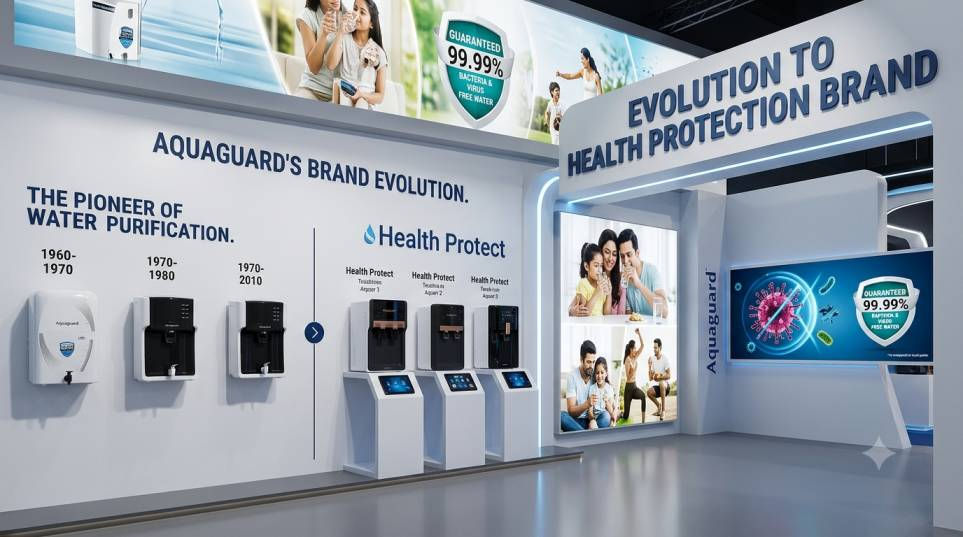
Brand Situation Prior to the Health Repositioning
Aquaguard's early advertising was built on function. An afaqs analysis described it as consistently focused on the functional benefits of purification, using a problem-solution-happiness format built around the Eureka Forbes salesman's knock on the door. The report is undated in the retrieved material. It shows that the direct-selling model and the purification claim were structurally tied together.
Health-adjacent claims appeared well before 2017. A 2009 launch campaign for Aquaguard Total used a mother's protective attitude toward her child to convey protection from known and unknown impurities, with trust described as the core of the brand. In June 2012, a commercial released before the monsoon reinforced the "Paani ka doctor" positioning, with the film linking Aquaguard to protection against typhoid, gastroenteritis and jaundice. Campaign India's report on the 2012 work attributes to the agency a visual device, a blue cross, as a symbol of trust, protection and expert advice.
In July 2013 the brand extended from protection to nutrition. The "Sehat ki awaaz" campaign was framed by company leadership as educating consumers about minerals essential to health, and as a move from purity to nutrition, with the brand describing itself as the healthiest water on earth.
Strategic Objective
Eureka Forbes did not publish a single master objective for this evolution, and no verified public document states one. What exists are campaign-level stated aims:
2017 ("Farak Dikhta Hai"). The company stated that the campaign aimed to create awareness of the patented "Biotron" technology and the clear differentiation it makes to consumers' lives. The press release justified the move by observing that consumers had become more health conscious and were seeking innovative solutions for good health and wellbeing.
2018 ("Har Water Purifier Aquaguard Nahi Hota"). The aim was to highlight the differentiation created by innovative technologies and to strengthen brand preference.
2020 (corporate identity). Company leadership said the focus was the health of consumers, with a commitment to filling a need gap in their lives.
2026 (genuine filters). The company's Chief Growth Officer said the campaign aimed to raise awareness of choosing genuine Aquaguard Nanopore Long-Life Filters designed for reliable purification and long-term protection.
Campaign Architecture and Execution
Phase 1: technology-led health differentiation (2017–2018). In 2017, Eureka Forbes launched "Farak Dikhta Hai" for Aquaguard. Madhuri Dixit appeared in the commercial discussing the impact of the new technology on the human body and the need to drink healthy water. The campaign was created by Triton Communications and launched across all media channels and platforms. Her accompanying statement, issued by the company, described her as a custodian of her family's health and wellbeing. The press release also introduced the parent as India's leading health and hygiene company while still centering on the Aquaguard brand.
In September 2018, "Har Water Purifier Aquaguard Nahi Hota" followed, this time from Taproot Dentsu. The film dramatized a generation-gap conversation between Madhuri Dixit and her grandmother, both agreeing that copper-infused water is good for the body. The company said the campaign aimed to create awareness of the benefits of "active copper ionic infusion." A later Active Copper + Zinc Booster campaign, undated in the retrieved coverage, promoted a cartridge that infuses copper and zinc ions to deliver "enriched healthy water," not just pure water.
Phase 2: corporate repositioning (December 2020). Eureka Forbes unveiled a new identity, including the "Posibol" mark. The company said it would operate two consumer-facing brands, Aquaguard and Forbes. Cleaning, air, health conditioner and security brands would sit under Forbes, and the rest would be clubbed under Aquaguard. A subsequent visual identity refresh was designed by Bombay Design Centre. Company executives said it was meant to communicate the technological advancements the products bring to modern consumers.
Phase 3: awareness, education and content-led communication. Several initiatives support the health thread:
Water test kits. In an undated campaign, Eureka Forbes distributed free DIY kits through its salespeople. Per afaqs, the campaign was activated across 18 cities where the brand's water labs are present. It drew on a company-GfK survey titled "Kya Aapka Paani Beemar Hai," which found water contamination to be the biggest issue for more than 70 per cent of Indian households.
Jal Daan. WARC lists this Triton Communications campaign, which urged homes with purifiers to pledge to share healthy water with less privileged people who visit daily, such as domestic help.
Mothers and cloth. WARC lists a shortlisted case in which Aquaguard targeted mothers and called out the cloth-filtering practice as a source of disease, using TVC, print, out-of-home and digital banners in Hindi and regional languages. The retrieved listing gives no year.
TVF "Gram Chikitsalay." Mediainfoline reports that Aquaguard extended its TVF partnership with two films in the Gram Chikitsalay universe. The first asks whether the water we consume is safe, and the second addresses what follows the purchase. The retrieved coverage does not state the date.
"Stop. Check. Relax." (June 2026). The campaign was launched on June 16, 2026, for Aquaguard Nanopore Long-Life Filters, and the company offers a Free Filter Check service.
Positioning and Consumer Insight
Insights that companies or case-listing bodies have stated publicly are limited to the following:
Eureka Forbes said in 2017 that consumers were more health conscious than before.
WARC's summary states that the mother-focused campaign rested on the insight that a mother's deepest self-reflection occurs when her child's health is on the line.
The company's GfK survey positioned contamination as a mass-market concern, as above.
The documented record shows four successive proposition layers. Trust and maternal protection (2009) gave way to expert authority ("Paani ka doctor," 2012) and then to nutrition (2013). Next came technology-linked health benefits, including copper, zinc and Biotron (2017–2018), and then protection maintained through servicing and genuine filters (2026). Each layer keeps health as the anchor and changes the reason to believe. The 2026 work is the clearest step toward a protection-as-ongoing-condition idea, because it shifts the claim from "this water is purified" to "your protection stays intact only if you maintain it with genuine parts."
The 2020 architecture decision is also analytically notable. Folding the non-water brands into Aquaguard and Forbes, the two consumer brands, narrowed the company to two brand identities, with Aquaguard carrying the health proposition for water and related categories.
Media and Channel Strategy
Verified media information is thin. Documented facts are:
The 2017 and 2018 campaigns were described as running across all media channels and platforms.
The mothers-and-cloth campaign used TVC, print, out-of-home and digital banners in Hindi and regional languages (WARC).
Jal Daan is listed by WARC under online display, online video, social and websites/microsites.
The 2013 "Sehat ki awaaz" campaign ran on television and print.
The 2026 "Stop. Check. Relax." campaign was rolled out across digital platforms, according to trade coverage of the launch.
The Eurochamp sales force distributed the test kits in the cities with water labs (afaqs).
Overall advertising and sales promotion spend was reported at INR 293.7 crore, or 10.8% of revenue, in FY26. That figure comes from a financial-media summary of the company's results, so confirm it against the primary filing before citing it. It is a corporate total and cannot be attributed to Aquaguard campaigns or to any single channel.
Business and Brand Outcomes
Corporate results. FY26 revenue rose 11.3% to INR 2,710.5 crore, the second consecutive year of double-digit growth. PTI reports that consolidated net profit for FY26 was Rs 162.62 crore, against Rs 164.41 crore the year before. In the most recent quarter, per the company's NSE investor presentation, Q1 FY27 revenue was Rs 700.8 crore against Rs 607.7 crore a year earlier, growth of 15.3%. Electric water purifiers accounted for 42.8 per cent of FY26 revenue. The company has also set a target of Rs 5,400–5,600 crore of revenue by FY30.
Product and service direction. Two water purifiers, Aquaguard Sure Hydra and Aspire Halo, were launched in Q4 FY26, and management cited a key opportunity in aftermarket filters for the large installed base of Aquaguard users not on annual maintenance contracts. The filters campaign sits within that commercial context.
Campaign-level outcomes. WARC's summary of the mothers-and-cloth case states that the under-penetrated category grew and Aquaguard sales and market share increased substantially. No figures or year appear in the retrieved text.
Strategic Implications
All points below are interpretation based on the documented record.
Health is a durable brand territory that can be re-grounded. Aquaguard has used the same emotional axis, family health, since at least 2009, and has changed the claimed mechanism several times. For incumbents in categories where the core function has become hard to differentiate, changing the reason to believe, while keeping the emotional territory, is a lower-risk path than changing the territory.
Technology claims need a health translation. The 2017–2018 work used a patented technology and a mineral-infusion story, and did not lead with technical specifications. Both were presented as health benefits (the Biotron announcement, and copper and zinc described as good for the body).
Corporate and product positioning can diverge in function. The 2020 architecture gave the parent a broad health-and-hygiene identity and left Aquaguard to carry the water-specific health meaning. That separation avoids overloading one brand but depends on each brand's promise staying coherent, and the retrieved sources do not show how consumers received it.
Protection claims eventually become service claims. In 2026 the message centers on genuine filters and servicing, which the company's own results presentations connect to a recurring revenue opportunity. This closes the gap The Ken identified in its reporting on service competition, though The Ken does not link the campaign to that gap. Brands that promise health must manage the consumer's maintenance behavior as well as the first sale.
Evidence limits matter for managers. The public record shows what the brand said and did. It does not show how much any of it moved consumer behavior. Managers evaluating this case should treat the causal question as open.
Discussion Questions
The documented propositions run from trust and protection (2009) through expert authority (2012) and nutrition (2013) to technology-linked health benefits (2017–2018). Which transitions strengthened the brand's differentiation and which risked diluting it, given that no verified results are published?
In 2020 Eureka Forbes folded its non-water brands into two consumer brands. What are the trade-offs for Aquaguard's health positioning of carrying water plus other categories, compared with a stand-alone water brand?
The 2026 "Stop. Check. Relax." campaign aligns consumer-protection messaging with an aftermarket revenue opportunity. How should a brand weigh the credibility risks of that alignment, and what disclosures would strengthen trust?
The evidence for outcomes is limited to corporate growth and one unquantified WARC summary. What data would you need to evaluate the return on the health-positioning strategy, and which of it could realistically be obtained from public sources?
Aquaguard describes itself as a category leader in an under-penetrated market (about 7% household adoption, per company commentary). Should a leader's messaging prioritize growing the category or defending share, and what does the documented campaign mix suggest the brand has done?

Comments