Milton's Everyday Utility Brand Strategy in Household Products
Industry & Competitive Context
Milton is sold by Hamilton Housewares Pvt. Ltd. (HHPL), a private company. CRISIL Ratings' rationales describe HHPL as a dominant player in India's domestic houseware industry. It sells plasticware, thermoware, thermosteel and melamine under the Milton brand, glassware under Treo, and cleaning articles under SpotZero.
CRISIL describes the sector as one with many small and medium enterprises because of low entry barriers. HHPL faces competition from international, national and regional players. In its June 2024 rationale, CRISIL says cheap imports and unorganised players created pricing pressure. It also says that being a premium player with strong brand recall protects HHPL "to some extent" from low-quality products.
The same rationale explains why household products are hard to differentiate. HHPL's key raw materials are steel and polymer, and polymer prices are linked to crude oil and domestic demand and supply. CRISIL states that competition limits HHPL's ability to pass raw-material increases on to customers.
The strategic problem is a category where products look alike, entry is easy and input costs are volatile. Brand, distribution and a steady flow of product improvements are among the few durable sources of advantage. CRISIL names "strong brand equity," a "wide product basket," a "well-spread distribution network" and "an aggressive marketing strategy" as the factors that have kept HHPL's market share strong.
Brand Situation Prior to the Campaigns Analysed
Milton is not a single-campaign case. It is a long-running brand with a succession of product-led campaigns, so this section describes the brand's documented position instead of a pre-launch baseline.
HHPL's own communications say Milton has been present in Indian households for decades. In October 2022, Managing Director Ajay Vaghani referred to "the past 50 years." Legal-entity history is described differently elsewhere. CRISIL states that the company was set up as a proprietorship named DG Glass in 2000 and reconstituted as a private limited company in 2003. These accounts are not reconciled in the sources reviewed.
CRISIL's July 2022 rationale places the company at a transition point. It cited entry into kitchenware and appliances, and the return of demand for water bottles and tiffins after schools and colleges reopened, as drivers of expected growth. The rating at that time was AA-/Positive.
Price positioning is documented. CRISIL says HHPL is largely present in the medium and lower price segments, with price points from ₹90 to ₹3,500. This is an everyday-utility position, not a luxury one.
Strategic Objective
Milton has not published a formal statement of campaign objectives, KPIs or targets in the sources reviewed.
What is documented is the stated intent in executive statements and the commercial rationale in CRISIL's reports.
Stated intent. In a 2022 exchange4media report, Vaghani said Milton keeps consumers "at the heart of everything we do." He said the films aim to show Milton providing convenient daily solutions by blending design with technology.
Commercial rationale. CRISIL's June 2024 rationale says HHPL plans to increase its market share in the drinkware category. It also says the company has regularly introduced new products and created "innovative sales strategies." It describes the move into household cleaning as part of that strategy.
Read together, the objective that can be supported from public record is sustained relevance in everyday-use categories through product innovation, backed by sustained marketing. This is an interpretation of the documented statements, not a published company objective.
Campaign Architecture & Execution
The public record shows an architecture built on a recurring brand philosophy carried by product-specific films.
The unifying line. The philosophy "Kuch Naya Sochte Hai" (roughly, "we think of something new") appears in a 2022 exchange4media report on a series of TV commercials. The report says the films showed the evolution of Milton products against changing consumer needs, from the thermosteel flask to the app-enabled Smart Range, with a focus on storing and preserving freshness. A separate exchange4media report on a kids' sipper bottle film describes it as carrying forward the "Kuch Naya Sochte Hain" message.
Product-specific executions. Each documented film pairs one product with one everyday problem.
Thermosteel bottle, travel (2018). exchange4media reports that Ogilvy India conceptualised the "Kahaan Ka Piya?" film, which positions the bottle as a travel essential for young explorers. The film follows a solo traveller across hot desert and snow-covered terrain. According to the report, it ran on Hindi, English, Marathi, Bengali, Malayalam, Tamil, Kannada and Telugu channels from August 12, 2018.
Hands-free sipper bottle for children. exchange4media reports that the Ogilvy-conceived film addressed parents' concern that children's hands spread germs onto bottles during play. Vaghani framed it as an innovation that makes customers' lives "effortless and convenient."
Microwow tiffin (October 2018). Adgully's archive lists a release in which Milton, in the release's own words, "solves India's 'Rozi' 'Roti' problem" with a TVC for the Microwow tiffin. The release describes the product as the world's first of its kind. Only the headline text was available, so this claim is the company's and is not independently verified.
Leak Lock bottles and tiffins (June 2022). Adgully lists a "Back to School" advertising effort for these products.
Brand-level recognition. The company states that Milton won "Brand of the Year" at the World Branding Awards in 2019, 2020-21 and 2021-22. Section 7 covers the award.
Portfolio architecture. The official Hamilton Housewares LinkedIn page lists Milton, Milton ProCook, Treo, SpotZero and Claro as brands under the Hamilton name. CRISIL's rationales show Milton, Treo and SpotZero as the commercially prominent lines. The brand strategy is therefore a house with separate brand names by category (houseware, glassware, cleaning), not one name stretched across everything.
Positioning & Consumer Insight
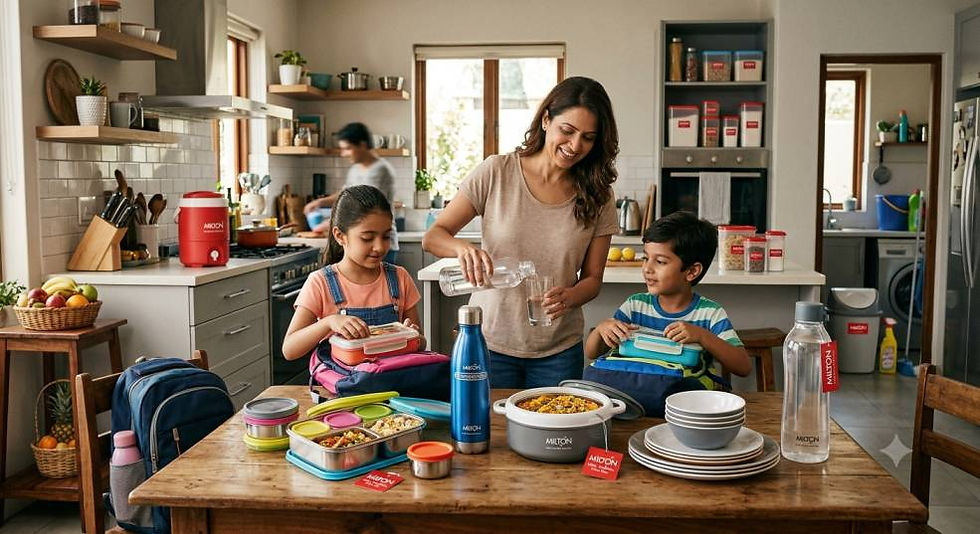
The documented films share a pattern. Each starts from a specific daily friction and positions the product as its solution:
a lunch that goes cold (the thermosteel flask and tiffin)
a lunch that cannot be reheated at the office (the Microwow tiffin)
a spill in a school bag (Leak Lock)
a child's hands touching a bottle (the hands-free sipper)
Vaghani said in a company statement, reported by Social Samosa in January 2020, that one campaign highlighted the culture of lunch breaks and the dilemma of every office-goer. That is a company-stated insight about a single campaign.
The strategic reading is that Milton positions on functional reassurance within routine moments, not on aspiration. This fits the price tiers CRISIL documents. A consumer buying a ₹90 to ₹3,500 product is buying a repeated-use object, so the case for choosing it rests on dependable performance and visible improvements. The "Kuch Naya Sochte Hain" line gives that evidence a single frame, which suggests innovation is meant to be the brand's main differentiator in a commoditised category. This is interpretation.
Media & Channel Strategy
Verified media. The documented media mix is national and regional television, and brand social channels. The 2018 "Kahaan Ka Piya?" film ran in eight languages across regional TV feeds. The 2022 films ran on national TV channels and were also promoted on Milton's YouTube, Facebook and Instagram pages, per exchange4media. The 2019 World Branding Awards press release describes Milton's campaigns as including ad campaigns, digital activations, PR and collaborations with influencers and platforms. exchange4media's article listing also carries headlines on an outdoor campaign executed by Posterscope and a WebAR campaign for thermosteel bottles with Vserv.
Distribution. The official LinkedIn page cites a network of 55,000 retailers. CRISIL's reports describe a "well-spread distribution network" and say HHPL has ventured into e-commerce portals. The June 2026 rationale says revenue through these portals has been growing in healthy double digits.
Manufacturing. CRISIL lists production units at Silvassa, Guwahati, Sricity and Haridwar. It says in-house manufacturing capacity helps HHPL serve demand better than peers.
Business & Brand Outcomes
Brand recognition. The company's press releases report that Milton won "Brand of the Year" in the houseware product category at the World Branding Awards in 2019, 2020-21 and 2021-22. The 2019 ceremony was reported as held at Kensington Palace, London. For the 2021-22 edition, a Business Standard-carried release says Milton won in the Regional tier and was the only Indian brand in that category.
The award's scoring should be stated carefully. The World Branding Forum's chairman said consumer votes make up 70 percent of the final score. Other coverage says winners are judged on three streams: brand valuation, consumer market research and public online voting. The award shows recall among voters in an organised programme. It is not a market-share measure.
Financial outcomes. All figures below are for HHPL as a whole, not for the Milton brand alone, and they are CRISIL's figures. The FY2024 and FY2026 numbers were provisional when reported.
Fiscal year | Operating income (₹ crore) | Profit after tax (₹ crore) |
FY2023 | 2,368 | 214 |
FY2024 (provisional) | 2,314 | 224 |
FY2025 | 2,529 | 219 |
FY2026 (provisional) | 2,865 | 264 |
CRISIL explains that FY2024 revenue was flat because of pricing pressure from aggressive competitor pricing, subdued discretionary spending, and input price deflation in plasticware. For FY2026 it reports revenue growth of over 13%. It attributes this to healthy demand across key categories and a newly commercialised product. It reports EBITDA margin rising to 16.0% from 14.2% in FY2025 on softer raw-material prices and operational efficiencies.
CRISIL's June 2026 rationale also reports net worth of ₹1,971 crore, debt of ₹164 crore and a reaffirmed AA/Stable rating. It notes that HHPL acquired a controlling stake in Hamilton Writing Instruments Pvt. Ltd. in the last quarter of FY2026.
Strategic Implications
Brand building in a low-differentiation category. The documented approach pairs distribution reach with a recurring innovation message. CRISIL's repeated rating of the position as strong, in a category it describes as price-pressured, is consistent with this. The sources do not prove that the advertising caused the resilience, since distribution and manufacturing are also cited.
Product claims as brand content. Milton's films use functional features (leak-proofing, hands-free drinking, microwave-use) as the creative core. This ties marketing spend to products that exist, but each claim must be validated by product performance. If a feature fails, the message is exposed.
Margin and brand discipline. FY2024 shows that a strong brand did not stop revenue stagnating under price competition. CRISIL's forward view for FY2027 expects "calibrated price hikes" to offset inflation from the West Asia conflict. Whether Milton's brand equity supports pricing power is the live test. The sources do not report volume response to those price increases.
Portfolio expansion. Entry into glassware, cleaning, kitchenware and writing instruments, through separate brand names, tests how far a utility reputation can travel. CRISIL's June 2026 rationale notes that HHPL has fully commercialised its opalware segment. The sources do not report brand-level results for these extensions.
Evidence limits. Public data cover revenue and recognition but not brand-health or campaign-effectiveness measures. Any claim of marketing ROI for Milton would go beyond the record.
Discussion Questions
In a category CRISIL describes as having low entry barriers and heavy price competition, what makes "innovation" a more defensible brand platform than price? What evidence would you need to test that claim?
Milton's documented films each start from a single daily problem. What are the benefits and risks of building a brand through a series of product-specific solutions instead of one emotional brand idea?
HHPL's FY2024 revenue was flat despite strong brand recall, while FY2026 growth exceeded 13%. Using only the documented drivers, how would you separate brand effects from distribution, capacity and pricing effects? What data would be missing?
Hamilton uses distinct brand names (Milton, Treo, SpotZero) by category. Under what conditions does a multi-brand house outperform extending a strong master brand? What does the public record not tell you?
The World Branding Awards weight consumer voting heavily. How should a marketing leader treat such an award alongside sales, share and brand-health metrics when judging strategy?

Comments