TradeIndia's RFQ Mechanism as a Lead-Generation Lever
Industry & Competitive Context
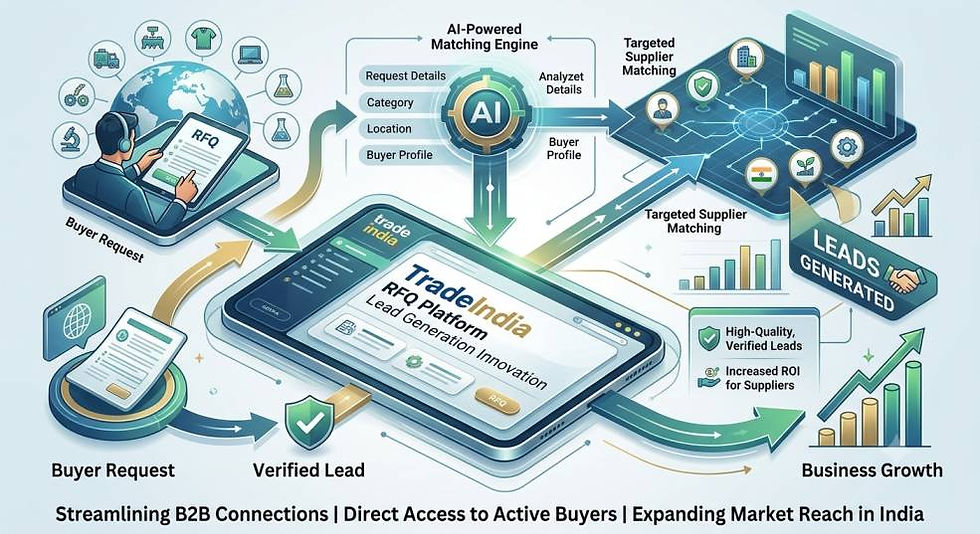
A request for quotation (RFQ) is a standard procurement tool in which a buyer sends specifications, quantities and terms to suppliers and invites price and delivery responses. It is a formal request that asks suppliers or vendors for pricing and other details on specific products or services. TradeIndia did not create this construct.
In India's online B2B marketplace category, the two names most often paired are TradeIndia and IndiaMART. TradeIndia is operated by Infocom Network Limited, which is headquartered in New Delhi and was founded in 1996. IndiaMART is the listed peer, so its disclosures are the only audited-style public benchmark in the category. For Q4 FY2025 it reported 27 million unique business enquiries (up 10% year on year), 8.4 million supplier storefronts, and 217,000 paying suppliers at quarter-end. For Q4 FY2026 it reported 27 million unique business enquiries and 220,000 paying suppliers.
The category's competitive logic, visible in these disclosures, is that lead volume is the product. Suppliers are the paying side, and enquiries are the value delivered to them. IndiaMART's management has also discussed the quality side of that equation. On its FY26 earnings call it said it was beginning to add more buyer-side verification, alongside existing supplier-side verification, to raise trust in the platform. Inc42 reported that management attributed a Q4 FY26 decline of 1,200 paying suppliers primarily to a price increase on its silver subscription plan.
Brand Situation Prior to Any RFQ-Related Positioning
TradeIndia describes itself as one of India's largest and oldest B2B e-commerce platforms. In its official app-store description, TradeIndia says it connects buyers and suppliers, was founded in 1996, and began as a way for the Indian business community to promote itself globally. Its registered-user claims vary by document and date. A 2022 company press release gave "7.5 million+ registered users" in its boilerplate. The app-store listing cites "10 million+". The listing is undated, and this case does not reconcile the two figures.
The platform's pre-digital behaviour is documented only in an executive interview, which falls outside this case's source rules. No verified public information is available from an official corporate channel on how TradeIndia's buyer-requirement flow worked at launch.
One earlier, human-assisted version of the RFQ exists on TradeIndia's own site. An archived community-forum page describes a "Buyers Helpdesk" service in which a buyer submits an RFQ form, a helpdesk executive phones to capture the requirement in detail, and the RFQ is then sent to the best-matched suppliers. The retrieved text shows no publication date, so no timeline is asserted here.
Strategic Objective
What the company's own interface language does document is the intended customer promise. TradeIndia's RFQ page tells buyers to submit what they need and get quotes from suppliers. Its buy-leads page invites buyers to post a requirement and promises multiple quotes within 24 hours. That is a speed-and-choice proposition aimed at the buyer. The commercial counterpart, a stream of qualified demand for suppliers, is implied by the structure but not stated as a metric anywhere retrievable.
An RFQ changes who initiates the lead. In a directory model, the supplier pays to be found and the buyer searches. In an RFQ model, the buyer declares a specific need and the platform routes it. The two models differ in the specificity of the demand signal, which is the strategic reason a marketplace might add an RFQ layer.
Campaign Architecture & Execution
TradeIndia's public site shows the mechanism in operation. Its public buy-leads page lists dated buyer requirements, each framed as a buyer looking for a named product (for example, entries dated 25 July 2026), with a "Post Buy Requirement" call to action. The app description lists posting a requirement among the tasks buyers and sellers can handle in the My TradeIndia account area.
TradeIndia's news page lists digital brand campaigns, including #PragatiKeRang, #SabMilegaYahinMilega (a digital film tied to the ICC T20 Men's World Cup and featuring Shaleen Malhotra), and an Independence Day-themed campaign. The listing gives no sign that any of these campaigns centred on the RFQ feature, and none is treated here as an RFQ campaign.
Positioning & Consumer Insight
The most defensible positioning evidence is TradeIndia's own corporate language, and it points beyond lead generation. In its TI Lending launch press release, a TradeIndia business head linked the company's long-term vision of enabling SMEs to go digital to extending credit to them. The company's YourStory profile lists payments protection (TI Pay), lending (TI Lending), logistics (TI Logistics) and export bill discounting among its services.
The documented direction is from lead exchange toward a wider SME services ecosystem. In that reading, an RFQ is a top-of-funnel demand-capture tool, and monetisation can extend into financing and fulfilment. The public record shows the ecosystem expansion. It does not show that the RFQ drove it.
Media & Channel Strategy
What can be said from the record is limited to the owned channels where the mechanism appears. These are the web RFQ and buy-leads pages and the My TradeIndia mobile app. The company's app listing positions the app as a way for buyers and sellers to manage tasks, including posting requirements, from anywhere. The brand campaigns noted in Section 4 were digital in format. apple
Business & Brand Outcomes
Company-level documented outcomes. The documented results concern adjacent products, not the RFQ.
TradeIndia's own news page reports that TI Lending disbursed loans worth Rs 50 crore to MSMEs within six months of its inception.
YourStory reported that TradeIndia launched TradeUdhaar, a lending arm for unsecured working-capital loans of Rs 50,000 to Rs 50,00,000, with a stated turnaround of 48 hours.
A news index lists a Business Standard headline from 24 September 2020 reporting that TradeIndia was looking to raise $10–15 million within two quarters. Only the headline was retrieved, and no verified public information is available on whether that raise was completed.
Strategic Implications
First, the documented asymmetry is itself the finding. IndiaMART publishes standardised lead and supplier metrics each quarter, while TradeIndia's public record offers claims and product launches without a comparable metric series. For a marketing strategist, this limits what can be concluded about the RFQ's effectiveness, and it also shows how little the market can verify about it.
Second (analysis), the RFQ is a trust problem as much as a volume problem. IndiaMART's management has framed buyer verification as a way to raise platform trust. That suggests the leads a platform generates matter only if suppliers believe they are real. TradeIndia's buy-leads page markets speed, and no public source documents how it addresses lead quality.
Third (analysis), the documented trajectory suggests the lead is a gateway product. TradeIndia's launches in lending, payments and logistics extend what it sells to suppliers beyond the lead itself. Whether the RFQ feeds that expansion is not established in public sources.
Fourth, the pricing lesson is available from the competitor. The Q4 FY26 supplier decline that IndiaMART's management attributed to a plan price increase shows the risk of monetising lead access aggressively. It is a documented episode at a peer.
Discussion Questions
The case finds that no public source documents RFQ volumes, conversion or revenue for TradeIndia. What minimum disclosures would an investor or acquirer need to value the RFQ as a growth lever, and why does their absence matter more in a supplier-pays model?
Compare directory-based discovery with buyer-initiated RFQs as lead sources. Which creates stronger evidence of buying intent for the paying supplier, and what are the risks of each?
TradeIndia's buy-leads page promises multiple quotes within 24 hours. Evaluate this as a positioning claim. What operational and measurement commitments would a platform need before making it publicly?
IndiaMART's management has linked its buyer-verification efforts to platform trust. How should a marketplace weigh the cost of verification against the volume of leads it screens out?
TradeIndia's documented product expansion moves into lending and payments. Under what conditions does adding financial services strengthen a lead-generation marketplace, and when might it dilute the core proposition?


Comments