BigBasket's Subscription Model for Grocery Delivery
Executive Summary
BigBasket is India's largest online grocery platform by revenue, having reached $1 billion in annual revenues by 2020 — a decade after its founding. Built on a foundation of inventory-led operations, supply chain integration, and private label architecture, BigBasket developed a multi-layered subscription strategy comprising two distinct products: bb Star, a loyalty membership offering free deliveries, priority slots, and exclusive discounts; and bb Daily, a recurring morning delivery service for daily essentials like milk, bread, and eggs, developed after the 2018 acquisitions of Raincan and Morning Cart. These subscription constructs served different strategic purposes: bb Star was a retention and basket-size tool aimed at converting transactional users into committed, higher-frequency buyers; bb Daily was a habit-formation mechanism designed to embed BigBasket into the daily rhythm of Indian households. Together, they formed the behavioural architecture beneath BigBasket's broader platform strategy. Understanding these models — their design logic, competitive context, and the tensions they created as quick commerce disrupted the market — offers a rigorous lens onto how subscription thinking works (and fails to work) in low-margin, high-frequency consumer categories.

Industry & Competitive Context
The Indian online grocery market was for much of its first decade a category that existed in investor imagination before it existed in consumer habit. When BigBasket launched in December 2011, the concept of ordering vegetables, milk, and staples from a website was alien to the vast majority of Indian consumers, who had relied on kirana stores, wet markets, and traditional retail for generations. The founders had prior experience in exactly this domain — they had founded Fabmart.com, an online retail platform including grocery, in 1999, and subsequently built Fabmall, an offline grocery chain that was eventually sold to the Aditya Birla Group and rebranded as "More." The industry context at BigBasket's founding was defined by two structural realities. First, the online grocery segment was genuinely nascent: internet and smartphone penetration were still limited, cold-chain infrastructure across India was underdeveloped, and consumer trust in the quality of online grocery — particularly fresh produce — was minimal. Second, the competitive environment was, by today's standards, uncrowded: there was no Blinkit, no Zepto, no Swiggy Instamart. BigBasket had the rare luxury of building a category with limited organised competition for much of its first decade. This changed dramatically from 2019 onward. The arrival of quick commerce — defined by 10–30 minute delivery windows enabled by dense dark store networks — fundamentally disrupted the scheduled-slot delivery model that BigBasket had built. By early 2022, the quick commerce segment in India was processing significant volumes through Blinkit (Zomato-owned), Zepto, and Swiggy Instamart. According to a UBS brokerage report cited in the Economic Times in August 2024, Blinkit held 40–45% of the quick commerce market, with Instamart at 20–25% and Zepto and BigBasket's BBNow each at 10–15%. The Indian quick commerce market grew from $0.5 billion in FY22 to $3.34 billion in FY24, representing 280% growth over two years, according to industry data cited in trade publications. It is in this context — a market leader in scheduled grocery delivery facing a structural disruption from faster formats — that BigBasket's subscription strategy must be evaluated. The subscriptions were not merely commercial products; they were mechanisms for customer retention, behavioural lock-in, and brand stickiness designed to protect a business model that was increasingly under competitive siege.
Brand Situation Prior to Subscription Strategy
BigBasket's founding model was inventory-led: the company purchased products directly from suppliers, stored them in its own warehouses, and fulfilled customer orders through a scheduled delivery slot system. This model prioritised reliability, breadth of assortment (initially 18,000 SKUs, growing to 50,000+ by the time of the Tata acquisition), and fresh produce quality — all areas where BigBasket invested heavily through its own supply chain and farm-to-fork network spanning more than 12,000 farmers, as documented in Tata Digital's acquisition announcement in May 2021. By the mid-2010s, BigBasket had established market leadership in the online grocery segment and was expanding geographically city by city. The company raised approximately $150 million from the Abraaj Group in 2016, enabling expansion into smaller cities. In early 2018, Alibaba Group led a $300 million funding round at a valuation of around $950 million. By May 2019, BigBasket achieved unicorn status after raising $150 million from Mirae Asset-Naver Asia Growth Fund, CDC Group, and Alibaba, as documented in its Wikipedia entry. Before formalising its subscription products, BigBasket's principal revenue levers were product sales margins, a growing private label portfolio, and delivery fee charges for orders below minimum order thresholds and express orders. Its private label brands — Fresho (fresh produce, dairy, meat), BB Royal (grocery staples, pulses, rice), BB Popular, and Tasties (snacks) — were generating approximately 33% of revenue from private labels as early as FY15, according to a Times of India report cited in Inc42. By the time of the Tata acquisition, private labels accounted for approximately 35–38% of total revenue, per statements by BigBasket's National Head of Buying and Merchandising Seshu Kumar Tirumala published in Business Today (August 2020). The subscription products — bb Star and bb Daily — emerged from a specific strategic need: as the platform scaled and competition intensified, the company needed mechanisms to make consumers stickier, increase order frequency, and reduce the cost of re-acquisition. Scheduled-slot grocery delivery, by its nature, is a high-consideration purchase: consumers plan, build a basket, choose a slot, and check out. Subscription models convert this deliberate act into a default behaviour — a habit, not a decision.
Strategic Objective
BigBasket's subscription strategy pursued three interlocking objectives that can be verified through the structure of the products themselves and through publicly stated company priorities. The first objective was behavioural lock-in through delivery economics. The primary benefit of the bb Star membership — free delivery on orders above ₹600, priority delivery slots, and exclusive cashback — directly addressed the most common friction point in grocery e-commerce: the delivery fee on smaller orders and the unavailability of preferred time slots. By absorbing the delivery cost into a membership fee, BigBasket shifted consumer psychology from a per-transaction calculation (is this order large enough to justify the delivery charge?) to a subscription mindset (I have already paid for delivery, so I should order more frequently to extract value). This is the same behavioural mechanic that has made Amazon Prime globally successful in its grocery operations. The second objective was daily habit formation through recurring delivery. The bb Daily subscription service — which emerged from BigBasket's 2018 acquisitions of Raincan (a Pune-based subscription-based morning delivery startup) and Morning Cart (a Bangalore-based daily essentials platform) — targeted a fundamentally different use case from the main BigBasket app. Daily milk, bread, and egg delivery is not a planned purchase; it is a daily routine. By establishing a subscription that delivered these items automatically every morning, BigBasket sought to become the default infrastructure of Indian household provisioning — not an app consumers opened when they needed groceries, but a service that operated invisibly, reliably, every day. The third objective was private label acceleration through subscription channels. Subscribers who ordered more frequently were also the most likely consumers of BigBasket's private label products, which carried higher margins than third-party branded goods. The subscription model therefore served as an accelerant for the most commercially valuable part of BigBasket's business: the in-house brands that generated the company's highest margin contribution.
Campaign Architecture & Execution
bb Star Membership — Structure and Evolution
The bb Star membership is BigBasket's premium loyalty subscription, offering members free delivery on orders above ₹600, priority access to delivery slots, exclusive discounts, and cashback benefits. Pricing, as documented on coupon and consumer review platforms citing BigBasket's published terms, has been offered at approximately ₹599 for six months (with promotional rates as low as ₹299 for six months through bank and partner offers). The programme has been distributed through financial services partnerships — SBI, HDFC, ICICI, Axis, DBS Digi Bank, and Visa prepaid cards — which have offered co-branded bb Star subscriptions as cardholder benefits, creating a customer acquisition channel for the membership that is partially subsidised by financial institution marketing budgets.
The bb Star programme is accessible through BigBasket's website and mobile app, with a 15-day cancellation window for refunds clearly documented in its terms. The membership integrates with BigBasket's slot booking system to provide priority access during high-demand periods — a benefit that became acutely valuable during the COVID-19 pandemic, when demand for delivery slots far exceeded supply across all grocery e-commerce platforms.
bb Daily — Subscription for Daily Essentials
The bb Daily service — branded and operated separately from the main BigBasket platform, then subsequently planned for integration into the main BigBasket app — offered a standing-order subscription for morning delivery of daily essentials: milk, bread, eggs, dairy products, fruits, vegetables, and related items. The service was built on the operational infrastructure of Raincan, acquired by BigBasket in October 2018, and Morning Cart, also acquired in October 2018. Both Raincan and Morning Cart were subscription-based daily delivery startups before their acquisition; their purchase was explicitly strategic — BigBasket was buying the operational model, the customer base, and the habit-formation expertise embedded in those businesses. BigBasket also acquired Daily Ninja, another daily essentials delivery startup, in March 2020, further strengthening its morning delivery infrastructure.
The bb Daily service operated on a model where consumers set their daily standing order, and the items would be delivered to their doorstep each morning — typically before 7 AM — without requiring a fresh order placement. This "set and forget" subscription model is distinct from the transactional bb Star model: bb Star rewards intentional purchases; bb Daily automates provisioning entirely. According to the Outlook Business report on BigBasket's FY24 results, bb Daily was subsequently announced for integration into the main BigBasket app as the company looked to consolidate its subscription infrastructure and strengthen its quick commerce position.
BB Now — Quick Commerce as Delivery Subscription Evolution
As quick commerce disrupted the market from 2019 onward, BigBasket launched BB Now — its 10–30-minute delivery service. According to statements by co-founders Hari Menon and Vipul Parekh reported in the Economic Times and Entrackr in August 2024, BB Now had grown to contribute more than 50% of BigBasket's total revenue, and the company announced its intention to pivot entirely to quick commerce. This pivot represented a structural evolution of the delivery subscription logic: in quick commerce, speed itself functions as the primary retention mechanic, making the scheduled-slot benefit of bb Star less differentiating.
Positioning & Consumer Insight
BigBasket's subscription products were premised on a consumer insight that was structurally different from the insight driving its product assortment strategy. The core product assortment insight was that Indian consumers wanted quality fresh produce, trusted staples, and broad assortment available online — a supply-side gap that BigBasket filled. The subscription insight was behavioural: that the biggest barrier to online grocery repeat purchase was not product availability or price but the friction of delivery fees, slot availability anxiety, and the effort of re-ordering regularly consumed items. The bb Star model addressed the delivery fee friction by converting it from a variable cost into a fixed subscription — economically rational for consumers who ordered more than a threshold number of times per month. The bb Daily model addressed reordering friction by eliminating it entirely. Both models targeted the same consumer segment: urban, dual-income households in metropolitan India, aged 25–45, for whom time was the scarcest resource and convenience was a willingness-to-pay driver. The delivery slot prioritisation benefit within bb Star was a particularly strategic positioning decision in the Indian context. In a market where delivery slots are genuinely scarce during peak periods — weekend mornings, festival seasons, pandemic lockdowns — the ability to guarantee a preferred slot is not a luxury feature but a functional necessity. BigBasket used this scarcity to create a genuine, tangible reason to subscribe that went beyond price benefits, anchoring the value proposition in reliability rather than discount.
Media & Channel Strategy
No verified public information is available on BigBasket's specific advertising spend allocations for its bb Star or bb Daily subscription products, television or digital GRP investments for subscription marketing campaigns, or subscription-specific customer acquisition costs. What is publicly documented is the directional media approach. BigBasket engaged Shah Rukh Khan as its brand ambassador, as noted in multiple published analyses of the company's marketing history. The brand's broader communication strategy centred on convenience, reliability, and fresh quality — the same values the subscription products operationalised. BigBasket's subscription products were promoted through the platform's owned channels (app, website, push notifications) and through financial institution co-marketing partnerships. The company's advertisement income from third-party brands on its platform was documented at ₹231 crore in FY24, remaining relatively flat year-on-year, according to Outlook Business's reporting on the company's regulatory filings. This advertising revenue stream — from FMCG brands paying for featured placement and promotional banners on the BigBasket platform — is a complementary monetisation layer that subscriptions support: higher-frequency subscribers see more impressions and therefore generate more advertising inventory.
Business & Brand Outcomes
The following outcomes are attributed to regulatory filings, official press releases, and credible trade and business media:
2015: BigBasket acquires Delyver, an online platform connecting offline retailers with consumers, to strengthen last-mile delivery. Private label revenue already at approximately 33% of net sales per FY15 data cited by Inc42 referencing Times of India.
2018: Acquisitions of Raincan (October 2018), Morning Cart (October 2018), and KWIK24 (October 2018), laying the operational foundation for bb Daily and automated vending through bb Instant.
2019: BigBasket achieves unicorn status after raising $150 million from Mirae Asset-Naver Asia Growth Fund and others, as documented in Wikipedia.
2020: BigBasket reaches $1 billion in annual revenues, confirmed in Tata Digital's official acquisition announcement press release (tata.com, May 2021). By early 2022, the company was processing over 7 million orders per month, documented in the same Tata Group press communications.
May 2021: Tata Digital acquires 64% majority stake, with CCI approval documented on 28 April 2021 at a valuation of approximately $1.85 billion. The acquisition press release on tata.com confirmed 50,000+ SKUs, 25+ cities, and a farm-to-fork supply chain with over 12,000 farmers.
November 2021: BigBasket opens its first physical Fresho store in Bengaluru, expanding its private label into offline retail.
January 2023: BigBasket receives $200 million in new funding from investors including majority shareholder Tata Digital, at a valuation of $3.2 billion, as reported by Reuters and documented in Wikipedia.
FY22: Revenue of approximately ₹8,500 crore (B2C entity Innovative Retail Concepts), per Entrackr's reporting on regulatory filings.
FY23: Revenue of approximately ₹9,468 crore (11% growth). Net loss surged 71% to ₹1,785 crore from ₹1,040 crore in FY22, per Entrackr. Private label contribution approximately 38–40% of revenue, per Seshu Kumar Tirumala's statements in Business Today.
FY24: B2C entity Innovative Retail Concepts revenue of ₹7,885 crore (approximately 6% growth adjusted for entity differences); net loss of ₹1,267 crore. Advertisement income of ₹231 crore. BB Now contributing more than 50% of total revenue. Private label brands contributing approximately 40% of total ₹10,062 crore sales (across entities), representing approximately ₹4,000 crore — the largest private label revenue in Indian e-commerce, per Inc42.
FY25: B2C entity revenue declined 3% to ₹7,673 crore; net loss increased 46% to ₹1,851 crore. B2B entity revenue declined 7% to ₹2,227 crore, but net loss narrowed 20.2% to ₹102.2 crore. Source: Tata Sons' annual report, as reported by Inc42.
Quick commerce market position (2024): BigBasket's BB Now held approximately 10–15% quick commerce market share, compared to Blinkit's 40–45%, as per UBS brokerage data cited in the Economic Times (August 2024).
Total cumulative funding raised: Approximately $1.3 billion across 19 rounds, as documented by multiple trade publications citing company filings.
Note: No verified public information is available on bb Star subscriber numbers, bb Daily active subscriber counts, subscription revenue as a percentage of total revenue, or subscription-specific churn rates. These metrics have not been publicly disclosed by BigBasket or Tata Digital.
Strategic Implications
8.1 The Subscription Paradox in Grocery E-Commerce
BigBasket's subscription products represent an inherent strategic tension in grocery e-commerce: the same features that make a subscription valuable — priority slots, free delivery, recurring orders — also increase a platform's operational cost per order. Free delivery for subscribers eliminates per-order delivery fee revenue. Priority slot guarantees require over-provisioning of delivery capacity. The model only works financially if subscriptions generate sufficient order frequency and basket size to compensate for these cost increases through volume. No verified data has been publicly disclosed by BigBasket on whether its subscription economics met this threshold. What is observable is that the company continued to operate at significant net losses through its entire subscription history, suggesting that the unit economics of the overall model — including but not limited to subscriptions — remained challenging.
8.2 bb Daily as a Habit-Formation Strategy
The acquisitions of Raincan, Morning Cart, and Daily Ninja between 2018 and 2020 were not simply geographic or operational expansions — they represented a deliberate strategic bet on the habit-formation theory of subscription value. The theory: if BigBasket can become the household's daily milk delivery service, it becomes part of an unconscious routine rather than a conscious choice, making churn structurally harder. This is the highest form of subscription stickiness — not loyalty earned through rewards, but inertia created through routine. The subsequent decision to integrate bb Daily into the main BigBasket app, as reported by Outlook Business, suggests an intent to consolidate this daily touch-point within the primary platform rather than managing it as a separate brand — a rationalisation that reduces operational complexity but may dilute the specific habit-formation advantage of a dedicated morning delivery identity.
8.3 The Quick Commerce Disruption of Subscription Logic
The rise of Blinkit, Zepto, and Swiggy Instamart from 2019 onward did not merely increase competition in grocery delivery — it structurally undermined the value proposition of scheduled-slot subscriptions. The central benefit of bb Star was priority slot access. But if a consumer can get any item delivered in 10 minutes without booking a slot at all, the value of a priority scheduled slot collapses. Quick commerce did not make BigBasket's subscriptions irrelevant — but it commoditised the key feature that made subscriptions valuable. This is a documented strategic dilemma: the company's co-founders explicitly acknowledged in public statements (published in the Economic Times and Entrackr, August 2024) that the "writing is on the wall" for the scheduled delivery business model, and that BigBasket would transition to being a fully quick commerce company.
8.4 Private Labels as the Enduring Competitive Moat
The most durable outcome of BigBasket's subscription strategy was not the subscriptions themselves but the private label portfolio they supported. With approximately ₹4,000 crore in private label revenue in FY24 — representing approximately 40% of total sales and the largest private label portfolio in Indian e-commerce — BigBasket built an owned-brand business that quick commerce competitors cannot easily replicate. Consumers who trust Fresho for fresh produce or BB Royal for staples have a product-level reason to choose BigBasket that delivery speed alone cannot overcome. As BigBasket's National Head of Buying and Merchandising Seshu Kumar Tirumala stated publicly: "We at BigBasket treat our private labels like an FMCG brand." This brand-management discipline, applied to in-house grocery labels, is the asset that remains most differentiated regardless of which delivery format dominates the market.
8.5 The Tata Ecosystem as a Subscription Amplifier
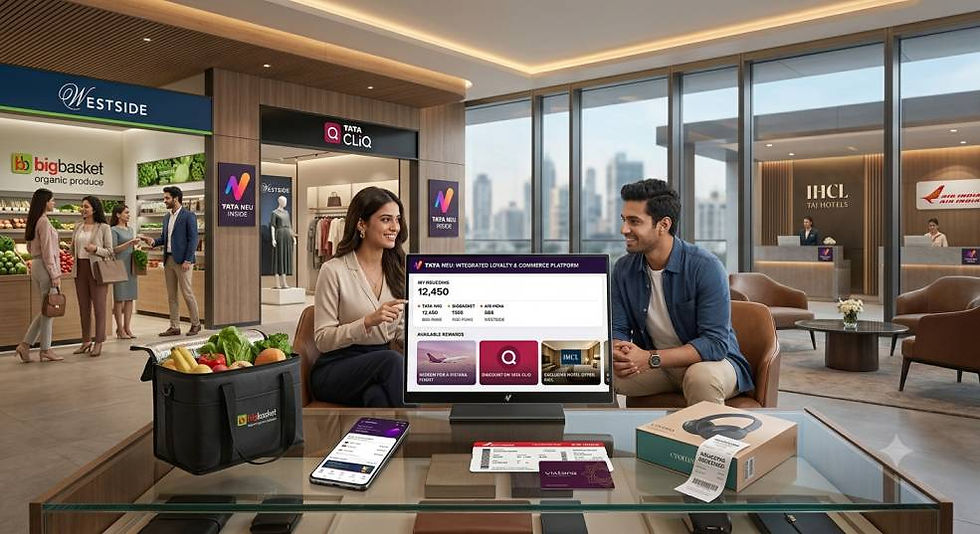
BigBasket's acquisition by Tata Digital in 2021 introduced a new dimension to its subscription strategy: the potential for cross-platform subscription bundling within the Tata super-app ecosystem (Tata Neu). No verified public information is available on whether or to what extent BigBasket's bb Star membership has been integrated with Tata Neu's Neu Pass subscription offering. However, the strategic logic is documented in the Tata Digital acquisition rationale: Tata's stated intention was to create a "large consumer digital ecosystem" in which food and grocery — BigBasket's domain — is "an important part." In a bundled subscription model, BigBasket's recurring grocery delivery becomes a component of a broader lifestyle subscription, increasing both acquisition scale and churn resistance beyond what a standalone grocery subscription could achieve.
Discussion Questions
1. The Economics of Free Delivery Subscriptions BigBasket's bb Star membership offers free delivery on orders above ₹600 in exchange for a periodic subscription fee. Analyse the unit economics of this subscription model from the platform's perspective. Under what assumptions — about order frequency, average basket size, and delivery cost per order — does the subscription become margin-accretive rather than dilutive? And given that BigBasket reported net losses through its entire documented subscription history, what does this suggest about the relationship between subscription strategy and platform-level profitability in Indian grocery e-commerce?
2. Habit Formation vs. Engagement: Two Subscription Philosophies bb Star is an engagement subscription — it rewards intentional purchases with economic benefits. bb Daily is a habit-formation subscription — it automates provisioning to create unconscious routine. Evaluate these two philosophies as complementary versus competing strategies. Which model creates stronger consumer retention in the Indian grocery context, and what are the conditions under which each model generates durable competitive advantage? What does the subsequent decision to integrate bb Daily into the main BigBasket app suggest about which philosophy the company prioritised?
3. The Quick Commerce Disruption of Subscription Value The core benefit of BigBasket's bb Star subscription was priority access to scheduled delivery slots — a scarce resource in high-demand periods. Quick commerce platforms like Blinkit and Zepto offer unscheduled, on-demand delivery in 10 minutes with no slot booking required. Analyse how the rise of quick commerce changed the competitive value of BigBasket's subscription proposition. Did BigBasket's subscription model become more or less defensible as the market shifted, and what strategic adaptations would you recommend to preserve subscription value in a quick-commerce-dominant market?
4. Acquisition as Subscription Infrastructure BigBasket's daily subscription service (bb Daily) was built not internally but through three acquisitions: Raincan (October 2018), Morning Cart (October 2018), and Daily Ninja (March 2020). Evaluate this build-via-acquisition approach to subscription infrastructure. What are the strategic advantages and risks of acquiring habit-formation businesses rather than building them organically? What integration challenges does this approach create, and what does the reported decision to eventually integrate bb Daily into the main BigBasket app suggest about the outcomes of this acquisition-led strategy?
5. Tata Ecosystem and the Future of Grocery Subscriptions BigBasket operates within Tata Digital's broader super-app ecosystem, which includes Tata Neu — a rewards and subscription platform that spans retail, travel, hospitality, electronics, and financial services. Evaluate the strategic opportunity for BigBasket to embed its grocery subscription within a Tata-wide loyalty ecosystem. What are the potential consumer value creation opportunities from such integration? What are the brand architecture risks of BigBasket's subscription identity being subsumed within a conglomerate-level loyalty programme? And how does this compare to Amazon Prime's approach to grocery subscription within a broader e-commerce ecosystem?


Comments