Brooke Bond Red Label Tea The "Swad Apnepan Ka" Campaign: Purpose as Competitive Strategy
Industry & Competitive Context
India is among the world's largest producers and consumers of tea, and the country's packaged tea market has long been a fiercely contested duopoly. As reported by trade sources, the Indian packaged tea market is estimated at approximately ₹12,000 crore within a broader tea industry valued at around ₹23,000 crore, with the remainder constituted by loose, unbranded tea that remains the preference in many rural and semi-urban markets. The branded segment is anchored by two dominant players: Hindustan Unilever Limited (HUL), which markets Brooke Bond Red Label among several other tea brands, and Tata Global Beverages, owner of Tata Tea and Tetley. Other competitors include Wagh Bakri and a long tail of strong regional brands that hold disproportionate influence in specific geographies given India's heterogeneous taste preferences. The category presents a structural challenge for brand-builders: tea is simultaneously among the most universal consumer habits and the least differentiated in functional terms. Price, color, and aroma are the primary purchase drivers in mass-market segments, making meaningful product-attribute differentiation difficult to sustain. Within this context, advertising and brand equity become critical levers for value-share gains — the logic being that a consumer who emotionally identifies with a brand is less likely to trade down to a cheaper alternative. This dynamic had, by the early 2010s, made the Indian tea category unusually competitive in terms of the ambition and creativity of its advertising. Tata Tea's long-running "Jaago Re" campaign, launched in 2008, had already demonstrated that purpose-led advertising could generate significant brand salience and cultural relevance in the tea space. The campaign linked tea consumption to civic consciousness and social action, reframing a commodity beverage as a symbol of an awakened, engaged citizenry. This precedent established the strategic terrain on which Brooke Bond Red Label would subsequently compete.
Brand Situation Prior to Campaign
Brooke Bond Red Label is among India's oldest FMCG brands, with a heritage exceeding a century. As the flagship brand of the Brooke Bond portfolio — which itself entered the Unilever fold through an international acquisition in 1984 — Red Label occupied the popular mid-market segment. A Campaign Asia brand health analysis described the brand's core challenge with precision: Red Label had become so universally distributed and so deeply embedded in mass consumption that it had approached near-generic status. The analysis noted that "every new brand that enters the category benchmarks on Red Label," which meant that every challenger implicitly positioned itself relative to Red Label's value anchor, continually eroding the brand's ability to command a premium or stand for anything beyond the baseline. Prior to 2014, Red Label's advertising had focused on rational product propositions and family-oriented emotional appeals — slogans such as "Piyo Toh Jaano," "Jiyo Mere Lal," and "Pyaar Ka Pyaala" — each framing tea as a domestic bonding ritual but without a sharply defined social point of view. As noted by Social Samosa's documented brand retrospective, the communication was "a hard product selling proposition" typical of the category rather than a distinctive brand narrative. The result was high awareness but undifferentiated equity: a brand that consumers bought but did not particularly champion.
By 2014, HUL's overall tea portfolio held approximately 20% value share of the packaged segment, trailing Tata Global Beverages. The competitive pressure from Tata Tea — with its more culturally assertive "Jaago Re" platform — had demonstrated that purpose-driven positioning could meaningfully shift brand perceptions. HUL's marketing leadership recognised that Red Label required a strategic repositioning: not merely a new advertising campaign, but a durable brand platform that could give the product an ownable identity in the cultural landscape.
Strategic Objective
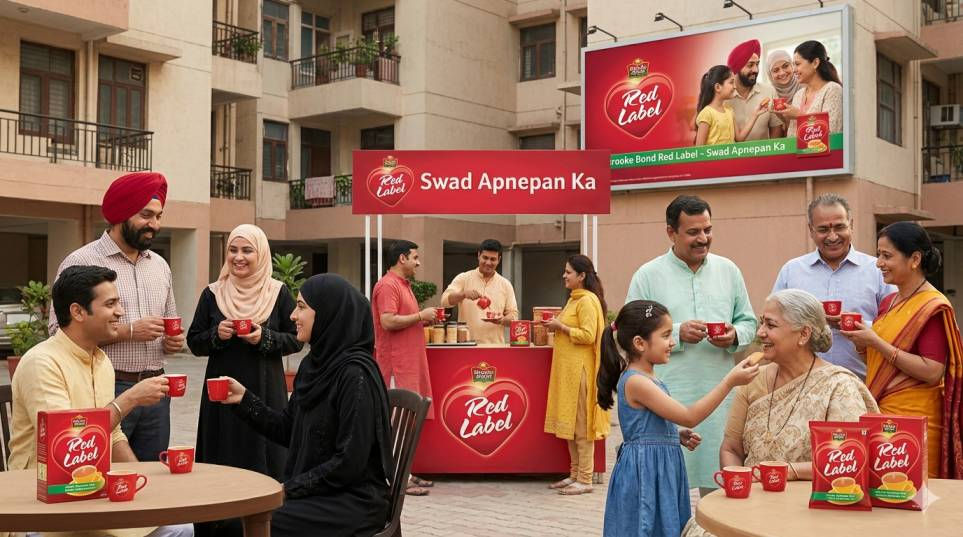
The strategic imperative was clear: transform Brooke Bond Red Label from a mass commodity into a brand with a coherent social purpose — one that would generate salience, emotional loyalty, and cultural conversation simultaneously. As Shiva Krishnamurthy, then Vice President for Tea and Foods at HUL, stated in multiple public communications, the articulated brand purpose was "to make India more inclusive." This was not framed as a transient campaign theme but as the brand's foundational reason for being: the proposition that a cup of tea can dissolve the social prejudices that divide people. Krishnamurthy articulated the dual objective in a statement published on Unilever's global website: "Did it impact our sales? I'm happy to say that our sales did go up and this was a key contributor. But we also had a lot of other activity for Brooke Bond at the same time, so it was part of a larger picture. Did it make people aware of our brand purpose? Most definitely, yes." This candid framing reveals that the campaign was understood internally as a brand-building instrument with commercial consequences, rather than a purely philanthropic exercise. The underlying consumer insight — developed with Ogilvy India, the brand's long-standing creative agency — was that tea in India functions as a social lubricant: it is the beverage offered to strangers, shared across class and community lines, and consistently present at moments of human connection. The strategic objective was to make that latent cultural truth explicit, and to tie it specifically to the Brooke Bond Red Label name. The tagline "Swad Apnepan Ka" — translating to "Taste of Togetherness" — was chosen as the campaign's anchoring proposition.
Campaign Architecture & Execution
What distinguishes "Swad Apnepan Ka" from most purpose-driven campaigns is its architectural discipline: the platform was designed from inception to be not a single campaign but a continuous creative series. Each execution would address a different social fault line in Indian society — a different prejudice or form of exclusion — while maintaining a consistent structural grammar: strangers divided by a social barrier, brought together over a cup of Red Label tea, with a twist that inverts the viewer's assumptions.
2014
Campaign launch — Communal harmony film. The inaugural execution depicted a Muslim woman extending hospitality and tea to a Hindu couple locked out of their home. The film addressed Hindu-Muslim social distance, marking Red Label's first explicit foray into social commentary. As documented in trade coverage, this was the moment the brand's communication pivoted from family-values advertising to what would become a consistent practice of cause-integrated storytelling.
2016
Six Pack Band — India's first transgender pop group. In partnership with Mindshare Mumbai and Y-Films (the youth arm of Yash Raj Films), HUL assembled a six-member band drawn entirely from India's transgender community. The band recorded music videos — including a cover of Pharrell Williams' "Happy" titled "Hum Hain Happy" — that were distributed across broadcast and streaming platforms, performed at major music events including Radio Mirchi's Music Awards, and generated significant earned media. The campaign won the Glass Lions Grand Prix at the 63rd Cannes Lions International Festival of Creativity.
2018
"A Tale of Two Blends" — social experiment format. Ogilvy Mumbai created a film structured as a social experiment proving that tea tastes better in company, extending the "Swad Apnepan Ka" proposition beyond social issues into an experiential demonstration of the brand's core claim.
2019
Veg-NonVeg Tension — dietary prejudice. A film featuring two old friends, one vegetarian and one non-vegetarian, separated by food-related prejudice and reunited over tea. HUL launched a corresponding #vegnonvegtension hashtag campaign to extend the conversation digitally.
2020
Transgender acceptance TVC & COVID-19 compassion film. In March 2020, a film addressed prejudice against the transgender community in a monsoon-themed narrative. In May 2020, the brand released a COVID-era film carrying the message that "being told to stay alone is not the same as being left alone," directly applying the togetherness platform to pandemic-era social stigma around infected individuals.
2024
Differently-abled community film — tenth-year milestone. A film set in a local train compartment featured a visually impaired man as the catalyst for cross-stranger trust, with the Ogilvy creative team noting that this execution marked ten years of the "Swad Apnepan Ka" journey. Throughout this decade-long arc, the creative team at Ogilvy India — led by Chief Creative Officers Kainaz Karmarkar and Harshad Rajadhyaksha — maintained a consistent structural signature: tea as the literal and symbolic bridge across a social divide, with a narrative twist that challenges the viewer's automatic prejudice. As Rajadhyaksha noted publicly, the creative challenge was formidable: "The brief remains the same, and that I am sure, makes it challenging to come up with different yet relevant stories every time."
Positioning & Consumer Insight
The campaign's strategic durability rests on an insight that is simultaneously simple and culturally specific. Tea in India is not consumed in the same register as, say, coffee in Europe or the United States — it is not primarily an individual pleasure or a premium lifestyle signal. It is the beverage of unconditional hospitality: offered to strangers who knock on the door, shared on trains between people who have never met, present at negotiations, condolences, and celebrations alike. This makes chai a uniquely credible vehicle for a togetherness proposition, because the ritual of offering tea is already encoded in Indian culture as an act of social inclusion. By selecting social fault lines — religious division, gender non-conformity, dietary prejudice, stigma around disability — that are widely felt but infrequently addressed in mainstream advertising, the brand positioned itself as a cultural interlocutor rather than merely a beverage. This is strategically significant: it meant that each campaign film had a built-in reason for earned media amplification. Stories that challenge social norms generate discussion, debate, and sharing in ways that conventional product advertising cannot. The brand effectively converted social tension into media inventory. Critically, the brand's social commentary is consistently structured so that tea is not incidental to the resolution — it is the mechanism of resolution. This prevents the campaign from functioning as mere "badging" of a social cause, where the product is a footnote to an issue the brand doesn't genuinely own. The structural grammar of every "Swad Apnepan Ka" film insists that the cup of Red Label tea is what makes the impossible connection possible.
Media & Channel Strategy
Based on publicly available information, the campaign was distributed primarily through television and digital video, with the Six Pack Band initiative additionally using audio streaming platforms, live event performances, and radio. HUL's VP Shiva Krishnamurthy confirmed that the Six Pack Band's music videos were distributed "across broadcast and online platforms," and that the songs "aired on Indian radio stations and on streaming apps." Cannes Lions records confirm that Mindshare Mumbai was the media agency responsible for the Six Pack Band campaign. The 2019 "veg-nonveg" film was accompanied by a social media hashtag campaign (#vegnonvegtension) to extend digital engagement, as confirmed by trade coverage from Exchange4media and Adgully. The COVID-era 2020 film was similarly distributed across "broadcast and online platforms" per HUL's official statement at the time. The campaign's media architecture reflects a television-first model with digital amplification — consistent with HUL's broader go-to-market approach for its mass-market brands. The Six Pack Band iteration was distinctive in using content marketing and entertainment sponsorship as primary vehicles rather than conventional advertising, reflecting the campaign's evolution toward earned-media-led distribution as the brand's purpose platform matured.
Business & Brand Outcomes
The campaign's documented outcomes fall into three categories: competitive market-share performance, brand equity indicators cited by HUL management, and industry recognition.
Market Share Performance. As reported by WARC and the Economic Times, HUL's value share in the Indian packaged tea market grew from approximately 20% in 2016 to 21.2% in 2017 — a gain of 1.2 percentage points — while Tata Global Beverages' share declined from 21.4% to 21% in the same period. By the three months ending January 2018, HUL had edged ahead of Tata Tea on value share, recording just over 21% against Tata's 20.6%, according to the same WARC report. By 2020, per a published Unilever retrospective, HUL's retail value share across its tea brands had grown to "little over 28%." It is important to note the caveat explicitly acknowledged by HUL's own leadership: these market-share gains cannot be attributed solely to the "Swad Apnepan Ka" campaign. As Krishnamurthy stated on Unilever's global website, "our sales did go up and this was a key contributor. But we also had a lot of other activity for Brooke Bond at the same time, so it was part of a larger picture." This caution is analytically appropriate: HUL simultaneously invested in product portfolio expansion, pricing strategy, and distribution during this period.
Brand Equity Indicators. Krishnamurthy stated publicly that the campaign "has given us great results on brand users, salience and equity besides the numerous accolades it has won." The campaign was described by HUL leadership as central to demonstrating that Red Label's "inclusiveness mission was well received by customers." No verified independent brand equity scores (e.g., Brand Finance valuations or YouGov BrandIndex data specific to Red Label) have been disclosed publicly.
Six Pack Band Reach and Industry Recognition. Music videos of the Six Pack Band reached over 25 million people on YouTube, as confirmed in official Unilever communications. The band performed at Radio Mirchi's Music Awards and collaborated with Indian A-list entertainers including Hrithik Roshan, Sonu Nigam, Karan Johar, Arjun Kapoor, Neha Kakkar, Vishal Dadlani, and Tiger Shroff, as documented in Social Samosa's brand retrospective. The campaign won the Glass Lions Grand Prix at the 2016 Cannes Lions International Festival of Creativity — the top prize in a category that "recognizes work that implicitly or explicitly addresses issues of gender inequality or prejudice through the conscious representation of gender in advertising," per Cannes Lions records.
Exhibit: Cannes Glass Lions Grand Prix — Jury Citation (2016)
"The brand is 113 years old, and for a brand that's that established and a household product to take on the issue of transgender people from the perspective of how do you embrace it, how do you combat gender norms… their approach was incredibly inventive." — Madeline Di Nonno, CEO, Geena Davis Institute for Gender in Media; Jury President, Glass Lion, Cannes 2016 (as reported by JWT Intelligence)
Strategic Implications
The brand platform as competitive moat. The most significant strategic achievement of "Swad Apnepan Ka" is the creation of a durable, defensible brand territory in a commodity category. By consistently occupying the intersection of tea and social inclusion for a decade, Brooke Bond Red Label has made it structurally difficult for competitors to claim the same territory without appearing derivative. The platform functions as a moat precisely because it requires long-term commitment and creative consistency — attributes that cannot be replicated quickly by a rival launching a single purpose-led campaign.
Purpose as earned media engine. The campaign's architecture treats social controversy not as a risk to be managed but as a media asset to be cultivated. By selecting taboo social subjects — transgender acceptance, interfaith relations, dietary divisions — the brand consistently generated organic discussion, debate, and sharing that extended the campaign's reach far beyond its paid media footprint. The Six Pack Band's 25 million YouTube views, achieved in a category with no tradition of entertainment-led marketing, illustrates how a well-constructed purpose narrative can generate earned media at scale. This is a structural lesson for FMCG brands operating in attention-scarce environments: advertising that stakes a position on a real social issue creates its own distribution incentive.
Creative constraint as innovation driver. The creative discipline of maintaining a single brief — "Swad Apnepan Ka," one cup of tea as a bridge across one social divide — across ten years and dozens of executions is an unusual example of strategic constraint generating creative richness. The platform's rigidity forced the creative team to continuously expand the universe of "social divides" it addressed, which in turn kept the campaign culturally current without requiring a brand repositioning. This approach contrasts with the more common FMCG pattern of abandoning platforms every two to three years in response to declining recall scores.
The risk calculus of cause marketing. The campaign's sustained engagement with contested social issues — most notably the Six Pack Band's advocacy for transgender inclusion at a time when the topic was highly controversial in India — required explicit corporate risk tolerance. Mindshare's South Asia CEO Prasanth Kumar acknowledged publicly at Cannes that "for a brand it can be a bit difficult to decide to do something like the 6-pack challenge, as you can make people feel a little bit uncomfortable." The brand's continued commitment across multiple controversial executions, without documented evidence of significant consumer backlash affecting sales, suggests that the risk calculus was managed effectively — but also that the brand's mass-market appeal provided a degree of insulation that might not exist for niche or premium brands attempting a similar strategy.
Attribution uncertainty in purpose-led campaigns. The HUL leadership's own public acknowledgment that sales gains "were part of a larger picture" reflects a fundamental tension in measuring purpose marketing's commercial contribution. Isolating the impact of brand-building advertising on category market share — particularly in a market as structurally complex as Indian tea, with its fragmented distribution, regional taste variation, and price sensitivity — is methodologically difficult. The case demonstrates that purpose-led campaigns can coincide with commercial gains, but establishing causality requires the kind of controlled experimental data that FMCG companies rarely disclose publicly.
Discussion Questions
Brooke Bond Red Label operates in the popular mid-market segment, selling to price-sensitive, mass-market consumers across India's diverse geographies. Purpose-led advertising is often associated with premium or urban brands targeting educated, socially progressive consumers. To what extent does the "Swad Apnepan Ka" platform transcend this typical demographic profile, and what product or cultural factors make it viable for a mass-market brand in this category?
The campaign consistently addressed social issues — transgender rights, communal harmony, disability — that are actively contested in Indian public discourse. How should a brand's marketing leadership assess the risk-reward profile of engaging with such issues, and what governance frameworks should guide decisions about which social causes a brand may credibly claim?
HUL's Krishnamurthy acknowledged that the market-share gains attributable to "Swad Apnepan Ka" cannot be cleanly isolated from other simultaneous commercial activities. What methodologies — experiment design, matched-market testing, brand health tracking — could a Chief Marketing Officer deploy to more rigorously estimate a purpose-led campaign's marginal contribution to revenue and share?
The Six Pack Band represented a significant evolution from traditional advertising to content marketing, brand-funded entertainment, and live event activation. Evaluate the organisational and agency ecosystem capabilities that HUL and Mindshare would have needed to execute this model. What does this shift imply for how FMCG companies should structure their media and creative agency relationships?
The "Swad Apnepan Ka" platform has sustained creative relevance for over a decade by widening the range of social divides it addresses while maintaining a single structural grammar. At what point does the repetition of a platform become a liability rather than an asset — and how should a brand's marketing leadership judge when to evolve, extend, or retire a long-running purpose platform?


Comments