How Tier 2 and Tier 3 Cities Are Changing India's Marketing Landscape
Industry & Competitive Context
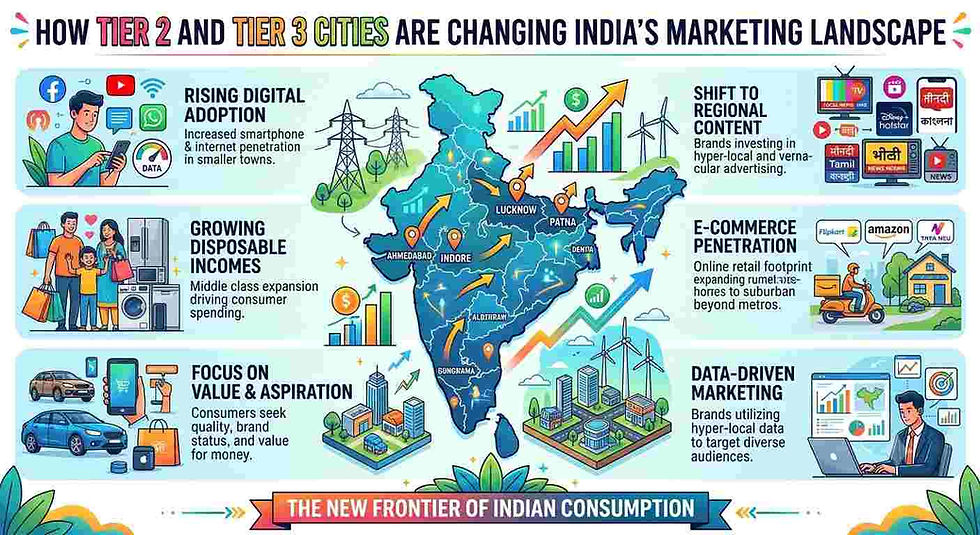
For most of the 2010s, Indian digital marketing was built around a metro-first logic: campaigns were conceived in English, tested in Mumbai, Delhi, Bengaluru, and Chennai, and only later adapted if at all for smaller towns. That logic has broken down. According to the “Internet in India 2024” report published jointly by Kantar and the Internet and Mobile Association of India (IAMAI) in January 2025, rural India had roughly 488 million active internet users compared with about 397 million in urban India, with rural user growth running at roughly double the urban rate. The same report noted that women made up 47% of rural internet users and that India was on track to cross 900 million active internet users, with that growth driven primarily outside the metros.
This shift has been pulled forward by three structural forces that are well documented in public reporting: the fall in mobile data prices following Reliance Jio’s 2016 entry, the spread of affordable smartphones, and the build-out of vernacular-language interfaces across major platforms. Industry estimates cited by outlets such as the Economic Times have repeatedly noted that roughly 70% of India’s population lives in Tier 2, Tier 3, and rural geographies, making these markets too large for any consumer-facing company to treat as an afterthought.
E-commerce data corroborates the pattern at the transaction level. Unicommerce’s India E-commerce Index 2023 found that while Tier 1 cities recorded order growth of 31.1% for the period studied, Tier 2 and Tier 3 cities grew at 23.3% and 22.4% respectively a narrower gap than might be expected, and one that several industry reports, including commentary from Inc42, linked to the record roughly $4 billion in online sales reported during major 2023 festive-season sale events, with smaller cities credited as a material driver of that volume. RedSeer had earlier projected, in a 2021 analysis, that Tier 2 cities and beyond would account for approximately 60% of India’s incremental e-commerce growth over 2020–2025.
The competitive set responding to this shift spans e-commerce (Flipkart, Amazon, Meesho, Reliance’s JioMart), content and social platforms (ShareChat, Josh, Moj), fintech, gaming platforms such as Dream11, and traditional FMCG and retail players repositioning their media mix. What differentiates this case from a single-brand campaign case study is that the “Tier 2/3 opportunity” has functioned as an industry-wide repositioning exercise, visible across multiple independently reported company strategies rather than one coordinated campaign.
Brand Situation Prior to the Shift
Before this period, most large digital-first brands in India had built their initial user bases in metro and Tier 1 markets, where English and Hindi-dominant, higher-income, app-literate consumers were easiest and cheapest to acquire. Flipkart and Amazon India’s early catalogues, interfaces, and advertising were overwhelmingly in English. Fantasy sports and real-money gaming platforms built their early marketing around premium cricket viewership concentrated in larger cities. Social and content platforms modeled on Western short-video and social formats assumed a baseline of English literacy that a large share of India’s population does not have.
This created an underserved market: a large, internet-connected population with distinct language preferences, different price sensitivities, and different trust dynamics (heavier reliance on word-of-mouth and social proof over brand advertising) that was not being served by products and messaging designed for metro audiences. Several companies that are now closely associated with Tier 2/3 growth were, at founding, explicitly built around this gap. Meesho, founded in December 2015 by Vidit Aatrey and Sanjeev Barnwal both IIT Delhi alumni began as a social commerce platform that let resellers, many of them women working from home, sell products through WhatsApp, Facebook, and Instagram, with an initial user base concentrated in smaller towns rather than metros.
Strategic Objective
The publicly stated and reported objectives across the companies examined in this case converge on a common theme: capturing the “next 200–300 million” internet users as the primary growth engine, once metro markets matured and acquisition costs there rose. For JioMart, Reliance’s retail and digital commerce arm, YourStory reported in June 2021 that the platform had shifted from a metro- and Tier 1-weighted user base at its May 2020 launch to a position where it was getting “more than half its orders” from Tier II and Tier III cities, a shift the report tied to pandemic-driven online shopping adoption and JioMart’s WhatsApp-based ordering flow. Reliance separately expanded JioMart’s operational footprint to roughly 200 Indian cities and towns, as reported by TechCrunch and other outlets.
For Flipkart, the stated objective behind its Shopsy app a zero-commission, social-commerce-style platform aimed at value-conscious shoppers and first-time online buyers was explicitly to deepen penetration in smaller towns rather than compete for the same urban customer Flipkart’s flagship app already served. For Meesho, the objective articulated by its founders in multiple reported interviews was to build commerce infrastructure logistics, cataloguing, and language support specifically suited to Tier 2/3 and rural geographies rather than adapting a metro-first playbook after the fact.
Campaign Architecture & Execution
Language as infrastructure, not translation
Across the sector, the most consistently documented execution choice was treating vernacular language as core product and marketing infrastructure rather than a cosmetic localization layer. Flipkart’s leadership publicly disclosed that over 1.5 million users were visiting the platform daily using its vernacular-language interface, a figure shared by Flipkart executive Jeyandran Venugopal and reported by Exchange4Media. Shopsy went further by unveiling dedicated Tamil and Telugu app interfaces, as reported by Indian Retailer, rather than treating regional language as a toggle within a single English-first design.
Meesho’s publicly reported language strategy was similarly structural: the platform made catalogues, search, and customer support available in seven or more Indian languages including Hindi, Tamil, Telugu, Kannada, Malayalam, Bengali, and Gujarati, and added voice search to accommodate users with limited text literacy. Meesho told The Hindu BusinessLine in October 2021 that nearly 60% of its users transacted in languages other than English or Hindi a figure that, if representative of the broader Tier 2/3 e-commerce base, underscores why language investment functioned as an acquisition lever rather than a retention nicety.
Social and referral mechanics over brand advertising
A second recurring execution pattern was reliance on peer-to-peer and referral-driven acquisition in place of, or alongside, conventional brand advertising. Meesho’s founders described this directly in public interviews: Sanjeev Barnwal told Inc42 in March 2022 that users themselves act as the platform’s primary marketers in smaller cities, where trust is built through word-of-mouth rather than advertising reach. Meesho’s referral program, which offered wallet credits to users whose referrals completed a first purchase, was documented in reporting by YourStory, where founder Vidit Aatrey stated in August 2021 that referrals accounted for a significant share of new user acquisition. This mechanic mirrors the platform’s origin as a social reselling network built on WhatsApp and Facebook groups rather than a paid-media-led marketplace.
Media and distribution built around cricket and vernacular content platforms
Sports cricket above all has continued to function as the broadest-reach advertising vehicle for brands pursuing Tier 2/3 audiences, given the Indian Premier League’s documented reach well beyond metro markets. Multiple industry commentators, including analysis published by The Media Ant on IPL advertising, have noted that brands including fantasy sports platforms such as Dream11 have treated IPL media buys as a primary vehicle for national reach that includes smaller-town audiences, given cricket viewership’s geographic spread across India. Separately, homegrown vernacular social and short-video platforms such as ShareChat and its video product Moj (and, in an earlier period, TikTok before its 2020 ban in India) became significant distribution channels precisely because their user bases skewed toward Tier 2/3 and rural India rather than metro markets, making them a natural complement to cricket-led mass reach for brands seeking non-English, non-metro audiences.
Positioning & Consumer Insight
The underlying consumer insight that recurs across these company strategies, as described in their own public statements, is that Tier 2/3 consumers are not simply “metro consumers with less money” but a distinct audience with different language comfort, different trust mechanisms, and different price and value expectations. Meesho’s positioning around affordability and social trust — building on its reseller-led origins — reflected an explicit bet that commerce in smaller towns travels through known, trusted intermediaries (family, neighbors, local resellers) more than through brand advertising alone. JioMart’s growth in Tier II/III cities, as reported by YourStory, was tied specifically to WhatsApp-based ordering — a channel that lowers the barrier for consumers less comfortable navigating a standalone app interface.
This represents a meaningful repositioning away from the earlier industry assumption that smaller-town consumers were simply a delayed version of the metro funnel, to be served once acquisition costs in large cities became prohibitive. Instead, the companies examined here treated language support, trust-based acquisition, and locally relevant product assortments (lower price points, region-specific catalogues) as first-order product and marketing decisions rather than later-stage adaptations.
Media & Channel Strategy
Where publicly documented, the channel strategy supporting this shift combines three elements. First, vernacular digital platforms ShareChat, Moj, and regional-language content more broadly served as both media inventory and a signal of product-market relevance, since a brand’s presence on these platforms itself communicated non-metro relevance. Second, cricket and large sporting properties, particularly the IPL, continued to serve as the broadest reach vehicle, given their documented penetration across city tiers; this is consistent with industry commentary describing IPL advertising as a shared, high-reach channel used across categories including gaming, e-commerce, and fintech. Third, messaging platforms principally WhatsApp were used not only as a media channel but as a transactional interface, as seen in JioMart’s WhatsApp-based ordering flow, blurring the line between advertising reach and the purchase funnel itself.
Beyond these three, publicly available information does not provide verified, company-disclosed detail on the specific media mix, spend allocation, or channel-level performance metrics used by individual brands in their Tier 2/3 campaigns.
Business & Brand Outcomes
Several outcomes have been publicly documented, directly attributable to company disclosures or credible reporting. JioMart was reported by YourStory in June 2021 to be receiving more than half of its orders from Tier II and Tier III cities, a reversal from its metro-weighted launch base in May 2020. Flipkart’s Shopsy platform reported 330 million cumulative app downloads over a three-year period as of its reporting in mid-2024, with the platform observing 70% participation from Tier 2 and Tier 3 cities, including specifically named towns such as Bhagalpur, Bankura, Kurnool, Nagaon, and Dhule.
Meesho disclosed 145 million transacting users as of December 2023 and more than 700,000 active sellers as of early 2022, according to reporting by the Economic Times. Founder Vidit Aatrey stated to Bloomberg in August 2023 that over 60% of Meesho’s orders came from Tier II cities and beyond. The company also announced in December 2021 a zero-commission model for sellers, and in July 2024 announced it had reached operating profitability, describing this as EBITDA-positive before stock-based compensation, per its own press release. Separately, Moneycontrol reported in July 2023, citing company statements, an 80% year-over-year reduction in Meesho’s monthly cash burn.
At the sector level, the Unicommerce India E-commerce Index 2023 documented Tier 2 and Tier 3 order growth of 23.3% and 22.4% respectively against 31.1% growth in Tier 1 cities, a data point that tempers any narrative of Tier 2/3 markets categorically outgrowing metros, while still representing substantial absolute growth given the larger population base these tiers represent.
Strategic Implications
This case illustrates a broader shift in how Indian marketing strategy treats geography: from a model where Tier 2/3 cities were a secondary market reached through diluted or translated metro campaigns, to one where language, trust-based distribution, and locally calibrated product assortments are treated as core strategic inputs from the outset. The companies most frequently cited in public reporting as successful in these markets Meesho, Flipkart’s Shopsy, and JioMart share a common pattern: each built or adapted a distinct product and acquisition model for smaller towns rather than simply extending an existing metro playbook with regional-language ad creative.
The sector-level data also suggests a more measured conclusion than “Tier 2/3 is now outgrowing metros.” The Unicommerce growth figures indicate Tier 1 cities retained the highest growth rate even as Tier 2/3 cities expanded meaningfully, implying that the opportunity in smaller cities is best understood as a large, still-growing, increasingly addressable market rather than one that has already overtaken metro India in commercial importance. For marketers, the documented strategies suggest that durable success in these markets has depended less on repackaging existing campaigns in regional languages and more on rebuilding acquisition mechanics referral and social trust, messaging-platform commerce, and vernacular-first product design around how Tier 2/3 consumers actually discover, trust, and transact.
A further implication concerns measurement and disclosure. Much of what is publicly verifiable about this shift comes from aggregate figures order share, download counts, user totals disclosed through press releases, executive statements to media, and third-party industry reports, rather than granular, audited performance data. This is a methodological caveat for any analysis of the space: company-level claims about Tier 2/3 performance, while directionally consistent across multiple independent companies and reports, should be read as self-reported or press-reported figures rather than independently audited metrics.


Comments