What Blinkit, Zepto and Instamart Teach Us About Consumer Behaviour
Industry & Competitive Context
India’s quick commerce (q-commerce) category grocery and general merchandise delivered in roughly ten to twenty minutes has moved from a pandemic-era experiment to a mainstream retail channel in under five years. Three platforms dominate it: Blinkit, owned by the listed company Eternal (formerly Zomato); Zepto, an independent venture-backed company that filed its Draft Red Herring Prospectus (DRHP) for an initial public offering in 2025, targeting a listing around mid-2026; and Instamart, the quick commerce arm of the listed food-delivery company Swiggy.
Disclosed order-volume data from Zepto’s DRHP for the quarter ending March 2025 shows the relative scale of the three players: Blinkit processed 274 million orders, Zepto 210 million, and Instamart 113 million. Eternal’s Q2 FY26 (quarter ended September 2025) results showed Blinkit’s adjusted revenue rising to ₹9,891 crore, up 756% year-on-year, following a shift to a predominantly inventory-led commercial model, with the company’s own management cautioning that this shift created a one-time reporting uplift. Blinkit’s dark store count stood at 1,816 at the end of that quarter, with a stated target of 2,100 stores by December 2025 and 3,000 by March 2027. Zepto’s DRHP disclosed 1,139 dark stores as of March 2025 and operating revenue of ₹7,498 crore for the January–March 2025 quarter, up 75% year-on-year, against a net loss of ₹1,539 crore. Swiggy’s Q4 FY25 results (quarter ended March 2025) showed the company’s consolidated net loss widening to ₹1,081 crore, with the company attributing continued investment to Instamart’s dark store expansion.
What distinguishes this category from earlier e-commerce cycles is not simply delivery speed but what that speed has done to the basket, frequency, and occasion mix of Indian online shopping a shift each company has documented, in different forms, through its own disclosures.

Brand Situation Prior to Scale-Up
Each platform entered the category solving a narrower problem than the one it now serves. Blinkit (formerly Grofers) was repositioned and rebranded in 2021 around speed as its core promise, built on Zomato’s existing food-delivery logistics and acquired by Zomato in 2022. Zepto launched in 2021 founded by Aadit Palicha and Kaivalya Vohra, built from inception as a ten-minute delivery company rather than a repositioned grocery player. Instamart launched as a Swiggy-owned grocery vertical leveraging Swiggy’s existing rider and merchant network from food delivery.
In each case, the originating use case was the same: replenishment of everyday groceries. Public commentary and company disclosures over 2023–2025 show that all three platforms subsequently broadened beyond grocery. Zomato’s own Q1 FY25 earnings call quoted CEO (Blinkit) Albinder Dhindsa stating that non-grocery online shoppers were increasingly shifting to Blinkit, and that the company’s target was to expand dark store count to 2,000 by 2026 a target that was itself revised upward in subsequent quarters, evidence of a company recalibrating its own growth assumptions in response to observed demand.
Strategic Objective
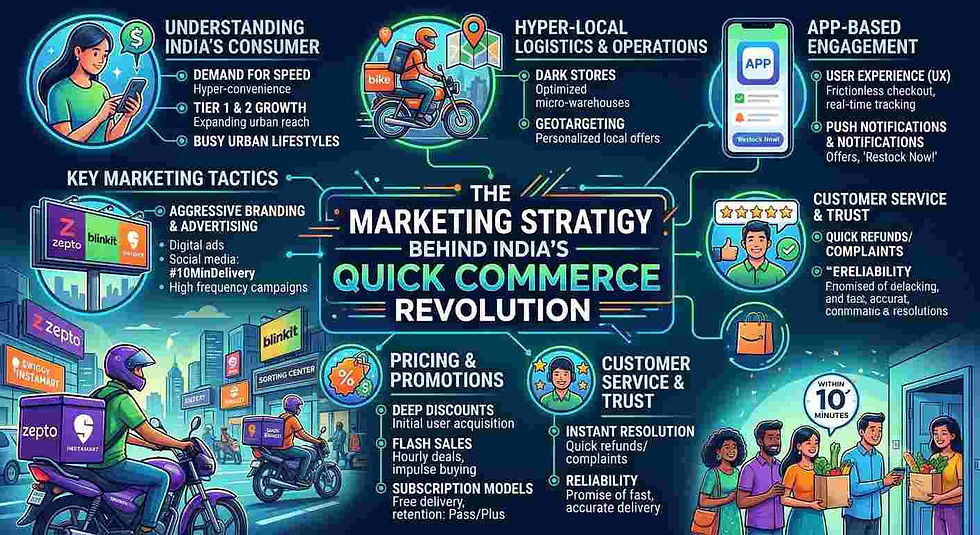
The publicly stated objective across all three companies, as disclosed in earnings calls and investor communication, has been to convert delivery speed from a feature into a category-defining consumer habit expanding the platforms’ addressable use occasions from scheduled grocery replenishment to impulse, emergency, gifting, and high-value discretionary purchase, while building the dark store density needed to sustain that promise profitably. Eternal’s FY26 capital allocation disclosures showed over 90% of its Q2 capex directed to Blinkit, at an approximate cost of ₹1 crore per store including warehousing a clear signal that density of physical fulfilment infrastructure, not marketing alone, is treated as the primary strategic lever.
Campaign Architecture & Execution
Rather than a single campaign, the three platforms’ public activity has centred on format and assortment expansion as the primary lever of consumer behaviour change, supported by occasion-specific marketing moments.
Zepto’s most clearly documented expansion was Zepto Café, launched to extend the ten-minute promise into food and beverage delivery. Public reporting (Storyboard18, YourStory, The Week) on Zepto Café’s 2024 rollout describes a nationwide expansion with a stated internal revenue run-rate target of ₹1,000 crore by 2026, and a subsequent decision to launch Zepto Café as a separate app. This represents a deliberate attempt to move the ten-minute-delivery habit from planned grocery purchase into impulse food-and-beverage consumption, a behaviourally distinct occasion from a weekly grocery run.
Blinkit’s publicly documented format extensions include a 10-minute passport photo printing service for Delhi and Gurugram users, reported by Inc42 in 2024, alongside its broader expansion into electronics, pharmacy, and general merchandise referenced in Zomato/Eternal earnings commentary. These additions function as recurring, low-friction demonstrations of the platform’s speed promise applied to categories outside grocery, reinforcing habitual use beyond the weekly shop.
Instamart’s most extensively documented consumer-behaviour campaign is not a conventional advertising campaign but an annual public data report “How India Instamarted,” now in its fifth edition as of 2025 which Swiggy and its vertical compile from millions of orders placed across more than 128 cities between January and November. As a communications exercise, publishing aggregated, unusual order data (rather than a conventional brand campaign) functions as a form of earned-media storytelling: it converts platform usage data into shareable, often humorous narrative content, positioning Instamart as a cultural mirror for Indian consumption habits rather than purely a delivery utility.
Positioning & Consumer Insight
The order data disclosed by Instamart’s 2025 report offers the most granular, publicly available window into what ten-minute delivery has actually done to consumer behaviour, and it supports several distinct insights.
First, speed has compressed the gap between desire and purchase to the point of near-instantaneity for even high-value items: the report recorded an instant noodle pack delivered to a Lucknow customer in under two minutes, and smartphones delivered in as little as three minutes in Pune and Ahmedabad during the iPhone 17 launch window. This indicates that quick commerce has begun competing not only with neighbourhood kirana stores for replenishment purchases but with planned retail and e-commerce purchase cycles for considered, high-value items a behavioural shift from “ordering ahead” to “ordering in the moment of want.”
Second, the basket extremes documented a ₹10 printout as the smallest recorded cart in Bengaluru, against a ₹4.3 lakh cart for three iPhone 17 units in Hyderabad, a near ₹2 lakh silver brick purchase in Bengaluru during Diwali, and a single customer’s cumulative annual spend exceeding ₹22 lakh across electronics, gold coins, and groceries indicate that quick commerce baskets are not confined to a narrow low-value grocery range, as the category’s original positioning might suggest. The platform has, in practice, become a channel for both trivial and significant discretionary spend within the same operating model.
Third, the data shows occasion-based demand spikes that mirror, and in some cases exceed, traditional retail seasonality: gold orders rose over 400% year-on-year on Dhanteras, and rose-and-chocolate gifting orders peaked at 666 per minute nationally on Valentine’s Day, reaching 1,780 per minute in Bengaluru alone. This suggests quick commerce has inserted itself into gifting and festive-occasion purchase behaviour that was previously the preserve of planned retail visits or traditional e-commerce.
Fourth, the report’s disclosure that one in every 127 orders included condoms, peaking in September, with purchase patterns concentrated around discretion (a single Chennai account placing 228 such orders), points to a less-discussed but commercially significant behavioural driver: quick commerce’s privacy and discretion value proposition for sensitive-category purchases, distinct from its speed value proposition for urgent ones.
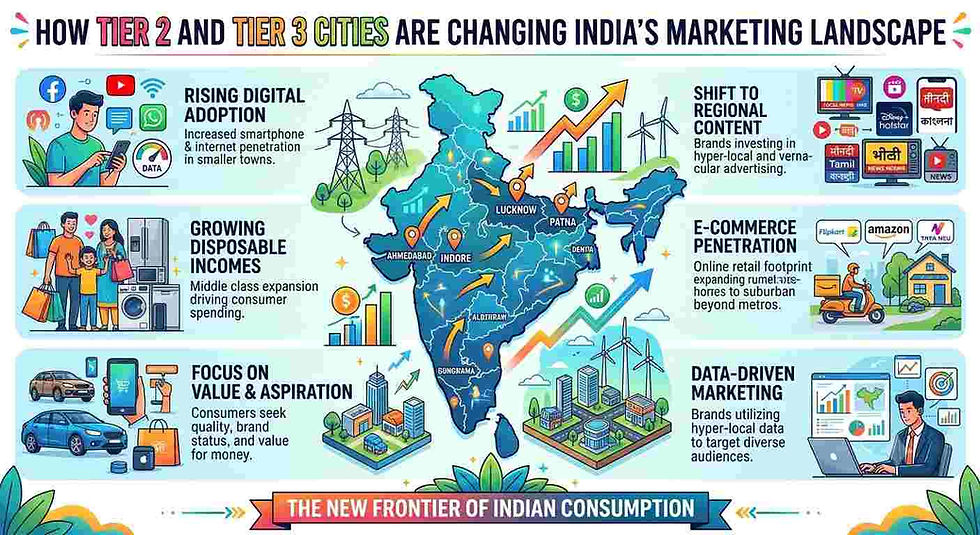
Fifth, growth data from smaller cities Rajkot’s order volume grew nearly tenfold year-on-year, with Ludhiana and Bhubaneswar also cited as growth engines, and first-time buyers from Tier-II and Tier-III cities forming a significant share of orders during the company’s “Quick India Movement” sale indicates that quick commerce adoption is no longer a metro-city phenomenon, and that smaller-city consumers are adopting the format at a faster relative rate than established metro markets, even if absolute order volumes remain metro-concentrated.
Across all three platforms, the common underlying insight that public disclosures support is this: once delivery speed falls below a threshold where it no longer requires planning, consumers do not simply order groceries faster they begin treating the platform as a general-purpose, always-available extension of retail for occasions ranging from the mundane to the exceptional, the planned to the impulsive, and the practical to the discreet.
Media & Channel Strategy
Public disclosure on paid media strategy is limited for all three companies relative to their operational disclosures. What is verifiable is that Eternal’s Q2 FY26 results showed Blinkit’s marketing spend rising 4x year-on-year and 1.4x quarter-on-quarter, reflecting significant incremental investment in customer acquisition and retention during a period of intensified competition. Beyond this, the most consistently documented channel strategy across all three platforms is earned media generated through data storytelling (Instamart’s annual report) and new-format launch coverage (Zepto Café, Blinkit’s passport-photo and electronics expansion), rather than disclosed details of paid advertising campaigns, creative strategy, or media mix. No verified public information is available on the specific creative content, agency partners, or media spend allocation across channels (television, digital, outdoor) for any of the three platforms’ consumer campaigns.
Business & Brand Outcomes
The clearest documented business outcomes are financial and operational rather than brand-metric based, since none of the three companies has publicly disclosed brand-tracking data such as awareness, consideration, or Net Promoter Score results.
Blinkit’s adjusted revenue reached ₹9,891 crore in Q2 FY26, up 756% year-on-year, though the company’s own management cautioned on the earnings call that the increase was substantially inflated by the accounting effect of its shift to an inventory-led model and that growth would normalise; the adjusted EBITDA loss for the quarter was ₹156 crore, an improvement of about 4% quarter-on-quarter but still a loss, and management stated on the call that the loss reduction was smaller than anticipated because incremental revenue was being reinvested in store network expansion rather than retained as margin. The company added 272 net new stores in the quarter, its highest net addition in the preceding ten quarters.
Zepto’s DRHP disclosed operating revenue of ₹7,498 crore for the January–March 2025 quarter, up 75% year-on-year, with a net loss of ₹1,539 crore, narrower than the ₹1,832 crore loss recorded in the same quarter the prior year. The company’s most recent primary funding rounds, reported by multiple outlets including Entrackr and Entrepreneur India, valued it at $5 billion in an August 2024 round that raised $340 million, with subsequent reports of a later round targeting a $7 billion valuation; final valuation at IPO was not available as of the information gathered for this case.
Swiggy’s Q4 FY25 results showed a consolidated net loss of ₹1,081 crore, up 95% year-on-year, which the company’s results commentary attributed in part to continued Instamart dark-store expansion, even as the same results period recorded what multiple outlets described as record Instamart revenue growth.
Strategic Implications
Several implications for marketing and category strategy follow directly from the verified record above, without requiring inference beyond what the companies and credible outlets have disclosed.
First, in quick commerce, infrastructure investment functions as a consumer-behaviour lever in its own right, not merely an operational cost separate from marketing. Eternal’s capital allocation directing over 90% of a quarter’s capex to Blinkit, overwhelmingly toward store network expansion, against a marketing spend that itself rose 4x year-on-year indicates that density of fulfilment infrastructure is treated by at least one major platform as the primary determinant of whether the speed promise can be kept, and therefore of whether habitual use forms at all. A ten-minute promise unsupported by store density is not a credible brand promise; the investment case precedes the communications case.
Second, format extension, rather than advertising alone, has been the primary observable lever for expanding the behavioural repertoire associated with each brand. Zepto Café and Blinkit’s passport-photo and electronics services are not incremental SKU additions; each represents a distinct consumption occasion (eating out, bureaucratic errand-running) being pulled into the speed-delivery frame, which is a different strategic move from simply advertising existing grocery delivery more aggressively.
Third, data transparency functions as a brand-building tool distinct from conventional advertising. Instamart’s recurring, publicly released order-pattern report converts operational data into earned media and cultural commentary, and the specificity of the disclosed figures (a ₹10 cart, a two-minute delivery, a 400% Dhanteras gold spike) gives the brand narrative credibility that a conventional campaign claim would not carry on its own, since the numbers are presented as observed fact rather than brand assertion.
Fourth, the financial disclosures across all three companies show that revenue growth and narrowing losses have not yet converged into sustained profitability for any of the three platforms during the periods covered by their most recent public results, which suggests that the consumer-behaviour shift documented above broader occasion coverage, higher basket ceilings, smaller-city adoption has not yet, on the evidence available, translated into a proven unit-economics model at the aggregate company level. Strategic claims about the category’s consumer-behaviour transformation should therefore be read alongside the financial record rather than in isolation from it.
Fifth, order-volume data from Zepto’s DRHP, showing Blinkit, Zepto, and Instamart processing 274 million, 210 million, and 113 million orders respectively in the same quarter, indicates that while all three platforms compete on an identical speed proposition, scale differences between them are already material and documented — a fact relevant to any comparative brand or marketing analysis of the category, since the three are not competing from equivalent starting positions.

Comments